2027 Delirium vs Dementia vs Depression: Why Nursing Students Learn the Distinctions
Audited and Verified:
Our Editorial and Data Verification Process
Research.com uses government datasets, official education statistics and primary institutional information to support its career and degree guides. Our review process checks factual accuracy, occupational definitions, source dates and the requirements associated with the credentials discussed.
How This Article Was Fact-Checked
Our editorial team verifies salary estimates, employment projections, education requirements and program information against original data providers and official organizations. Salary figures are checked against the relevant occupational definitions and reporting periods. Information about licensure, accreditation and required in-person training is reviewed separately.
Fact-checked and verified on:

Co-Founder and Chief Data Scientist
A patient who seems confused, withdrawn, or forgetful may have delirium, dementia, depression, or more than one of them. For nursing students, the distinction changes what to assess, how urgently to report a change, and what care is appropriate.
This guide compares the conditions, explains the assessment skills taught in nursing programs, and shows how to evaluate preparation for caring for older adults. It is an educational guide, not a substitute for supervised clinical judgment or a facility's assessment protocols.
Key Things You Should Know
- Delirium usually develops over hours to days and fluctuates; a new change in attention or awareness warrants prompt clinical assessment.
- Dementia generally develops over months to years, while a major depressive episode involves symptoms lasting at least two weeks; neither pattern rules out a second condition.
- Nursing students learn to establish a patient's baseline, assess attention and mood, document changes, and escalate concerns - not to diagnose from one symptom or screening score.
What are the key differences between delirium, dementia, and depression?
Delirium is an acute disturbance in attention and awareness that tends to fluctuate and has an underlying medical, medication-related, or other physiological cause. Dementia describes a typically gradual decline in cognitive abilities that interferes with independence; clinicians may use the term major neurocognitive disorder. Depression is a mood disorder that can affect concentration, sleep, energy, and memory.
The comparison below gives students a starting framework. It cannot establish a diagnosis, and the conditions can coexist.
| Feature | Delirium | Dementia | Depression |
| Typical onset | Hours to days | Usually months to years | Often develops over weeks or longer |
| Course | Fluctuates, sometimes within a day | Usually persists and progresses, though abilities vary | Symptoms may persist or vary with mood and circumstances |
| Useful clue | New difficulty sustaining attention | Decline from prior cognitive and functional ability | Persistent low mood or loss of interest, with other symptoms |
| Immediate nursing concern | Identify and escalate an acute change | Support function and notice changes from baseline | Assess distress, function, and safety concerns |
A patient with dementia can develop delirium, and a patient with either condition can also have depression. This differential is foundational RN knowledge; RN-to-BSN programs without traditional clinical rotations do not make bedside assessment experience interchangeable with coursework.
How do nurses assess delirium, dementia, and depression in patients?
Nurses start by asking what has changed and when. They compare the patient's current attention, behavior, cognition, and ability to perform usual activities with a documented baseline or reliable history. They also review vital signs, symptoms, medications, sleep, pain, sensory needs, and other information relevant to the setting and their scope of practice.
Assessment tools answer different questions. A structured delirium screen such as the Confusion Assessment Method (CAM) focuses on acute change, fluctuation, inattention, and either disorganized thinking or altered consciousness. Cognitive screens can help characterize impairment but do not, by themselves, diagnose dementia. Depression screens such as the PHQ-9 identify symptoms that need further evaluation; they are not a standalone psychiatric diagnosis.
The student's practical sequence is to observe, establish baseline and timing, use the tool approved by the clinical site, document specific findings, and communicate a new or concerning change to the supervising nurse or appropriate clinician. Advanced assessment education - whether through ADN-to-MSN degree progression or another route - builds on these habits rather than replacing supervised competency checks.
Why must nursing students distinguish delirium from dementia and depression?
The most consequential error is treating a sudden change as a patient's "usual dementia." Delirium can signal a time-sensitive problem requiring evaluation. Conversely, assuming every memory complaint is dementia can obscure treatable mood symptoms or another cause of cognitive difficulty.
The distinction also changes nursing priorities. A student who notices new inattention should report when it began and how it differs from baseline, rather than merely charting "confused." A student who notices withdrawal should assess mood and function without assuming that quiet behavior means depression. In both cases, precise observations help the licensed team decide what further assessment is needed.
For nurses who later lead quality-improvement efforts, reducing missed acute changes may become a systems-level goal. Leadership DNP education after a nursing master's serves a different purpose from the supervised bedside assessment students must first learn.
Look at the pattern, not an isolated symptom. New inattention, altered awareness, and symptoms that vary markedly over a shift point toward delirium. A history of gradually worsening memory or other cognitive abilities that affects everyday independence supports evaluation for dementia. Sustained low mood or loss of interest, often accompanied by changes in sleep, appetite, energy, or concentration, supports evaluation for depression.
There are important exceptions. Delirium can be hypoactive: a patient may appear drowsy or unusually quiet rather than agitated. Depression can produce substantial concentration complaints. Dementia does not protect a patient from either condition. Ask what the patient was like before the change, and avoid using a single "normal" or "abnormal" test result to settle the question.
Recognizing these patterns is necessary at every nursing education level. Even short online Doctor of Nursing Practice degrees are not substitutes for observed assessment skills or setting-specific clinical preparation.
Interventions follow assessment, orders, the patient's needs, and local protocols. For suspected delirium, the immediate nursing priority is to report the acute change, support safety, and help the team evaluate possible contributors. Reorientation, access to glasses or hearing aids, and attention to sleep and mobility may be part of supportive care when appropriate; they do not replace evaluation of an underlying cause.
For dementia, nursing care commonly emphasizes understandable communication, familiar routines, functional support, and attention to new changes. For depression, nurses use therapeutic communication, assess effects on daily function, follow the care plan, and promptly escalate any concern about self-harm under facility policy. Medication decisions and psychiatric diagnoses require appropriately authorized clinicians.
Students considering an advanced practice role should distinguish RN interventions from a nurse practitioner's education and legal scope. Nurse practitioner education on a budget is relevant only if that broader role is the goal; it is not required to provide appropriate RN care.
Programs commonly integrate these distinctions across health assessment, adult health, gerontological, pharmacology, and mental health coursework. Students may practice obtaining a baseline history, recognizing changes in attention, using screening tools, communicating with families, and giving a concise handoff through case studies, simulation, and supervised clinical care.
The meaningful test is not whether a student can recite three definitions. It is whether the student can recognize a change in a realistic situation, gather relevant evidence, communicate uncertainty, and escalate safely. Simulation can develop those skills, but performance with actual patients requires supervision and evaluation under program and clinical-site rules.
An RN exploring online and hybrid LPN-to-RN pathways should check how the receiving program builds on prior assessment preparation. Regardless of degree route, a course description alone does not establish independent clinical competence.
Prelicensure RN education, such as an ADN or BSN program, combines classroom learning with supervised clinical preparation. Graduation does not itself grant an RN license: graduates must meet their state board's eligibility requirements, pass the NCLEX-RN, and receive licensure before practicing as RNs. LPN/LVN education and scope differ, and both RN and LPN/LVN practice are governed by state law and employer policies.
After licensure, orientation and observed competency matter - especially in settings where a subtle change in cognition may be easy to miss. An RN who wants to diagnose and manage conditions in an advanced practice role needs the appropriate graduate population-focus preparation, certification where required, and state authorization.
A short-format online PMHNP study is an option to investigate for an eligible nurse seeking that specific advanced role, not a shortcut around its clinical and regulatory requirements.
Start with eligibility, then examine learning opportunities. Confirm that the prelicensure program has the approval or recognition required by the relevant state board, and verify its institutional accreditation and applicable nursing program accreditation directly with the responsible organizations. These are distinct forms of oversight.
Ask the program where students encounter older adults, how it teaches delirium screening and depression assessment, and how faculty evaluate communication and escalation during supervised care. Also ask who arranges clinical placements, what simulation supplements, and which activities require on-site attendance. A geriatric course title is less informative than evidence of what students practice and how performance is assessed.
Admissions policies are a separate decision. If testing affects where you can apply, compare nursing admissions without TEAS testing, but verify each program's current requirements and clinical preparation before choosing it.
RNs encounter these conditions in medical-surgical units, emergency departments, long-term care, home health, and behavioral health settings. The work differs: an acute-care nurse may need to recognize a new change during a shift, while a long-term care nurse may be especially well placed to notice a departure from an established baseline.
New graduates should compare orientation, mentorship, staffing support, and opportunities to practice assessment - not assume a job title guarantees specialty readiness.
Experienced nurses may move toward gerontological or psychiatric-mental health nursing. Psychiatric-mental health nurse practitioners have a distinct advanced practice role requiring appropriate graduate preparation and authorization. For an RN considering that transition, MSN-PMHNP program length comparisons are useful only alongside checks of population-focus preparation, supervised clinical arrangements, certification eligibility, and state requirements.
What salary and job outlook can nursing graduates expect?
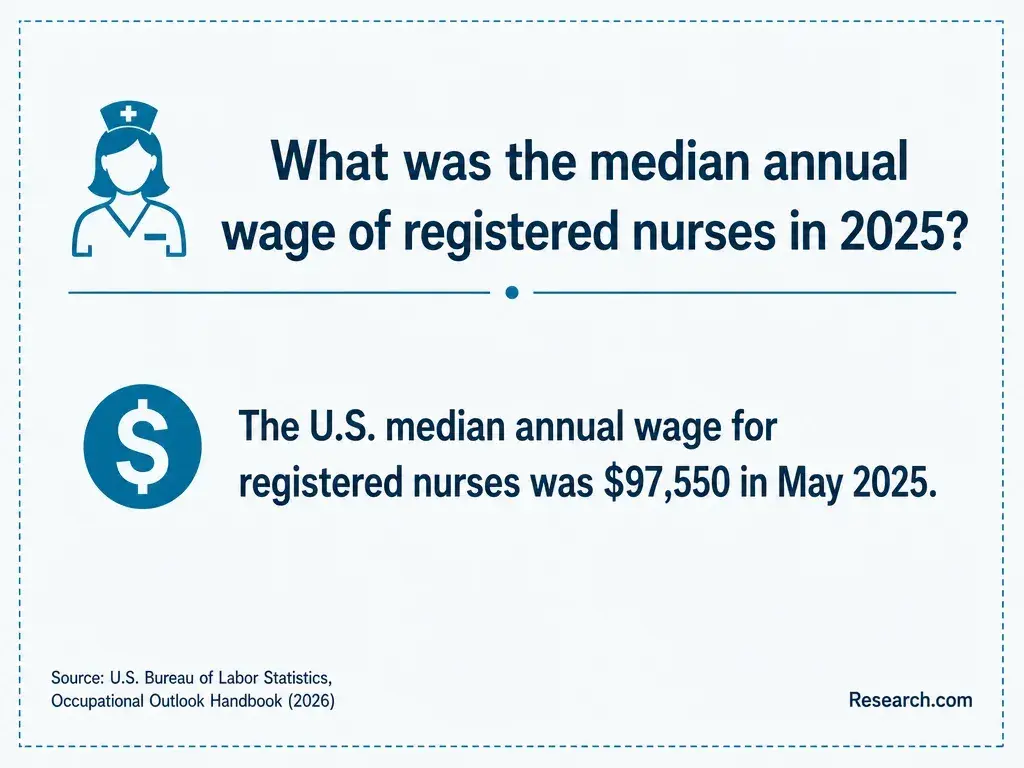
For a general RN career comparison, the U.S. Bureau of Labor Statistics' Registered Nurses occupational profile is the appropriate starting point for national median pay and projected employment growth. Its figures describe an occupation, not the starting salary of a particular graduate or the pay for a delirium-focused position.
Specialty, location, shift, experience, and employer all affect an individual offer; psychiatric-mental health nurse practitioners should be compared with the relevant advanced practice occupation instead.
Before paying for additional education, compare local job postings and actual offers with the full cost of the proposed route, including fees, clinical travel, and earnings forgone while studying. Planning the cost of a BSN-to-MSN transition makes sense when a specific role requires graduate preparation. Learning to distinguish delirium, dementia, and depression does not, by itself, justify another degree.
Other Things You Should Know About Nursing
Yes. Dementia can make an acute change harder to recognize, so compare current behavior with the patient's usual abilities and report a new change.
No. Delirium may present with reduced activity or unusual drowsiness. A quiet patient with a new change in attention still needs assessment.
Yes. Check that the patient can hear, see, and understand the task as intended, and document barriers when interpreting the result.
Follow the clinical site's privacy rules and the supervising nurse's direction. A screening result is not a diagnosis, and disclosure depends on the patient's preferences and applicable permissions.
- Delirium Clinical Care Standard | safetyandquality.gov.au https://www.safetyandquality.gov.au/clinical-care-standards/delirium
- Chapter 2 Health History - Nursing Skills - NCBI Bookshelf https://www.ncbi.nlm.nih.gov/books/NBK593197/
- Delirium or Dementia? | PSNet https://psnet.ahrq.gov/web-mm/delirium-or-dementia
- The collateral history: an overlooked core clinical skill - PMC https://pmc.ncbi.nlm.nih.gov/articles/PMC7376322/
- Differential diagnosis - depression, delirium and dementia | health.vic.gov.au https://www.health.vic.gov.au/older-people-in-hospital/cognition-dementia-delirium-and-depression/differential-diagnosis-depression-delirium-and-dementia
- Delirium - Symptoms and causes https://www.mayoclinic.org/diseases-conditions/delirium/symptoms-causes/syc-20371386
- Screening for Delirium: What Clinicians Should Know | Center to Advance Palliative Care https://www.capc.org/blog/screening-for-delirium-what-clinicians-should-know/
- Overview of Delirium and Dementia - Neurology | Merck Manual Professional Edition https://www.merckmanuals.com/professional/neurologic-disorders/delirium-and-dementia/overview-of-delirium-and-dementia
- Cognitive Screening and Assessment | Alzheimer's Association https://www.alz.org/professionals/health-systems-medical-professionals/cognitive-assessment
- Causes of Delirium | American Geriatrics Society | HealthInAging.org https://www.healthinaging.org/a-z-topic/delirium/causes