2027 Data Catalogs in an Online Data Science Master's: Courses, Projects, and Program Selection

Co-Founder and Chief Data Scientist
Key Things You Should Know
- A data catalog is a searchable inventory of data assets and their metadata; meaningful graduate-level work also examines lineage, quality, ownership, and permitted use.
- Judge curriculum depth by assignments and capstone requirements, not course titles: a catalog demonstration offers less evidence of skill than building, maintaining, and evaluating one.
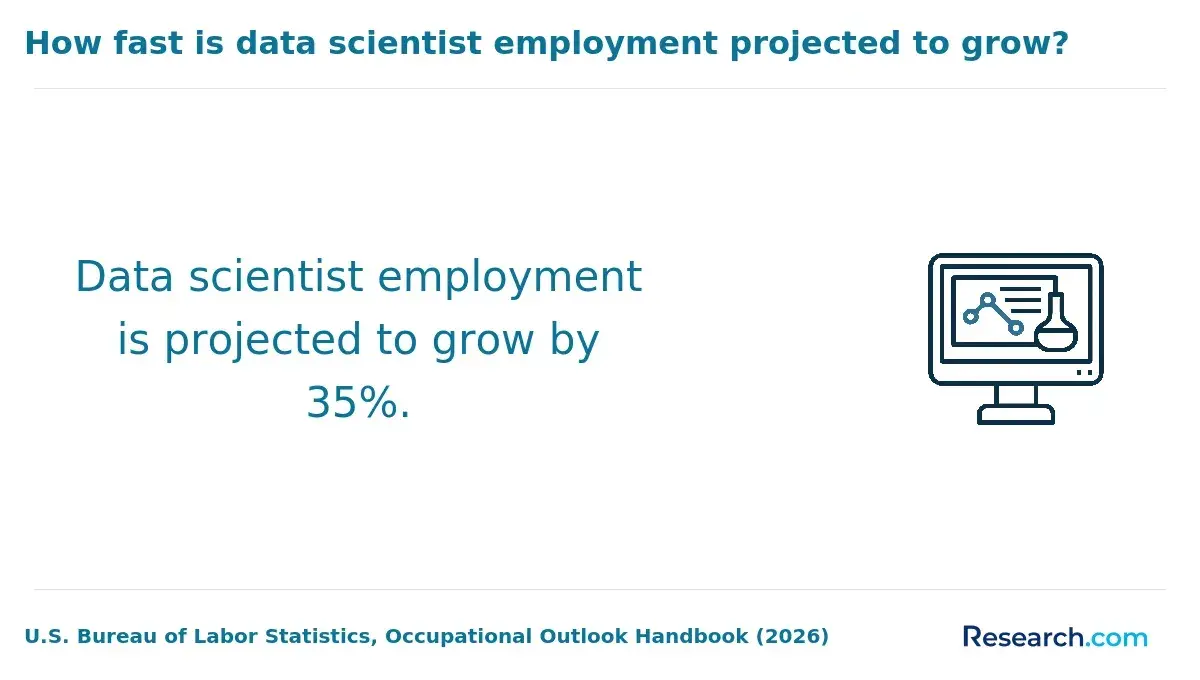
- The U.S. Bureau of Labor Statistics projects 35% growth in data scientist employment from 2025 to 2035, but that occupation-wide forecast does not establish demand for a particular catalog tool or guarantee a graduate a job.
What Is an Online Data Science Master's Degree?
An online data science master's is a graduate program that typically combines statistical reasoning, programming, data management, and applied analysis through remote coursework. Its relevance to data catalogs depends less on the degree title than on whether students work with the systems that make data findable and usable. Related graduate programs in data analytics may also be worth comparing if they offer stronger data management and governance work.
A data catalog is a searchable inventory of datasets, tables, dashboards, or other data assets and their metadata: descriptions, owners, schemas, classifications, and sometimes lineage or quality information. It is not the warehouse that stores the data. For a data scientist, the practical question is whether a promising dataset is appropriate for a particular analysis - not merely whether it can be opened.
What Courses Are Included in an Online Data Science Master's?
Look for catalog-related work across data engineering, database systems, governance, and applied analytics. A machine learning course might use well-prepared datasets without teaching students how those datasets were discovered or approved. Students comparing data science with AI-focused curricula can use AI degree comparisons based on career interests to clarify which emphasis better matches their goals.
The table shows where catalog skills may appear. These are curriculum signals to check in a syllabus, not claims that every online program includes the listed work.
| Course area | Relevant catalog work | Evidence of depth |
| Database systems or data engineering | Schemas, metadata extraction, ingestion, and lineage | Students connect an inventory to changing data pipelines. |
| Governance or responsible data use | Ownership, classifications, access rules, and retention context | Students resolve a realistic question about whether data may be used. |
| Applied analytics or machine learning | Dataset discovery, provenance, and fitness for use | Students justify their source selection and document limitations. |
Depth has levels. A passing mention introduces the term; a single unit may teach basic navigation; a dedicated course can examine metadata architecture and governance; and a substantial project requires students to apply those ideas to imperfect data. Ask for recent syllabi and assignment descriptions rather than assuming that a course called "data engineering" covers catalogs.
How Much Does an Online Data Science Master's Cost?
There is no reliable single price for an online master's, and a program's tuition figure is not necessarily its total cost. Compare each school's current tuition and mandatory fees using the same credit load, residency status, and expected time to completion. Then check whether software access, cloud computing, textbooks, or an in-person requirement would add expense. Do not assume that a catalog product used in class requires a personal license; ask what the program provides.
For this particular interest, assess cost per relevant learning opportunity, not just cost per credit. A less expensive program may be sufficient if you can complete a rigorous metadata project with supported tools. Paying more may be worthwhile if it gives you supervised work with complex pipelines and governance decisions, but neither feature establishes a financial return. Request an itemized estimate from each school and confirm any employer tuition assistance before enrolling.
What Projects and Capstone Experiences Do Online Programs Offer?
Programs may offer course projects, research work, industry-sponsored assignments, or a capstone; their requirements vary. For catalog experience, the strongest project does more than produce a searchable list. It defines who needs to find data, what decisions they must make, and how the catalog helps them judge whether an asset is suitable.
A prospective project should allow you to demonstrate a coherent sequence of work:
- Inventory a permitted collection of data assets and document their schemas, owners, and intended uses.
- Capture or reconstruct provenance and identify where missing descriptions or inconsistent labels could mislead users.
- Define classifications and access expectations without exposing restricted records.
- Test whether intended users can find and assess appropriate assets, then document the catalog's limitations.
Ask whether students can choose this topic, obtain appropriate data, receive technical feedback, and publish a sanitized portfolio artifact. A capstone label alone does not establish that the program supports catalog work; some projects focus entirely on modeling.
What Are the Admission Requirements for Online Data Science Programs?
Admission rules are set by individual programs. Check their current policies for degree eligibility, quantitative preparation, programming experience, recommendations, and written materials; do not assume that professional data work automatically replaces a formal prerequisite. Applicants comparing application formats can separately review machine learning master's applications without essays, while verifying the requirements of each data science program they consider.
Catalog experience can strengthen an application when it shows what you actually did: wrote SQL to inspect sources, documented metadata, traced a pipeline, or worked with data stewards. If you lack that experience, database and programming preparation is more useful than memorizing a vendor interface. Ask admissions which preparation is required for eligibility and which is merely recommended for success.
How Long Does an Online Data Science Master's Take to Complete?
Completion time depends on required credits, course availability, enrollment pace, and any capstone sequence. Compare schools' published plans for the pace you can actually maintain, including whether the courses that support a catalog project run often enough to take before the capstone. Readers prioritizing speed can examine faster paths to a data science master's degree, but should check what project time a shorter schedule leaves.
For working students, flexibility is not only the ability to watch lectures later. Group projects, scheduled presentations, and access to a project sponsor can affect whether a metadata-focused project is feasible. Confirm these obligations and the program's maximum completion period directly with the school.
Is an Online Data Science Master's as Valuable as an On-Campus Degree?
For catalog skills, the useful comparison is what students can do, not whether instruction takes place online or on campus. An online program can provide substantive practice if students can work with realistic data systems, collaborate with stakeholders, receive feedback, and explain their decisions. Campus attendance does not, by itself, establish that a program teaches those skills.
Ask to see project expectations and find out whether online students have the same access to relevant courses, software, faculty supervision, and career services. Also check the institution's accreditation and whether the program can enroll students where you live. A weak sign is promotional language about "industry tools" without examples of assignments or clarification of which students can use them.
What Jobs Can You Get With an Online Data Science Master's?
Catalog skills can support data scientist, analytics engineer, data engineer, and data governance work, but these roles use them differently. A data scientist may evaluate source suitability; an engineer may generate metadata from pipelines; a governance specialist may coordinate ownership and usage rules. Job titles and degree expectations vary by employer. For a broader view of online data science programs and employment pathways, compare the skills employers request with projects you could show them.
The Bureau of Labor Statistics projects 35% growth in U.S. data scientist employment from 2025 to 2035. That signals a growing occupation, not a catalog-specific hiring forecast. If your target is data engineering or governance, review postings for those roles rather than treating the data scientist projection as a substitute.
How Much Do Data Science Master's Graduates Earn?
The Bureau of Labor Statistics reports a $120,230 median annual wage for U.S. data scientists in May 2025. That is an occupation-wide figure, not the median for master's graduates, online graduates, or people who use data catalogs. It also says nothing about the salary increase a particular student would receive after earning a degree.
For a personal decision, compare the roles you could realistically seek with your current experience, location, and skills. If a school publishes graduate earnings, check who responded, when the measurement was taken, and whether the figure reports salary level or change in salary. Do not use an occupation-wide median to justify borrowing without a plan for the full program cost.
How Can You Choose an Accredited Online Data Science Master's Program?
First verify the institution's current accreditation through the institution and its recognized accreditor, then confirm that the online program is available to students in your state. Accreditation is an important institutional check, but it does not certify that a curriculum teaches data catalogs well.
For the subject-specific decision, ask each finalist the same questions and compare the answers:
- Which required courses teach metadata, lineage, data quality, and governance, and what do students produce in them?
- Can a student undertake a catalog-centered project, and who approves the topic and data source?
- What tools or computing resources are included, and can students use alternatives when access is restricted?
- What is the complete current cost at my expected pace, including mandatory fees?
Choose a program with demonstrable coursework and project support if you want to build or govern catalogs. If your main goal is predictive modeling, a program with lighter catalog coverage may be a better fit - provided you understand the data management skills you will need to develop elsewhere. Avoid selecting on a tool name alone: the transferable skill is making data discoverable, interpretable, and responsibly usable.
Other Things You Should Know About Data Science
No. A well-designed project can teach metadata modeling, discovery, documentation, and evaluation without a particular commercial product. Check what tools a course supplies before buying access yourself.
Only with the permissions your employer and program require. Metadata itself can disclose sensitive system names, business processes, or personal information. A synthetic or approved public example may be safer.
Concepts such as metadata quality, provenance, ownership, and discovery are transferable. Interfaces and integrations differ, so be ready to explain the decisions behind your work rather than only the buttons you used.
With appropriate permission, describe the problem, your method, and what you learned without revealing protected details. Otherwise, recreate the workflow with data you are allowed to publish and clearly identify it as a demonstration.
References
- Partnering with Students to Develop a Capstone for a... - PMC https://pmc.ncbi.nlm.nih.gov/articles/PMC11732519/
- Curriculum | Master's in Data Science - University of Notre Dame https://datascience.nd.edu/masters/curriculum/
- Data catalog tools: A systematic multivocal literature review | sciencedirect.com https://www.sciencedirect.com/science/article/pii/S0164121225002535
- Online Applied Data Science Master's Degree | Syracuse University https://ischool.syracuse.edu/academics/online-applied-data-science-masters-degree/
- Data Science - UCSD Catalog https://catalog.ucsd.edu/curric/DSC-gr.html
- Online Master's in Data Science and Analytics | OU Online https://online.ou.edu/program/ms-in-data-science-and-analytics/
- Applied Data Science, MS - Course Catalog | Syracuse University Academic Catalog https://coursecatalog.syracuse.edu/graduate/information-studies/applied-data-science-ms/
- Data Analytics Engineering, MS | George Mason University Catalog https://catalog.gmu.edu/colleges-schools/engineering-computing/data-analytics-engineering-ms/
- Curriculum - MU Institute for Data Science and Informatics https://muidsi.missouri.edu/academic-programs/m-s-data-science-and-analytics-program/masters/curriculum/
- Data Analytics Engineering Master's Degree Requirements | jhu.edu https://ep.jhu.edu/programs/data-analytics-engineering/masters-degree-requirements/