2027 Choosing an Online Data Science Master's for a Career in Renewable Energy

Co-Founder and Chief Data Scientist
Choosing an online data science master's for renewable energy means looking beyond a program's machine-learning course list. Solar forecasting, battery operations, and electricity-grid planning require different data, methods, and domain knowledge. This guide helps prospective students compare programs against a target role, identify worthwhile project opportunities, and weigh the degree's cost and format against what they already know.
Key Things You Should Know
- Choose a program with strong statistics, software, and data-engineering foundations, then look for energy-relevant electives or a flexible capstone - not necessarily a degree labeled "renewable energy."
- Check whether you can build and evaluate a project using time-series, weather, grid, or equipment data; a generic machine-learning project may provide less evidence of fit for an energy role.
- The U.S. Bureau of Labor Statistics reports a $120,230 median annual wage for data scientists in May 2025, but that occupation-wide figure is not a renewable-energy salary or a predicted return on a master's degree.
What is an online data science master's for renewable energy careers?
It is usually a general data science master's that a student adapts to energy problems through electives, research, industry projects, or a capstone. The degree teaches how to obtain, analyze, model, and communicate data; energy-specific expertise comes from applying those skills to physical systems and operational decisions.
That distinction matters when comparing programs. A strong general program with access to relevant projects may serve a future solar-forecasting analyst better than a program with energy branding but little statistical or computing depth. Conversely, someone seeking to design electrical systems rather than analyze their data may be better served by an engineering degree. Start with the job you want, then evaluate the curriculum backward from its work.
Which data science skills are most valuable in the renewable energy industry?
Renewable energy data science often combines time-dependent measurements with weather, location, and equipment information. The challenge is not merely producing an accurate prediction: it is producing one that remains useful when conditions change and decisions have operational consequences.
The table connects common energy problems to the data and analytical approaches students are likely to encounter. It can help distinguish substantive industry preparation from a program that only mentions energy as an example.
| Energy problem | Typical data | Relevant methods |
| Wind or solar generation forecasting | Historical output, weather observations, and forecasts | Time-series modeling, uncertainty estimates, and forecast evaluation |
| Battery or grid operations | Load, prices, generation, and equipment constraints | Optimization, simulation, and scenario analysis |
| Equipment fault detection | Sensor readings and maintenance records | Anomaly detection, classification, and careful handling of rare events |
Across these applications, SQL, Python, reproducible workflows, and reliable data pipelines matter because real measurements can be delayed, missing, or inconsistent. A program's treatment of data infrastructure skills in artificial intelligence graduate programs offers a useful adjacent comparison, but check the data science program's own course descriptions. For forecasting in particular, look for evaluation on future periods rather than a random split that lets information from nearby timestamps leak into training.
What careers can an online data science master's lead to in renewable energy?
Potential roles include renewable-generation forecasting analyst, energy data scientist, grid analytics specialist, battery analytics scientist, and equipment-reliability analyst. Employers may include developers, utilities, grid operators, equipment manufacturers, and software firms. Job titles and required qualifications vary; some positions emphasize modeling, while others require deeper power-systems or engineering experience.
Match the program to the work behind the title. For a forecasting role, prioritize statistics, time-series analysis, and weather-data projects. For battery operations, prioritize optimization and an understanding of physical constraints. If your goal is an engineering position responsible for system design or approval, confirm its engineering and licensing requirements before assuming a data science degree is sufficient.
How do you choose an accredited online data science master's program?
First, verify the institution's current accreditation through its accreditor or the U.S. Department of Education's accreditation records. Then confirm that the online program accepts students in your state; institutional accreditation and state authorization answer different questions. Neither alone establishes that a curriculum fits an energy career.
Use the following checks to narrow your shortlist before applying:
- Identify a target role and compare its work with required courses, available electives, and faculty or project opportunities.
- Ask whether online students can pursue an energy-related capstone and whether they must find their own data or project sponsor.
- Request the full tuition and mandatory-fee schedule, plus any residency, technology, or project-related costs.
- Confirm course availability, scheduling, career support, and whether any advertised industry partnership is accessible to online students.
A common mistake is choosing by ranking, price, or an appealing specialization name without checking what students can actually study. If you are considering an adjacent AI degree, affordable university programs in AI may broaden a cost search, but compare their required coursework with data science programs on the same energy-relevant criteria.
What courses should an online data science master's include?
Look for graduate-level probability and statistics, machine learning, databases or data engineering, and programming-intensive work. For renewable energy goals, especially useful additions include time-series analysis, optimization, geospatial analysis, causal inference, and courses addressing uncertainty or decision-making. Power-systems or energy-policy coursework can add context, but may be available outside the data science department rather than within it.
Course titles are only a starting point. Read descriptions and, when available, assignments: Does a forecasting course evaluate predictions across future time periods? Does an optimization course model operational constraints? Does the capstone require a defensible baseline, uncertainty analysis, and an explanation a nontechnical stakeholder could use? A passing energy example is less valuable than a substantial project in which those issues shape the analysis.
What are the admission requirements for online data science master's programs?
Requirements differ by institution. Programs may ask for a bachelor's degree, transcripts, evidence of quantitative preparation, programming experience, recommendations, or a statement of purpose; applicants should check each program's current admissions page rather than assume a computer science degree is mandatory.
Applicants from engineering, physics, economics, or environmental science may bring useful domain or quantitative experience while still needing preparation in coding or statistics. Conversely, a software developer may need more exposure to physical systems and energy data. A small, well-documented analysis of public energy data can demonstrate interest and readiness, but it does not automatically satisfy a formal prerequisite. Guidance on AI master's program fit for non-CS applicants can help frame questions about adjacent degrees; confirm the data science program's own policies with admissions staff.
How long does an online data science master's take and cost?
There is no dependable single price or completion time across programs. Both depend on required credits, enrollment pace, course availability, tuition rules, and fees. Compare the total cost to finish - not one course's price - and ask whether the schedule you can sustain permits timely access to the electives and capstone you want.
Build a personal estimate using published tuition and mandatory fees, then account for books or software, any travel requirement, and financing costs if you borrow. Check eligibility for employer tuition assistance and financial aid directly with the relevant offices. A shorter schedule may reduce time away from other goals but can leave less room for a substantial energy project. A guide to faster online AI master's programs illustrates a neighboring option; do not assume its timelines or costs apply to data science degrees.
How do online and campus-based data science master's programs compare?
Either format can teach the technical foundations. The more consequential difference for an energy-focused student may be access: campus attendance can make some laboratory, faculty, and local employer connections easier, while online study may let a working professional keep a relevant job and apply coursework immediately.
Choose online study if its course times, collaboration requirements, and project arrangements fit your schedule and still provide the mentorship or data access you need. Consider campus study if a specific laboratory or in-person partnership is central to your goal. Do not assume either format offers an internship, energy dataset, or employer connection; ask who is eligible and how students secure those opportunities.
What salaries and job outlook can renewable energy data scientists expect?
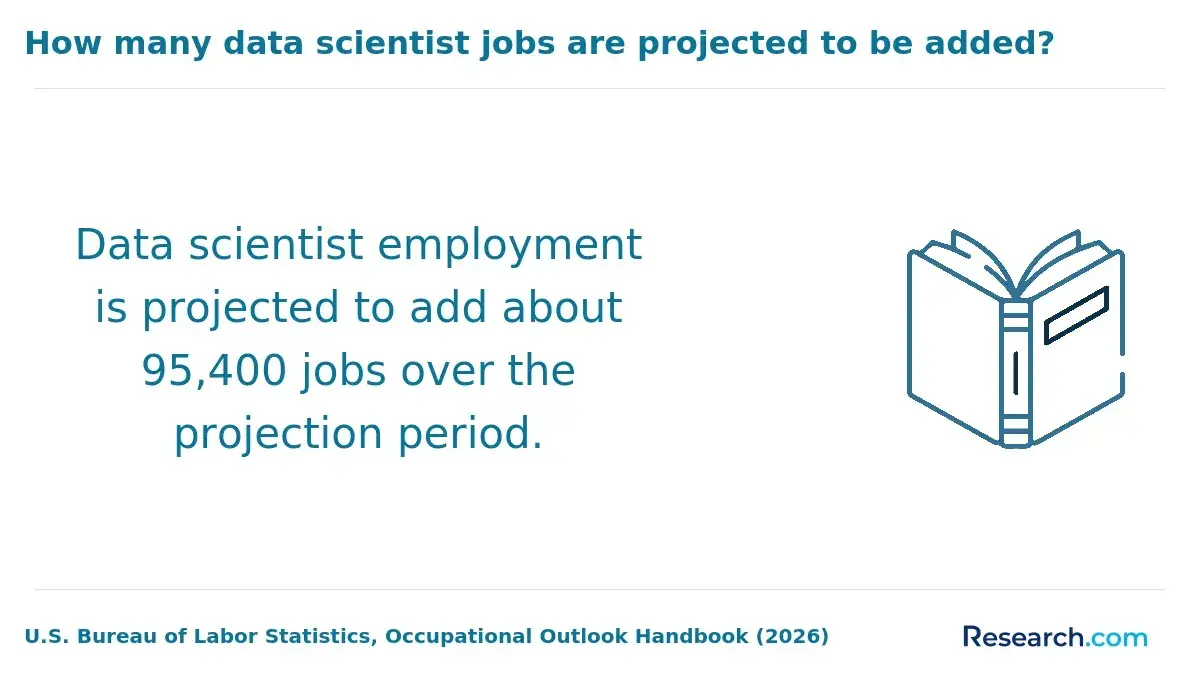
The U.S. Bureau of Labor Statistics reports a median annual wage of $120,230 for data scientists in May 2025 and projects 35% employment growth for the occupation from 2025 to 2035. These are national, occupation-wide measures - not forecasts for renewable energy jobs, new graduates, or holders of a particular degree. They indicate a broader market for data science skills, but cannot establish what an energy employer will pay you.
Compare actual openings by role, location, experience level, and employer type. The discussion of industry salary differences for data science graduates provides additional context, but an industry comparison should not be treated as a personal salary offer. When judging whether tuition is worthwhile, consider your current earnings and the roles you could realistically enter - not the occupation-wide median as an expected post-degree salary.
Do renewable energy data science careers require certifications or licenses?
Data scientist and analytics roles generally do not have a single required professional license. Employers may value demonstrated ability with relevant software, cloud platforms, or energy systems, but a certificate is not a substitute for sound statistical work and credible projects.
The boundary changes when a job includes regulated engineering responsibilities. Professional engineer licensure is governed by state rules and may matter for work requiring engineering sign-off. Read the duties of your target positions closely: if they involve designing or approving electrical systems, ask the employer and relevant state board which credentials are required before selecting a data science degree as your route.
Other Things You Should Know About Data Science
No. Public weather and electricity datasets can support a credible project if you document their limitations, prevent data leakage, and explain what additional information a real deployment would need.
Yes. Developers, equipment makers, software providers, research organizations, and public agencies also use energy data. Their analytical needs and hiring requirements differ.
Look for a clear decision the analysis would inform, an appropriate baseline, evaluation on data unavailable during training, and an honest account of uncertainty and operational constraints.
Only if you have the right to share the data and results. For employer or partner work, check confidentiality terms and use a public-data recreation or a permitted description of your methods when necessary.
References
- Career Map: Resource Scientist | Energy.gov https://www.energy.gov/cmei/systems/career-map-resource-scientist
- DAPIP | Homepage - Office of Postsecondary Education (OPE) https://ope.ed.gov/dapip/
- Cost of Attendance (Budget) | 2025-2026 Federal Student Aid Handbook https://fsapartners.ed.gov/knowledge-center/fsa-handbook/2025-2026/vol3/ch2-cost-attendance-budget
- Types of Financial Aid: Grants, Work-Study, and Loans | studentaid.gov https://studentaid.gov/understand-aid/types
- Careers in Sustainable Energy | MA in Sustainable Energy https://energy.sais.jhu.edu/articles/careers-in-sustainable-energy/
- What to Look for in an Online Data Science Master's Degree | njit.edu https://online.njit.edu/blog-posts/what-to-look-for-online-data-science-masters-degree
- MEM: Environmental Analytics and Modeling | duke.edu https://nicholas.duke.edu/academics/masters-programs/master-environmental-management/mem-environmental-analytics-and-modeling
- Data Science and Energy: Some Lessons From Europe on Higher Education Course Design and Delivery https://hdsr.mitpress.mit.edu/pub/pn3w0aes
- What You'll Learn in Applied Data Science: Modeling to AI | Bay Path University https://www.baypath.edu/news/bay-path-university-blogs/post/what-you-ll-learn-in-applied-data-science-modeling-to-ai/
- The future of forecasting for renewable energy - Sweeney https://wires.onlinelibrary.wiley.com/doi/10.1002/wene.365