2027 Choosing an Online Data Science Master's for a Career in Life Insurance

Co-Founder and Chief Data Scientist
Choosing an online data science master's for a life insurance career means looking beyond a program's machine learning courses. Insurers work with policy, underwriting, claims, and customer data, while decisions about coverage and pricing require careful attention to privacy, fairness, and explanation. This guide is for prospective students and insurance professionals deciding whether a degree fits their target role - and which program features are worth paying for.
Key Things You Should Know
- Prioritize statistics, predictive modeling, data engineering, and a substantial project you can connect to life insurance decisions; a program need not carry an insurance label.
- Choose the credential for the role: a data science master's can support analytics work, but it does not replace actuarial exams for positions that require them.
- The Bureau of Labor Statistics projects 35% growth in U.S. data scientist employment from 2025 to 2035; that is an occupation-wide forecast, not a life insurance hiring forecast.
What is an online data science master's degree for life insurance careers?
It is a graduate data science program chosen for its usefulness in life insurance - not necessarily a degree with "insurance" in its name. The most relevant programs let students build statistical and computing skills, then apply them to questions such as which policies may lapse, how claims patterns change, or how to evaluate an underwriting model without overlooking unequal outcomes.
Program titles alone are weak evidence of fit. A broadly named degree may offer stronger statistics and project options than an insurance-branded program with limited technical depth. Conversely, a technically strong degree may leave students to learn insurance terminology, data governance, and regulatory context through work or independent study.
Choose a data science program if your goal is to develop and evaluate models across insurance functions. If your intended work centers on building AI systems beyond insurance analytics, affordable paths to an AI master's qualification may be a useful comparison - but compare the actual courses and projects, not just degree names.
Is a data science master's useful for working in life insurance?
Yes, when it closes a specific gap between your current skills and the work you want to do. A life insurance employee who knows policy operations but needs stronger programming and modeling skills may gain more from the degree than an experienced data scientist who primarily needs insurance-domain knowledge. Neither profile automatically requires a master's to enter the industry.
The clearest payoff is the ability to work through an entire insurance analytics problem: define a decision, assess whether the available data supports it, build and validate an appropriate model, and explain its limitations to business and risk stakeholders. A portfolio project can provide evidence of those abilities, but it does not substitute for professional experience with insurer data and controls.
Before enrolling, compare the jobs you actually want with the skills you already have. A broader look at data science degrees and growing data occupations can help distinguish insurance-specific interests from a desire for a more flexible data career.
What careers can a data science master's lead to in life insurance?
A master's can be relevant to several teams, but job titles and credential expectations vary by employer. The comparison below shows how the analytical work differs; it is not a list of roles a degree alone qualifies someone to hold.
| Potential role | Typical life insurance question | Most useful preparation |
| Data scientist | Which patterns predict lapse or claims activity, and how reliable are the predictions? | Statistical modeling, validation, programming, and model communication |
| Underwriting analytics specialist | How might data improve review workflows without creating unacceptable errors or unfair outcomes? | Classification, evaluation across groups, and insurance-domain judgment |
| Customer or retention analyst | Which policyholders may need outreach, and how should an intervention be evaluated? | Experimentation, causal reasoning, and customer-data governance |
| Insurance data engineer or analytics engineer | Can policy, claims, and operational data be made reliable enough for analysis? | Databases, pipelines, documentation, and data quality |
For applicants already working in life insurance, an adjacent analytics role may be a more realistic first move than a senior data scientist position. If the target posting instead emphasizes actuarial exams, reserving, or formal actuarial progression, compare an actuarial path before choosing a data science degree.
Which data science courses matter most for life insurance analytics?
Look for a sequence that teaches students to handle incomplete, time-dependent data and to evaluate decisions - not merely produce a high model score. Course descriptions, assignments, and capstone examples reveal more than a catalog title.
| Course area | Why it matters in life insurance | Evidence of substantive coverage |
| Probability, statistical inference, and regression | Supports uncertainty estimates and interpretable relationships. | Students test assumptions, quantify uncertainty, and explain results. |
| Survival or time-to-event analysis | Fits questions about when a lapse, claim, or other event occurs. | Assignments address censoring and time-dependent outcomes. |
| Machine learning and model evaluation | Supports prediction while exposing errors a single accuracy figure can hide. | Students compare baselines, validate on appropriate data, and examine subgroup performance. |
| Databases and data engineering | Helps connect records across policies, customers, and events. | Projects include data cleaning, reproducible pipelines, and quality checks. |
| Ethics, privacy, and governance | Matters when sensitive information informs consequential decisions. | Students document permitted uses, limitations, and potential harms. |
A dedicated course is useful, but project depth matters more than a keyword in a syllabus. Ask whether students can use synthetic or suitably de-identified insurance-like data for a capstone, evaluate a model against a simple baseline, and explain what they would monitor before its use in practice. Do not assume a school can provide access to an insurer's private records.
Do life insurance data scientists need actuarial credentials?
Not necessarily. Data scientist and analytics roles can focus on data pipelines, predictive models, experiments, or model monitoring without requiring actuarial credentials. Actuarial positions are different: employers may expect progress through a professional exam and credentialing pathway, particularly for work assigned to actuarial teams.
Use the job description rather than the department name to decide. If several target postings require actuarial exam progress, a data science master's alone is unlikely to meet that expectation. If they emphasize Python or R, statistics, data infrastructure, and model validation, actuarial exams may be less relevant than demonstrated technical work and insurance knowledge.
A combined path can make sense for an actuarial professional seeking deeper data science skills, but it carries the workload of both pursuits. Confirm with prospective employers whether the degree would support the specific position you want before assuming one credential can replace the other.
How do online and campus-based data science master's programs compare?
An online program can make it easier to keep an insurance job while studying and apply new skills at work. A campus program may be preferable if you need in-person recruiting, lab access, or a structured weekly routine. Neither delivery format establishes curriculum quality on its own.
For a working professional, the decisive details are operational: Are lectures live or recorded? When do group projects meet? Can you reduce course load during a busy work period? Does the capstone require an external partner, campus visit, or fixed meeting time? An "online" label does not answer those questions.
Choose online study when continued employment and scheduling flexibility are central to the decision, provided the program still offers meaningful feedback and project supervision. Choose campus study when its specific recruiting or learning opportunities outweigh the cost and time of changing your work arrangements.
What admission requirements do online data science master's programs have?
A common mistake is treating "no computer science degree required" as "no quantitative preparation required." Read the admissions policy and the first-term course descriptions together, then obtain written clarification if your background does not fit the listed examples.
How long does an online data science master's take and cost?
There is no reliable universal figure: required credits, course load, tuition basis, and fees differ by program, and a working student's pace can change the completion date. Compare schools using a total-cost estimate for the schedule you would actually follow, not a tuition rate or advertised minimum duration alone.
Request an itemized estimate covering tuition for all required credits, mandatory fees, prerequisite or foundation courses, materials, and any travel. Then ask how employer assistance, scholarships, or eligible financial aid would change what you must pay; availability and conditions vary. For a broader affordability benchmark, the online AI degree affordability guide can help frame questions about price, though an AI program is not automatically a substitute for insurance-focused data science preparation.
Also account for time away from paid work if a program demands a pace you cannot sustain. An inexpensive degree is a poor value if its course sequence omits the methods your target role requires; an expensive one does not guarantee a salary increase.
How can you evaluate an accredited online data science master's program?
Start by verifying the institution's current accreditation through the accreditor or an official U.S. education directory. Then confirm that the school can enroll students in your state and that the specific online degree, courses, and support described to you are available in your planned term. Institutional accreditation does not, by itself, show that a curriculum fits life insurance work.
Use the following checks to turn a shortlist into a decision. Ask for current documents or examples rather than relying on rankings or a program's marketing summary.
- Compare required courses and electives with the methods used in your target jobs, especially statistics, time-to-event analysis, data engineering, and model evaluation.
- Review a syllabus or capstone description to see whether students must justify data choices, validate results, and discuss privacy and fairness.
- Confirm live-session requirements, project supervision, expected study pace, and whether your employer can support a relevant project.
- Obtain a written total-cost estimate and check whether any published career outcomes describe graduates with backgrounds similar to yours.
Be cautious if a program promises insurance careers without showing relevant coursework or projects, treats an AI tool demonstration as evidence of modeling depth, or quotes graduate salaries without explaining who responded. The best choice is the program that addresses your skill gaps at a cost and pace you can manage.
What are the salaries and job prospects for life insurance data professionals?
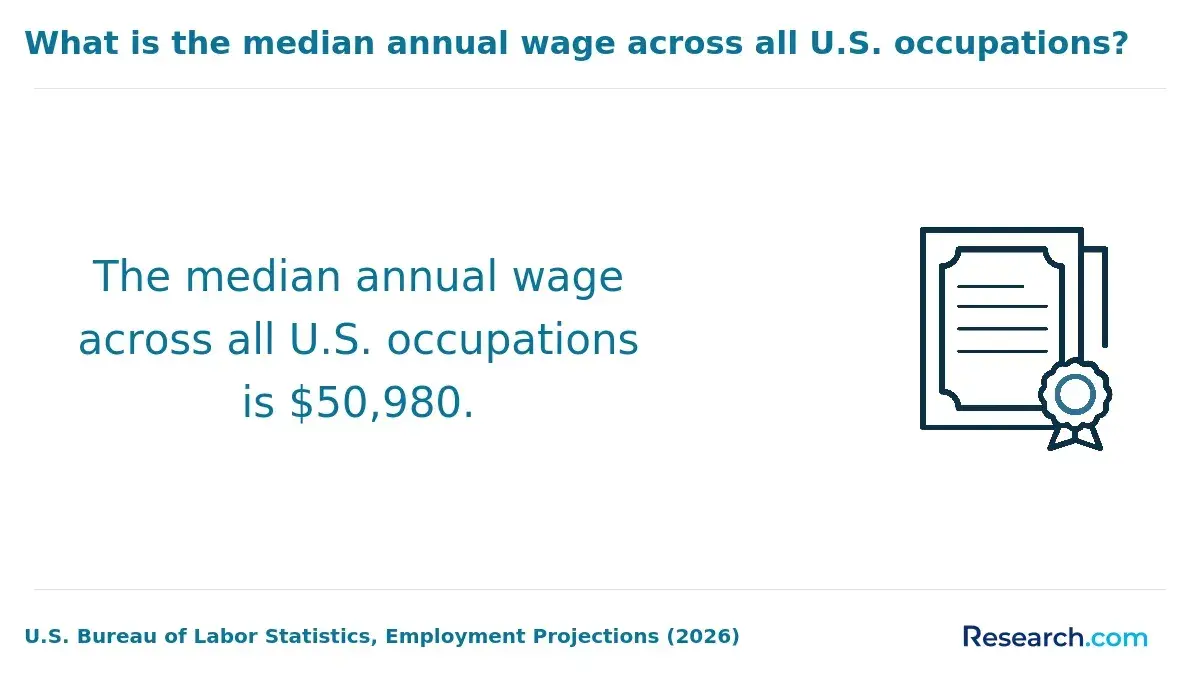
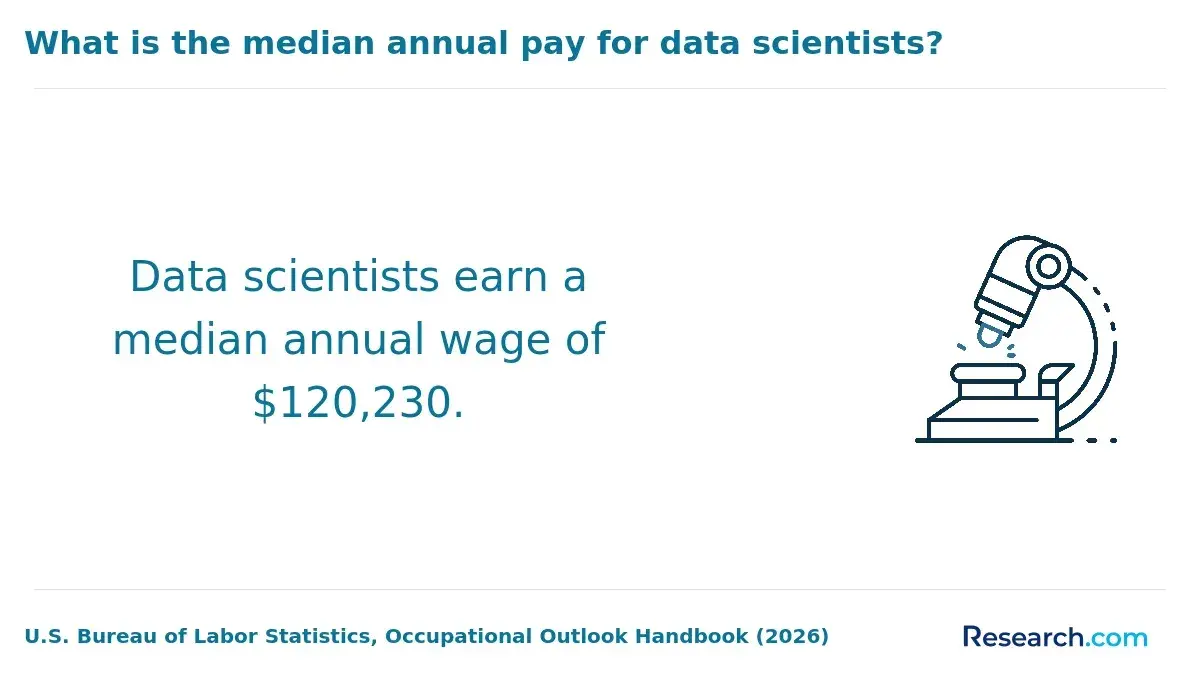
The U.S. Bureau of Labor Statistics reports a median annual wage of $120,230 for data scientists in May 2025. That figure covers the occupation across industries, experience levels, and locations; it is not a life insurance salary, a starting salary, or an expected outcome from a master's degree.
Use national occupational figures to understand the broader market, then compare current life insurance postings by role, location, required experience, and actuarial expectations. A closer look at how to compare data science graduate pay across industries can help prevent an industry-wide figure from becoming an unrealistic personal salary target.
For an individual applicant, evidence of employability is more concrete than a broad growth forecast: relevant work experience, a defensible project, and the ability to explain a model's business and ethical limits. Ask programs for outcome definitions and response rates before using graduate salary claims to justify the cost.
Other Things You Should Know About Data Science
Yes. Use synthetic or appropriately public data and clearly label what it cannot represent. A strong project explains the decision, evaluation method, and limitations rather than claiming to reproduce an insurer's real results.
Not automatically. An internal analytics assignment with defined supervision and deliverables may be more relevant. Check whether your program requires an internship and whether it accepts an employer-based project.
No. A capstone demonstrates learning, not approval for operational use. Real deployment would require the employer's review of data permissions, performance, documentation, monitoring, and applicable rules.
Bring a few target job postings, a summary of your math and programming background, and a proposed insurance analytics question. Ask which courses and project options would help you meet the gaps those materials reveal.
References
- Chapter 1: Theory of Markets and Privacy | National Telecommunications and Information Administration https://www.ntia.gov/page/chapter-1-theory-markets-and-privacy
- Understanding College Costs | studentaid.gov https://studentaid.gov/resources/prepare-for-college/students/choosing-schools/consider-costs
- AI revolution in insurance: bridging research and reality - PMC https://pmc.ncbi.nlm.nih.gov/articles/PMC12014612/
- Master of Applied Data Science | umsi https://www.si.umich.edu/programs/degree-programs/master-applied-data-science
- Actuarial Science, MS - ASU degree - Arizona State University https://degrees.asu.edu/masters-phd/major/ASU00/LAACTMS/actuarial-science-ms
- Data Science Applications Across 10 Different Industries | MDS@Rice https://csweb.rice.edu/academics/graduate-programs/online-mds/blog/data-science-industry-applications
- Master of Science in Actuarial Science | BU MET https://www.bu.edu/met/degrees-certificates/ms-actuarial-science/
- Data Science and Artificial Intelligence Master's Degree Requirements | Harvard Extension School https://extension.harvard.edu/academics/programs/data-science-artificial-intelligence-graduate-program/data-science-artificial-intelligence-degree-requirements/
- Employment Outcomes - Master of Analytics https://analytics.berkeley.edu/employment-outcomes/
- Syracuse Online Master's in Applied Data Science https://onlinegrad.syracuse.edu/information-science/applied-data-science/