2027 Choosing a BS in Business Administration When You Want a Degree for an Employer That Does Not Require a Specific Major
Audited and Verified:
Our Editorial and Data Verification Process
Research.com uses government datasets, official education statistics and primary institutional information to support its career and degree guides. Our review process checks factual accuracy, occupational definitions, source dates and the requirements associated with the credentials discussed.
How This Article Was Fact-Checked
Our editorial team verifies salary estimates, employment projections, education requirements and program information against original data providers and official organizations. Salary figures are checked against the relevant occupational definitions and reporting periods. Information about licensure, accreditation and required in-person training is reviewed separately.
Fact-checked and verified on:

Co-Founder and Chief Data Scientist
When an employer requires a bachelor's degree but accepts any major, the BS in Business Administration is an option - not an automatic best choice. Its broad coursework may help you qualify for the job while building useful business skills. But if your immediate goal is simply to meet the degree requirement, a faster or less expensive program may serve you better.
This guide shows how to compare those outcomes, check what your employer will accept, and choose a degree you can realistically finish.
Key Things You Should Know
- Confirm whether the employer accepts any accredited bachelor's degree, an in-progress degree, or only a completed degree before choosing a program.
- Choose a BS in Business Administration when its coursework supports roles you want beyond the immediate job; otherwise, compare the remaining time and total cost of other acceptable degrees.
- Do not mistake occupation-wide pay for a graduate's starting salary: the U.S. median for human resources specialists was $75,940 in May 2025, across workers at all career stages.
What is a business administration degree, and who should consider it?
A BS in Business Administration is an undergraduate degree combining general education with subjects such as accounting, finance, marketing, management, operations, and business analysis. The "BS" describes the credential awarded, but it does not guarantee a particular level of mathematics or technical coursework. A BBA or BA in Business may cover similar ground; compare actual requirements rather than relying on the degree title.
It is a strong candidate if you want the employer-required bachelor's degree and expect to use business knowledge in coordination, operations, customer-facing work, or a later career change. If you already have substantial credits in another subject and the employer accepts any major, finishing that subject may be more efficient. Compare your degree audit with options such as inexpensive online business administration colleges, but ask each institution which of your credits would fulfill requirements - not merely transfer as electives.
Why choose business administration when employers do not require a specific major?
The best reason is that it serves two goals: satisfying the employer's degree requirement and preparing you for work you actually want. The weakest reason is assuming a business degree is automatically more valuable to an employer that has explicitly said the major does not matter.
The comparison below separates eligibility for the immediate job from preparation for a later one. No option is preferable until you know how your prior credits apply and what the employer's policy says.
| Path | Potential advantage | Key limitation |
| BS in Business Administration | Broad preparation across business functions | Required business courses may add time if your existing credits are in another field |
| Finish another acceptable bachelor's major | May preserve more applicable credits and speed completion | May not address business-specific skill gaps |
| Choose a function-specific degree | More focused preparation for a defined role | May be unnecessary for a major-agnostic employer and require additional prerequisites |
If the job is specifically in project coordination, for example, lower-priced project management degrees offer another comparison. Evaluate their required courses and your applicable credits against the BS - not the program names alone. A short course or employer training may instead address a skill gap after you complete whichever acceptable bachelor's degree is most practical.
What careers can you pursue with a bachelor's in business administration?
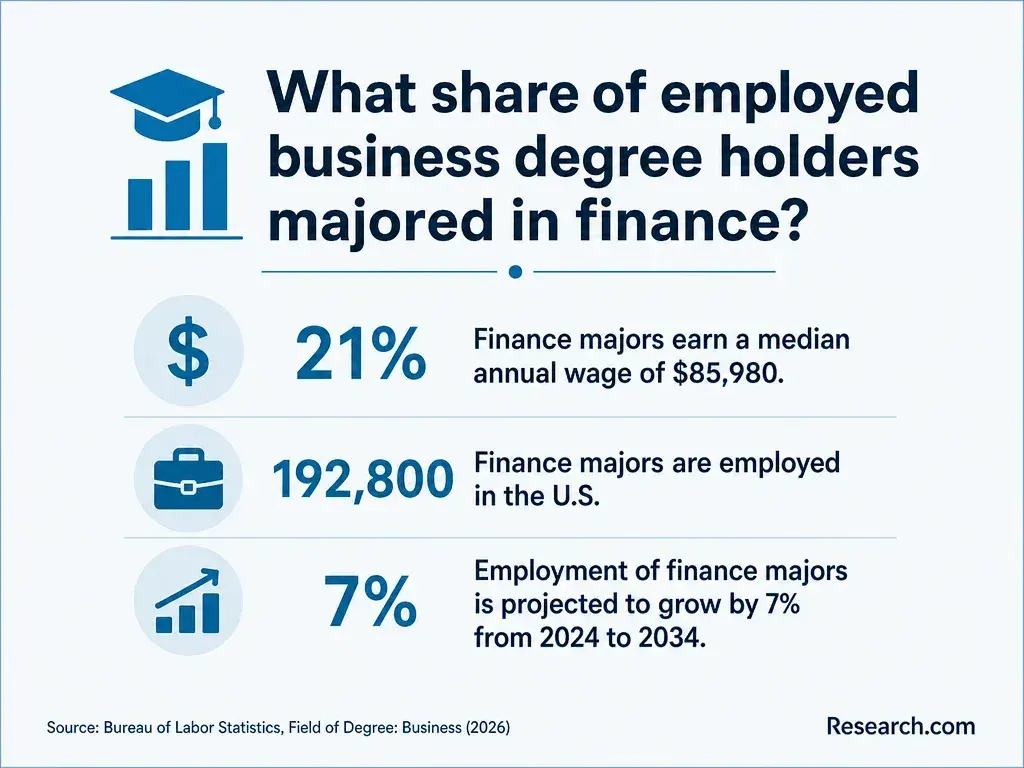
A business administration graduate can apply for roles such as operations coordinator, administrative specialist, sales operations associate, marketing coordinator, or HR assistant. Duties may include tracking budgets, improving workflows, preparing reports, supporting customers, or coordinating projects. Employers may also require relevant experience, software skills, or industry knowledge; the degree does not itself confer a management position.
Start with the duties in the job posting. If you have customer-service experience, a marketing or sales-support role may be a closer step than financial analysis. If you want HR work, compare business electives with human resources education and career options, then seek evidence of skills such as careful recordkeeping, professional communication, and familiarity with HR processes. Internships, supervised projects, and relevant employment can make those skills easier to demonstrate.
Programs commonly include accounting, economics, finance, marketing, management, statistics, operations, and a strategy or capstone course alongside general education. Some offer a formal concentration; others offer only electives. Check the catalog to see which courses are required, whether prerequisites delay enrollment, and whether a concentration adds credits or changes course availability.
For a major-agnostic employer, prioritize courses that fill a real gap rather than choosing the longest list of business electives. Spreadsheet analysis and accounting fundamentals may help an operations employee; marketing research may be more useful in a customer-facing role. If project management is your intended direction, compare those courses with the requirements for applying previous coursework to a project management degree. Only an official evaluation can tell you which route makes better use of your credits.
Choose the format you can complete consistently. Online study can reduce travel, while campus study may offer easier access to in-person faculty, classmates, and local recruiting. Neither format is inherently faster or better regarded by an employer; the institution, degree awarded, and your ability to finish matter more.
Before enrolling, ask about live attendance, weekly deadlines, group presentations, proctored exams, internships, and required campus visits. Those obligations can make an advertised flexible program difficult to combine with work. If timing is decisive, compare bachelor's degrees with compressed schedules against a realistic weekly workload and the sequence in which required courses are offered.
First, verify that the institution holds recognized institutional accreditation and that the credential meets your employer's written policy. Institutional accreditation and business-specific accreditation are different: AACSB, ACBSP, or IACBE recognition, where applicable, has a defined scope that you should check for the particular school and program. Business-specific accreditation is not automatically necessary when an employer accepts any major.
Ask the employer whether it has accreditation restrictions, then confirm the institution's status directly with the accreditor and review the program's current catalog. When comparing affordable accredited business administration programs accepting FAFSA, also verify aid eligibility with each school. Accreditation alone does not establish your aid award, credit-transfer outcome, or employment prospects.
Requirements vary by institution and entry route. First-year applicants generally provide evidence of secondary-school completion; transfer applicants provide transcripts from previous colleges. A school may admit you to the institution before you meet separate requirements for the business major, such as particular prerequisite courses or academic-standing rules.
Request both an admissions decision and an evaluation showing how previous coursework applies to general education, the business core, electives, and any residency requirement. If application costs matter while you compare options, you can explore fee-free online university applications. A waived application fee is useful, but it says nothing about the credits you will still need to earn.
A bachelor's degree is often planned as four years of full-time study, but your remaining time depends on applicable prior credits, course sequencing, enrollment pace, and the school's graduation requirements. For someone who already has college credit, the relevant comparison is not each program's advertised duration; it is the number and availability of courses left after an official audit.
Compare tuition and mandatory fees for those remaining courses, then add books, technology, travel, and any lost work hours. Subtract only aid or employer benefits you are confirmed to receive. If speed matters, business programs with accelerated online classes may shorten the calendar, but a shorter term can increase weekly workload without reducing the number of credits or total price. Ask whether employer reimbursement requires a completed course, a minimum grade, or continued employment.
There is no single salary or job-growth rate for BS in Business Administration graduates; outcomes depend on the occupation, location, experience, and employer. As one relevant benchmark, the U.S. Bureau of Labor Statistics reports a May 2025 median annual wage of $75,940 for human resources specialists. That is the occupation-wide midpoint, not a predicted starting salary for someone with this degree.
BLS projects employment of human resources specialists to grow 6% from 2025 to 2035. That projection describes an occupation, not demand for a particular major. If you are considering another function, review its duties and requirements separately; supply chain degree duration and salary considerations can help frame that distinct pathway. For your immediate decision, the employer's pay range and advancement policy are more useful than a national median alone.
Do business administration graduates need licenses or certifications?
No general license is required simply to hold a BS in Business Administration or apply for many business-support roles. Particular work may have separate rules: a business degree alone does not qualify someone for CPA licensure, a financial-services license, or a professional designation. Certifications may help in a defined function, but check their eligibility and experience requirements before treating them as part of your degree plan.
If your employer only requires a bachelor's degree, do not pay for an additional credential without a clear purpose. An aspiring supervisor, for instance, could compare business administration with accelerated organizational leadership degrees; neither degree replaces the workplace results and responsibility an employer may expect for promotion.
Other Things You Should Know About Business Administration
Ask whether any bachelor's major qualifies, whether the institution must meet particular accreditation criteria, and when the completed degree must be documented. Get the answer from HR or the hiring team in writing if possible.
Only if the employer accepts applicants with an in-progress degree or allows completion by a stated date. Describe your status accurately on the application; do not list the degree as awarded before it is conferred.
Use the credential's official name, institution, and graduation date. Add a concentration only if it is formally awarded, and highlight relevant projects or work experience separately.
It could if your future target role requires deeper subject knowledge. Review several postings for that role before choosing; you may be able to build the needed skills through electives, projects, work experience, or later training without changing your fastest acceptable path to graduation.
- Accreditation in the U.S. | ed.gov http://www.ed.gov/laws-and-policy/higher-education-laws-and-policy/college-accreditation/accreditation-in-the-us
- Annual Earnings by Educational Attainment - COE https://nces.ed.gov/programs/coe/indicator/cba/annual-earnings
- Transfer Credit Policy - IU Academic Bulletins https://bulletins.iu.edu/iun/2024-2026/schools/business/undergraduate/policies/transfer-credit.shtml
- 11 Types of Business Degrees and Career Pathways | National University https://www.nu.edu/blog/types-of-business-degrees/
- Why AACSB Accreditation Matters to Employers | CSUSM https://www.csusm.edu/coba/about/aacsb/accreditationmatters/aacsbemployers.html
- BA vs BS in Business Administration: What's the Difference? | CSP Global Concordia University, ST. Paul https://online.csp.edu/resources/article/ba-vs-bs-in-business/
- BA vs. BS in Business Administration | New England College https://www.nec.edu/news/ba-vs-bs-business-administration
- What Jobs Can You Get With a Business Degree? | snhu.edu https://www.snhu.edu/about-us/newsroom/business/what-jobs-can-you-get-with-a-business-degree
- Do Business Administration Degrees Have a High Satisfaction Rate? | Campus https://campus.edu/blog/business/do-business-administration-degrees-have-a-high-satisfaction-rate
- How Do Transfer Credits Work When You Go Back to School? | Whitworth Online https://online.whitworth.edu/news-articles/how-do-transfer-credits-work-when-you-go-back-to-school/