2027 BS in Business Administration Transfer Planning: Using Summer Classes to Finish a Transfer Requirement
Audited and Verified:
Our Editorial and Data Verification Process
Research.com uses government datasets, official education statistics and primary institutional information to support its career and degree guides. Our review process checks factual accuracy, occupational definitions, source dates and the requirements associated with the credentials discussed.
How This Article Was Fact-Checked
Our editorial team verifies salary estimates, employment projections, education requirements and program information against original data providers and official organizations. Salary figures are checked against the relevant occupational definitions and reporting periods. Information about licensure, accreditation and required in-person training is reviewed separately.
Fact-checked and verified on:

Co-Founder and Chief Data Scientist
A missing prerequisite can delay a business administration transfer even when the rest of your coursework is ready. A summer class may close that gap - but only if the receiving school accepts the course, applies it to the right requirement, and receives your final grade on time.
This guide is for transfer and returning students weighing where to take that class. It explains how to confirm equivalency, protect your admission and financial-aid plans, and decide whether summer enrollment will actually move graduation closer.
Key Things You Should Know
- Get written approval for the specific summer course and requirement before enrolling; a transferable elective may not satisfy a missing business prerequisite.
- Check the admission or major-entry deadline separately from the transcript deadline. Finishing a class in summer helps only if the final grade arrives when the receiving school requires it.
- Compare the summer course's tuition, fees, aid eligibility, and effect on the degree audit with the cost and timing of taking the requirement after transfer.
What is BS in Business Administration transfer planning?
Transfer planning means matching completed and proposed coursework against the receiving school's requirements for institutional admission, entry to the business major, and graduation. Those are separate decisions. A school may admit you and accept a course for credit without counting it toward the BS in Business Administration requirement you still need.
Start with the current catalog and an official or adviser-reviewed degree audit. Identify the missing requirement by its exact course or approved category, then note whether it must be finished before admission, before upper-level business courses, or only before graduation. Students still comparing entry conditions can check prerequisites before applying to business administration programs, but the receiving institution's rules govern their own transfer plan.
How can summer classes help complete BS in Business Administration transfer requirements?
A summer class is most useful when one missing course blocks major admission or the next course in a sequence. It is less useful when the receiving school would count it only as a free elective, when its final grade will arrive too late, or when the required course is available just as soon after transfer.
Before committing, follow this sequence so that an apparently quick fix does not become an extra expense:
- Ask the receiving business adviser which exact requirement is outstanding and when it must be completed.
- Send the proposed summer institution, course number, description, syllabus if requested, credit value, and term dates to the transfer office for written equivalency review.
- Confirm with admissions or the business school whether completion may be pending when you apply and the deadline for the final grade.
- Check enrollment permission, summer tuition, aid eligibility, and transcript-processing time before registering.
- After the grade posts, request an official transcript and check the updated degree audit for the promised application of credit.
Taking the class at the receiving university can simplify equivalency review, but it may cost more or require admission first. Taking it at a community college can be practical if the course is approved in advance. Students considering a faster overall schedule can compare American fast-paced business bachelor's degrees; a shorter advertised timeline does not override prerequisite or course-availability rules.
Which credits transfer into a BS in Business Administration program?
The receiving institution decides both whether prior coursework earns credit and where that credit applies. An AA or AS may align differently from an AAS; prior business study can also encounter course-level, upper-division, residency, or recency rules. Credit earned through exams, military learning, competency-based study, or international institutions needs its own evaluation.
The table separates common audit outcomes because only some remove the summer requirement you are trying to finish.
| Audit outcome | What it means for the missing course |
| Business prerequisite or core equivalency | May clear the requirement, subject to grade and timing rules. |
| General education or elective credit | Adds degree credit but may leave the business requirement unmet. |
| Credit accepted without a direct equivalency | May require a formal substitution decision before it satisfies the requirement. |
| No credit awarded | The course will not reduce remaining degree requirements. |
Watch especially for quantitative courses: introductory statistics, business statistics, and other math courses are not automatically interchangeable. Quarter-credit conversion and minimum-grade rules can also change the outcome. If your likely destination is HR rather than general business, HR bachelor's programs with flexible transfer pathways offer another comparison, but obtain a separate evaluation from each school.
Requirements vary by institution and sometimes by business school within it. Review the minimum transferable coursework and GPA, official transcript rules, application deadlines, and any prerequisite grades. Then check whether admission to the university also grants admission to the BS in Business Administration major. Some programs allow a prerequisite to be in progress; others require a posted passing grade before making the major decision.
If the summer course finishes after an application deadline, ask admissions whether an in-progress transcript is acceptable and what happens if the final grade misses the major-entry deadline. An admission offer should not be read as approval of a proposed transfer equivalency. Application expense is a separate consideration: students applying to several schools can find online colleges with free admissions applications, then compare their actual business-major and transfer requirements.
For this summer decision, the best format is the one that offers the approved course early enough to meet your deadline. An online section may avoid a commute but still have scheduled exams, live sessions, group assignments, or fixed due dates. A campus section may offer easier access to tutoring while conflicting with work or travel.
Ask the summer provider about attendance and assessment obligations, then ask the receiving school whether online and campus sections carry the same approved equivalency. For the degree beyond summer, review required-course rotation rather than relying on a general claim of flexibility. Working-adult business administration program comparisons can help frame scheduling questions, but only the school can confirm its upcoming sections.
Programs commonly combine general education with accounting, economics, quantitative reasoning or statistics, finance, marketing, management, operations, and a senior-level integrative course. The exact mix - and whether a course is an admission prerequisite, business-core requirement, or later elective - depends on the catalog.
That distinction controls summer course choice. An introductory accounting class might unlock later finance coursework; an unrelated business elective might add credits without improving your sequence. If you are choosing between a general business degree and an HR-focused path, compare the actual required courses against human resources degree requirements. An HR elective in a BS program does not by itself create a formal HR concentration or separate credential.
Neither an accepted-credit total nor a summer enrollment alone establishes a graduation date. Remaining required courses, prerequisites, upper-division and residency rules, course rotation, and whether you study full- or part-time determine the schedule. Ask an adviser to show a term-by-term plan both with and without the summer class; the difference reveals whether it actually prevents a delay.
Compare summer tuition and mandatory fees with the alternative term's costs, including books, travel, and any added enrollment period. Ask financial aid how attendance at another institution affects eligibility and whether a consortium arrangement is available; do not assume aid at your future school will pay the summer provider. If project work is your career objective and extra business-degree requirements change the economics, you can also find project management programs with lower total costs - then compare verified remaining requirements, not advertised prices alone.
Verify the receiving institution's accreditation through the accreditor and the institution's current disclosures. If AACSB, ACBSP, or IACBE accreditation matters to you, check the accreditor's stated scope rather than assuming every business degree is covered. Accreditation does not itself establish that a particular summer course will satisfy a requirement.
For the course decision, request a written evaluation from the receiving transfer office, confirm its application with the business adviser, and inspect the revised official audit after the final transcript arrives. Ask which catalog applies to you, whether an equivalency can change, and how to seek a substitution or appeal if the audit differs from the written evaluation. The same checks matter when you compare accelerated undergraduate programs: speed is useful only if your credits apply and required courses remain available.
Business administration study can support applications for roles in operations, marketing, HR, sales support, and project coordination. Employers also assess relevant experience, spreadsheets and other technical skills, communication, and evidence of completed work. Finishing a transfer prerequisite advances the degree plan; it does not qualify a student immediately for a management position.
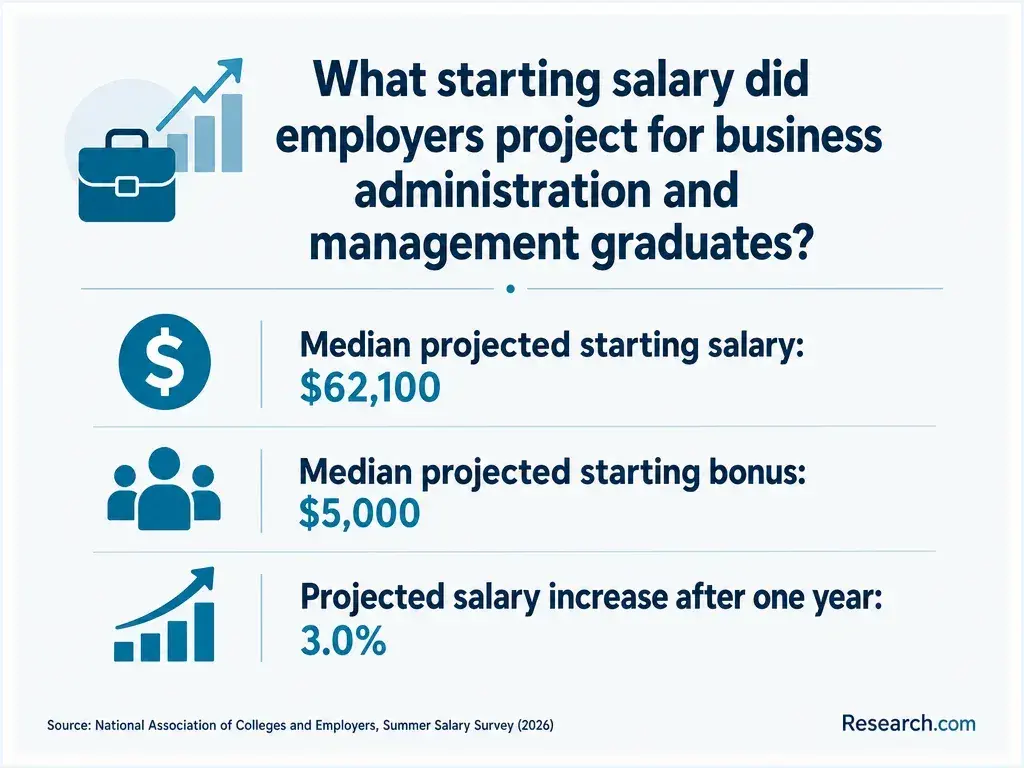
For context, the U.S. Bureau of Labor Statistics reports a $78,760 median annual wage in May 2025 for market research analysts. That occupation-wide figure includes workers at different experience levels; it is not a starting salary for BS in Business Administration graduates. Students specifically targeting supply chain work may want to review fast-track online supply chain bachelor's options before choosing later electives or changing degrees.
What job outlook and certifications apply to business administration graduates?
Outlook depends on the occupation, not the degree title. For example, the Bureau of Labor Statistics projects 18% employment growth for logisticians from 2025 to 2035. That is a national occupation forecast, not a promise of employment or a reason to take an unapproved summer elective. Choose the summer course primarily for its verified role in your degree sequence.
Professional credentials are separate from the BS. HR, project management, accounting, and other fields may have certifications or licenses with their own education and experience rules. If your goal is broader leadership preparation rather than a particular certification, online leadership bachelor's programs with compressed schedules are another degree-path comparison - not a substitute for checking the transfer requirement at your chosen school.
Other Things You Should Know About Business Administration
Only if the receiving school accepts that grading basis for the specific requirement. Ask before enrolling, especially when a minimum letter grade is required.
Notify the receiving school promptly. A withdrawal may leave the prerequisite unfinished and affect an admission condition or your planned course sequence; ask the summer school about its refund and transcript policies.
Possibly. Ask whether the receiving school awards credit for the particular exam and applies that credit to the requirement - not merely as an elective.
Start with the receiving school's transfer office and business adviser. Request its formal review or appeal process and provide the syllabus and learning outcomes rather than relying on a course title alone.
- Academic Policies and Procedures - UVA Summer Session https://summer.virginia.edu/academic-policies-and-procedures
- Transfer Credit Listings | Troy University https://www.troy.edu/academics/academic-resources/records-office/academic-evaluation-center/undergraduate-transfer-credit-listings.html
- Transfer Toolkit - Tuition, Financial Aid, and Scholarships | NCCCS https://www.nccommunitycolleges.edu/transfer-advising-toolkit/draft-transfer-toolkit-tuition-financial-aid-and-scholarships/
- Parts of Term FAQs - Office of the Registrar - UNC Charlotte https://registrar.charlotte.edu/advising-resources/parts-term/parts-term-faqs/
- Transfer to CSU with Transferology https://www.csu.edu/registrar/transfer.htm
- Transfer Students - College Catalog - The University of Chicago http://collegecatalog.uchicago.edu/thecollege/transfercredit/transferstudents/
- Transfer credit policies - Office of Admissions https://admit.washington.edu/apply/transfer/policies/
- Bachelor of Business Administration, BBA | Johnson County Community College Catalog https://catalog.jccc.edu/transfer-guides/ku/bachelor-business-admin-bba/
- Transfer Plans | Admissions - The University of Iowa https://admissions.uiowa.edu/transfer-plans
- Admission Requirements - Online BA in Business Administration https://extension.fullerton.edu/onlinedegrees/baba/requirements.aspx