2027 BS in Business Administration Transfer Planning: A School That Has Closed and Missing Course Descriptions
Audited and Verified:
Our Editorial and Data Verification Process
Research.com uses government datasets, official education statistics and primary institutional information to support its career and degree guides. Our review process checks factual accuracy, occupational definitions, source dates and the requirements associated with the credentials discussed.
How This Article Was Fact-Checked
Our editorial team verifies salary estimates, employment projections, education requirements and program information against original data providers and official organizations. Salary figures are checked against the relevant occupational definitions and reporting periods. Information about licensure, accreditation and required in-person training is reviewed separately.
Fact-checked and verified on:

Co-Founder and Chief Data Scientist
A college closure can leave you with completed business courses but no easy way to prove what they covered. If you are transferring into a BS in Business Administration, the immediate issue is not simply whether a new school will accept your credits; it is whether those credits will satisfy the requirements you need to graduate.
This guide explains where to find records, how to build evidence when descriptions are missing, and what to ask before enrolling. You can use it to compare realistic completion plans rather than relying on an informal credit estimate.
Key Things You Should Know
- Start with an official transcript from the closed college's records custodian. Missing catalog descriptions do not make transfer impossible, but the receiving school may need other evidence to determine course equivalencies.
- Ask for a written degree audit that separates accepted credits from credits applied to general education, business prerequisites, the major, electives, and residency requirements.
- Confirm accreditation for the dates you attended and obtain a final course-by-course evaluation before treating any projected graduation date or cost as reliable.
What Is a Bachelor's Degree in Business Administration?
A BS in Business Administration is an undergraduate degree combining general education with business subjects such as accounting, economics, marketing, management, finance, and quantitative analysis. A school may also offer a concentration or electives in a particular function. Its requirements are not interchangeable with those of a BBA or a specialized business degree, even when course titles look similar.
For a transfer student, the important distinction is between admission, credit acceptance, and degree applicability. A school might admit you and accept an old accounting course as elective credit while still requiring its own accounting prerequisite. If you are returning while employed, compare the curriculum and actual scheduling obligations in working-adult business administration program comparisons; flexibility matters only if the courses you still need are available when you can take them.
How Can You Transfer Credits From a Closed College?
A closed college usually no longer processes routine transcript requests, but its academic records may be held by a state agency, another institution, or a designated records custodian. The receiving university - not the custodian - decides whether and how documented coursework transfers. Begin before applying broadly so you know which schools can evaluate the records you can obtain.
Use this sequence to establish an official record and avoid planning around credits a university has not approved:
- Find the former college's records custodian through the relevant state higher education agency or closure notice, and request an official transcript sent by its accepted method.
- Collect your own catalog pages, syllabi, assignments, degree plan, and correspondence showing course content and the term you attended. Keep originals and note where each item came from.
- Ask each prospective school's transfer office what it requires for courses without descriptions and whether it will issue a preliminary evaluation before admission.
- After admission, request a program-specific degree audit and submit any disputed equivalencies through the school's formal appeal or department-review process.
Check whether a transfer agreement or teach-out arrangement applies to your enrollment period, but do not assume it binds every receiving institution. Even where a course transfers, upper-division and residency rules may leave substantial work to complete. The same distinction appears in project management bachelor's residency and transfer requirements if you are comparing a different business-related major.
How Do You Verify Accreditation Before Transferring Credits?
Check the closed college's institutional accreditation during the terms you attended, not merely whether it appears in a directory now. The U.S. Department of Education's accreditation records and the accreditor's historical records can help establish dates and status. Give the receiving school the college's former name and campus, if relevant, so staff can match the correct institution.
Institutional accreditation and business-program accreditation answer different questions. AACSB, ACBSP, or IACBE recognition, where applicable, has a defined scope; it does not automatically cover every business program or compel another university to award equivalent credit. Conversely, the absence of a business-specific accreditation does not, by itself, tell you whether an institution's courses are transferable. Ask the transfer office whether its policy requires particular accreditation or applies additional standards to specific courses.
If cost and aid eligibility will influence your destination, use accredited affordable business administration colleges with aid options as a starting point, then verify each school's current accreditation, aid participation, and transfer policy directly.
Ask the transfer evaluator which evidence it accepts instead of, or alongside, a catalog description. A syllabus showing topics, learning outcomes, textbooks, contact hours, assessments, and prerequisites is often more informative than a course title. Archived catalogs, departmental outlines, and records from a former instructor may also help, but the receiving institution decides whether they are sufficient.
Prepare a separate evidence file for each disputed course. Match the transcript's course code, title, credits, and term to the supporting materials; flag any discrepancy rather than silently combining records from different years. Request faculty or department review when the issue is whether a course satisfies financial accounting, statistics, economics, or another specific requirement. If the evidence supports only elective credit, ask whether an approved substitution, challenge exam, or remaining-course plan is available.
Different majors may evaluate the same old course differently. If human resources is a serious alternative, HR bachelor's programs with flexible transfer pathways can help you identify programs to question about equivalencies; their published transfer claims are not a decision on your transcript.
Requirements vary by university and catalog year, but a BS in Business Administration commonly includes general education, introductory business and quantitative prerequisites, an upper-division business core, and electives or a concentration. The decisive document is the receiving school's official degree audit under the catalog rules that apply to you.
The categories below show why a total of accepted credits cannot, by itself, predict your remaining coursework.
| Degree-audit category | What to check | Possible closed-college issue |
| General education | Writing, mathematics, and other university requirements | A course transfers but does not meet a specific requirement |
| Business prerequisites | Accounting, economics, statistics, or other required foundations | Missing descriptions prevent a direct equivalency |
| Business core and concentration | Required upper-division courses and approved electives | Course level, content, or recency does not meet program policy |
| Residency and graduation | Credits that must be completed at the new institution | Accepted transfer credits cannot replace in-residence work |
Also confirm prerequisite order and when required courses are offered. A student interested in operations might compare fast-track online supply chain bachelor's options, but a different degree may use old business courses differently and require its own specialized sequence.
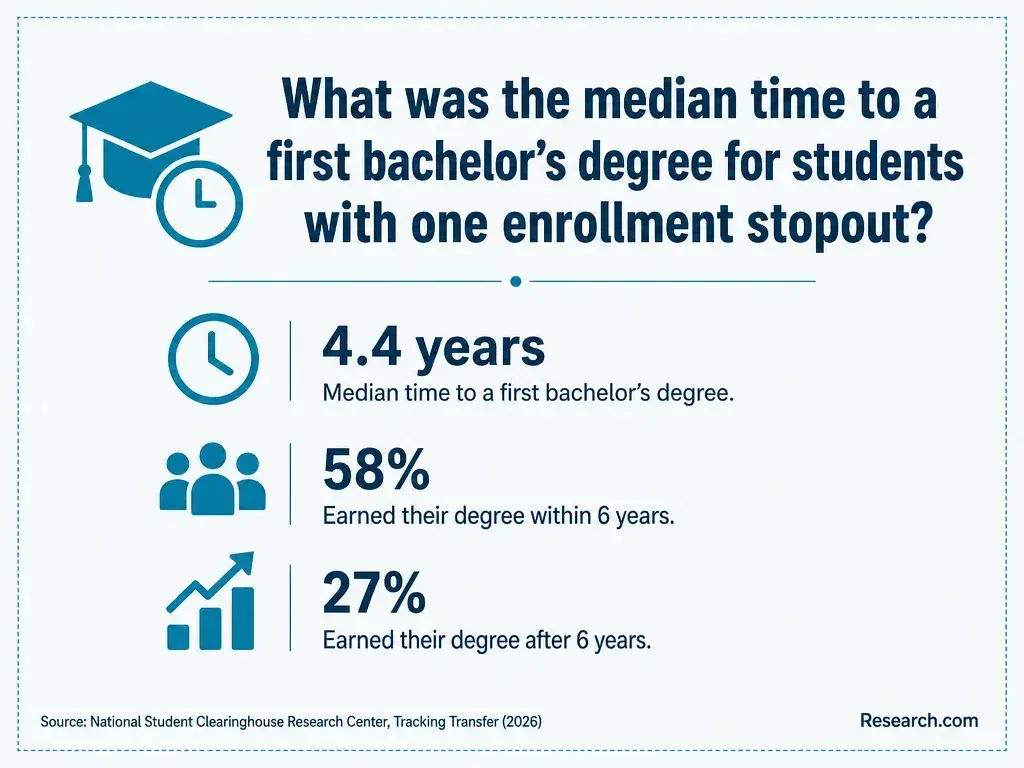
Transfer admission commonly requires an application and official records of prior college work; individual schools set their own academic-standing, prerequisite, and document rules. A closed college is an unusual records problem, so tell admissions where its official transcript is held. Ask separately whether the business major has a second admission step or required courses that must be completed first.
If a transcript cannot be located, request the school's written policy on unavailable records before paying a deposit or enrolling. Personal copies may help an adviser estimate credit, but they may not satisfy an official-transcript requirement. If you are submitting several applications while awaiting records, schools with zero-cost college applications may reduce application expense; confirm that any listed school offers the degree and transfer review you need.
Your completion time depends less on the number of credits a school accepts than on the remaining required courses and their sequence. A missing accounting equivalency, for example, can delay later finance coursework even if other credits transfer. Ask an adviser for a term-by-term plan showing prerequisites, course availability, residency work, and the pace you can realistically sustain.
For cost, compare tuition and mandatory fees for those remaining courses, plus books, technology, travel, and any income affected by your schedule. Request a financial-aid estimate based on your intended enrollment intensity, and ask the aid office how accepted transfer credits and repeated or substituted courses affect eligibility. Do not assume an appeal will succeed or that a preliminary credit estimate will reduce your bill.
If lost credits lead you to consider a specialized alternative, compare its remaining requirements and aid offer on the same basis. Guidance on financial aid packages for online project management bachelor's students can frame that comparison, but it cannot establish what aid your business administration program will award.
Neither format fixes a weak transfer evaluation. Choose among programs that can review your closed-college coursework and provide a credible path through the remaining degree requirements. Online study may reduce commuting, while campus study may offer in-person access to faculty and activities; either format can include scheduled sessions, group assignments, proctored assessments, or limited course offerings.
Ask for the delivery format of the specific courses left on your audit, not just the format advertised for the degree. An accelerated calendar is useful only if prerequisites are offered in order and the workload fits your commitments. Compare those conditions when reviewing fast-track business degree options; a shorter calendar is not evidence that more of your old coursework will apply.
A BS in Business Administration can support applications for roles such as operations coordinator, marketing coordinator, HR assistant, sales operations associate, or project coordinator. The appropriate target depends on your prior work, electives, and demonstrated skills. A degree alone does not confer a management position, professional license, or specialist experience.
Use the transfer plan to preserve courses and projects that serve your intended role. An operations applicant, for example, may benefit from evidence of spreadsheet analysis and process documentation; an HR applicant may need relevant employment practices and communication experience. If project coordination is your clear goal, compare the remaining business degree with online degree options in project management at lower cost. The better path is the one whose approved credits, required coursework, and opportunities to demonstrate skills fit that goal - not necessarily the one with the most credits accepted.
What Salaries and Job Outlook Can Business Graduates Expect?
There is no single salary or growth rate for BS in Business Administration graduates. For one relevant occupation, the U.S. Bureau of Labor Statistics reports a $78,760 median annual wage for market research analysts in May 2025 and projects 7% employment growth from 2025 to 2035. Those are occupation-wide figures, not an entry-level offer or a return guaranteed by this degree; roles, locations, skills, and experience vary.
For a transfer decision, compare the cost of finishing each viable program with the roles you can realistically pursue, rather than dividing a national median salary by tuition. Once you have written degree audits, compare tuition for online business colleges using the courses each school actually requires you to complete.
Other Things You Should Know About Business Administration
A closure does not automatically erase an awarded degree. Keep an official transcript or other available award record, and verify any separate credential requirements with the organization that sets them.
Tell both the records custodian and receiving school about the difference. Ask what identity or institutional-name documentation they need to match the transcript to your application.
It can. Federal closed-school discharge rules consider, among other factors, whether you completed a comparable program through a teach-out or by transferring credits. Ask your loan servicer or Federal Student Aid about your specific eligibility before assuming a discharge is available.
No. You can apply to a different major, including business administration, if you meet the receiving school's requirements. Changing majors may change which previous courses satisfy degree requirements.
- Closed School Discharge | studentaid.gov https://studentaid.gov/manage-loans/forgiveness-cancellation/closed-school
- Accreditation in the U.S. | ed.gov http://www.ed.gov/laws-and-policy/higher-education-laws-and-policy/college-accreditation/accreditation-in-the-us
- .14 Evaluation and Review Process for Transfer of Courses and Credits. | Library of Maryland Regulations https://regs.maryland.gov/us/md/exec/comar/13B.06.02.14
- Student Academic Record or Transcript Requests | Texas Higher Education Coordinating Board https://www.highered.texas.gov/student-academic-record-or-transcript-request/
- For Students | Private Postsecondary Education https://ppse.az.gov/students
- Closures of Degree-Granting Institutions | New York State Education Department https://www.nysed.gov/college-university-evaluation/closures-degree-granting-institutions
- Transfer Credit Equivalencies - Undergraduate Admissions https://admissions.newhaven.edu/portal/tca
- Academic Rules - Course Catalog - Syracuse University https://courses.syracuse.edu/undergraduate/academic-rules
- Transfer Principles | Berkshire Community College https://www.berkshirecc.edu/academics/transfer-planning/transferprinciples.php
- Transfer Credits | Brooklyn College https://www.brooklyn.edu/admissions-aid/transfer/transfer-credits/