2027 BS in Business Administration Curriculum: How to Evaluate Preparation in Professional Networking
Audited and Verified:
Our Editorial and Data Verification Process
Research.com uses government datasets, official education statistics and primary institutional information to support its career and degree guides. Our review process checks factual accuracy, occupational definitions, source dates and the requirements associated with the credentials discussed.
How This Article Was Fact-Checked
Our editorial team verifies salary estimates, employment projections, education requirements and program information against original data providers and official organizations. Salary figures are checked against the relevant occupational definitions and reporting periods. Information about licensure, accreditation and required in-person training is reviewed separately.
Fact-checked and verified on:

Co-Founder and Chief Data Scientist
A business degree can teach you how organizations work, but its value for professional networking depends on what you actually do with classmates, faculty, alumni, and employers.
If you are comparing BS in Business Administration programs, look beyond promises of "connections" to the assignments and support that make professional relationships possible.
This guide shows you how to assess the curriculum, applied learning, online access, and program quality, and how to decide whether those opportunities justify the time and cost.
Key Things You Should Know
- Look for assessed collaboration, stakeholder interviews, presentations, and follow-up, not just a course description that mentions networking.
- Ask whether internships, employer projects, alumni events, and career services are accessible to students in your location and delivery format.
- Networking may support a job search, but it is not a job outcome: the BLS reports a $78,760 May 2025 median wage for market research analysts across the occupation, not for new business graduates.
What Is a BS in Business Administration, and Why Does Networking Matter?
A BS in Business Administration is an undergraduate degree built around business functions such as accounting, marketing, management, operations, and analysis. Its exact requirements vary by school. A BBA or specialized business degree may cover similar ground but offer a different mix of courses and applied work.
Professional networking means building and maintaining work-related relationships through useful, respectful exchanges. For an early-career student, that might mean learning from a guest speaker, collaborating reliably on a project, or asking an internship supervisor for feedback. It does not mean collecting contacts or expecting a referral.
When comparing fast-paced online business degrees, check whether shorter terms leave enough time for sustained teamwork and employer interaction. A quicker credential can be worthwhile, but speed alone does not establish strong networking preparation.
How Does a Business Administration Curriculum Build Professional Networking Skills?
The strongest curriculum treats relationship-building as a practiced professional skill. Students should learn to identify relevant stakeholders, communicate a clear purpose, contribute to shared work, receive feedback, and follow up appropriately. These activities matter more than a syllabus promising "networking opportunities."
Inspect assignment descriptions for group projects with defined responsibilities, presentations to audiences beyond the instructor, interviews conducted with permission, and reflection on professional conduct.
An effective assessment asks not only whether students made contact, but whether they prepared, listened, delivered useful work, and respected boundaries.
Students who remain employed can ask whether business administration programs supporting continued employment permit approved workplace projects; an existing job does not automatically satisfy a course requirement.
What Courses Should a BS in Business Administration Include?
No single course creates a professional network. Look instead for a sequence that develops business knowledge, communication, and repeated opportunities to work with others.
The following course areas are especially relevant when their assignments involve real audiences or realistic stakeholder decisions:
| Course area | Networking-related preparation to look for |
| Business communication | Professional introductions, concise writing, presentations, and feedback |
| Organizational behavior or management | Team roles, conflict resolution, and ethical relationship-building |
| Marketing or customer research | Appropriate outreach, listening, and interpreting stakeholder needs |
| Project management or operations | Cross-functional coordination, status updates, and accountable follow-through |
| Capstone or applied seminar | An assessed project with a clearly identified audience and permitted external interaction |
Check which courses are required, which are electives, and whether prerequisites or term-by-term availability limit your choices. An HR-focused student, for example, may benefit more from supervised HR experience and relevant coursework than from a general networking elective.
If considering a separate HR degree instead, compare the curriculum and how previous coursework might apply through options to apply prior credits to an HR bachelor's degree; a school must make the final credit determination.
Internships and approved employer projects let students demonstrate reliability to people outside the classroom. The most useful placement offers substantive tasks, an accessible supervisor, feedback, and opportunities to explain work to colleagues or stakeholders.
A simulation can build communication skills, but it cannot provide the same employer relationships as supervised work.
Ask the internship coordinator how placements are found, whether remote and paid positions are eligible, what supervision is required, and whether students can use a current job. Obtain academic approval before assuming an activity earns credit, and employer permission before using internal information in an assignment or portfolio.
For students interested in cross-functional project work, transfer-friendly project management bachelor's degrees offer another curriculum to compare; accepted transfer credit and access to project-based placements must be checked separately.
Neither delivery format guarantees stronger connections. Campus programs may make informal encounters easier; online programs may connect working students across locations but require more deliberate participation. Compare the actual access available to students in your format, not the school's overall event calendar.
This comparison highlights where each format may help and what to verify before choosing it:
| Format | Potential advantage | Important limitation to check |
| Campus | In-person faculty, student organizations, and local employer events | Whether events and internships fit your class and work schedule |
| Online | Access to classmates and alumni beyond one local area | Whether live sessions, career events, and employer introductions include online students |
| Hybrid | Some in-person contact alongside remote coursework | Required travel, meeting frequency, and location of applied work |
If you use US business college rankings for online learners to create a shortlist, follow up with program staff about live attendance, group-project scheduling, alumni access, and career appointments. "Online" does not necessarily mean self-paced or free of campus visits.
First, verify the institution's accreditation with the accreditor and confirm that the school awards the stated degree. Then check whether any claimed AACSB, ACBSP, or IACBE business accreditation covers the school or program you are considering.
Institutional and business accreditation have different scopes; neither proves that a particular student will obtain a job or a strong network.
For networking quality, request evidence closer to the experience you will receive: sample assignments, internship eligibility rules, career-service access for online or transfer students, and the schedule of employer events.
Ask how the school measures participation or placement, including who was counted and when. When you compare ranked accelerated undergraduate business schools, give course access and applied opportunities as much scrutiny as completion speed.
Requirements vary by institution and entry route. First-year applicants may need secondary-school records; transfer applicants generally submit prior college transcripts.
Some schools admit students directly to the business major, while others require additional coursework or a separate major application. Admission, transfer-credit acceptance, and satisfaction of business-core requirements are different decisions.
If networking through a particular concentration, internship, or capstone drives your choice, ask admissions and a business adviser when you become eligible for it. Request a degree audit showing prerequisites and remaining courses before relying on an estimated graduation date.
Applicants comparing business administration with a project-focused degree should evaluate program eligibility separately from affordability; an online project management undergraduate funding guide can help frame financial-aid questions, but it does not establish admission or credit eligibility.
A full-time student entering without college credit commonly plans around four academic years, but transfer credit, course sequencing, enrollment pace, and residency requirements can change the timeline.
Ask for a program-specific plan that includes the internship or capstone you want; an opportunity available only in certain terms could affect completion.
Compare the cost of the remaining required courses, not just advertised tuition. Include mandatory fees, books or software, travel for events or placements, and any earnings affected by unpaid work.
Economical college choices for business administration majors can be a starting point, but a lower listed price is not necessarily a lower total completion cost after credit evaluation and scheduling are considered. Do not pay substantially more for promised connections without confirming that you can use them.
A BS in Business Administration can support applications for roles such as marketing coordinator, operations coordinator, HR assistant, or project coordinator, depending on the applicant's skills and the employer's requirements.
Coursework and contacts may help a student learn about openings; hiring still depends on demonstrated ability, relevant experience, and competition. Management positions typically require more responsibility and experience than graduation alone provides.
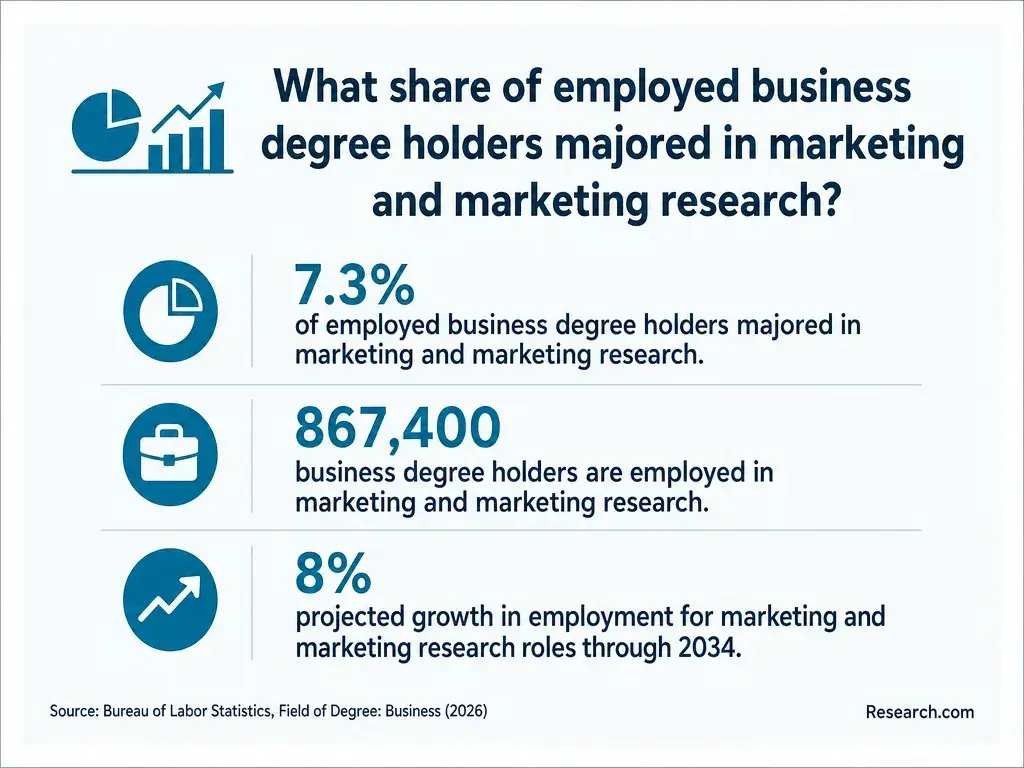
For salary context, the U.S. Bureau of Labor Statistics reports a $78,760 median annual wage in May 2025 for market research analysts and projects 7% employment growth from 2025 to 2035. Those figures describe an occupation across experience levels, not starting pay or a guaranteed outcome for business graduates.
If supply chain work is your target, compare its specialized coursework and local openings alongside supply chain college costs versus potential career outcomes rather than assuming a broad business degree is the most direct route.
Do Business Administration Careers Require Certifications or Licenses?
Many general business support roles do not require an occupational license, but requirements depend on the job and employer. A BS in Business Administration does not itself confer a CPA license, a financial-services license, an HR certification, or a project-management credential. Those pathways may have separate education, examination, or experience requirements.
Before selecting electives for networking value, identify your target role and check its actual qualification requirements. A useful professional contact can explain a field, but cannot replace a required credential or relevant experience.
Likewise, even online leadership bachelor's programs with compressed schedules should be evaluated for their coursework and applied opportunities - not treated as automatic preparation for a management appointment or license.
Other Things You Should Know About Business Administration
State who you are, why their work is relevant to a specific interest, and what brief, reasonable request you have. Ask for insight rather than a job, and respect a declined or unanswered invitation.
No. Follow up when you can refer to something specific you learned or a relevant next step. A thoughtful message is more useful than a generic connection request.
Yes. Reliable collaboration can lead to lasting peer relationships. Treat classmates as colleagues: meet commitments, share credit, and stay in touch without assuming they owe you referrals.
Describe the work you performed - such as coordinating a team presentation or interviewing permitted stakeholders - rather than claiming a network as an achievement. Identify your contribution without disclosing confidential information.
- Professional Networking 101 page | Young Leaders of the Americas Initiative https://ylai.state.gov/professionals/growing-business/professional-networking-101/
- Internship Experiences Contribute to Confident Career... - PMC https://pmc.ncbi.nlm.nih.gov/articles/PMC6007763/
- How a Business Administration Degree Can Prepare You for Entrepreneurship - Missouri Baptist University (Mobap) https://www.mobap.edu/news/how-a-business-administration-degree-can-prepare-you-for-entrepreneurship/
- Networking & Informational Interviews | Washington University in St. Louis https://careers.washu.edu/blog/2024/08/06/networking-informational-interviews/
- Business Administration (BS) - San Luis Obispo | Cal Poly Academic Catalog https://catalog.calpoly.edu/business/undergraduate/business-administration-bs/
- BSBA Career Prospects - Olin Business School - WashU https://olin.washu.edu/programs/bs-business-administration/career-prospects.php
- A Guide To Experiential Learning, Internships, Capstones, and Practicums - UOnline - The University of Utah https://online.utah.edu/blog/posts/learning-experiences.php
- Online vs On-Campus College: Choose the Right Format | Bay Path University https://www.baypath.edu/news/bay-path-university-blogs/post/online-vs-on-campus-college-choose-the-right-format/
- How to Build a Powerful Professional Network at Minnesota | umn.edu https://carlsonschool.umn.edu/graduate/resources/build-professional-network-minnesota-carlson
- Bachelor of Science in Business Administration | utdallas.edu http://sites.utdallas.edu/osim/bs-ba/