2027 BS in Business Administration Curriculum: How to Evaluate Preparation in Leadership Development
Audited and Verified:
Our Editorial and Data Verification Process
Research.com uses government datasets, official education statistics and primary institutional information to support its career and degree guides. Our review process checks factual accuracy, occupational definitions, source dates and the requirements associated with the credentials discussed.
How This Article Was Fact-Checked
Our editorial team verifies salary estimates, employment projections, education requirements and program information against original data providers and official organizations. Salary figures are checked against the relevant occupational definitions and reporting periods. Information about licensure, accreditation and required in-person training is reviewed separately.
Fact-checked and verified on:

Co-Founder and Chief Data Scientist
A business administration degree may teach management concepts without giving students much practice leading people or making difficult decisions. If leadership development is your goal, the useful comparison is not which program uses the word "leadership" most often. It is which curriculum builds judgment, communication, financial awareness, and accountability through assessed work. This guide shows prospective and returning students how to examine courses, applied assignments, delivery formats, and outcomes before choosing a BS in Business Administration.
Key Things You Should Know
- Look for assessed leadership practice - such as team projects with feedback, simulations, or supervised workplace work - not just a course titled "Leadership."
- Check whether management, accounting, analytics, and ethics courses build toward a substantial capstone; a concentration or elective alone does not establish managerial readiness.
- Compare the remaining credits, required attendance, project access, and total cost alongside career goals. The degree can support advancement, but supervisory jobs generally also require relevant experience.
What Is a BS in Business Administration?
A Bachelor of Science in Business Administration, often shortened to BSBA, is an undergraduate degree combining general education with business subjects such as accounting, finance, marketing, operations, and management. Its leadership value comes from learning how decisions in one function affect employees, customers, budgets, and organizational goals.
The BS designation does not guarantee more quantitative coursework than a BBA or BA in Business; schools set their own requirements. Likewise, a management elective is not necessarily an official concentration. Compare the published degree audit and course descriptions rather than relying on the credential name. If your goal is specifically to coordinate projects, a specialized route may be worth comparing, particularly if prior coursework could count toward colleges accepting coursework toward project management bachelor's study. Only the receiving school can determine how those credits apply.
How Does a Business Administration Degree Develop Leadership Skills?
A strong curriculum moves beyond describing leadership styles. It asks students to set priorities with incomplete information, explain decisions, manage disagreements, consider affected stakeholders, and revise their approach after feedback. Organizational behavior can explain team dynamics; accounting and analytics can test whether a proposed decision is financially and operationally sound.
To judge the depth of practice, ask to see assignment descriptions or capstone criteria. A team presentation may assess communication but reveal little about an individual student's leadership unless the instructor also evaluates decisions, contribution, and reflection. A workplace project can offer stronger evidence when the school approves its scope and the employer permits use of the information. Neither a simulation nor an academic project is the same as supervising staff.
If your immediate goal is project coordination rather than broad organizational leadership, compare the curriculum and total cost with online project management programs for smaller budgets. A focused program may fit better, but it should still provide practice with stakeholders, budgets, and project risks.
What Courses Are Included in a Business Administration Curriculum?
Most BSBA programs have a business core, general education requirements, and some room for electives or a formal concentration. Leadership preparation depends on how those pieces connect: a student should be able to use financial evidence and operational constraints when recommending a course of action, not study each subject in isolation.
The following comparison shows what to look for in a degree plan. Course titles and requirements vary by school.
| Curriculum area | Contribution to leadership preparation | Evidence to examine |
| Accounting, finance, and analytics | Interpreting costs, financial statements, and uncertain forecasts | Assignments requiring a justified recommendation, not only calculations |
| Management, organizational behavior, and HR | Understanding teams, motivation, employment practices, and conflict | Case analysis, feedback, and assessment of individual judgment |
| Operations, marketing, and strategy | Balancing capacity, customer needs, and organizational priorities | Projects that connect multiple business functions |
| Capstone or applied experience | Presenting and revising a defensible decision | Clear supervision, assessment criteria, and data-use rules |
Check prerequisite chains before choosing electives: statistics may be required before analytics, for example. Ask an adviser which courses are required, which are offered regularly, and whether a proposed set of electives appears as a concentration on the transcript. For a closer look at possible entry-course expectations, consult the business administration degree admissions requirements guide, then confirm your school's rules.
Delivery format affects how students practice leadership. Campus courses may make in-person teamwork and presentations easier to arrange. Online courses can support collaboration across locations, but asynchronous lectures do not mean group meetings, presentations, exams, and deadlines are flexible.
Request a sample syllabus for an upper-level management course and the capstone. Check required live sessions, group-work expectations, proctoring, internship or campus visits, faculty feedback, and access to career services. Working students should compare those obligations with actual weekly availability, not just advertised course length. A nationwide comparison of online business programs can help form a shortlist; use each school's current catalog and syllabi to verify leadership-specific opportunities.
Start by confirming that the institution holds recognized institutional accreditation. Then check whether its business school or the specific program is covered by business-focused accreditation from AACSB, ACBSP, or IACBE. These are different reviews with different scopes; the presence of an accreditor's name on a university website does not establish that the BSBA you plan to enter is included.
Accreditation is a quality-screening factor, not proof that a program will develop your leadership skills or lead to a promotion. Examine assessed learning outcomes and applied-course requirements as well. When cost matters, low-cost business administration degrees with federal aid options can provide candidates to investigate, but verify current accreditation, aid eligibility, and charges directly with each institution.
Requirements vary by institution and by entry point. First-year applicants may need a high school credential and transcripts; transfer applicants generally submit prior college records. Some schools admit students directly to the business major, while others require introductory courses or a separate application before upper-level business study.
If you have prior coursework, ask for an official evaluation showing which credits satisfy general education, business core, electives, and residency requirements. Accepted credit does not necessarily replace a required management or accounting course. Also confirm any mathematics or statistics preparation and whether an entry requirement can be completed after admission. If you are applying to several schools, reduce upfront college application expenses where possible, but do not let an application-fee policy outweigh curriculum fit.
Full-time bachelor's study commonly spans four academic years, but completion time depends on accepted credits, course sequencing, enrollment pace, and whether required classes run when you need them. An accelerated calendar may shorten elapsed time without reducing the coursework or its weekly demands. Use ranked accelerated undergraduate business schools as a starting point, then request an individualized course plan.
Compare programs using the cost of remaining required study, not a headline tuition rate. Include tuition, mandatory fees, books, software, travel or proctoring, and the effect of reduced work hours. Ask the financial-aid office how your intended pace affects eligibility and when aid or employer reimbursement is paid. A cheaper program can cost more overall if unavailable courses delay completion or transferred credits apply only as electives.
A BSBA can support entry into roles such as operations coordinator, HR assistant or specialist, marketing coordinator, sales operations associate, or project coordinator. These positions offer opportunities to demonstrate leadership through reliable decisions, cross-functional communication, and ownership of defined work. They are not interchangeable with managing employees or controlling a major budget.
Match the curriculum to the responsibilities you want next. For operations, seek process analysis and budgeting work; for people-focused roles, look for HR practice, employment-law context, and supervised communication. Internships or approved workplace projects can supply evidence of those skills. If supply chain work is the target, compare general business preparation with a specialized program using supply chain degree duration and salary considerations. The more specialized option may be preferable when its courses and recruiting opportunities align closely with the roles you seek.
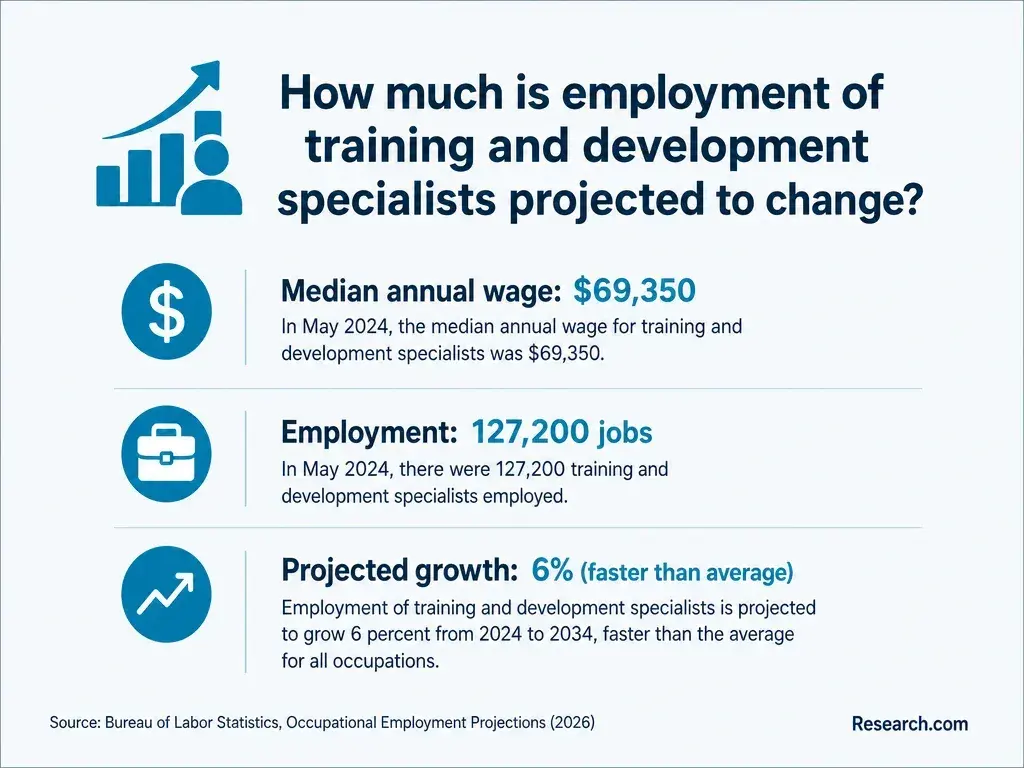
There is no single salary or growth rate for BSBA graduates: labor statistics describe occupations, not outcomes for everyone holding a particular degree. For one relevant occupation, the U.S. Bureau of Labor Statistics reports a May 2025 median annual wage of $69,280 for training and development specialists and projects 11% employment growth from 2025 to 2035. That occupation can involve developing employee learning programs, but its median includes workers with differing experience; it is not a starting-salary estimate for a new graduate.
For a realistic return-on-investment comparison, examine local openings for your target role, their experience requirements, and your remaining degree cost. Online business degrees with lower tuition may reduce the education-cost side of that comparison, provided their schedules and applied learning meet your needs. Do not use managers' occupation-wide wages as a forecast of what you will earn immediately after graduation.
Do Business Administration Graduates Need Certifications or Licenses?
A general business administration degree does not itself require an occupational license, and completing it does not award one. Requirements depend on the work: regulated accounting and certain financial-services activities can require separate qualifications, while employers may value voluntary HR or project-management certifications. Check the relevant licensing authority or credential provider before selecting courses on the assumption that they establish eligibility.
For leadership development, choose an additional credential only after identifying a specific skill or job requirement it addresses. Employer training, mentorship, and progressively responsible work may be more direct than another academic program. If you are considering a separate project-management bachelor's instead, undergraduate project management grants and scholarship planning can inform the cost comparison; that degree is a different commitment from pursuing a certification.
Other Things You Should Know About Business Administration
Yes, if you can describe your responsibility, decisions, collaboration, and results accurately. It counts for academic credit only if the school approves it under its own rules.
Not automatically. Compare the actual courses and assessed projects. A formal concentration may document a focused course sequence, but well-chosen electives can be more relevant to a particular goal.
Request the current degree plan, upper-level course descriptions, sample applied assignments, capstone requirements, and an individualized credit evaluation if you have prior study.
Only with the necessary employer permission and faculty approval. Otherwise, use permitted public information or an appropriately fictionalized case; removing a company name alone may not protect sensitive data.
- Applying Experiential Learning to Career Development... - PMC https://pmc.ncbi.nlm.nih.gov/articles/PMC8711830/
- Adding Ethics to the Business Classroom | AACSB https://www.aacsb.edu/insights/articles/2016/01/adding-ethics-to-the-classroom
- In-Person vs. Online Learning: An Educator's Guide | American College of Education https://ace.edu/blog/examining-in-person-instruction-from-a-virtual-mindset-what-can-we-improve/
- The Nature of Hybrid Courses in Writing | Academic Affairs https://academicaffairs.du.edu/content/nature-hybrid-courses-writing
- Experiential Learning | Capital University, Columbus Ohio https://www.capital.edu/faculty-and-staff/center-for-excellence-in-learning-and-teaching/experiential-learning/
- Full article: A systematic review: pedagogies and outcomes of formal leadership programs for college students https://www.tandfonline.com/doi/full/10.1080/2331186X.2024.2314718
- The Leadership Competency Framework | umn.edu https://hr.umn.edu/Professional-Development/Supervisory-and-Leadership-Development/Leadership-Competencies-and-Assessments/Leadership-Competency-Framework
- Business Administration Degrees (Types, Courses & FAQ) | allbusinessschools.com https://www.allbusinessschools.com/business-administration/degrees/