2027 BS in Business Administration Curriculum: How to Evaluate Preparation in Applied Business Projects
Audited and Verified:
Our Editorial and Data Verification Process
Research.com uses government datasets, official education statistics and primary institutional information to support its career and degree guides. Our review process checks factual accuracy, occupational definitions, source dates and the requirements associated with the credentials discussed.
How This Article Was Fact-Checked
Our editorial team verifies salary estimates, employment projections, education requirements and program information against original data providers and official organizations. Salary figures are checked against the relevant occupational definitions and reporting periods. Information about licensure, accreditation and required in-person training is reviewed separately.
Fact-checked and verified on:

Co-Founder and Chief Data Scientist
A business administration curriculum may promise practical experience, but a case discussion, a simulation, and a supervised workplace project prepare students in different ways. If you are comparing BS programs, the useful question is what you will actually produce, who will assess it, and which skills the work demonstrates.
This guide shows how to examine applied assignments alongside the business core, scheduling, cost, and career outcomes, so you can choose a program that fits the work you hope to do rather than relying on "hands-on learning" as a marketing claim.
Key Things You Should Know
- Look for a sequence from business fundamentals to a project with a defined decision, evidence, feedback, and a defensible recommendation - not simply a required capstone.
- Check whether projects use simulated, public, or employer-approved data; what supervision is provided; and whether you may share a redacted work sample with employers. Judge career preparation against entry-level tasks.
- The U.S. Bureau of Labor Statistics reports a May 2025 median annual wage of $78,760 for market research analysts, but that occupation-wide figure is not a starting salary for business graduates.
What Is a Business Administration Curriculum Designed to Teach?
A BS in Business Administration typically combines general education with accounting, finance, marketing, management, operations, and quantitative decision-making. Its purpose is broad business literacy: understanding how a decision about customers, staffing, costs, or processes affects other parts of an organization. The exact mix and depth vary by school; a BS, BBA, and specialized business bachelor's degree need not have identical requirements.
For applied-project preparation, look beyond course titles. A useful curriculum teaches students to define a business problem, choose appropriate measures, analyze imperfect information, communicate trade-offs, and explain ethical constraints. A project that produces a polished slide deck without testing its assumptions may demonstrate presentation skills but offer weaker evidence of decision-making.
Breadth is valuable if you are still choosing a function or expect to coordinate across teams. If your goal is specifically procurement or logistics, compare the general business core with specialized supply chain program tuition, time, and earnings context. The better fit depends on the courses and projects you can complete, not the degree title alone.
How Do Applied Business Projects Prepare Students for Careers?
An applied business project asks a student to use business concepts to inform a realistic decision. For example, a team might map an order-fulfillment process, identify where delays could occur, compare improvement options, and recommend what a manager should measure before changing the process. A simulation can teach this reasoning without access to an employer's records; an employer project adds stakeholder and implementation constraints but requires permission.
Compare projects by the evidence of skill they generate. Strong assignments identify a decision-maker and objective, document data sources and assumptions, consider costs and risks, and require revision after faculty or stakeholder feedback. Ask whether you will submit a model, process map, research brief, or recommendation - and whether assessment covers the reasoning behind it. A proposed improvement is not a proven business result.
Internships, co-ops, simulations, and capstones are different arrangements. Confirm which are required, who approves a workplace site, who supervises the work, and whether your current job can qualify. Transfer applicants seeking a more explicitly project-focused degree can also compare online project management degrees for transfer applicants; accepted credits still need an official evaluation to establish how they apply.
Before using organizational information, check employer permission, course rules, privacy obligations, and intellectual-property restrictions. Public or synthetic data may be the safer choice. A portfolio should describe your own contribution and limitations without revealing customer, employee, financial, or proprietary records.
What Courses Are Included in a Business Administration Bachelor's Degree?
Course names differ, but the relationship between foundational study and later assignments matters more than a long catalog of electives. The table shows what common course areas can contribute to an applied project; it does not imply that every program requires every course.
| Course area | Relevant preparation | Possible project evidence |
| Accounting and finance | Reading statements, estimating costs, and separating profit from cash flow | An operating-budget analysis with stated assumptions |
| Statistics and business analytics | Interpreting data quality, variation, and uncertainty | A reproducible spreadsheet or dashboard with limitations |
| Marketing and operations | Understanding customer needs and how work moves through a process | A research brief or process map tied to a defined decision |
| Management and business law | Considering stakeholders, responsibilities, and constraints | A recommendation that addresses implementation and risk |
Check prerequisites and sequencing, a capstone may require completion of the business core, while an analytics elective may depend on earlier statistics coursework. If a concentration matters to you, verify that it is officially offered, that its courses run when needed, and that its project options add useful depth without delaying graduation. Students weighing specialized, shorter-term study can examine supply chain undergraduate programs with shorter terms, then confirm actual course availability and remaining requirements with each school.
Compare access to projects, not just where lectures take place. An online student may collaborate remotely using shared files and scheduled meetings; a campus student may have more opportunities for in-person presentations or local employer contacts. Neither format guarantees an approved employer project, an internship placement, or individual faculty feedback.
Request a recent syllabus for the capstone and a representative project-based course. Check live attendance, group-meeting expectations, presentation times, proctored assessments, software requirements, campus visits, and whether projects can use public or simulated data. For students balancing work or caregiving, a program described as asynchronous may still require coordination with a team on fixed deadlines.
Use ranked school options for studying business online as a starting set of programs to investigate, not as evidence that a particular curriculum suits your schedule or target role. The deciding evidence is the current catalog, course schedule, assignment requirements, and support available to you.
First, verify the institution's accreditation with its accreditor and the U.S. Department of Education's accreditation information. Then check any claimed business accreditation directly with AACSB, ACBSP, or IACBE, including which school, degree level, and programs the accreditation covers. Institutional accreditation and business-program accreditation are distinct; neither proves that a student will receive an internship or a job offer.
For project quality, ask the department for a capstone rubric, examples of permissible project formats, faculty-supervision arrangements, and rules for employer-sponsored work. If the school publishes completion or employment outcomes, check the graduating group measured, time period, response rate, and whether figures describe business administration students specifically. You can compare accredited business administration programs and federal student aid, but confirm each institution's current accreditation and aid eligibility before relying on a listing.
Requirements depend on the institution and on whether you are applying as a first-year, transfer, or returning student. Schools may request prior transcripts and evidence of academic preparation, entry to the institution may be separate from entry to the business major. Mathematics or introductory business courses might be admission conditions at one school and degree requirements completed after enrollment at another.
Ask admissions which documents and prerequisites apply to your applicant category, then ask an adviser how prior courses would satisfy the business core and prerequisites for later project work. An accepted transfer course can count as elective credit without replacing required accounting or statistics. For a closer look at questions to raise, see prerequisites for a business administration degree. Use the school's official evaluation and degree audit - not an informal estimate - to plan your sequence.
Completion time depends on accepted credits that apply to the degree, enrollment pace, prerequisites, required course availability, and any internship or capstone sequence. A compressed calendar does not remove coursework. For a returning student, a course offered infrequently may matter more than the advertised program length.
Compare total remaining cost rather than tuition alone: include mandatory fees, software, books, travel or campus visits, and borrowing costs where applicable. If a workplace project requires fewer travel hours than an internship, verify that the department allows it before treating the difference as savings. Ask for a degree audit and a term-by-term course plan, then price the remaining requirements at the school's current rates.
Compare the least expensive business administration schools to identify candidates, but recalculate costs using your own approved credits and aid offer. A lower advertised tuition rate may not mean a lower cost to graduation if more courses remain.
A broad business curriculum can support applications for roles such as operations coordinator, marketing coordinator, HR assistant, sales operations associate, or project coordinator. These jobs differ, one may emphasize process tracking, another customer research, and another records and communication. Match a project to the tasks in the jobs you want, then supplement it with an internship, relevant employment, or other supervised experience where possible.
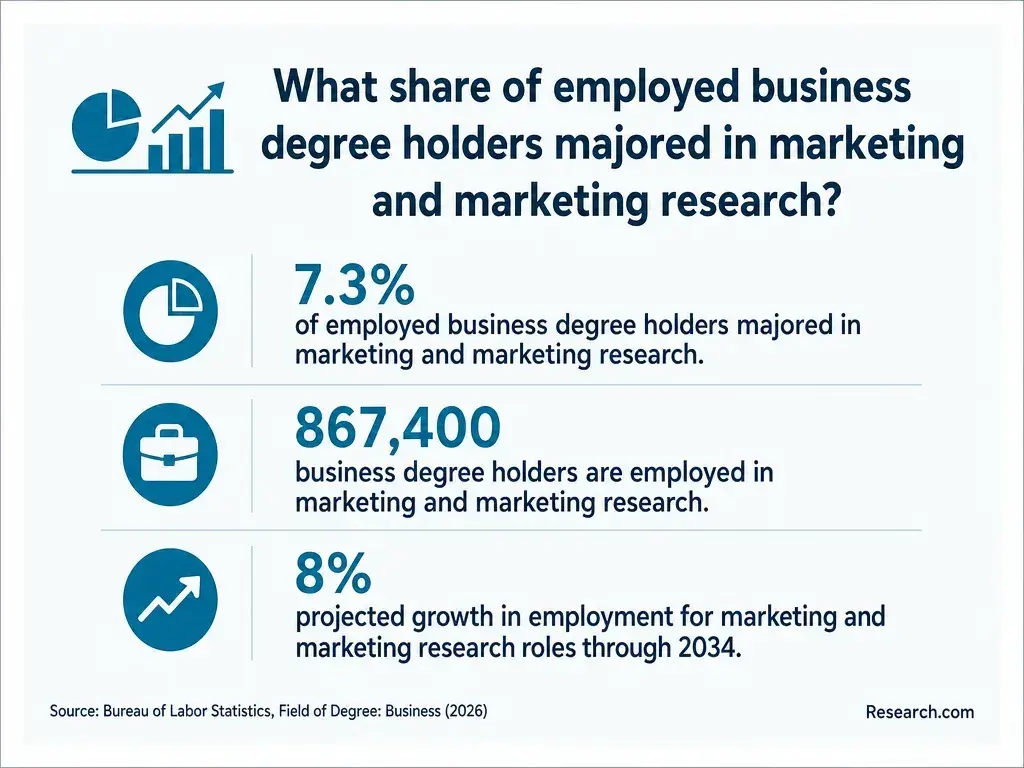
For example, an applicant targeting marketing analysis can show how they framed a research question, assessed data limitations, and presented a recommendation. The Bureau of Labor Statistics projects 7% employment growth for market research analysts from 2025 to 2035; that occupation-wide projection signals potential demand, not that a general business degree alone qualifies an applicant. Analyst roles may require stronger research and quantitative preparation than a single introductory project provides.
If time to enter a role is the main constraint, compare a full degree with relevant work experience and fast-track bachelor's degree options. An accelerated format makes sense only if its schedule permits you to complete the same required learning and build credible work samples.
There is no single wage for a BS in Business Administration: pay attaches to an occupation, location, employer, and level of responsibility, not the degree title. For context, the Bureau of Labor Statistics reports a May 2025 median annual wage of $75,940 for human resources specialists. That median covers workers across experience levels and should not be read as an expected first-job offer for a new graduate.
When considering the financial value of a curriculum, compare roles you could realistically pursue, their stated requirements, and the cost and time left to complete the degree. A well-documented project can strengthen an application by showing relevant work, but it cannot establish a salary increase. Quick-completion business degree pathways may change when you can apply for degree-requiring jobs; confirm that faster pacing will not crowd out the project, internship, or job experience you need.
Do Business Administration Graduates Need Certifications or Licenses?
Most general business coordination roles do not have a license that comes automatically with the degree. Requirements become more specific by occupation: accounting licensure, certain financial-services activities, and some other regulated work have separate rules. Voluntary credentials in HR or project management may also require particular education or experience. Check the relevant state board, regulator, or credential issuer before assuming a concentration or capstone satisfies eligibility.
Choose additional training for an identified skill gap, not merely to add letters to a résumé. If project coordination is the goal, compare employer training, supervised project experience, a focused credential, and formal education; online project management undergraduate funding guidance can help frame the financing question if a separate degree is under consideration. A BS project can demonstrate planning and communication, but it is not a professional certification.
Other Things You Should Know About Business Administration
Only within your course's rules and any employer data-use policy. Disclose permitted use, verify outputs and sources, and do not enter confidential or personal information into an unapproved tool.
Yes, if you label the data as simulated and show your method, assumptions, and reasoning. Do not present the exercise as an implemented workplace result.
Keep approved records of your role, such as the analysis you performed or sections you drafted. In a portfolio or interview, distinguish your work from the team's without sharing restricted materials.
No. A careful finding that evidence is insufficient or a proposal is too costly can show sound judgment. Explain what you tested, what remains uncertain, and what decision the evidence supports.
- Step 4 - Gather Credible Evidence | Program Evaluation https://www.cdc.gov/evaluation/php/evaluation-framework-action-guide/step-4-gather-credible-evidence.html
- A Practical Guide to Writing Quantitative and Qualitative... - PMC https://pmc.ncbi.nlm.nih.gov/articles/PMC9039193/
- What are best practices for designing group projects? | Carnegie Mellon University https://www.cmu.edu/teaching/designteach/design/instructionalstrategies/groupprojects/design.html
- Consulting Projects | Foster School of Business https://foster.uw.edu/recruiters-business-partners/engage-students/consulting-projects/
- Transferable Skills in Business Administration Across Industries | The College of Westchester https://www.cw.edu/blog/how-business-administration-courses-build-transferable-skills-across-multiple-industries/
- The Power of Partnerships in Experiential Learning | AACSB https://www.aacsb.edu/insights/articles/2025/04/the-power-of-partnerships-in-experiential-learning
- 5 key reasons why data analytics is important to business | upenn.edu https://lpsonline.sas.upenn.edu/features/5-key-reasons-why-data-analytics-important-business
- Developing Your Project Sequence | gatech.edu https://sites.gatech.edu/bfhandbook/course-design-guidelines/developing-your-project-sequence/
- Topic Guide: Assessment Evidence | ucdavis.edu https://cee.ucdavis.edu/topic-guide-assessment-evidence