2027 BS in Business Administration: Career Services for Part-Time Online Students
Audited and Verified:
Our Editorial and Data Verification Process
Research.com uses government datasets, official education statistics and primary institutional information to support its career and degree guides. Our review process checks factual accuracy, occupational definitions, source dates and the requirements associated with the credentials discussed.
How This Article Was Fact-Checked
Our editorial team verifies salary estimates, employment projections, education requirements and program information against original data providers and official organizations. Salary figures are checked against the relevant occupational definitions and reporting periods. Information about licensure, accreditation and required in-person training is reviewed separately.
Fact-checked and verified on:

Co-Founder and Chief Data Scientist
A part-time online business degree can fit around a job, but career development may not fit as easily. A résumé appointment during work hours or an internship requiring daytime availability can limit the value of otherwise strong career services.
This guide is for prospective students who need to study while working or managing other commitments. It explains what support to expect, how to test whether online students can use it, and how to connect the degree to a realistic next role.
Key Things You Should Know
- Ask whether career coaching, employer events, interviews, and internship support are available remotely at times you can attend - not merely advertised to all students.
- Compare career services against your target role: a project-coordination applicant needs different recruiting contacts and work samples than someone pursuing HR.
- U.S. Bureau of Labor Statistics occupation-wide medians are not starting salaries: the May 2025 median was $75,940 for human resources specialists, across workers at all experience levels.
What is a BS in Business Administration for part-time online students?
A BS in Business Administration is an undergraduate degree covering business functions such as accounting, marketing, management, operations, and quantitative decision-making. "Part-time online" describes how a student takes courses, not a separate academic credential. The diploma and major requirements depend on the institution; a BS, BBA, and specialized business degree should not be assumed to have identical curricula.
For a working student, the decisive question is whether professional support works at the same pace as the coursework. A useful program offers access to career advisers who can help translate current responsibilities into evidence for a specific role, review work samples, and identify employers recruiting remote students. When using online business degree rankings for US college applicants to build a shortlist, check each school's current career-service eligibility and hours yourself. A ranking does not establish that its services fit your schedule.
How do part-time online business administration programs compare with campus programs?
Both formats may provide advisers and recruiting events, but access can differ. Online classes are not necessarily self-paced, and a school that streams a campus career fair may still leave remote students unable to speak with employers. This comparison identifies the access details that matter most.
| Career-service feature | Part-time online student should verify | Potential campus advantage |
| Career coaching | Video appointments, evening availability, and adviser continuity | Drop-in office hours |
| Employer recruiting | Remote event access and whether employers consider online students | In-person conversations and local recruiting |
| Interview preparation | Virtual mock interviews and feedback between shifts | On-site practice and interview rooms |
| Experiential learning | Remote or current-workplace options and required academic approval | Established nearby internship sites |
Request the career-event calendar and appointment schedule, not just a list of services. If considering online business study with accelerated terms, also ask whether recruiting events, group assignments, and application deadlines remain manageable during shorter courses. Faster terms do not make career preparation less time-consuming.
What careers can you pursue with a BS in Business Administration?
Start with the work you already do and the responsibility you want next. Someone who tracks orders and resolves supplier problems may be a stronger candidate for procurement or operations coordination than for an unrelated finance role. A student with customer-service experience might target sales operations or marketing coordination, using coursework and a documented project to show new skills.
Career services are most valuable when they help test that transition against job postings: which tasks you can already perform, which tools you need to learn, and whether the employer expects related experience. Ask for examples of employers recruiting for your target function and whether part-time students can attend those events. If your goal is supervising teams rather than broad business analysis, compare the curriculum with leadership bachelor's degrees with accelerated pacing; neither degree alone qualifies someone to manage staff.
Programs commonly combine general education with accounting, economics, finance, marketing, management, statistics, operations, and a strategy or capstone course. Requirements vary, as do formal concentrations and the frequency with which electives run. For career planning, examine assignments as closely as course titles: a spreadsheet model, process analysis, or customer-research proposal may give an adviser something concrete to discuss with you.
Ask whether the career center helps students turn approved class projects into interview examples and whether faculty can advise on a project aligned with your target role. A proposed classroom analysis is not a verified business result, and employer data requires permission before it appears in coursework or a portfolio. If logistics is your goal, compare available operations electives with shorter supply chain degrees and career value rather than assuming a general business core provides the same functional depth.
Schools set their own requirements for first-year and transfer applicants, which may include prior transcripts, minimum academic standing, or preparation in mathematics and writing. Admission to the university, entry into the business major, and application of transfer credits to degree requirements can be separate decisions. A working applicant should request an official evaluation before relying on an estimated completion date.
Before applying, check prerequisites before applying to business administration programs and ask whether outstanding courses can be taken online at your intended pace. Also establish when career-service access begins. Early access could help you explore target roles before choosing electives; access restricted until enrollment may limit that opportunity.
Completion time depends on credits that apply to the degree, courses taken each term, prerequisite order, and when required classes are offered. Accepted transfer credits may count only as electives. A program with frequent starts can still delay graduation if a required business course runs infrequently.
Ask an adviser for a term-by-term plan showing remaining requirements and a realistic workload alongside employment. Then ask the career center when it recommends starting applications, networking, or internship planning; waiting until the final term may leave too little time to use those services. National rankings of fast-paced business bachelor's programs can suggest options, but advertised speed is not your personal completion timeline.
Compare the cost to finish, not just the advertised tuition rate. Request a written estimate covering the courses left after transfer evaluation, mandatory fees, books, software, proctoring, and any travel for required activities. Part-time enrollment can spread payments across more terms; it may also affect aid eligibility or expose you to future price changes. Confirm those rules with the financial-aid office.
Career services can change the practical value of two similarly priced programs, but they do not justify assuming a salary increase. When comparing inexpensive business administration degree options, check whether remote coaching, employer events, and alumni access are included or limited. If an employer offers tuition assistance, verify reimbursement timing and conditions before counting it toward your budget.
Confirm the institution's accreditation through the accreditor's directory and the U.S. Department of Education's recognized-accreditor resources. Then check whether any claimed AACSB, ACBSP, or IACBE accreditation covers the relevant business school or program. Institutional accreditation and specialized business accreditation are different claims; neither proves that a particular student will secure a job.
Accreditation is one screening step, not a substitute for checking career support. Even when considering schools with zero-cost college applications, verify the exact degree, online delivery, accreditation scope, and access to recruiting before applying. A waived application fee says nothing about the program's total cost or employer connections.
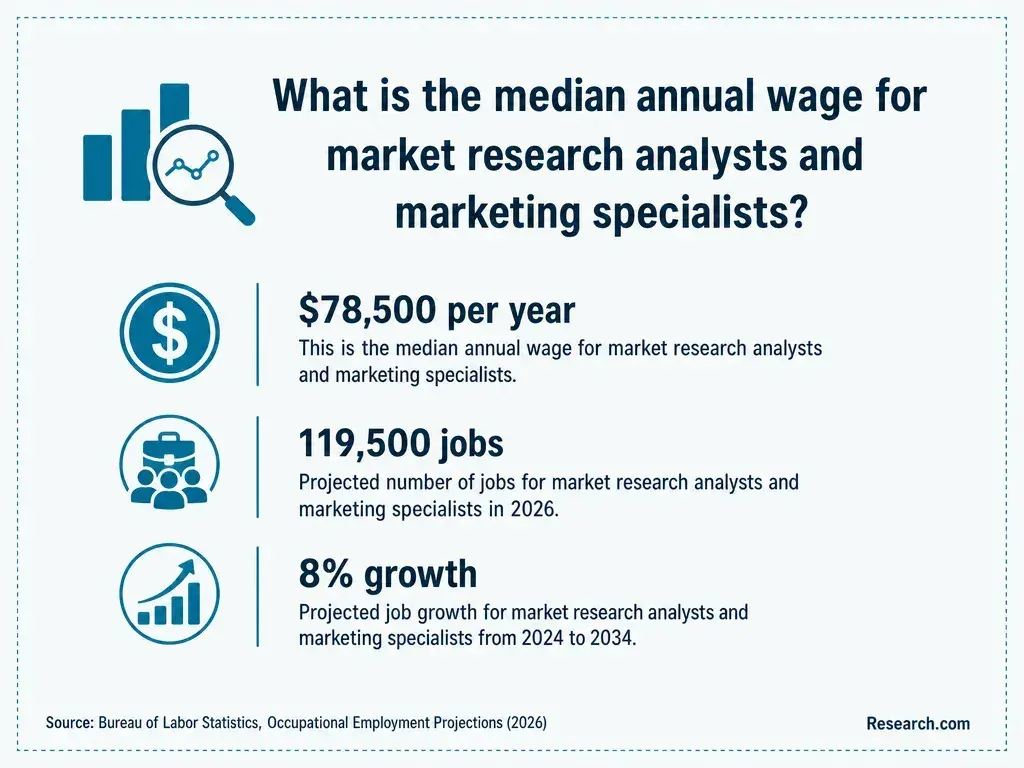
A BS in Business Administration has no single salary or employment-growth rate. The U.S. Bureau of Labor Statistics reports figures by occupation, not by undergraduate major. The examples below use May 2025 national median annual wages and projected U.S. employment change from 2025 to 2035; each occupation includes workers with different education and experience levels.
| Occupation | Median annual wage | Projected employment change |
| Human resources specialist | $75,940 | +6% |
| Market research analyst | $78,760 | +7% |
| Project management specialist | $102,320 | +7% |
These medians are not offers to new graduates. HR, research, and project roles involve different tasks, and an employer may require function-specific skills or experience. Use career coaching to identify attainable openings in your location, then compare their stated qualifications and pay with your current position. For a financial comparison, compare cost-to-finish for shorter business administration programs without treating occupation-wide wages as a forecast of your return.
Which certifications can complement a business administration degree?
A certification is a separate credential, not an automatic result of completing a business course. The useful choice depends on your target work: a recognized project-management credential may support project roles, while an HR credential may matter more in human resources. Certifying organizations set their own eligibility, examination, and renewal rules; check those rules before paying for preparation.
Ask a career adviser to review actual postings before adding a credential to your plan. If postings repeatedly call for substantial HR coursework or experience you lack, compare certification study with transfer-friendly human resources bachelor's degrees. A specialized degree may be a better route for a major career change, while an established employee may need a narrower skill or credential rather than another degree.
Other Things You Should Know About Business Administration
Some schools extend coaching or job-board access to alumni, but eligibility and appointment limits vary. Ask for the written alumni policy before enrolling.
Possibly. Confirm student eligibility, event hours, and whether participating employers recruit in your location or offer remote positions.
Only if your employer's confidentiality and intellectual-property rules permit it. Otherwise, describe your responsibilities without sharing restricted data, or create a clearly labeled public-data example.
Contact the school's accessibility office and career center before an event to discuss available arrangements. Do not assume accommodations requested for classes automatically carry over to employer-hosted recruiting.
- Online and computer-assisted career guidance: Are students prepared for it? - PMC https://pmc.ncbi.nlm.nih.gov/articles/PMC10074588/
- Career services: Graduation and Beyond - Learning Online at IU https://learningonline.iu.edu/graduation/career-services.html
- How to Build Strong Employer Partnerships to Support Student Success - UPCEA https://upcea.edu/how-to-build-strong-employer-partnerships-student-success/
- Cooperative Education and Internship Program (CEIP) | vt.edu https://www.vt.edu/content/career_vt_edu/en/experience/ceip.html
- Bachelor of Science in Business Administration | Georgia Tech Catalog https://catalog.gatech.edu/programs/business-administration-bs/
- Find an Internship - Advising & Career Center - UW-Madison https://advising.humanecology.wisc.edu/find-an-internship/
- Frequently Asked Questions - Career Center - Temple University https://careercenter.temple.edu/about/frequently-asked-questions
- Gain Experience - Experiential Learning • UCF https://explearning.sswb.ucf.edu/students/gain-experience/
- Online/Distance Students - UNI Career Services https://careerservices.uni.edu/students/onlinedistance-students
- Cooperative Education | CT State https://ctstate.edu/locations/manchester/cooperative-education