2027 Best Online Surgical Tech Degree Programs at Nonprofit Universities

Co-Founder and Chief Data Scientist
Choosing an online surgical technology program is complicated because the classroom portion may be online, but operating-room clinical training cannot be completed entirely remotely. The U.S. Bureau of Labor Statistics projects 6% employment growth for surgical assistants and technologists from 2023 to 2033, faster than the average for all occupations. This guide helps prospective students compare nonprofit programs by accreditation, required clinical experiences, total cost, scheduling, and career fit before they apply.
Key Things You Should Know
- For entry-level surgical technologist work, an associate degree or postsecondary certificate with appropriate programmatic accreditation and clinical training is usually more relevant than a fully online general degree.
- The U.S. Bureau of Labor Statistics projects 6% job growth for surgical assistants and technologists from 2023 to 2033, but certification and state requirements can affect whether graduates qualify for local jobs.
- The strongest nonprofit option is not automatically the lowest-cost or most flexible one; compare institutional accreditation, programmatic accreditation, local clinical placement, total charges, certification eligibility, and student outcomes.
What Makes an Online Surgical Tech Degree Program at a Nonprofit University Different?
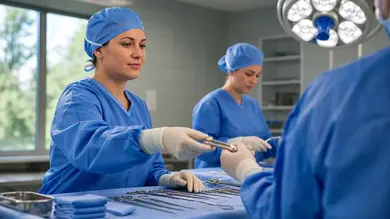
An online surgical tech degree at a nonprofit university typically combines web-based academic coursework with in-person laboratory practice and supervised clinical rotations. Surgical technologists prepare operating rooms, arrange sterile instruments, maintain aseptic technique, assist surgical teams, and help account for supplies before, during, and after procedures. Because these are hands-on responsibilities, a legitimate entry-level program should not promise that every requirement can be completed from home.
Nonprofit status describes how an institution uses revenue rather than proving that a particular program is high quality. Public community colleges, state universities, private faith-based colleges, and independent private universities can all be nonprofit. A nonprofit institution may offer lower in-district tuition, stronger local hospital relationships, or established advising services, but students should still examine the individual surgical technology program.
Students will encounter several education pathways. The right one depends on whether they are entering the profession, already hold surgical technology training, or want preparation for management or graduate study.
| Pathway | Typical purpose | Online feasibility | Best fit |
| Certificate or diploma | Career-focused entry preparation | Didactic courses may be online; labs and clinicals are in person | Students seeking the shortest direct route to surgical technology work |
| Associate degree | Entry-level training plus general education | Often hybrid rather than fully online | New students who want a college credential and transfer options |
| Bachelor's completion degree | Advanced clinical, leadership, or health-science study | Often more online-friendly for credentialed professionals | Certified or experienced surgical technologists seeking advancement |
| Master's degree | Health administration, education, leadership, or related specialization | Frequently online, but not usually entry-level surgical tech training | Professionals pursuing nonclinical leadership or academic roles |
For most first-time students, an associate degree or certificate is the practical comparison point. A bachelor's degree may be valuable for advancement, but it does not replace the clinical and programmatic requirements employers may expect for entry-level operating-room roles.
How Can Students Verify Accreditation for an Online Surgical Tech Degree at a Nonprofit University?
Students should verify two separate forms of accreditation before paying an enrollment deposit. Institutional accreditation evaluates the college or university as a whole. Programmatic accreditation evaluates the surgical technology program's curriculum, facilities, faculty, outcomes, and clinical education. Both matter, but they answer different questions.
For entry-level surgical technology education, programmatic accreditation is especially important because it may affect eligibility for national certification examinations and employer consideration. The Commission on Accreditation of Allied Health Education Programs and the Accrediting Bureau of Health Education Schools are commonly associated with surgical technology program accreditation. Requirements can change, so students should confirm the program's current status directly with the accreditor and school.
Use the following verification sequence before applying. It can prevent the common mistake of assuming that institutional accreditation alone makes a program suitable for surgical technology certification or employment.
- Find the institution in the U.S. Department of Education or Council for Higher Education Accreditation directory and confirm its current institutional accreditation.
- Search the program name and campus location in the relevant programmatic accreditor's directory rather than relying only on marketing language.
- Ask whether the exact online or hybrid track is included in the accreditation decision, especially if the school offers multiple campuses.
- Request written confirmation of certification-exam eligibility, required clinical cases, graduation requirements, and any state-specific restrictions.
- Contact employers or hospitals in the state where you intend to work to learn which credentials they prefer or require.
Red flags include vague claims such as "accreditation pending," a program that avoids naming its accreditor, no explanation of clinical placement, or an advisor who cannot explain certification eligibility. Approval to operate, institutional accreditation, and specialized program accreditation are not interchangeable.
How Rigorous Are Online Surgical Tech Degree Programs at Nonprofit Universities?
A credible online or hybrid surgical technology program is rigorous because it must teach both scientific knowledge and observable clinical skills. Students generally study anatomy and physiology, microbiology, pharmacology, medical terminology, surgical procedures, patient safety, sterile processing concepts, instrumentation, and professional ethics. They also practice sterile field setup, gowning and gloving, instrument handling, surgical counts, and communication within an operating-room team.
Online delivery changes where students complete lectures, quizzes, discussions, and case-based assignments; it does not eliminate performance standards. Expect scheduled skills labs, competency checkoffs, simulation activities, health and immunization documentation, background checks, drug screening when required, and clinical rotations that may follow hospital schedules rather than a traditional academic calendar.
Students looking for the fastest degree to get online should be careful when evaluating surgical technology. Accelerated academic terms may shorten lecture sequences, but clinical hours, skill validation, and site availability limit how quickly a legitimate entry-level pathway can be completed.
The table below separates academic flexibility from clinical requirements, which is essential when comparing "online" claims.
| Program component | Common delivery method | What students should confirm |
| General education | Online asynchronous or scheduled online courses | Transfer-credit acceptance and term schedule |
| Surgical theory | Online lectures, modules, exams, and discussions | Live attendance requirements and proctoring rules |
| Skills laboratory | On campus or at an approved training site | Travel distance, weekend options, equipment access, and attendance policy |
| Clinical practicum | Hospital or ambulatory surgery center | Who secures placement, required hours, commuting, and schedule control |
Part-time enrollment can make the academic portion more manageable for working adults, but clinical rotations may still require daytime availability. Students should ask for a sample term-by-term plan rather than assuming asynchronous courses mean a fully self-paced program.
How Much Does an Online Surgical Tech Degree Cost at a Nonprofit University?
The advertised tuition rate is only one part of the cost of a surgical technology credential. Public nonprofit colleges may charge different rates for in-district, in-state, and out-of-state students, while private nonprofit institutions often use one published rate but may provide institutional scholarships. The better value depends on net price, transfer credit, clinical placement convenience, and whether the program supports the certification path needed for employment.
Students should compare a written program-cost estimate that includes expenses beyond tuition. Clinical education can add costs that are easy to miss because they may be billed by outside vendors or paid directly by the student.
| Cost category | Why it matters | Question to ask |
| Tuition and mandatory fees | These form the academic base price | What is the estimated charge for all required terms, not one credit or term? |
| Books, digital tools, and supplies | Specialized texts, uniforms, and equipment may be required | Which items are mandatory, and can they be purchased elsewhere? |
| Laboratory and clinical fees | Hands-on training may carry separate charges | Are lab, simulation, affiliation, and clinical fees included in the estimate? |
| Compliance requirements | Background checks, immunizations, physicals, and screenings can be prerequisites | Which costs recur before each clinical placement? |
| Travel and lost work time | Clinical sites may be far from home or scheduled during work hours | Where have recent students completed rotations, and can I decline a distant site? |
| Certification examination costs | Graduates may pursue a national credential after completion | Does the school include preparation resources or exam costs in its estimate? |
A low-tuition program can become less affordable if it requires extensive travel or delays graduation because clinical placements are limited. Conversely, a higher-priced program may be worth consideration when its clinical network, transfer policy, and certification alignment reduce avoidable delays. Ask the financial aid office for the net price after grants and scholarships, not simply the published tuition.
What Financial Aid Is Available for an Online Surgical Tech Degree at a Nonprofit University?
Eligible students at institutionally accredited nonprofit colleges may qualify for federal financial aid by completing the Free Application for Federal Student Aid. Depending on eligibility and enrollment status, aid may include federal grants, Direct Loans, work-study, state grants, institutional scholarships, workforce-development assistance, and employer tuition benefits. Availability differs by school, state, program length, and student circumstances.
Students should prioritize gift aid and carefully compare borrowing needs across programs. For learners who eventually pivot toward administration or leadership, reviewing affordable master's degrees online can also provide perspective on how undergraduate borrowing may affect future education plans.
Before accepting aid, ask the college to explain how enrollment changes could affect eligibility. A clinical term may have a different credit load, start date, or attendance rule than a lecture-based term, which can matter for aid disbursement and satisfactory academic progress.
These practical questions help students avoid financing surprises.
- Does the program qualify for federal Title IV aid, and is every required term eligible?
- What grants or scholarships are available specifically for allied health, workforce, rural health, or returning-adult students?
- Will transferred credits reduce the number of billable credits without affecting financial aid eligibility?
- How will repeating a course, withdrawing, or delaying a clinical rotation affect aid and loan repayment timing?
- Does the college offer an installment plan for non-tuition clinical and compliance expenses?
Never treat aid eligibility as a reason to skip accreditation review. Federal aid can help finance education, but it does not establish that a specific program meets certification or employer expectations.
How Flexible Are Online Surgical Tech Degree Programs at Nonprofit Universities?
Flexibility varies by program component. Online theory courses may be asynchronous, meaning students can complete weekly work at convenient times before deadlines. Other programs use synchronous video classes with required live attendance. Labs and clinical rotations are usually the least flexible elements because students must demonstrate competencies and work within the schedules of hospitals, instructors, and surgical teams.
A working student should ask for exact meeting times and clinical expectations before enrolling. Do not rely on a program's use of "online," "hybrid," or "accelerated" as a complete schedule description. Those labels can apply to lectures while overlooking mandatory campus visits or weekday clinical assignments.
Students considering a broader health-related academic change may also compare program designs such as an accelerated bachelor's degree psychology, but surgical technology requires a more location-dependent practicum structure than many classroom-based majors.
The comparison below can help students decide whether online, hybrid, or traditional delivery fits their circumstances.
| Format | Scheduling advantage | Important limitation | Best fit |
| Mostly online theory with local clinicals | Reduces commuting for academic coursework | Clinical availability may still require daytime travel | Students near approved sites with some schedule flexibility |
| Hybrid cohort program | Predictable sequence and in-person skills support | Fixed lab dates and cohort pacing | Students who benefit from structure and can attend campus sessions |
| Traditional campus program | Frequent direct access to labs and faculty | More regular on-campus attendance | Students living close to campus who want extensive in-person instruction |
| Completion bachelor's program | May offer online courses for credentialed professionals | Usually does not substitute for entry-level clinical preparation | Working surgical technologists pursuing advancement |
A program is likely a poor fit if you cannot reliably attend required labs and clinical rotations, even when you can complete online coursework at night. Students with limited daytime availability should ask whether part-time sequencing is possible and how long a delayed clinical start could extend completion.
What Student Support Services Do Nonprofit Universities Provide for Online Surgical Tech Degree Students?
Support services can materially affect whether an online learner completes a demanding clinical program. Useful services include academic advising, tutoring in anatomy and science prerequisites, online library access, technical support, disability accommodations, career counseling, mental health resources, financial aid counseling, and a clinical coordinator who communicates placement requirements clearly.
For surgical technology students, clinical support is often more important than generic online-learning features. Ask whether the school has established agreements with hospitals or ambulatory surgery centers, whether it places students or expects them to find sites independently, and what happens if a placement falls through. A school should explain its process without guaranteeing a particular location or schedule.
Students should also evaluate faculty access. Instructors with current or recent perioperative experience can help learners connect online theory to operating-room workflows, sterile technique, instrumentation, and professional conduct. However, faculty credentials alone do not replace adequate lab capacity and supervised clinical education.
Before choosing between nonprofit universities, request information on the services below and compare the answers in writing.
- Named clinical-placement contact and clear responsibility for securing sites
- Online tutoring and faculty office hours that fit evening or weekend learners
- Technology orientation, exam-proctoring support, and rapid help-desk access
- Career assistance that includes résumé guidance, interview preparation, and local employer connections
- Transparent policies for remediation, course repetition, leave, and clinical reassignment
A common mistake is comparing only course modality and tuition. A program with responsive clinical coordination and realistic student support may provide better practical value than a cheaper option that leaves placement logistics entirely to the student.
Do Online Surgical Tech Degree Programs at Nonprofit Universities Prepare Graduates for In-Demand Careers?
They can, provided the program includes appropriate clinical preparation, meets relevant accreditation standards, and aligns with the hiring expectations where the graduate plans to work. Surgical technologists work primarily in hospitals, outpatient surgery centers, physicians' offices, and other procedural settings. Their work requires precision, stamina, infection-control awareness, calm communication, and the ability to follow established protocols.
The U.S. Bureau of Labor Statistics reports a 2023 median annual wage of $60,370 for surgical technologists. This national figure is not a starting-pay guarantee: pay varies by geographic area, employer, shift, experience, certification, and job duties. Use it as a broad labor-market benchmark rather than a personal earnings prediction.
Demand is influenced by healthcare needs, outpatient procedure growth, and replacement needs as workers leave the occupation. Technology also affects the role: electronic documentation, advanced surgical equipment, minimally invasive procedures, and robotics can change workflows, but they do not remove the need for trained staff who can maintain sterile technique and assist the surgical team safely.
When assessing career preparation, students should ask schools for outcomes that are specific, recent, and clearly defined. The following evidence is more useful than broad claims that graduates are "career ready."
| Outcome to review | Why it matters | What to clarify |
| Certification-exam eligibility and performance | May indicate alignment with professional preparation expectations | Which exam, which graduating cohort, and how many eligible students tested? |
| Completion rate | Shows whether students finish the planned pathway | What time frame and student group does the rate represent? |
| Job-placement reporting | Can indicate employer connections and transition support | What counts as placement, and is work related to surgical technology? |
| Clinical-site network | Provides exposure to actual perioperative environments | Which sites are active, how far away are they, and how often are placements available? |
Certification requirements and employer preferences vary by state and facility. Verify local rules before enrollment, particularly if you expect to relocate after graduation.
Can an Online Surgical Tech Degree From a Nonprofit University Prepare Students for Graduate School?
An associate degree or certificate in surgical technology can build healthcare experience, but it is usually not a direct route into most graduate programs. Many master's programs require a bachelor's degree from an institutionally accredited college, prerequisite coursework, and sometimes professional experience. A bachelor's completion degree in health sciences, healthcare administration, education, or a related field may be the more logical next step for an experienced surgical technologist.
Graduate school is most useful when it supports a defined goal, such as healthcare management, clinical education, public health, quality improvement, or a different licensed profession. A master's degree does not normally qualify a person to become a surgical technologist if they lack the required entry-level clinical education.
For surgical technologists interested in supervising teams or improving workplace systems, programs such as the best organizational development master's programs online may be relevant after completing a bachelor's degree and gaining experience.
Before selecting a surgical technology program with graduate school in mind, confirm whether it awards transferable college credit, whether general education courses meet bachelor's-completion requirements, and whether the institution has articulation agreements. Students should retain syllabi and clinical documentation because future schools may review prerequisite content individually.
How Should Students Compare the Best Online Surgical Tech Degree Programs at Nonprofit Universities?
The best program is the one that makes you eligible for your intended entry-level role while fitting your budget, location, academic preparation, and ability to complete clinical requirements. For most prospective surgical technologists, programmatic accreditation and reliable in-person clinical education should carry more weight than a broad university ranking, marketing claims about online convenience, or nonprofit status alone.
Start by creating a shortlist of programs that serve your state or region. Then obtain written answers from each school before comparing costs. This process is especially important when a college advertises an online surgical tech program but relies on limited clinical sites or requires travel for labs.
- Confirm that the school has current institutional accreditation and that the exact surgical technology pathway has appropriate programmatic accreditation.
- Verify whether the program qualifies graduates for the certification examination and employment requirements relevant to your state and target employers.
- Request a complete cost worksheet covering tuition, fees, equipment, compliance requirements, travel, testing, and possible repeat-course charges.
- Ask who arranges clinical placement, where recent students trained, what schedules are typical, and what happens if placement is delayed.
- Compare transfer-credit policies, prerequisite requirements, program length, cohort start dates, and part-time options.
- Review recent completion, certification, and employment information with definitions and cohort sizes rather than relying on promotional testimonials.
- Speak with admissions, financial aid, and program faculty separately so you can compare their answers about scheduling, support, and outcomes.
The table below offers a practical scorecard for making a final decision. Give the greatest weight to the factors that determine whether you can complete clinical education and pursue the credential required for your career goal.
| Comparison factor | Strong sign | Potential concern |
| Accreditation | Current institutional and relevant programmatic accreditation are easy to verify | Unclear status, expired approval, or unsupported certification claims |
| Clinical education | Established sites, clear coordination process, and transparent attendance expectations | Student must independently locate a site or receives no placement details |
| Total cost | Written estimate includes academic, clinical, and compliance expenses | Only per-credit tuition is disclosed |
| Format | Online, lab, and clinical requirements are clearly mapped by term | "Fully online" language without explanation of hands-on requirements |
| Student support | Accessible faculty, advising, tutoring, and clinical troubleshooting | Generic support claims with no program-specific contact |
| Career alignment | Curriculum and certification pathway match local employer expectations | School cannot explain how training connects to the intended role |
Students who need maximum flexibility, cannot travel for labs, or cannot commit to clinical shifts may be better served by a different healthcare pathway or by waiting until their schedule changes. A surgical technology credential is a sound investment only when its accreditation, clinical design, cost, and expected career use all align with your personal plan.
Students seeking a behavioral-science career change should separately examine an accelerated master's program psychology, including its prerequisites and whether it leads toward the intended professional credential.
Other Things You Should Know About Surgical Tech
Usually not. Coursework may be online, but surgical technology education normally requires in-person skills practice and supervised clinical experience. Be cautious of programs claiming that entry-level preparation requires no hands-on training.
A certificate can be an efficient career-focused route, while an associate degree usually includes more general education and may offer smoother transfer options later. Choose based on accreditation, certification eligibility, clinical quality, cost, and your long-term education goals.
Requirements vary by state. Some states regulate surgical technologists, while employers elsewhere may require or strongly prefer national certification. Check the rules where you intend to work before enrolling.
Strong candidates are detail-oriented, comfortable with science and medical terminology, reliable under pressure, able to stand for long periods, and committed to patient safety. They also need to communicate clearly with surgeons, nurses, anesthesia staff, and other operating-room personnel.
References
- Hofstra | Surgical Technologist https://hofstra.workforcetraining.io/surgical-technologist.html
- Surgical Technology Recognized Nationally | St. Cloud Technical and Community College https://sctcc.edu/news/03-03-2023/surgical-technology-recognized-nationally
- National ST Program and Graduate Outcomes - ARC/STSA https://arcstsa.org/surgical-technology-program-and-graduate-outcomes/
- How to Choose the Best Surgical Tech Program | Your Guide https://www.brooklinecollege.edu/blog/how-to-choose-the-best-surgical-tech-program/
- Steps On How To Become A Surgical Tech | HowToBecome Guide https://www.learnhowtobecome.org/surgical-tech/
- Highest-Paying Applied Technology Degree Hands On Jobs: Surgical Technologist https://www.redlandscc.edu/news/okahoma-top-hands-on-jobs-surgical-technologist.php
- Surgical Technology | Kirkwood Community College https://www.kirkwood.edu/programs/degrees/health-wellness/surgical-technology
- Surgical Technologist-Online - Eastern West Virginia Community and Technical College https://easternwv.edu/workforce-education/surgicaltech/
- Surgical Technology Program Online | Hybrid Surgical Tech Training in California https://www.ach.edu/programs/surgical-technology-program-online/
- Surgical Technologist Prerequisites and Requirements https://www.cbd.edu/blog/surgical-technology/surgical-technologist-prerequisites/