2027 Best Online Associate Degrees With Full-Time Online Options

Co-Founder and Chief Data Scientist
Can you earn an associate degree online while taking a full-time course load - and will it lead where you want to go? The answer depends on more than whether a college labels a program "online." Course schedules, required labs, clinical placements, and transfer rules can change what full-time study actually looks like.
Cost matters, too: College Board reported average published in-district tuition and fees of $4,050 at public two-year colleges for 2024-25, before other expenses. This guide compares six degree fields and shows you what to check before committing to a program.
Key Things You Should Know
- Business, IT, and criminal justice can offer online coursework suited to full-time study; nursing and some healthcare tracks require closer scrutiny for in-person components.
- A 60-credit degree typically requires about 15 credits per fall and spring semester to finish in two academic years without summer courses; taking the minimum full-time load may take longer.
- Confirm that required courses are offered online when needed, then check total costs, accreditation, transfer applicability, and any separate licensing requirements.
Top 10 Best Online Associate Degrees With Full-Time Online Options
Business Programs
Online business associate degrees commonly cover accounting, management, marketing, and business communication. An AA or AS may suit students planning to transfer; an AAS may emphasize immediate workplace skills. This is a strong full-time option if required courses run regularly and group projects fit your schedule. Before enrolling, check whether the program's accounting and general education credits will apply to your intended bachelor's major. The degree can support applications for entry-level office roles, but management jobs usually require experience.
Healthcare Programs
Healthcare administration, health information, and medical coding programs may offer substantial online coursework. They are different from hands-on clinical programs: a course listed as online may still require an internship, supervised experience, or an in-person assessment. An AAS may focus on workforce preparation, while an AS may offer a broader transfer route. Ask whether full-time students can obtain required courses each term and whether the curriculum prepares them for any certification their target employer expects.
Information Technology Programs
IT associate degrees may cover networking, cybersecurity fundamentals, programming, and technical support. Online labs can make full-time remote study feasible, but check software, equipment, scheduled sessions, and exam-proctoring requirements. An AAS often emphasizes job-ready technical work; an AS may better support transfer into computing. Compare the actual courses with job postings you hope to pursue. Certifications and a project portfolio can strengthen an application, but neither the degree nor a certificate guarantees a technical role.
Nursing / Pre-Nursing Programs
A pre-nursing AA or AS may allow online study of general education and some prerequisites; it is not a nursing license or a guaranteed seat in a nursing program. An associate degree in nursing requires supervised clinical training and may require campus-based labs even when lectures are online. Full-time scheduling must accommodate those fixed commitments. Check separate nursing-program admissions rules, clinical placement arrangements, state board approval, and eligibility for the NCLEX-RN before relying on a program's online label.
Criminal Justice Programs
Criminal justice associate programs often include law, courts, corrections, and research or writing courses that can be completed online. An AA or AS may serve students transferring into a bachelor's program; an AAS may focus more on entry-level employment. Full-time online study can work well if core courses are offered in a predictable sequence. Police and other public-safety positions have separate agency requirements, which may include academy training, background checks, and physical standards.
Psychology / Counseling Programs
An online psychology AA or AS is usually a transfer foundation, not preparation for independent counseling practice. Students typically study introductory psychology, development, statistics, and general education. It can suit a full-time learner who has identified a bachelor's transfer destination and confirmed which courses count toward that major. Some entry-level human-services positions may be accessible with an associate degree, but professional counselor and psychologist roles generally require substantially more education and, where applicable, licensure.
What Are the Best Online Associate Degrees With Full-Time Online Options?
The best option is the degree field whose required courses you can complete online at a sustainable full-time pace and whose credential matches your next step. "Full-time online" describes enrollment intensity and course delivery, not necessarily self-paced study or freedom from in-person requirements. No field is universally best, and a program should not be treated as fully online until its complete requirements are confirmed.
This comparison shows where each field is most useful and which delivery issue deserves the closest check. It compares degree paths, not a verified ranking of individual colleges.
| Degree field | Best suited to | Full-time online question to ask |
| Business | Transfer or entry-level office work | Are required courses available online every needed term? |
| Healthcare | Administrative or health-information work | Is an internship or assessment in person? |
| Information technology | Technical skills and entry-level applications | Are labs, software, and exams accessible remotely? |
| Nursing / pre-nursing | Nursing prerequisites or a licensed nursing pathway | Where and when are labs and clinical rotations held? |
| Criminal justice | Transfer or exploration of justice careers | Do required courses follow a predictable online sequence? |
| Psychology / counseling | Transfer toward further study | Will courses satisfy the intended bachelor's major? |
When comparing formats, remember that short online classes do not make the entire degree a short program. Request a term-by-term plan showing every required course, its delivery mode, and its next scheduled offering.
Are Fully Online Associate Degree Programs Accredited and Recognized?
Yes. A fully online associate degree can be an accredited, recognized college credential when the institution holds recognized institutional accreditation. Delivery mode alone does not determine whether employers or other colleges will accept it. Check the institution's accreditation with the accreditor and the U.S. Department of Education, then verify that the specific program is authorized to enroll students in your state.
Institutional accreditation is not the same as programmatic approval. Nursing and certain allied-health pathways may need additional accreditation or state board approval for a graduate to pursue licensure or certification. For transfer, ask the destination college whether each course applies to your intended major - not merely whether it accepts credits from the sending institution.
How Much Do Online Associate Degrees Cost and How Long Do They Take?
Most associate degrees require roughly 60 semester credits, although major requirements, prerequisites, and institutional rules vary. At 15 credits in each fall and spring semester, a 60-credit plan can fit into two academic years if every course is available in sequence. A student taking 12 credits each term, repeating a course, or waiting for a required class should expect a longer timeline. Accelerated course lengths do not shorten the degree unless the full credit plan fits the schedule.
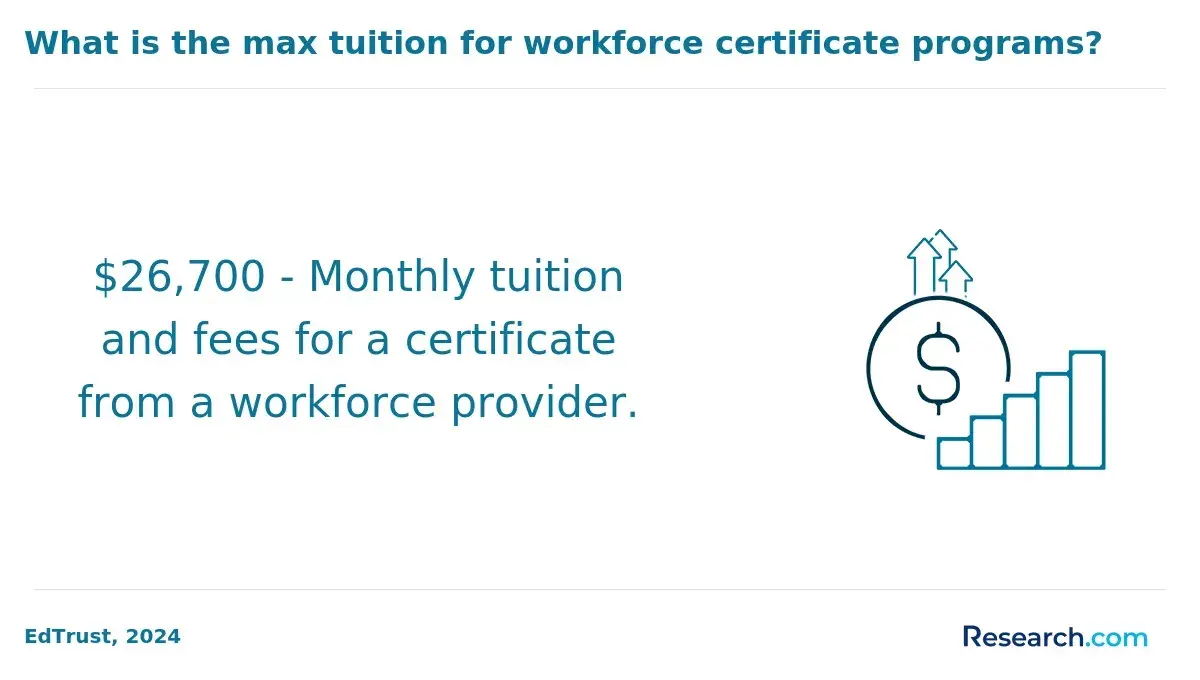
For a cost benchmark, College Board's 2024-25 average published in-district tuition and fees at public two-year colleges was $4,050 for one academic year. That is not an online-program quote or a student's final bill. Compare tuition for all remaining credits plus mandatory online, technology, lab, exam, and clinical fees; books, equipment, and any travel can also matter. Residency rates, accepted transfer credits, grants, and employer assistance may substantially change out-of-pocket cost. Confirm financial aid eligibility with each college rather than assuming every program or course qualifies.
What Admission Requirements Apply to Online Associate Degree Programs?
Colleges commonly ask associate degree applicants for a high school diploma or equivalent, an application, and previous college transcripts when applicable. Placement or prerequisite rules can affect which courses you take first. Policies on GPA and standardized tests vary; do not infer that a missing published cutoff means there are no academic requirements.
Admission to a college does not necessarily mean admission to a selective major. Nursing and some allied-health programs may separately require prerequisite grades, an application, health documentation, background checks, or other conditions. Before applying, ask admissions and the department for the major-specific requirements and the earliest term in which a new student could begin required courses.
Which Courses and Curricula Do Online Associate Degree Programs Include?
Associate curricula generally combine general education - such as writing, mathematics, and social science - with courses in the major. An AA or AS often emphasizes transfer, while an AAS commonly emphasizes occupational preparation, but the actual course plan and articulation agreement matter more than the abbreviation. IT students may complete virtual technical labs; healthcare and nursing students may encounter prerequisites, supervised experiences, or clinical components.
Read the catalog alongside the online course schedule. A program can advertise online study while offering a required course only on campus or only once a year. Also check whether courses have live meeting times, fixed deadlines, proctored exams, group work, or scheduled placements. These details determine whether a full-time plan is workable around a job or caregiving.
How Do Online Associate Degrees Compare With Campus-Based Programs?
Online and campus-based associate degrees can cover comparable academic content, but their demands differ. Online study can eliminate routine commuting and widen scheduling choices; it also requires reliable technology and independent time management. Campus study may offer easier access to facilities and face-to-face help. Neither format guarantees flexible deadlines, and programs with labs or clinical placements may use a hybrid schedule regardless of how lectures are delivered.
Choose the format you can complete, not simply the one with the most convenient label. If transfer is the goal, compare both formats against the receiving college's degree map. Even someone exploring the easiest bachelor's degree to get should confirm that associate courses fulfill that particular bachelor's program's requirements; accepted elective credits may not advance the major.
What Careers Can You Start With an Online Associate Degree?
An associate degree may support applications for entry-level office, customer support, IT support, health-information, or human-services work, depending on the curriculum and employer. These are possible pathways, not jobs awarded by the credential. Look at local postings for required skills, experience, certifications, and whether an internship or portfolio would make your application stronger.
Match the degree to the role's actual entry requirements. Nursing involves a separate licensure process; policing typically involves agency selection and training. Counseling and psychology professions generally require education beyond an associate degree. If those professions are the goal, plan the transfer pathway first and investigate later-stage options, including masters degrees online, against the relevant licensing rules rather than treating graduate study as an automatic next step.
What Salaries and Job Outlook Can Graduates Expect?
Occupational pay reflects many factors besides education, including location, experience, employer, and licensure. For context, the U.S. Bureau of Labor Statistics reports a May 2024 median annual wage of $93,600 for registered nurses and projects 5% employment growth for the occupation from 2024 to 2034. That figure describes working registered nurses - not graduates of online associate programs - and an associate degree alone does not authorize nursing practice.
For other fields, avoid comparing a prospective program with the salary of a senior or licensed occupation. Instead, identify realistic entry-level job titles, review local postings, and compare their requirements and pay with the program's total cost. A transfer-oriented psychology or business degree may have its greatest value as part of a longer education plan rather than as a direct route to a particular starting salary.
Which Licenses or Certifications Do Online Associate Degree Graduates Need?
Requirements depend on the occupation and state, not on whether coursework was online. Registered nurses must meet state board requirements and pass the NCLEX-RN; confirm that a nursing program's approval and clinical arrangements support eligibility in the state where you intend to practice. Some health-information and IT employers value industry certifications, but requirements vary by role. Public-safety agencies may impose their own training and screening standards.
An associate degree in psychology does not qualify someone for independent professional counseling. That path generally involves graduate education, supervised experience, and state licensure. If comparing the quickest cheapest master's degree for a future counseling goal, first verify that its curriculum and supervised-training provisions meet the relevant board's rules; speed and price cannot substitute for eligibility.
Other Things You Should Know About
Sometimes. Business, IT, and other nonclinical programs may allow it, but required labs, exams, internships, or orientations can change that. Ask for written confirmation covering every degree requirement.
Colleges commonly use 12 semester credits as the full-time threshold, but a 60-credit degree generally calls for about 15 credits per fall and spring semester to finish in two academic years without summer study. Verify your college's calendar and aid rules.
Choose based on your next step. An AA is often designed for transfer; an AAS often emphasizes workplace skills. Check the actual curriculum and receiving college's credit evaluation before deciding.
Request a complete term-by-term plan, the full cost for your residency status, written details of any in-person requirements, and confirmation of how credits or the degree apply to your career or transfer goal.
References
- Full-time Study | HESC https://hesc.ny.gov/dictionary/tap-coach/term/full-time-study
- Cost of Attendance (Budget) | 2025-2026 Federal Student Aid Handbook https://fsapartners.ed.gov/knowledge-center/fsa-handbook/2025-2026/vol3/ch2-cost-attendance-budget
- An Overview of Accreditation of Higher Education in the United States | Congress.gov | Library of Congress https://www.congress.gov/crs-product/R43826
- DAPIP | Homepage - Office of Postsecondary Education (OPE) https://ope.ed.gov/dapip/
- .16 Graduation Requirements. | Library of Maryland Regulations https://regs.maryland.gov/us/md/exec/comar/13B.02.02.16
- Graduation Requirements for Associate Degrees | Lansing Community College https://www.lcc.edu/academics/rules-requirements-procedures/graduation-requirements-for-associate-degrees.html
- Fully Online Programs - Blue Ridge Community College https://www.blueridge.edu/programs-courses/online-learning/online-programs/
- Enrollment Requirements - Student Financial Planning https://financialaid.mercer.edu/managing-your-aid/financial-aid-policies/enrollment-requirements/
- How Do Transfer Credits Work? A Guide for Adult Learners | Whitworth Online https://online.whitworth.edu/news-articles/how-do-transfer-credits-work-when-you-go-back-to-school/
- CCV Academic Support | Tutoring & Student Resources https://ccv.edu/student-support/academic-career-support-services/academic-support/