2027 Best Online Associate Degrees With Fast Transfer Credit Evaluation

Co-Founder and Chief Data Scientist
Already have college credits but unsure how many will count toward an online associate degree? A quick, useful transfer evaluation can prevent you from paying for courses you do not need. Cost matters, too: the College Board reports average public two-year, in-district tuition and fees of $4,050 for 2024-25. That figure is a starting point, not your completion price.
This guide compares six degree fields and shows students with prior credit how to verify evaluation timelines, degree applicability, online requirements, and total remaining cost before choosing a program.
Key Things You Should Know
- There is no universally fastest degree field. Evaluation speed depends on the college's transcript process, while the time saved depends on whether accepted credits fulfill degree requirements.
- Compare the remaining degree, not just the transfer total. A typical associate degree requires about 60 credits, but major prerequisites, residency rules, and course schedules determine what you still need.
- Ask for a written, program-specific evaluation before committing. The $4,050 public two-year tuition-and-fees average for 2024-25 does not include every expense or predict your bill.
Top 10 Best Online Associate Degrees With Fast Transfer Credit Evaluation
Business Programs
Online business AA, AS, and AAS programs can be good matches for previous courses in accounting, economics, communication, and general education. Choose a transfer-oriented program if a bachelor's degree is the goal; an AAS may emphasize workplace applications instead. Ask whether old accounting credits satisfy current major requirements, not merely elective requirements. Business is attractive when you want broad course availability, but accepting credits quickly does not guarantee that they shorten the path to graduation.
Healthcare Programs
Healthcare administration and health information associate programs may accept previous general education and introductory health courses. Some courses are available online, but internships, employer-site activities, or proctored work may still apply. If you are targeting a particular credential or occupation, check program-specific accreditation and certification eligibility before choosing the fastest evaluator. Science credits may face recency or laboratory requirements, so request a course-by-course evaluation rather than assuming every prior class will count toward the major.
Information Technology Programs
Online IT associate programs commonly cover networking, systems, cybersecurity fundamentals, or programming. Prior math and general education courses may transfer readily; technical courses can require closer review when tools or content have changed. Ask whether industry certifications can be assessed for credit, how that assessment works, and whether required labs use remote software or scheduled access. An AS may support transfer, while an AAS may focus more heavily on employment skills; neither designation alone establishes how a bachelor's program will accept the credits.
Nursing / Pre-Nursing Programs
Online pre-nursing pathways may offer transferable general education and science prerequisites, but they are not nursing licenses. Associate degree in nursing programs often combine online coursework with required in-person labs and clinical placements. Nursing admission can be selective even when the college itself has broad admission. Before transferring, verify science-course age limits, lab equivalencies, the nursing program's approval and accreditation status, clinical placement rules, and whether completing it supports licensure eligibility in your state.
Criminal Justice Programs
Online criminal justice AA, AS, and AAS programs may recognize prior writing, sociology, government, and introductory criminal justice courses. A transfer-oriented pathway makes sense if your intended occupation or advancement goal calls for a bachelor's degree; a career-oriented program may emphasize applied public-safety topics. Check whether an employer or academy accepts the credential for your goal. A criminal justice degree does not replace agency hiring standards, background checks, academy training, or state certification where those apply.
Psychology / Counseling Programs
Online psychology associate degrees are usually strongest as bachelor's transfer pathways. Existing introductory psychology, statistics, and general education credits may fit, provided the destination institution accepts them toward the intended major. Counseling-related associate coursework can introduce helping skills, but independent professional counseling generally requires substantially more education and state licensure. Choose this field if you have a clear transfer plan or an entry-level support goal; do not select it on the assumption that an associate degree qualifies you to practice as a counselor.
What Are Online Associate Degrees With Fast Transfer Credit Evaluation?
Online associate degrees with fast transfer credit evaluation are programs at colleges that review prior coursework early enough for you to make an informed enrollment decision. "Fast" should mean a stated timeline for a program-specific review - not just prompt admission or an immediate estimate of how many credits the college might accept.
The degree designation offers a useful starting point, but the curriculum and receiving school determine its value. This comparison shows why the best choice depends on what you plan to do after graduation.
| Degree type | Common emphasis | Most important transfer check |
| AA | Broad general education; often bachelor's transfer | Whether courses meet the intended bachelor's major and general education requirements |
| AS | Science, technical, or quantitative study; often bachelor's transfer | Whether math, science, and major prerequisites match the receiving program |
| AAS | Applied, career-focused coursework | Whether technical credits count toward a later degree rather than only as electives |
A college can accept a course for credit without applying it to the requirement you need. That distinction is especially important when comparing programs for students who already have substantial coursework.
Which Accredited Online Associate Degrees Accept Transfer Credits Quickly?
No associate degree major can reliably be named the fastest at accepting transfer credits. Evaluation timelines are set by institutions and can vary with transcript volume, course documentation, and whether faculty must review major courses. Among the six fields above, business, criminal justice, and psychology may offer a straightforward review of broadly taught introductory courses; nursing, healthcare, and IT can involve additional checks for labs, recency, clinical requirements, or technical equivalency. These are reasons to investigate - not verified speed rankings.
To compare accredited online options, ask each college for its institutional accreditation status, published transfer policy, transcript submission method, expected time to a final evaluation, maximum transferable credits, and minimum credits that must be earned there. Then request a written degree audit showing credits applied to general education, the major, electives, and prerequisites. A quick preliminary estimate is less useful if the final audit arrives after you have enrolled or changes your course plan.
How Does Fast Transfer Credit Evaluation Work for Online Associate Degrees?
Fast evaluation usually begins when a college receives official transcripts, not when you submit an application. Schools may first issue an unofficial estimate and later complete a final review after official records arrive. The sequence below helps you distinguish an enrollment estimate from a decision-ready result.
- Request official transcripts from every previously attended college and confirm when the prospective school receives them.
- Supply syllabi if requested for courses whose titles or content do not clearly match current requirements.
- Ask when the program-specific evaluation will be final and whether it can be completed before your enrollment or payment deadline.
- Review the resulting degree audit for unmet major, general education, prerequisite, and residency requirements.
Military training, exams, professional certifications, and other prior learning may qualify for separate assessment under school policy; work experience alone does not automatically earn credit. Keep copies of the evaluation and ask how appeals or major changes could affect it.
What Admission Requirements Apply to Online Associate Degree Programs?
Many associate programs require an application, evidence of high school completion or its equivalent, and transcripts from prior colleges. Placement measures or prerequisite courses may be needed even when standardized admission tests are not. Requirements for a particular major can differ: nursing and some allied-health programs may have selective entry, minimum grades, or additional screening.
An easy application is not a transfer-credit policy. Students comparing online schools no application fee should still ask when transcripts will be evaluated and whether admission to the college also grants entry to their chosen program. Check deadlines early enough to obtain official records before registering for courses that might duplicate previous work.
How Long Do Online Associate Degrees Take, and What Do They Cost?
Associate degrees commonly require around 60 semester credits, but a calendar estimate depends on how many credits fulfill requirements, your course load, start dates, and the availability of remaining classes. Full-time students starting without transferable credit often plan for roughly two academic years. Part-time study can take longer; accepted transfer credits can shorten the path only when they replace required coursework. Sequential sciences, restricted course offerings, and clinical placements can limit acceleration.
The College Board's $4,050 average public two-year, in-district tuition and fees for 2024-25 provides a comparison point, not a quote for an online degree. Residency rates, online or technology fees, books, equipment, proctoring, and required travel may change the total. Ask for a written estimate based on your remaining credits, including mandatory fees, and compare financial aid eligibility, scholarships, employer assistance, and payment options. Lower per-credit tuition is not necessarily cheaper if fewer of your credits apply.
Which Online Associate Degree Coursework Transfers Most Easily to Bachelor's Programs?
General education courses in writing, mathematics, natural science, and social science often offer the clearest bachelor's transfer opportunities when they meet the receiving school's specific requirements. Major prerequisites can be even more valuable - but only if their content, credit hours, lab components, and grades match. Applied AAS courses may transfer as electives rather than satisfy bachelor's major requirements.
Start with your intended bachelor's program, not just the associate college's list of accepted credits. A published articulation agreement or transfer map can clarify how courses apply; verify that it covers your major and is still current. If you are comparing the best 4-year degrees for your goals, ask the receiving school to confirm which associate courses fulfill that degree plan. The strongest transfer pathway minimizes credits you must retake or add after transfer.
What Careers and Salaries Can Online Associate Degree Graduates Expect?
Career possibilities differ substantially by field and by whether you intend to transfer. Business and IT graduates may pursue entry-level support or operations work; healthcare and public-safety roles can have additional employer or state requirements. Psychology is often a foundation for further study rather than a direct route to professional counseling.
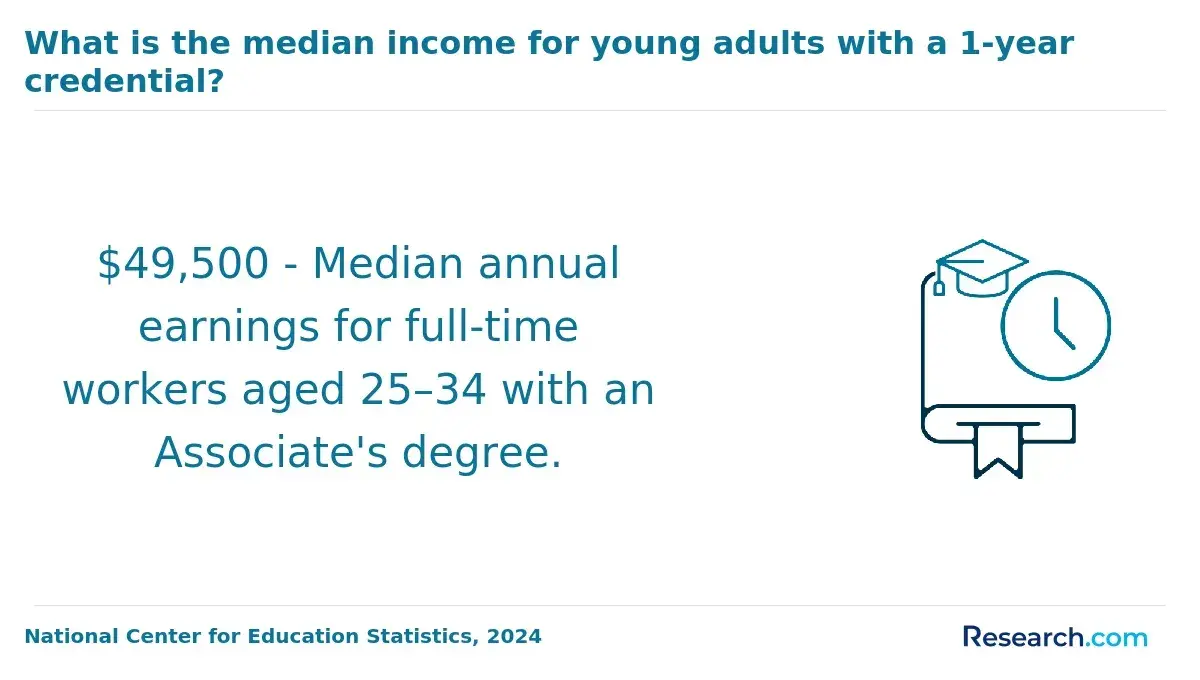
For perspective, the U.S. Bureau of Labor Statistics reports a 2024 median annual wage of $93,600 for registered nurses and projects 5% employment growth from 2024 to 2034. These are occupation-wide figures, not expected earnings or job-placement results for associate graduates. Becoming an RN also requires completing an approved nursing program and meeting state licensure requirements. When judging value, compare the entry requirements for the job you actually want with the credentials and experience your chosen program can provide.
Which Certifications or Licenses May Online Associate Degree Graduates Need?
A degree, an industry certification, and a professional license serve different purposes. An IT student may consider a certification relevant to a target support or networking role; a healthcare student should check whether a particular program meets an exam's eligibility rules. Nursing graduates seeking RN licensure must meet their state board's requirements and pass the required licensing examination. Criminal justice occupations may require academy training or agency certification, while professional counseling generally requires advanced education and licensure.
Before paying for extra training, check the credential requirements in current job postings and with the relevant state board or certifying organization. A list of certifications that pay well can suggest options to investigate, but neither certification nor an associate degree guarantees a particular wage or job.
How Can Students Choose a Reputable Online Associate Degree Program?
The best program for a student with prior credit is one that provides a timely, reliable evaluation and a workable route through the remaining degree. Popularity or a short advertised term cannot establish either. As you compare the most popular online colleges, use the same questions for each associate program.
These checks turn a general promise of transfer friendliness into an enrollment decision you can verify:
- Confirm institutional accreditation and any program approval or accreditation needed for your intended occupation or license.
- Obtain a written degree audit before committing, and compare credits applied to requirements rather than credits merely accepted.
- Ask about evaluation turnaround, transfer limits, required grades, course recency, prior-learning assessment, and minimum residency credits.
- Confirm whether labs, clinicals, internships, scheduled online sessions, proctored activities, or campus visits are required.
- Compare the full cost and realistic schedule for your remaining courses, including whether each required class is offered when you need it.
Be cautious if a school promises a rapid finish without reviewing your transcripts or cannot explain how accepted credits satisfy your chosen degree. Request clarification before paying or registering.
Other Things You Should Know About
Some colleges offer an unofficial estimate before enrollment, while others can complete a final, program-specific review once they receive official transcripts. Ask which result you will receive and when.
No. A credit may count only as an elective. It shortens your path when it replaces a requirement you would otherwise need to complete.
It depends on the program. Nursing and some healthcare pathways require in-person clinicals or labs; other fields may have scheduled sessions or proctored activities. Check the requirements for your exact program.
Ask for the reason and its appeal process. A syllabus or detailed course description may support a second review, but equivalency and grade rules still apply.
References
- .14 Evaluation and Review Process for Transfer of Courses and Credits. | Library of Maryland Regulations https://regs.maryland.gov/us/md/exec/comar/13B.06.02.14
- Understanding U.S. Accreditation | EducationUSA https://educationusa.state.gov/understanding-us-accreditation
- Standards for Academic Associate Degree Programs | texas.gov https://reportcenter.highered.texas.gov/agency-publication/miscellaneous/standards-for-academic-associate-degree-programs/
- How Many Credits Do You Need to Graduate College? | snhu.edu https://www.snhu.edu/about-us/newsroom/education/how-many-credits-to-graduate-college
- Online College Transfer Credits: Answers to 8 Important Questions | Franklin University https://www.franklin.edu/blog/online-college-transfer-credits
- Submit & Review of Transcripts - Central Evaluation Unit https://ceu.berkeley.edu/transfer-credit/submit-and-review-transcripts/
- Transfer Credit Evaluation | Undergraduate Admissions - Penn State https://www.psu.edu/resources/credit/transfer-credit-evaluation
- Transfer Credit FAQs | umich.edu https://admissions.umich.edu/apply/transfer-applicants/transfer-credit/transfer-credit-faqs
- The Credit Evaluation Process | Transfer Hub | ECU https://transfer.ecu.edu/the-credit-evaluation-process/
- Transfer Credits to MC from US and Non-US Colleges and Universities | Montgomery College, Maryland https://www.montgomerycollege.edu/academics/learning-recognition-and-advancement/faq.html