
2027 Best Online Associate Degree Programs for High-Paying Careers

Co-Founder and Chief Data Scientist
Which online associate degree offers a credible path to a well-paying job - and which ones require more training than the program description suggests? The distinction matters: the U.S. Bureau of Labor Statistics (BLS) reported a May 2024 median wage of $94,260 for dental hygienists, but entering that occupation also requires clinical training and state licensure.
This guide compares career-focused and transfer-oriented fields, explains what "online" may exclude, and shows prospective students how to weigh pay potential against cost, time, and eligibility for the job they want.
Key Things You Should Know
- For direct career preparation, compare nursing and allied-health programs against the occupation's licensing rules; an online lecture schedule does not eliminate in-person clinical work.
- BLS occupational medians - not starting salaries or associate graduate earnings - provide useful context: dental hygienists earned a median $94,260 in May 2024.
- The strongest choice is the program that meets your target job's requirements at a manageable total cost, whether that is a workforce-focused AAS or a transfer-oriented AA or AS.
Top 10 Best Online Associate Degree Programs for High-Paying Careers
Business Programs
An online associate in accounting, business administration, or supply chain management can prepare students for bookkeeping, operations support, or entry-level sales roles. Coursework often includes spreadsheets, accounting, and business communication. Management jobs generally require experience beyond the degree, so treat advertised management salaries as career possibilities, not entry-level outcomes. Choose an AAS for applied skills or an AA/AS with a confirmed transfer pathway if a bachelor's degree is your goal.
Healthcare Programs
Dental hygiene, respiratory therapy, and medical imaging offer clearer links to specialized occupations than a general healthcare studies degree. Their science courses may be partly online, but approved labs and supervised clinical placements require in-person participation. Check whether the specific program qualifies graduates for the certification or state license their target occupation requires. A fully online healthcare administration associate may be easier to schedule, but it does not qualify students for clinical practice.
Information Technology Programs
Online IT, networking, cybersecurity, and web development associate programs can build portfolios and practical skills without clinical placements. Entry-level support or web work may be accessible, depending on skills and employer requirements; a cybersecurity analyst title commonly calls for additional experience or education. Look for hands-on projects, current tools, and career support. An AAS can suit immediate employment, while an AS may better support transfer into computer science.
Nursing / Pre-Nursing Programs
An associate degree in nursing can lead toward registered nurse licensure when the program meets state requirements and graduates pass the NCLEX-RN. Classroom content may be online, but skills labs and clinical rotations are in person. Pre-nursing is different: it usually covers prerequisites and does not itself qualify students for RN licensure. Ask whether admission to the college also grants admission to its nursing cohort; selective programs often have separate prerequisites and application deadlines.
Criminal Justice Programs
An online criminal justice associate can introduce legal systems, report writing, and public-safety practice. It may support applications for some entry-level roles, but police and corrections jobs can require academy training, background checks, physical standards, or state certification. Pay and eligibility vary widely by employer and location. Before enrolling, compare the degree with local agency hiring requirements; it is not a substitute for a required academy or license.
Psychology / Counseling Programs
Online psychology or human services associate degrees can support entry-level work in community services or serve as a transfer foundation. They do not qualify graduates to practice independently as psychologists or licensed counselors; those careers require further education and state licensure. If counseling is the goal, prioritize transferable courses and a written bachelor's pathway. For immediate employment, examine local human-services job descriptions and any required supervised experience.
What Are the Best Online Associate Degrees for High-Paying Careers?
The best online associate degree depends on the job you intend to pursue. For a defined, potentially high-paying occupation, a qualifying nursing or allied-health program may offer the clearest route - but usually the least freedom to avoid in-person training. IT offers more online coursework and multiple entry routes, while business, criminal justice, and psychology degrees require especially careful checks of entry-level job requirements.
The comparison below separates a degree's potential advantage from the condition that could change your decision. "Online" describes some instruction, not necessarily the entire program.
| Field | Strongest fit | Decisive trade-off |
| Nursing | Students seeking an RN pathway | Selective admission, clinical rotations, examination, and licensure |
| Allied health | Students targeting a specific licensed or certified occupation | In-person labs or clinicals and occupation-specific approval |
| Information technology | Students who can demonstrate technical work through projects | Job requirements differ; a degree alone may not establish experience |
| Business | Students seeking entry-level operations work or bachelor's transfer | Higher-paying management roles generally require experience |
| Criminal justice or psychology | Students with a verified entry-level role or transfer plan | Academy training or advanced degrees may be necessary |
If your target job asks for a particular skill rather than a degree, compare the full program with quick certifications that pay well. A shorter credential can cost less time, but it will not replace a degree or license where either is required.
Which High-Paying Careers Can You Start With an Online Associate Degree?
Dental hygienist, registered nurse, and web developer are examples of occupations to investigate - not jobs an online associate degree automatically secures. The first two have explicit clinical and licensing hurdles. Web development can have more varied education requirements, making demonstrable skills particularly important.
These BLS May 2024 medians describe workers across each occupation, including experienced workers. Use them to compare career potential, not to forecast your first paycheck or the earnings of a particular college's graduates.
| Occupation | U.S. median annual wage | Key entry consideration |
| Dental hygienist | $94,260 | Qualifying education, clinical training, and state licensure |
| Registered nurse | $93,600 | Qualifying nursing program, NCLEX-RN, and state licensure |
| Web developer | $90,930 | Employer requirements vary; a portfolio can demonstrate ability |
Criminal justice applicants should also check background and hiring rules before paying for a degree. Those comparing education options after a conviction may find the best degrees for felons useful, but only the relevant employer or licensing board can clarify an individual's eligibility.
How Much Do Online Associate Degree Graduates Earn?
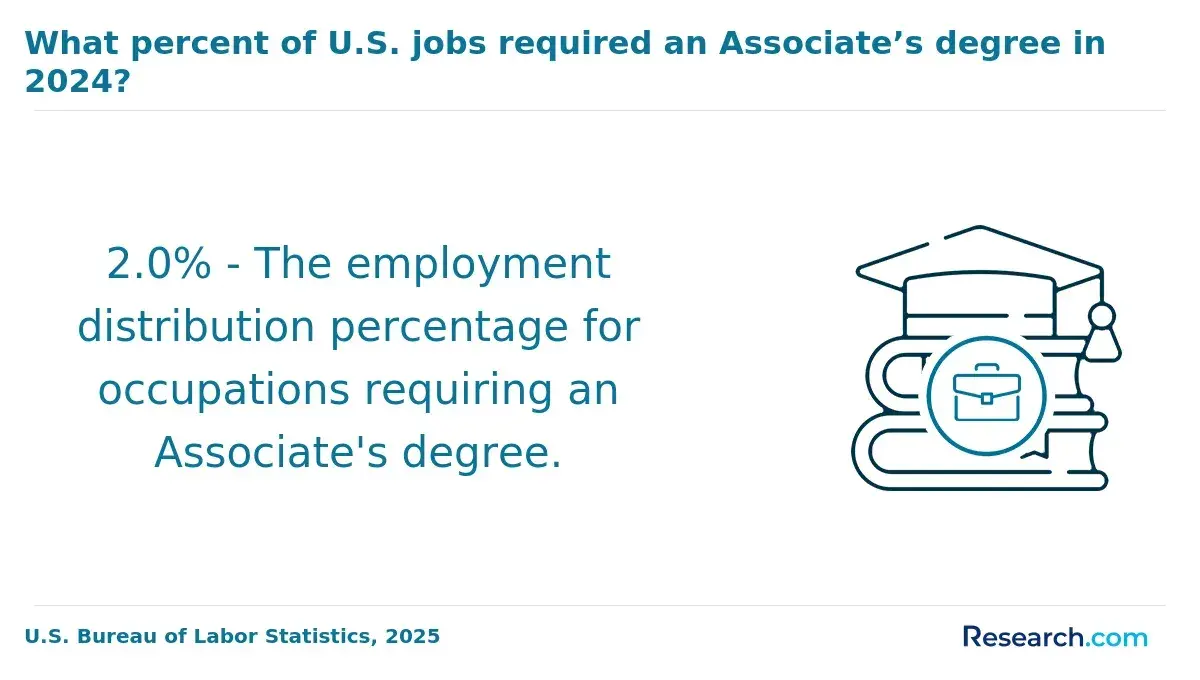
There is no single reliable salary for "online associate degree graduates." Earnings depend on the occupation entered, location, experience, credentials, and hours worked; occupational medians include people whose education and experience differ from yours. For context, BLS reported a May 2024 median of $49,500 across all U.S. occupations. A higher occupational median signals potential worth investigating, not a return the degree itself guarantees.
Demand matters alongside pay. BLS projects registered nurse employment to grow 5% from 2024 to 2034, but that national projection cannot predict openings in your community or admission to a nursing program. Compare local job postings, their stated qualifications, and likely entry-level pay before calculating whether a degree is worth its cost.
How Long Do Online Associate Degree Programs Take and Cost?
Many associate degrees require about 60 semester credits and take roughly two years with full-time enrollment. Part-time study, course sequencing, prerequisites, and clinical placements can extend that timeline; accepted transfer credits may shorten it. Short online course terms do not mean the whole degree can be finished in a term.
For a cost benchmark, the College Board reported average published tuition and fees of $4,050 for in-district public two-year college students in 2024-25. That is an annual sticker price, not the total cost of an online degree. Residency rates, required fees, books, equipment, travel to clinical sites, and time away from work can change the comparison. Ask each college for an estimate based on your actual enrollment plan and eligible financial aid.
If a bachelor's degree is ultimately required, compare the associate-to-bachelor's route with 2 year bachelor degree programs. A short advertised bachelor's timeline may assume substantial previous credit; confirm how your associate courses would apply to the major, not merely transfer as electives.
Are Online Associate Degree Programs Accredited?
Online associate programs can be accredited, but verify the institution's accreditation through the U.S. Department of Education's accreditation database rather than assuming that an online listing proves it. Institutional accreditation matters for quality review and may affect federal aid eligibility and transfer; it does not ensure every course will count toward another school's degree.
For regulated healthcare fields, also check whether the specific program has the accreditation or approval required by the relevant state board or credentialing body. Ask the school to identify that approval and explain which states its curriculum is designed to satisfy before enrolling from another state.
What Do Online Associate Degree Programs Teach?
Associate curricula usually combine general education - such as writing and mathematics - with major courses. An AA or AS often emphasizes courses intended for transfer; an AAS often emphasizes occupational skills. Those tendencies are not guarantees, so compare the actual course map with your intended job or bachelor's program.
Technical programs may include software projects and labs; nursing and allied health add supervised clinical skills; business programs often cover accounting and communication. If you need only one discrete skill, online courses may be worth comparing, but they do not award the same college credential or satisfy professional requirements unless the relevant authority accepts them.
What Are the Admission Requirements for Online Associate Programs?
Colleges typically ask associate applicants for a high school diploma or equivalent, an application, and prior transcripts. Placement or prerequisite coursework may affect when students can enter certain classes. Requirements for a major can be stricter than general college admission: nursing and allied-health cohorts may have science prerequisites, separate applications, limited seats, and clinical eligibility checks.
Before applying, ask when the major accepts students, which prerequisites must be complete, and whether prior coursework will count. Do not interpret admission to an open-access college as a promise of admission to a selective clinical program.
Do High-Paying Careers Require Licensure or Certification?
Yes, some of the most clearly defined career paths do. Registered nurses need state licensure and must pass the NCLEX-RN; dental hygienists need state licensure under their state's rules. Other roles may call for an industry certification, employer training, academy completion, or experience rather than a license. Requirements can differ by state and occupation.
Check the relevant licensing board or credentialing body for your intended work location. Confirm that the specific program makes students eligible for the required next step; earning an associate degree and qualifying to practice are separate milestones.
How Should You Choose a Reputable Online Associate Degree Program?
Choose backward from a job you would accept, not forward from an attractive salary figure. These checks expose the most costly mismatches before you enroll:
- Find local entry-level job postings and separate required credentials from preferred ones; check whether the degree matches the actual hiring standard.
- Verify institutional accreditation and, for regulated fields, program approval and eligibility in the state where you plan to work.
- Request a term-by-term plan showing online classes, scheduled sessions, labs, clinical sites, campus visits, and expected completion time at your intended pace.
- Compare estimated tuition, mandatory fees, supplies, and travel after an official review of transfer credit and available aid.
- If transfer is the goal, obtain written guidance on which courses satisfy the destination bachelor's major, not just how many credits it will accept.
Be wary of a program that advertises a high occupational wage without explaining its entry requirements, calls clinical training "fully online," or quotes low per-credit tuition without a full cost estimate. The right program is one you can complete, afford, and use for your verified next step.
Other Things You Should Know About
Usually not if it prepares you for hands-on clinical practice. Lectures may be online, but required labs and supervised clinical work generally take place in person.
An AAS may be a better fit for direct occupational training; an AS may fit a bachelor's transfer plan. Check the specific curriculum, job requirements, and transfer agreement rather than relying on the abbreviation.
No degree guarantees a salary. Occupational wages include experienced workers, and some higher-paying roles require licensure, certifications, further education, or years of experience.
Confirm accreditation, any required program approval, your total estimated cost, in-person obligations, and whether graduates are eligible for the credential or transfer pathway you need.
References
- Education pays: U.S. Bureau of Labor Statistics https://www.bls.gov/emp/chart-unemployment-earnings-education.htm
- Helping Transfer Students Achieve Their Education Goals | THECB Data https://databridge.highered.texas.gov/helping-transfer-students-achieve-their-education-goals/
- United States Bureau of Labor Statistics Education and Training Classification System | ca.gov https://labormarketinfo.edd.ca.gov/LMID/BLS_Training_Levels.html
- Tuition & Fees - UF Online - University of Florida https://ufonline.ufl.edu/tuition/tuition-fees/
- Why Is Accreditation Important? | ACE Blog https://ace.edu/blog/why-is-accreditation-important/
- Accreditation matters in higher ed: Here's why | cmich.edu https://www.cmich.edu/blog/all-things-higher-ed/accreditation-matters-in-higher-ed-here-s-why
- Our Online Campus | CHCP https://www.chcp.edu/locations/online-school/
- Tuition & Fees | State University System of Florida https://www.flbog.edu/universities/parents-students/tuition-fees/


