2027 Best College Degrees for In-Demand Careers

Co-Founder and Chief Data Scientist
Choosing a degree means weighing job demand against tuition, time, and the credentials employers actually require. In the U.S. Bureau of Labor Statistics (BLS) 2023-2033 projections, employment for information security analysts was expected to grow 33% - but entering that field still depends on skills and experience, not a degree title alone.
This guide compares career-relevant fields for first-time students, career changers, and professionals considering a master's degree. You'll learn which paths fit different goals, where licensure changes the equation, and what to check before committing to a program.
Key Things You Should Know
- Match the degree to the occupation: nursing and teaching have defined licensing pathways, while many business and technology roles accept multiple majors.
- BLS projected 33% employment growth for information security analysts from 2023 to 2033, but its occupational projections do not measure job placement for graduates of a particular program.
- Compare total cost, required experience, accreditation, and any clinical or fieldwork requirements before treating a high-demand field as a good personal investment.
Top 10 Best College Degrees for In-Demand Careers
Business Programs
A bachelor's in accounting, finance, or supply chain management can prepare students for distinct entry-level roles; a general business degree offers broader choices but may require a more deliberate internship strategy. Master's options include an MBA, master's in accounting, and master's in business analytics. Choose a specialized master's when a target role requires deeper technical preparation; an MBA usually makes more sense after gaining work experience. Management salaries should not be treated as starting salaries for new graduates. Accounting students should also check their state's CPA education and examination rules.
Healthcare Programs
Healthcare administration and public health degrees suit students interested in improving services without providing bedside care. A bachelor's may support entry into operations or community health work; an MHA or MPH can build specialized leadership, policy, or epidemiology skills. Healthcare management positions commonly require related experience, so a master's alone is not a shortcut into leadership. If your goal is to diagnose or treat patients, investigate the specific clinical degree and license instead. Compare internships and employer partnerships with the work you actually want to do.
Information Technology Programs
IT degrees commonly emphasize networks, cloud systems, support, and cybersecurity operations. A bachelor's can provide broad technical preparation, while master's programs in cybersecurity or information systems can deepen a specialty. For some entry-level support roles, a relevant certificate, certification, and hands-on practice may cost less than another degree. Security analyst positions often require prior IT experience; a new graduate should not assume direct entry. Look for labs, practical projects, and coursework that keeps pace with changing tools - not promises of a particular job title.
Computer Science Programs
Computer science focuses on programming, algorithms, systems, and mathematical foundations. A bachelor's is a common route into software development; a master's can support specialization in areas such as machine learning or systems, but is not generally required for every developer role. Choose computer science over a narrower coding certificate if you want a stronger theoretical base and wider technical options. Expect employers to assess projects and problem-solving skills as well as credentials. Check whether a program's required mathematics and software projects match your preparation and goals.
Nursing Programs
Associate and bachelor's nursing pathways can lead toward registered nurse (RN) licensure when they meet applicable state requirements; graduates must also pass the required licensing examination. A BSN may offer broader preparation and satisfy some employers' preferences. For licensed RNs, an RN-to-BSN program can build on earlier education. Master's nursing programs serve more specialized goals, but advanced practice roles have additional clinical, certification, and state licensure requirements. Before enrolling, verify state-board approval, clinical placement arrangements, and eligibility for the license you seek.
Psychology Programs
A psychology bachelor's builds research, writing, and behavioral-science skills applicable to several fields, but does not qualify someone to practice independently as a psychologist. Master's programs can support research, organizational work, or certain counseling pathways, depending on the degree and state. Psychologist licensure generally requires doctoral education and supervised training. If therapy is your goal, compare counseling, clinical social work, and psychology requirements before choosing a program: similar-sounding degrees can lead to different licenses.
Education Programs
An education bachelor's can provide a route toward initial teacher licensure if it includes state-approved preparation and student teaching. Master's options in curriculum, special education, or educational leadership may support specialization or advancement; leadership jobs often require teaching experience and additional credentials. Licensure rules differ by state and subject. Ask whether the program prepares graduates for the state where you intend to work, and account for the time commitment of student teaching even if academic courses are online.
Criminal Justice Programs
Criminal justice degrees cover law, institutions, policy, and research, but entry standards vary widely among law enforcement, corrections, and civilian analysis roles. A bachelor's may help with roles requiring research or administrative skills; a master's in criminal justice or criminology is better suited to specialized analysis, policy, or advancement than to every entry-level job. Some agencies provide their own academy training and may accept multiple majors. Review the hiring requirements of your target employer before paying for an advanced degree.
Engineering Programs
Engineering bachelor's degrees provide discipline-specific preparation in fields such as electrical, mechanical, and civil engineering. Choose a discipline by the problems and industries that interest you, not a broad salary ranking. A specialized master's can deepen technical expertise or support a career shift within engineering, but many engineering roles do not require one. If professional engineer licensure is a goal, investigate the relevant degree accreditation, examination, and experience requirements in your state. Laboratory access and design projects matter when comparing delivery formats.
Social Work Programs
A bachelor of social work (BSW) prepares students for some generalist roles; a master of social work (MSW) is the usual educational step toward clinical social work. Eligible BSW graduates may qualify for an advanced-standing MSW, but admission and credit rules vary by program. Clinical practice also requires supervised experience and state licensure after graduation. Compare field-placement support and the populations you hope to serve. Students primarily interested in independent therapy should verify that a specific MSW pathway meets their state's requirements.
What college degrees lead to the most in-demand careers?
The strongest degree choice is the one that connects clearly to your intended occupation and its entry requirements. These fields offer different kinds of demand: some lead through a defined license, while others reward a combination of education, projects, and experience. The comparison below shows where each path is most useful.
| Degree field | Career connection | Decision that matters most |
| Nursing | Direct pathway toward RN practice | State approval, clinical access, and licensure eligibility |
| Computer science or IT | Preparation for software, systems, or security roles | Which technical skills and projects the program develops |
| Engineering | Preparation for discipline-specific technical work | Specialization and, where relevant, licensure plans |
| Business | Multiple routes into accounting, operations, and analysis | Whether a focused major fits the target role better than a general degree |
| Education or social work | Preparation for service roles with potential licensing requirements | Whether the program satisfies the intended state and occupation |
No field is universally "best." Start with job postings for roles you would accept, identify recurring degree and experience requirements, then compare programs against those requirements.
Which careers offer the strongest job outlook and salary potential?
Job outlook describes projected employment in an occupation; median pay describes workers already in it. Neither is a forecast of what a new graduate will earn. These BLS figures provide U.S. benchmarks, with their dates shown so you can distinguish historical wages from projections.
| Occupation | Median annual pay, May 2023 | Projected employment growth, 2023-2033 | Important qualification |
| Information security analysts | $120,360 | 33% | Related IT experience is often expected. |
| Registered nurses | $86,070 | 6% | State licensure is required. |
| Medical and health services managers | $110,680 | 29% | Related healthcare work experience is commonly needed. |
Rapid growth can make a field worth investigating, but it does not establish how many openings will be accessible to beginners in your area. Compare local openings, entry requirements, and the newest BLS outlook before choosing a degree for its salary potential.
What degree or certificate pathways prepare students for growing fields?
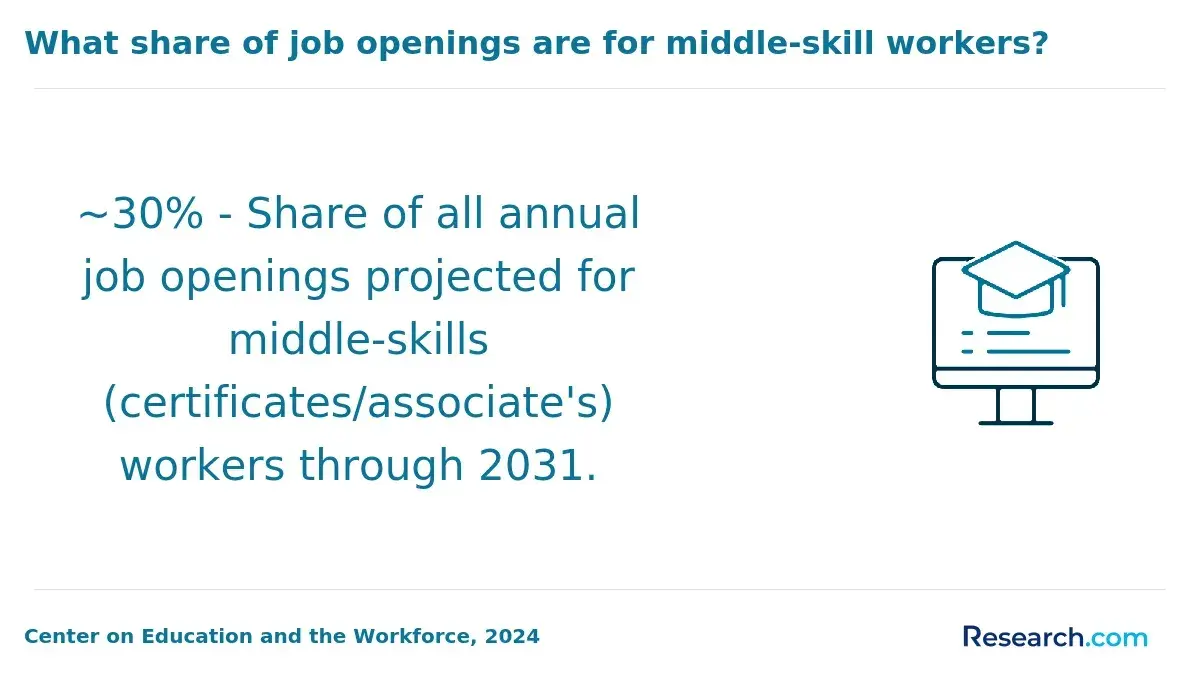
A degree is not always the first or only step into a growing field. IT support may be accessible through certificates and demonstrated skills; nursing requires an approved education and licensing pathway; some business roles value experience before a master's. A certificate can be a useful, lower-commitment test of interest, but do not assume its credits will later count toward a degree.
For students comparing bachelor's majors, an easiest online bachelor degree may sound attractive, but perceived difficulty is less important than whether its coursework builds the skills your target occupation uses. Ask a school to show how prior credits, certifications, or an eligible bridge pathway would apply to your specific graduation requirements.
How do online and campus-based degree programs compare?
Online study can reduce travel and make coursework easier to fit around work, but it does not necessarily mean self-paced study. Programs may require live meetings, fixed deadlines, proctored assessments, or in-person labs. Nursing clinicals, social work field placements, and student teaching still require substantial time at approved sites even when classes are online.
Campus study may be preferable if you need regular access to laboratories, equipment, or face-to-face instruction. In either format, check the course schedule and placement policy rather than relying on the delivery label. If ownership and mission are part of your comparison, a non profit online university can be one option to investigate; nonprofit status alone does not establish program quality, affordability, or licensure eligibility.
What accreditation should students verify before enrolling?
First, confirm that the institution holds recognized accreditation. Then check whether your intended occupation requires approval or accreditation of the specific program. This distinction is especially important in nursing, engineering, teacher preparation, counseling, and social work. A college can be institutionally accredited while a particular program does not meet the requirements for your intended license.
Ask the program for its accreditor or approval body and confirm its standing with that body and the applicable state licensing board. Also verify requirements in the state where you plan to work; an online program's location does not determine your state's licensing rules.
What coursework do high-demand degree programs typically include?
High-demand programs usually combine foundations with applied work, but the mix should reflect the job. Computer science emphasizes programming, algorithms, and projects; engineering adds discipline-specific mathematics, labs, and design; nursing includes sciences and supervised clinical education. Business analytics may combine statistics with databases, while social work and education include supervised practice.
Review the actual course sequence before enrolling. A concentration may appear in marketing materials yet be offered infrequently, and a required placement may limit when you can finish. For career relevance, look for assessed projects or field experiences that let you demonstrate what you can do.
What are the admission requirements for in-demand college programs?
Bachelor's applicants generally need a high school credential, while master's applicants need a bachelor's degree. Selective programs may add prerequisite sciences or mathematics, minimum grades, experience, interviews, or background checks. Clinical programs can have a separate admission process after entry to the college; admission to the institution is not necessarily admission to the major.
If timing matters, online colleges that start soon may help you find an application window, but confirm the start date for your specific program and prerequisites. Before applying, request a written evaluation of transfer credits and ask which requirements remain.
How long do these programs take and how much do they cost?
At full-time enrollment, an associate degree often takes about two years and a bachelor's about four; master's timelines vary substantially by credits, enrollment pace, prerequisites, and practicum or thesis requirements. A bridge or advanced-standing route can shorten the remaining work only for students who meet its eligibility rules. Accepted transfer credit may reduce cost, but credits that transfer as electives might not replace major requirements.
Compare the total estimated cost to completion: remaining credits, tuition, mandatory and program fees, books, equipment, travel, and unpaid placement time. Request an aid estimate rather than comparing advertised tuition alone. Students exploring online colleges that accept FAFSA should still verify the school's and program's federal-aid eligibility and their own aid offer; submitting the FAFSA does not guarantee funding.
Which licenses and certifications do graduates need for employment?
Graduation and permission to practice are separate milestones. RNs need state licensure and the required licensing examination. Teachers need the credential required by their state. Clinical social workers need an eligible degree, supervised experience, and state licensure; advanced practice nurses face additional certification and licensing requirements. Engineering graduates pursuing professional engineer licensure must meet state-specific education, examination, and experience rules.
In less regulated fields, employer-requested certifications can help demonstrate particular skills but do not replace every degree or experience requirement. Before paying a deposit, ask the relevant licensing board - not just admissions - whether the program satisfies the educational requirements for your intended role and state.
Other Things You Should Know About
Choose a field with coursework you want to use and several plausible roles, then test your interest through introductory classes, projects, or work experience. A broad major is useful only if you build relevant skills alongside it.
Not always. Many software, business, and engineering roles accept a bachelor's degree; other paths, including clinical social work, require graduate education for the intended license. Check the occupation before choosing a credential.
Some academic coursework may be online, but labs, clinicals, field placements, and student teaching can require in-person attendance. Confirm the requirements of the specific program.
Compare your total cost and likely borrowing with realistic local entry-level opportunities, not an occupation-wide median salary. Include required licenses, experience, and any additional education in that comparison.
References
- Projected openings in occupations that require a college degree: Career Outlook: U.S. Bureau of Labor Statistics https://www.bls.gov/careeroutlook/2021/article/projected-openings-college-degree.htm
- Fast Facts: Employment rates of young adults (561) | ed.gov https://nces.ed.gov/fastfacts/display.asp
- Research Summary: Education and Lifetime Earnings | ssa.gov https://www.ssa.gov/policy/docs/research-summaries/education-earnings.html
- The Major Payoff: Evaluating Earnings and Employment Outcomes Across Bachelor's Degrees - CEW Georgetown https://cew.georgetown.edu/cew-reports/major-payoff/
- College is still worth it, even with student debt, but we can do better | Brookings https://www.brookings.edu/articles/college-is-still-worth-it-even-with-student-debt-but-we-can-do-better/
- Washington: Labour Market Relevance and Outcomes of Higher Education in Four US States | OECD https://www.oecd.org/en/publications/labour-market-relevance-and-outcomes-of-higher-education-in-four-us-states_38361454-en/full-report/component-11.html
- 10 careers requiring a bachelor's degree that will have the most job openings through 2034 | al.com https://www.al.com/education/2026/02/10-careers-requiring-a-bachelors-degree-that-will-have-the-most-job-openings-through-2034.html
- The fastest growing jobs require a college degree - or more | Jed Kolko https://jedkolko.com/2024/09/03/the-fastest-growing-jobs-require-a-college-degree-or-more/
- How does a college degree improve graduates' employment and earnings potential? - APLU https://www.aplu.org/our-work/publicuvalues/employment-earnings/