
2027 Best Associate Degree Programs With Tutoring Support

Co-Founder and Chief Data Scientist
Choosing an associate degree is hard enough without wondering whether help will be available when a course gets difficult. Tutoring can be especially important in math-heavy, technical, and clinical programs, but "student support" can mean anything from a searchable resource library to regular appointments with a subject specialist. The College Board reports average published tuition and fees of $4,050 for in-district students at public two-year colleges in 2024-25; that price does not tell you what academic help is included. This guide compares degree fields and shows how to verify tutoring, costs, transfer options, and career requirements before you enroll.
Key Things You Should Know
- The best fit depends on both your goal and the tutoring you can actually use: ask about help in required courses, appointment hours, online access, and any fees.
- AA and AS degrees often support transfer, while AAS degrees often emphasize employment; check the curriculum and transfer agreement rather than relying on the abbreviation.
- Published in-district tuition and fees averaged $4,050 at public two-year colleges in 2024-25, according to the College Board, but books, transportation, clinical expenses, and extra terms can substantially change your total cost.
Top 10 Best Associate Degree Programs With Tutoring Support
Business Programs
A business AA or AS may suit students planning to transfer into accounting, finance, or management; a business AAS may emphasize immediate office or operations skills. Prioritize tutoring in accounting, statistics, spreadsheets, and writing, and ask whether tutors can help with the software used in class. Business is a flexible choice, not a direct route to a management job: those roles commonly require experience. Before enrolling, confirm that required courses will apply to your intended bachelor's program if transfer is your goal.
Healthcare Programs
Healthcare associate options include transfer-oriented health sciences and career-focused allied-health programs. Their tutoring needs differ: anatomy and medical terminology help may matter broadly, while an imaging or laboratory track may require specialized support and supervised practice. Ask whether tutoring covers prerequisites as well as major courses, and whether required clinical placements fit your schedule. For a regulated occupation, verify programmatic accreditation and eligibility for the relevant exam or state credential; an associate degree alone does not necessarily authorize practice.
Information Technology Programs
IT associate programs may focus on networking, cybersecurity, software development, or general computing. A transfer-oriented AS and a workforce-oriented AAS can have very different math and technical requirements. Look for tutoring that supports programming assignments, networking labs, and troubleshooting - not just general computer literacy. Remote tutoring can be useful if it includes screen sharing or access to the same software used in class. Compare the program's lab facilities, portfolio opportunities, and employer-relevant skills alongside tutoring availability; an IT degree does not guarantee a particular job or certification.
Nursing / Pre-Nursing Programs
A pre-nursing AA or AS generally prepares students to apply to a nursing program; it is not itself a nursing license. An associate degree in nursing combines classroom study with supervised clinical education and may lead to eligibility for the NCLEX-RN, subject to state rules and program approval. Admission to the college may be separate from competitive admission to nursing. Ask whether tutoring covers anatomy, dosage calculations, and nursing courses, and whether it remains available during clinical terms. Check clinical schedules and licensing-board eligibility before committing.
Criminal Justice Programs
A criminal justice AA or AS can provide a transfer foundation; an AAS may put more emphasis on applied coursework. Writing, research, and statistics tutoring can help with reports and evidence-based assignments. Compare the degree with the actual entry requirements for your target role: police, corrections, and federal positions can have distinct hiring standards, training, and background checks. If you hope to earn a bachelor's degree, verify that criminal justice courses satisfy its major requirements rather than transferring only as electives.
Psychology / Counseling Programs
A psychology or counseling-focused AA or AS is usually a starting point for transfer, not a qualification to practice as a licensed counselor or psychologist. Strong writing, statistics, and research-methods tutoring may be more valuable here than generic homework help. Ask whether the college has an articulation agreement for your intended bachelor's major. Students seeking a counseling license should map the full path - including graduate education and supervised experience - against their state's requirements before choosing an associate program.
What Are the Best Associate Degree Programs With Tutoring Support?
There is no universally best associate degree with tutoring support. The strongest choice is a program that matches your transfer or career goal and provides usable help in the courses most likely to slow your progress. The comparison below identifies where subject-specific tutoring is particularly important; it does not imply that every college offering a field provides that service.
| Program direction | Good fit when your goal is... | Tutoring to verify | Key trade-off |
| Business AA, AS, or AAS | Broad transfer options or applied office skills | Accounting, statistics, spreadsheets | Broad preparation may need a clearer career specialization |
| Allied-health program | Preparation for a specific healthcare role | Anatomy, major courses, exam preparation | Clinical schedules and credential rules limit flexibility |
| IT AS or AAS | Technical skills, a portfolio, or later transfer | Programming, math, networking labs | Tools and employer expectations change |
| Nursing or pre-nursing | RN preparation or entry into a nursing program | Science, dosage calculations, nursing coursework | Selective admission and clinical requirements |
| Criminal justice or psychology AA/AS | Transfer or exploration of a longer career path | Writing, research, statistics | Many target roles require further qualifications |
Use these as conditional recommendations, not a ranking of unverified schools. A program should make your shortlist only after you confirm that its current students can access the relevant tutoring, in your study format, at times you can attend.
How Do You Choose an Accredited Associate Degree Program With Tutoring Support?
Start with institutional accreditation recognized by the U.S. Department of Education. For a licensed healthcare occupation, also check any programmatic accreditation, state approval, and exam-eligibility rules that apply. Accreditation is a baseline, not proof that tutoring is effective or that every credit will count toward another degree.
Then ask an admissions adviser and the tutoring center for current, written answers to these questions:
- Which required courses have subject-specific tutors, and are appointments, drop-in sessions, and evening or weekend hours available?
- Can online students use the same services, and are sessions live, asynchronous, or limited during breaks and clinical terms?
- Is tutoring included in mandatory fees, and how are wait times or session limits handled?
- Which credits apply to my intended bachelor's major, and which requirements must I complete after transfer?
If military training or frequent moves affect your plans, compare transfer evaluations and remote tutoring alongside the schools in an online college for military search. Do not assume military experience automatically earns credit; the receiving institution decides what it accepts and how that credit applies.
Are Online Associate Degree Programs With Tutoring Support as Effective as Campus Programs?
Online associate programs can work well when course design and support fit the student. They are not automatically as convenient - or as hands-on - as campus programs. An asynchronous class may still have weekly deadlines, while a live online class may require attendance at fixed times. Campus study can make labs and drop-in tutoring easier to access; online study can reduce travel if tutors offer useful live sessions or timely feedback.
Check the delivery of the entire degree, not just its lectures. Nursing and some allied-health programs require in-person clinical work; IT programs may require particular lab equipment or proctored assessments. Ask for the current course schedule, tutoring hours in your time zone, and a demonstration of the online tutoring platform. If frequent entry points matter, online colleges with weekly start dates are worth comparing, but a frequent start date does not mean every required course - or tutor - is available every week.
What Do Associate Degree Programs With Tutoring Support Cost and How Long Do They Take?
Many associate programs require roughly 60 semester credits, but prerequisites, clinical sequences, and institution-specific requirements can add time. Full-time students may finish in about two academic years when required courses are available; part-time enrollment, missed course sequences, or selective admission can extend the timeline. Accepted transfer credit may shorten it, but only when that credit satisfies remaining requirements.
The College Board's 2024-25 average of $4,050 in published tuition and fees for in-district public two-year students is a useful benchmark, not a program quote or a total cost. Compare tuition and mandatory fees for all remaining terms, then account for books, software, equipment, travel, and any clinical-related costs. Confirm whether tutoring carries a separate charge. Financial aid eligibility depends on the student and institution; ask about grants, scholarships, employer assistance, and payment plans before deciding that a low sticker price is the cheapest path.
What Admission Requirements Apply to Associate Degree Programs With Tutoring Support?
General college admission often involves an application and proof of high school completion or an equivalent credential. Schools may use transcripts or placement measures to determine course readiness. Admission to a particular major can be more demanding: nursing and some allied-health programs may require prerequisite grades, separate applications, health documentation, background checks, or competitive selection.
Request the program's current admission checklist and prerequisite sequence, not just the college-wide policy. If you have previous college credit, obtain an official evaluation showing which courses meet general education, major, and prerequisite requirements. Check minimum grades and any age limits on science coursework. This avoids a common mistake: assuming that admission to the college also reserves a seat in a selective program.
Which Courses and Tutoring Services Do These Associate Degree Programs Include?
Most associate curricula combine general education - such as writing and mathematics - with major courses. Career-focused programs may add labs, simulations, internships, or clinical placements. Tutoring should reflect that mix: writing-center appointments alone will not replace help with anatomy, accounting, coding, or statistics.
Services vary by institution and sometimes by course. Look for a published subject schedule, tutor qualifications, appointment limits, remote-access instructions, and help available before exams. Ask whether tutors teach problem-solving or simply review submitted work; the former is more useful when courses build on earlier material. If a school advertises "24/7 support," find out whether that means live subject tutoring, a question-submission service, or access to learning resources. A program's strongest support is the help you can reliably use throughout the term.
What Careers and Salaries Can Associate Degree Graduates Expect?
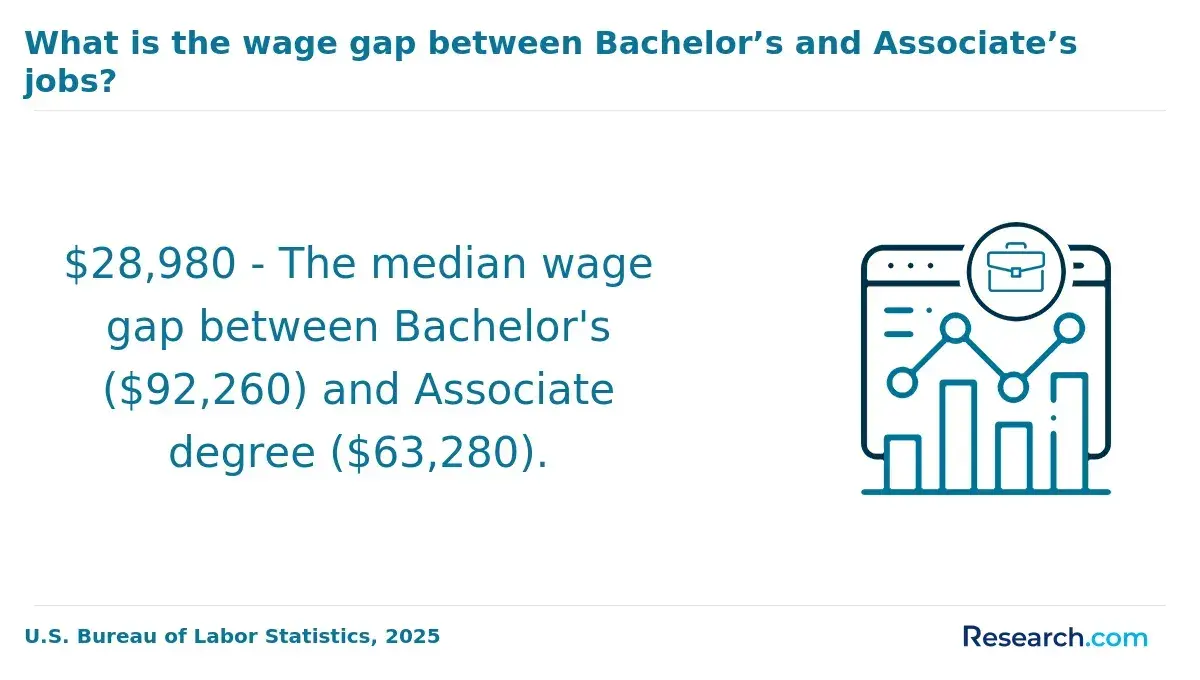
Career outcomes depend on the specific program, local hiring standards, experience, and any required credential. For perspective, the U.S. Bureau of Labor Statistics reports a 2024 median annual wage of $93,600 for registered nurses. That is an occupational wage across workers, not the expected earnings of a newly licensed associate degree graduate; an eligible graduate must also meet state licensing requirements and pass the licensing examination.
Business and IT degrees may support applications for entry-level roles, but job titles and requirements differ widely by employer. Criminal justice and psychology graduates should be especially careful not to mistake a field of study for eligibility for every occupation within it. If earnings are central to your decision, compare your realistic entry role and any further education it needs; lists of the most profitable college majors address a different question and should not substitute for local job postings or program outcomes.
Which Certifications or Licenses Can Associate Degree Programs Prepare You For?
Credentials are separate from degrees. An approved associate degree in nursing can be one part of the path to RN licensure, followed by the NCLEX-RN and state requirements. Some allied-health programs are designed around eligibility for a professional exam, but the applicable accreditor and rules depend on the occupation and state. IT programs may teach skills relevant to industry certifications without awarding those certifications or guaranteeing that students will pass their exams.
Psychology and counseling associate degrees do not qualify graduates for independent clinical practice. Counseling licensure generally involves qualifying graduate education and supervised experience; even a search for the cheapest easiest master's degree should come after checking your state board's curriculum and licensing rules. Ask each program to name the specific exam or license it prepares students for and to explain what remains after graduation.
How Do You Compare Job Outlook and Employer Demand After Graduation?
Use occupational projections as context, not a promise of a job. The Bureau of Labor Statistics projects 5% employment growth for registered nurses from 2024 to 2034. That national projection can indicate broad demand, but it does not show how many openings exist near your preferred clinical site or whether a particular program's graduates secure them.
Compare current local job postings with a program's curriculum: note required licenses, software, experience, schedules, and education levels. Ask the college for clearly defined, recent completion, exam-pass, transfer, or employment outcomes when relevant, including how many students those figures cover. Be wary of claims that tutoring, career services, or an employer partnership guarantees placement. The best next step is to shortlist programs whose verified tutoring fits your toughest required courses, then check their total cost and whether they meet your actual career or transfer goal.
Other Things You Should Know About
Many colleges offer tutoring, but subjects, hours, eligibility, and fees vary. Confirm the current service details for your required courses before enrolling.
Some can, but an online degree does not guarantee live or after-hours help. Ask for the tutoring schedule and whether appointments are available remotely in your time zone.
Choose based on the actual curriculum and your goal. AA and AS programs often emphasize transfer; AAS programs often emphasize job preparation, though policies vary by school.
Accessible, course-relevant help can support learning, but availability alone cannot predict an individual outcome. Check when tutoring is offered and make a plan to use it early, before you fall behind.
References
- Error codes - OpenAI API https://developers.openai.com/api/docs/guides/error-codes


