2027 Best Accredited Online Adult Gerontology Primary Care Nurse Practitioner Master's Programs With Asynchronous Classes: No Set Class Times

Co-Founder and Chief Data Scientist
Choosing an online Adult-Gerontology Primary Care Nurse Practitioner (AGPCNP) master's program means balancing advanced-practice preparation with an existing nursing career. The U.S. Bureau of Labor Statistics projects employment of nurse practitioners to grow 46% from 2023 to 2033, making credential quality and certification eligibility especially important. This guide explains how "no set class times" really works, what accreditation to verify, where flexibility ends at clinical practice, and how to compare programs by cost, support, pacing, and career fit.
Key Things You Should Know
- Choose a program with both institutional accreditation and nursing-program accreditation from the Commission on Collegiate Nursing Education or Accreditation Commission for Education in Nursing; this is central to employer confidence and national certification eligibility.
- "Asynchronous" usually means no required weekly live lectures, not no deadlines: coursework is commonly term-based, while clinical placements, skills checks, orientations, and exams may still have fixed times.
- AGPCNP preparation is a substantial investment: nurse practitioners had a $129,210 median annual wage in May 2024, but students should compare total tuition, clinical-placement support, certification alignment, and state licensure rules rather than choosing on price alone.
What Does "Asynchronous" Mean in an Online Adult Gerontology Primary Care Nurse Practitioner Master's Program?
In an asynchronous online AGPCNP master's program, students generally access recorded lectures, readings, discussion boards, case studies, and assignments when their schedule allows. It does not mean the degree is self-paced or that students can finish clinical education whenever they choose. Most programs use structured academic terms with weekly modules and due dates.
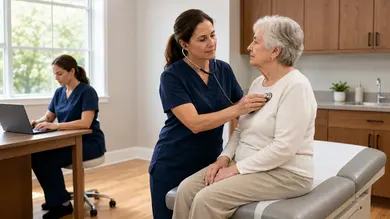
AGPCNP programs prepare registered nurses to provide primary care to adolescents, adults, and older adults across preventive, chronic, and acute-care needs in outpatient and community settings. The graduate curriculum typically includes advanced pharmacology, advanced pathophysiology, advanced health assessment, diagnostic reasoning, population health, and supervised clinical practicum courses. Nurses exploring adjacent medication-focused careers can also review online pharmacy schools, although pharmacy and nurse practitioner pathways lead to different scopes of practice.
This comparison separates course-delivery labels that schools sometimes use inconsistently.
| Format | Typical class schedule | Best fit | Key limitation |
| Fully asynchronous coursework | No routine live lecture; deadlines still apply | Shift-working nurses with reliable independent-study habits | May include scheduled clinical or assessment activities |
| Partially asynchronous or hybrid online | Recorded work plus periodic live sessions | Students who want more real-time faculty contact | Live sessions can conflict with rotating shifts |
| Synchronous online | Required virtual meetings at set times | Students who prefer classroom structure | Least adaptable to unpredictable work schedules |
| Self-paced | Variable progression, often with completion limits | Rare for clinical graduate nursing education | Usually not appropriate for sequenced practicum curricula |
"No set class times" should therefore be read as a description of didactic coursework, not a promise of unrestricted scheduling across every requirement.
How Can Students Verify Accreditation for an Asynchronous Online Adult Gerontology Primary Care Nurse Practitioner Master's Program?
Verify accreditation at two levels before applying or paying a deposit. Institutional accreditation evaluates the university as a whole. Nursing-program accreditation evaluates the nursing education program and is particularly important for professional credibility, financial-aid eligibility, transferability, and certification pathways.
Use this verification sequence rather than relying on an advertising claim.
- Find the institution in the U.S. Department of Education or Council for Higher Education Accreditation directories and confirm that its accreditor is recognized.
- Check the nursing school directly in the CCNE or ACEN directory, using the exact campus and degree level when applicable.
- Read the AGPCNP curriculum to confirm it is a nurse practitioner population-focus program, not merely a general nursing master's degree.
- Ask the school whether graduates are educationally eligible for the American Nurses Credentialing Center or American Association of Nurse Practitioners AGPCNP certification examination.
- Confirm with the board of nursing where you intend to practice that the program can support your licensure pathway.
Institutional and nursing accreditation are complementary, not interchangeable. A university may be institutionally accredited while a particular nursing program lacks programmatic accreditation. Students also should not confuse nursing accreditation with specialized accreditation in another field; for example, cahiim accredited health information management programs online follow a different professional-accreditation framework.
A red flag is a school that will not clearly identify its institutional accreditor, nursing accreditor, certification alignment, or clinical-state authorization. Ask for written confirmation, because approval and distance-education authorization can change.
How Can Students Tell If an Online Adult Gerontology Primary Care Nurse Practitioner Master's Program Truly Has No Set Class Times?
Do not treat "100% online" as evidence of fully asynchronous delivery. A program can be online while requiring evening webinars, weekend intensives, virtual simulations, live presentations, proctored exams, or on-campus visits. The relevant question is whether attendance is required at a specified time and whether that requirement applies to every course.
Ask admissions for a sample plan of study and the syllabus from a recent clinical and nonclinical course. The following questions expose the practical schedule more clearly than a marketing label.
- Are any live lectures, office hours, simulations, orientations, skills validations, or residencies mandatory?
- Are exams available within a multi-day testing window, or must they be completed at a fixed appointment time?
- Do group projects require live meetings or presentations?
- How often are course deadlines set, and are they due during a particular time zone?
- Can students complete clinical hours during evenings, weekends, or nontraditional blocks if an approved preceptor is available?
- Does the no-set-times claim apply to every term, including advanced assessment and practicum courses?
Request answers by email and compare them with the catalog. A school that says live activities are "recommended" should clarify whether missed participation affects grades, progression, or clinical readiness. Required clinical hours remain scheduled care experiences even when lectures are asynchronous.
How Flexible Are Asynchronous Online Adult Gerontology Primary Care Nurse Practitioner Master's Programs for Working Professionals?
Asynchronous coursework can make graduate study practical for full-time registered nurses, especially those working nights, weekends, or rotating shifts. Flexibility is strongest in foundational didactic terms, when students can complete readings and recorded content outside work hours. It becomes more limited during clinical courses because preceptors, patients, clinical sites, and faculty evaluations operate on real schedules.
The typical trade-off is between maximum schedule freedom and the level of built-in support. This overview helps applicants match a study plan to their employment realities.
| Enrollment approach | Scheduling advantage | Likely trade-off | Who it may suit |
| Part-time, term-based | Lower weekly course load | Longer time to completion | Full-time nurses and caregivers |
| Full-time, term-based | Earlier completion | Heavy workload and less buffer for overtime | Nurses with reduced work commitments |
| Accelerated coursework | Shorter individual terms | Compressed reading, discussion, and assessment deadlines | Highly organized students with predictable schedules |
| Clinical-placement-supported model | Potentially less site-search burden | Less control over site, preceptor, and shift selection | Students in areas with limited clinical networks |
Budget for reduced work availability during practicum terms. Nurses considering an administrative path rather than direct patient care may find healthcare administration masters more compatible with a nonclinical career goal, but that degree does not qualify someone for NP certification or practice.
Asynchronous delivery is not automatically best for everyone. Nurses who benefit from immediate discussion, accountability, and instructor-led demonstrations may do better in a partially synchronous program, even if it requires protected evening hours.
How Do Asynchronous Online Adult Gerontology Primary Care Nurse Practitioner Master's Programs Handle Faculty Interaction and Group Work?
Quality asynchronous programs replace live lecture time with intentional instructor presence. Faculty may provide recorded feedback, annotated clinical documentation reviews, discussion-board facilitation, virtual office hours, telephone appointments, and scheduled clinical-site evaluations. In a strong program, students can obtain timely clarification before an assignment or patient-care decision becomes a larger problem.
Group work is often manageable but deserves scrutiny. Case analyses, evidence-based practice projects, and presentations may require teams to coordinate across work schedules. Ask whether groups can use asynchronous collaboration tools, whether live meetings are graded, and how faculty address unequal participation.
Evaluate support beyond course content. Useful services include librarian assistance, writing support, simulation preparation, disability accommodations, clinical-placement staff, technology help outside business hours, and faculty with current primary-care practice experience. A high tuition price does not automatically mean better access; compare published response expectations and student-support processes.
Applicants entering nursing from an earlier support role should remember that prerequisites and RN licensure still come first. An MA to LPN pathway can be a practical early transition for some medical assistants, but LPN preparation alone is not an AGPCNP entry credential.
How Do Course Deadlines and Pacing Affect an Asynchronous Online Adult Gerontology Primary Care Nurse Practitioner Master's Degree?
Most asynchronous AGPCNP programs are cohort-based or term-based, not open-ended. Students may watch a lecture at 6 a.m. or midnight, but they commonly submit discussion posts, quizzes, papers, and clinical logs by weekly deadlines. Sequential courses also mean a delayed course or failed clinical requirement can postpone later practicum courses.
Before enrolling, calculate workload from the school's credit-hour policy, syllabus, and clinical-hour expectations. A course that appears flexible can become difficult when work overtime, family responsibilities, and a weekly clinical shift converge. Protecting recurring study blocks is generally safer than assuming spare time will appear.
Common pacing mistakes include registering for too many credits in the first term, overlooking time-zone-based deadlines, and assuming a leave of absence will not affect cohort sequencing. Ask whether students may reduce their load, repeat a course, take a planned break, or move into another cohort without losing clinical placement support.
Completion time depends on prior graduate coursework, transfer-credit policy, enrollment intensity, and the availability of clinical placements. Students seeking a broader timeline for the profession can review how long to become a nurse practitioner; an individual pathway may take longer when RN education, experience requirements, or part-time enrollment are still ahead.
How Do Exams, Projects, and Technology Requirements Work in an Asynchronous Online Adult Gerontology Primary Care Nurse Practitioner Master's Program?
Online delivery changes where assessments occur, not the standard students must meet. Courses may use timed quizzes, proctored examinations, SOAP notes, diagnostic case studies, recorded patient-interview simulations, research appraisals, and comprehensive clinical evaluations. Clinical courses also require documentation of encounters and hours under approved supervision.
Confirm the assessment rules before committing to a program. The following items can affect whether "no set class times" works with a student's schedule.
- Remote-proctoring requirements, including identity checks, webcam use, quiet-room rules, and appointment windows
- Minimum computer, operating-system, internet-speed, webcam, microphone, and browser requirements
- Whether students must travel for skills intensives, objective structured clinical examinations, or orientation
- Clinical-documentation platform training and access to electronic resources
- Backup expectations when internet service, workplace demands, or illness disrupt a timed assessment
Students should use a personal computer rather than relying only on a phone or employer device, which may restrict software or create privacy concerns. Ask whether technical problems are documented through the school's help desk and whether make-up policies apply consistently. Never assume a remote exam can be taken during a work shift.
How Rigorous Are Asynchronous Online Adult Gerontology Primary Care Nurse Practitioner Master's Programs Compared With Campus-Based Programs?
A legitimate asynchronous AGPCNP master's program is not academically easier than a campus-based program. It must teach the same advanced-practice competencies, assess clinical judgment, and provide supervised patient-care experiences required by its curriculum and accreditor. The learning mode changes how students engage with material; it does not eliminate advanced assessment, pharmacology, diagnostic reasoning, or clinical evaluation.
Rigor is better assessed through outcomes and design than through whether lectures are live. Look for a coherent sequence of the three advanced-practice core courses, transparent clinical-hour requirements, qualified faculty, direct clinical evaluation, certification preparation, and clear progression policies.
Online study can demand more self-direction than classroom study because students must plan reading, ask questions promptly, and engage without a fixed meeting routine. Conversely, campus programs can be a stronger fit for students who need scheduled practice, in-person simulation access, or immediate peer interaction. Neither format is inherently superior; alignment with learning habits and clinical support matters more.
A warning sign is a program that minimizes the clinical commitment, makes vague claims about independent completion, or cannot explain how faculty observe and evaluate competencies. Flexibility should never come at the expense of patient-safety preparation.
What Career Value Does an Asynchronous Online Adult Gerontology Primary Care Nurse Practitioner Master's Degree Provide?
An AGPCNP master's degree can prepare an experienced RN for national certification and advanced-practice licensure, subject to the requirements of the relevant certifying organization and state board of nursing. AGPCNPs commonly work in primary-care practices, community health centers, specialty outpatient clinics, long-term care settings, home-based care, and telehealth-supported services. Their focus is primary care across adolescence through older adulthood, not neonatal or pediatric primary care.
The U.S. Bureau of Labor Statistics reported a $129,210 median annual wage for nurse practitioners in May 2024. That national occupation-wide figure is useful salary context, not a forecast for an individual graduate: pay varies by state, specialty, employer, productivity model, experience, shift expectations, and scope-of-practice law.
Career value is strongest when the program fits the role a student actually wants. A prospective AGPCNP should confirm that the population focus matches their intended patients, that clinical experiences include relevant adult and older-adult primary care, and that the degree meets certification and state licensure expectations. Students seeking acute-care practice, pediatric care, psychiatric-mental health care, or nurse-midwifery should pursue the matching population-focus program instead.
Core skills developed include comprehensive assessment, differential diagnosis, chronic-disease management, preventive counseling, pharmacologic decision-making, interprofessional communication, health-equity awareness, and evidence appraisal. Employers may also value prior RN experience and local clinical relationships, so the degree should be part of a deliberate career plan rather than a stand-alone credential purchase.
How Should Students Compare the Best Asynchronous Online Adult Gerontology Primary Care Nurse Practitioner Master's Programs?
There is no single best asynchronous AGPCNP program for every nurse. The strongest option is the one that is properly accredited, available to students in the relevant state, aligned with certification and licensure goals, realistic for the student's work schedule, and transparent about total cost and clinical obligations.
Use the comparison factors below to create a short list. Request identical information from each school so that marketing language does not obscure meaningful differences.
| Comparison factor | What to verify | Why it matters |
| Accreditation and approval | Institutional accreditation, CCNE or ACEN status, and state authorization | Supports quality review, aid access, and professional progression |
| Certification alignment | Eligibility preparation for AGPCNP national certification | Certification is commonly needed for advanced-practice licensure |
| Asynchronous design | Required live sessions, intensives, exam windows, and time zones | Determines actual schedule control |
| Clinical support | Who secures sites, preceptor criteria, travel expectations, and placement timeline | Clinicals are often the least flexible part of the degree |
| Total cost | Per-credit tuition, required fees, travel, technology, books, and clinical expenses | Prevents an incomplete tuition comparison |
| Progression and support | Part-time options, leave policies, faculty access, tutoring, and technical help | Shows whether the program is workable during disruptions |
After narrowing the list, speak with admissions and, if possible, current students or alumni. Ask for the clinical handbook, sample syllabi, fee schedule, state-authorization information, and a written list of required synchronous activities. Compare net cost after employer tuition assistance, scholarships, and federal aid rather than comparing only posted per-credit tuition.
Do not choose solely on a ranking, low advertised tuition, or a claim of being fully online. A lower-cost program may create significant clinical-site search costs, while a more expensive one may offer placement infrastructure that reduces delays. The best investment is the program whose documented requirements you can complete while preserving patient-care quality, financial stability, and progress toward your intended license.
Other Things You Should Know About Adult Gerontology Primary Care Nurse Practitioner
AGPCNP education focuses on adolescents, adults, and older adults. It does not prepare a nurse practitioner for pediatric primary care across childhood. Nurses who want to treat infants, children, and adolescents should investigate pediatric-focused nurse practitioner education and certification.
No. Many work in outpatient primary care, but opportunities can also exist in specialty clinics, community health, long-term care, home-based care, and transitional-care settings. The role should remain consistent with the practitioner's population-focus preparation, employer privileges, and state scope-of-practice rules.
Applicants generally need an active RN license and a BSN or qualifying nursing degree, but experience requirements vary. Some schools prefer or require professional RN experience, particularly in adult, medical-surgical, community, or primary-care settings. Review each program's admissions page and clinical eligibility rules.
Prescriptive authority depends on state law, advanced-practice licensure, national certification, collaborative-practice requirements where applicable, and employer credentialing. Graduate pharmacology education is important, but students should verify the rules in the state where they plan to practice.
References
- Adult-Gerontology Primary Care Nurse Practitioner https://nursinglicensemap.com/advanced-practice-nursing/nurse-practitioner/adult-anp/
- MSN Adult-Gerontology Primary Care Nurse Practitioner | WCU https://westcoastuniversity.edu/online-programs/msn/agpcnp
- Top Online Adult-Gerontology NP Programs 2026: AGNP Rankings https://www.npschools.com/rankings/all-online-agnp-programs
- Masters | Cedar Crest College https://www.cedarcrest.edu/program/nursing-adult-gerontology-acute-care-nurse-practitioner/masters/
- Adult-Gerontology Nurse Practitioner: Educator's Guide https://www.nurseeducator.com/articles/adult-gerontology-nurse-practitioner/