How Bowling Green State University Supports Students From Day One

Co-Founder and Chief Data Scientist
The first year of college can expose students to challenges that have little to do with whether they were academically prepared to enroll. Students are learning how to navigate unfamiliar systems, build relationships, manage coursework and, in many cases, begin making decisions about careers and their future.
That makes the structure of a university's first-year experience worth examining closely. A useful question is not simply whether a university offers academic advising, career services or student organizations, but how early students encounter those resources and what happens when they begin to struggle.
Bowling Green State University (BGSU) provides one example of an institution taking a proactive approach. Its first-year strategy combines early career exploration and campus involvement with engagement data, faculty alerts and personal outreach. The approach is designed to connect students with people and resources before relatively manageable challenges become larger obstacles.
Key Findings
- Twenty-six percent of respondents in a CollegeData survey reported experiencing homesickness occasionally or often during their college transition.
- An analysis of National Survey of Student Engagement (NSSE) data indicated that about one in five first-year students experienced difficulty both learning course material and getting help with coursework.
- Bowling Green State University reported an 8% increase in retention among first-year students who received Early Alert intervention between 2021 and 2025.
- The First Year Is More Than an Academic Transition First Year
- BGSU's First-Year Approach Combines Engagement With Early Support Engagement + Support
- What Happens When a Student Starts Struggling? Struggling Intervention
- What Prospective Students Should Evaluate in a First-Year Experience First-Year Experience
- Where BGSU Fits Into the Decision BGSU's Approach
The First Year Is More Than an Academic Transition
The transition to college can involve academic, social and personal adjustments simultaneously. In a CollegeData survey, 26% of respondents said they experienced homesickness occasionally or often, illustrating how the transition can extend beyond the classroom. Other survey findings pointed to concerns about academic preparation and balancing college responsibilities.
Academic support can also be harder to access than universities' lists of services might suggest. An analysis of National Survey of Student Engagement (NSSE) data found that about one in five first-year students reported difficulty both learning course material and getting help with coursework. The students who encountered these difficulties were also more likely to have seriously considered leaving their institution.
When comparing colleges, career planning factors are worth your attention. A university may have tutoring, advising and counseling available, but students still need to know where to go, feel comfortable seeking assistance and make that connection at a useful point in the semester.
Research on student engagement provides another reason to pay attention to the relational side of the first year. A meta-analysis involving 93,188 participants found significant associations between student engagement and several learning-related factors, including teacher-student relationships and positive teacher behavior. The research does not establish that any particular university's engagement strategy will produce the same outcomes, but it reinforces the importance of looking beyond coursework when evaluating the first-year experience.
BGSU's First-Year Approach Combines Engagement With Early Support
BGSU's approach attempts to address both sides of the equation: helping students become engaged early and identifying students who may need additional support.
Students encounter career exploration and opportunities to become involved in campus life from the beginning of their BGSU experience. The university also uses engagement information, faculty alerts and other indicators to identify students who may benefit from outreach.
That approach is reflected in BGSU's recent retention results. The university reported an 81.1% overall retention rate in 2024, a record at the time. It subsequently reported a 93% first-year retention rate into Spring 2026.
Although these numbers should not be interpreted as proof that a particular intervention caused the overall retention increase, they do relate to BGSU's broader strategy, particularly because the university has reported sustained improvements in first-year retention alongside its personalized-support efforts.
BGSU was also selected as one of three finalists for the 2026 Association of Public and Land-grant Universities (APLU) Excellence in Student Success Award. The recognition focused on an institutional approach that incorporates early alerts, personalized outreach, engagement tracking and other student-success practices.
Starting Career Exploration Early
Career planning is often treated as something students tackle near graduation. For undecided students in particular, that can create pressure to choose a major before they have had meaningful opportunities to explore their interests or understand where different academic pathways might lead.
BGSU introduces career exploration intentionally introduced from the very beginning of the student experience. Through Career and Life Design programming, students begin thinking about their interests and possibilities during orientation and continue that exploration in an introductory course taken by students across all majors. As part of that course, students attend a career fair during their first week on campus. The experience is designed not to push students toward an immediate career decision, but to introduce them to what it is like to engage with employers, practice having professional conversations and begin discovering companies, industries and career paths that might spark their curiosity.
This approach also creates a valuable dynamic for employers, who welcome the opportunity to engage with students at different stages of their career journeys. At the same event, an employer might have an exploratory conversation with a first-year student who is just beginning to consider possibilities, followed by a more in-depth discussion with an upper-level student about an upcoming internship cycle or a job opening for a soon-to-be graduate. These interactions help students recognize that career development is a process, while giving employers opportunities to build relationships with potential talent long before students enter the job market.
The practical value is not that every first-year student leaves the career fair knowing what they want to do. Rather, by making career exploration an intentional part of the undergraduate experience from the first week, BGSU gives students more time to connect their interests with potential majors, pursue relevant experiences, build confidence engaging with employers and adjust their plans as their understanding of themselves and the opportunities available to them evolves.
Building Connections Through Campus Involvement
Student involvement is often viewed as something students discover gradually once they settle into college life. BGSU introduces first-year students to finding a sense of belonging and becoming part of a campus community is intentionally introduced from the very beginning.
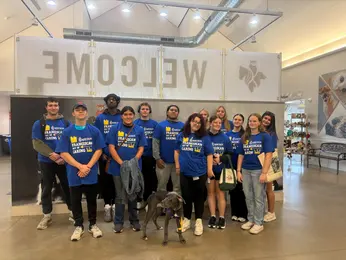
During the first week on campus, students are encouraged through their introductory course to attend Campus Fest, where they can explore more than 300 student organizations, meet fellow students who share their interests and discover communities they might not have even known existed. Whether it is a waterskiing and wakeboarding club, a herpetology organization or a group focused on service, culture or professional interests, the experience helps students recognize that there are communities within the larger university community where they can find connection, pursue their passions and contribute something meaningful.
These organizations and clubs do more than offer opportunities to make friends or participate in activities. They provide students with early experiences in what it means to be an active member of a community. Through organizing events, collaborating on shared goals, taking on leadership roles and relying on one another, students develop valuable skills in communication, leadership, collaboration and responsibility that carry into their academic work, future careers and lives beyond college. In many ways, these smaller communities become places where students practice the skills and responsibilities of civic engagement.
What Happens When a Student Starts Struggling?
The most consequential part of a first-year support system may be what happens after an early warning sign appears.
At BGSU, faculty alerts and engagement indicators can help identify students who may be encountering academic or engagement difficulties. The university's Early Alert program then connects students with outreach coordinators and relevant support.
BGSU reports that retention among first-year students who received Early Alert intervention increased by 8% between 2021 and 2025. That result provides more specific evidence about the relationship between targeted intervention and retention than the university-wide retention figures alone, although it still should not be interpreted as proof that Early Alert was solely responsible for the improvement.
The approach addresses a practical problem highlighted by the NSSE research: students can experience difficulty with coursework while also struggling to obtain help. In that situation, simply making a tutoring center or advising office available may not be enough.
The potential advantage of proactive outreach is timing. A student who receives a personal connection to an appropriate resource early in the semester may have more options than one who waits until academic problems have accumulated.
What Prospective Students Should Evaluate in a First-Year Experience
Whether students are comparing BGSU with other U.S. universities or building a broader college shortlist, several questions can reveal how first-year support actually works:
- When does career exploration begin?Students should look for opportunities to explore interests before they are close to graduation.
- How are new students introduced to campus involvement?A long list of organizations matters less if students have difficulty finding where they fit.
- How accessible are faculty and staff?Relationships can influence whether students know whom to approach when something goes wrong.
- What happens when a student starts struggling?Ask whether the university has early-alert or outreach mechanisms, rather than relying entirely on students to initiate help.
- How are academic and nonacademic signals considered together?Engagement, attendance, faculty concerns and other indicators can provide context that grades alone may miss.
- Can a new student navigate the system without already knowing how college works?Students should be introduced early to the resources, relationships and support systems that help them confidently navigate college life and make the most of their experience..
Where BGSU Fits Into the Decision
What distinguishes BGSU's approach is the intentional way it brings together academic exploration, career development, campus involvement and opportunities to build meaningful relationships from the very beginning of the college experience. Rather than expecting students to discover these opportunities on their own over time, BGSU introduces them early and helps students begin making connections between their interests, their academic pathways and the communities they become part of.
Career exploration gives students an early opportunity to think about where their education could lead. Campus involvement creates opportunities to develop relationships and become connected to university life. Engagement monitoring and Early Alert create another layer intended to identify students who may need assistance.
The university's recent retention figures, its reported Early Alert results and its recognition by APLU provide evidence of an institution investing in this model. BGSU has topped a ranking also among public universities in Ohio for first-year experiences. Still, students should still examine the underlying practices rather than treating a ranking as a substitute for evaluating fit.
For some students, the most important consideration may be a particular academic program, location or cost. For others, especially those anticipating a major transition into college, the quality and accessibility of first-year support may deserve greater weight.
The Better Question to Ask About First-Year Support
The first year is where many students begin discovering whether their expectations about college match reality. They may need academic assistance, rethink a career interest, look for a community or simply figure out whom to contact when something is not going well.
That is why prospective students should look beyond the question, “What resources does this university offer?” A better question is, “How will I be connected to those resources when I need them?”
BGSU offers a useful framework for evaluating what proactive first-year support can look like—and what prospective students should investigate before choosing a university.
References:
- Bowling Green State University. (2025, October 9). BGSU nationally recognized for increasing first-year retention rates through an innovative, personalized approach. https://www.bgsu.edu/news/2025/10/bgsu-nationally-recognized-for-increasing-first-year-retention-rates-through-an-innovative-personalized-approach.html
- Bowling Green State University. (2026, January 7). BGSU sees largest spring enrollment in nearly 20 years, with record number of students continuing their education at the University. https://www.bgsu.edu/news/2026/01/bgsu-sees-largest-spring-enrollment-in-nearly-20-years-with-record-number-of-students-continuing-their-education-at-the-university.html
- College Data. (n.d.). Transition to college survey results. https://www.collegedata.com/resources/transition-to-college/transition-to-college-survey-results
- Ohio Department of Higher Education. (2026). Bowling Green State University completion plan 2026 [PDF]. https://dam.assets.ohio.gov/image/upload/highered.ohio.gov/completion/2026/BGSU_Completion-Plan_2026.pdf
- U.S. Department of Education, Institute of Education Sciences, National Center for Education Statistics. (2018). Transition to college: A national survey of high school seniors’ perceptions and experiences (ED574512). ERIC. https://files.eric.ed.gov/fulltext/ED574512.pdf
- Zhang, Y., & Zhou, M. (2023). Understanding college students’ mental health and well-being during the transition to college: A longitudinal study. BMC Public Health, 23, Article 108. https://pmc.ncbi.nlm.nih.gov/articles/PMC9855184/