2027 Wraparound Services in Social Work: Team Roles and Professional Preparation
Audited and Verified:
Our Editorial and Data Verification Process
Research.com uses government datasets, official education statistics and primary institutional information to support its career and degree guides. Our review process checks factual accuracy, occupational definitions, source dates and the requirements associated with the credentials discussed.
How This Article Was Fact-Checked
Our editorial team verifies salary estimates, employment projections, education requirements and program information against original data providers and official organizations. Salary figures are checked against the relevant occupational definitions and reporting periods. Information about licensure, accreditation and required in-person training is reviewed separately.
Fact-checked and verified on:

Co-Founder and Chief Data Scientist
A wraparound job can involve coordinating a family's goals, school supports, behavioral health care, and community resources - but the title alone rarely tells you what qualifications you need. For social work students, new graduates, and human services professionals, the key is to distinguish team facilitation from clinical treatment and match your preparation to the actual duties.
This guide explains how wraparound teams operate, what their members do, and how to evaluate degrees, field placements, credentials, and job offers without paying for education you may not need.
Key Things You Should Know
- Wraparound is a family- and youth-driven team process, not a single therapy or a standard package of referrals; a facilitator coordinates the plan while team members deliver services within their own roles.
- Facilitator jobs may accept a BSW or another relevant bachelor's degree plus training; psychotherapy and protected social work titles require the qualifications and authorization applicable to the state and role.
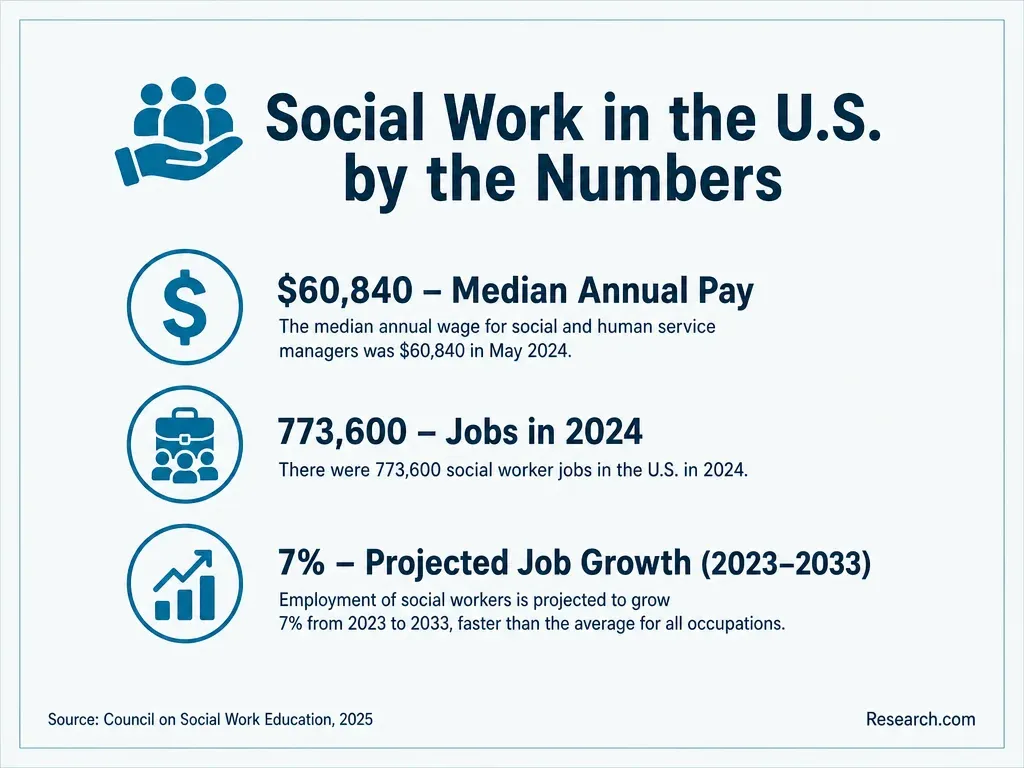
- For context - not a facilitator pay estimate - the U.S. Bureau of Labor Statistics reports a May 2025 median annual wage of $59,550 for child, family, and school social workers and projects 4% employment growth for that occupation from 2025 to 2035.
What are wraparound services in social work, and how do they work?
Wraparound is a structured approach to coordinating individualized support for children or youth with complex needs and their families. Rather than requiring a family to fit a fixed menu of services, a facilitator brings together people the family identifies as helpful, clarifies shared goals, and helps the team build and revise a plan around strengths, needs, culture, and available resources. Programs often use it where behavioral health, school, child welfare, or juvenile justice systems intersect; eligibility and funding rules vary by program.
The process typically moves from engagement and team preparation to an initial plan, ongoing implementation, and transition when formal coordination is no longer needed. A plan should identify who will do what, how the family can access support, and how the team will judge whether the plan is helping. Wraparound does not itself provide psychotherapy, guarantee a service is available, or override a family's rights or an agency's legal obligations.
For someone considering this work as a starting point, planning professional progression with an MSW is a separate decision from learning to facilitate a team. First determine whether the target job calls for coordination, licensed treatment, or program leadership.
Who serves on a wraparound team, and what does each member do?
Membership follows the youth's and family's needs, preferences, and consent, subject to program rules. The following comparison separates coordinating the plan from providing a particular service - an important distinction when reading job descriptions.
| Team member | Typical contribution | Important boundary |
| Youth and family | Identify priorities, strengths, preferred supports, and whether the plan is workable | Participation should be meaningful, not merely a signature on a professional-designed plan |
| Facilitator or care coordinator | Organize meetings, document agreed actions, follow up, and help resolve coordination gaps | Does not become every team member's supervisor or automatically provide clinical treatment |
| Family or youth peer-support partner | Offer perspective grounded in relevant lived experience and help the family navigate services | Peer support has its own training, boundaries, and employer requirements |
| Service providers and natural supports | Provide authorized care, school or community support, and practical help within their roles | Information sharing depends on consent, law, and agency policy |
A clinician may contribute an assessment or treatment plan, while a teacher, relative, or housing worker contributes a different kind of expertise. If the part you want to perform is psychotherapy rather than facilitation, compare the required license pathway before choosing a guide to clinical MSW education options.
What education do wraparound facilitators and social workers need?
There is no single national wraparound degree requirement. Employers may hire facilitators with a BSW, another relevant bachelor's degree, or qualifying experience and agency training; some contracts or positions require an MSW or a license. A BSW can prepare graduates for generalist service coordination. A traditional MSW is an option for graduates of other disciplines seeking advanced social work preparation, while advanced-standing MSW entry generally requires a qualifying BSW and satisfaction of the program's criteria.
Choose education according to the duties you want. If a posting emphasizes meetings, referrals, family engagement, and documentation, ask whether a degree you already hold plus supervised experience and wraparound training qualifies. If it requires clinical assessment or treatment, check its MSW and license specifications. A DSW or PhD is generally unnecessary for entry-level facilitation; those routes serve different advanced practice, leadership, or research goals.
An accelerated MSW study planning resource can help applicants compare schedules, but speed is worthwhile only if the sequence still permits the required field learning and fits their obligations.
Facilitating a wraparound team does not, by itself, establish a universal social work license requirement. The answer depends on the job's duties, protected titles, state law, employer rules, and any program or payer contract. Agency wraparound training, a voluntary credential, a university certificate, and a state-issued professional license are different things; none automatically substitutes for another.
A facilitator who is also assigned clinical duties must meet the requirements for those duties. An MSW alone does not authorize independent psychotherapy, and post-degree clinical supervision is distinct from student field education. Compare the posting with the applicable state board's rules and ask the employer which tasks require a license.
For school comparisons, MSW professional licensure disclosure comparisons can help identify questions to verify with the program and board; a disclosure is not a license approval.
Useful coursework covers person-in-environment assessment, family and youth engagement, social welfare systems, cultural responsiveness, ethics, research literacy, and evaluation. Practice exercises should develop meeting facilitation, collaborative goal setting, documentation, conflict navigation, and attention to structural barriers. Knowledge of a service system matters, but knowing how to obtain a referral is not the same as knowing whether it meets the family's stated need.
Look for a school-approved field placement where students can observe interdisciplinary meetings, practice under supervision, learn confidentiality procedures, and receive feedback on engagement and follow-through. Ask what tasks students may actually perform rather than relying on an agency's name. Paid work or volunteering counts toward curricular field education only if the program approves the arrangement and its learning requirements.
Keep academic field instruction separate from any later board-approved clinical supervision. The distinction is particularly important when reviewing social work experience requirements and professional milestones.
What are the salary and job outlook for wraparound professionals?
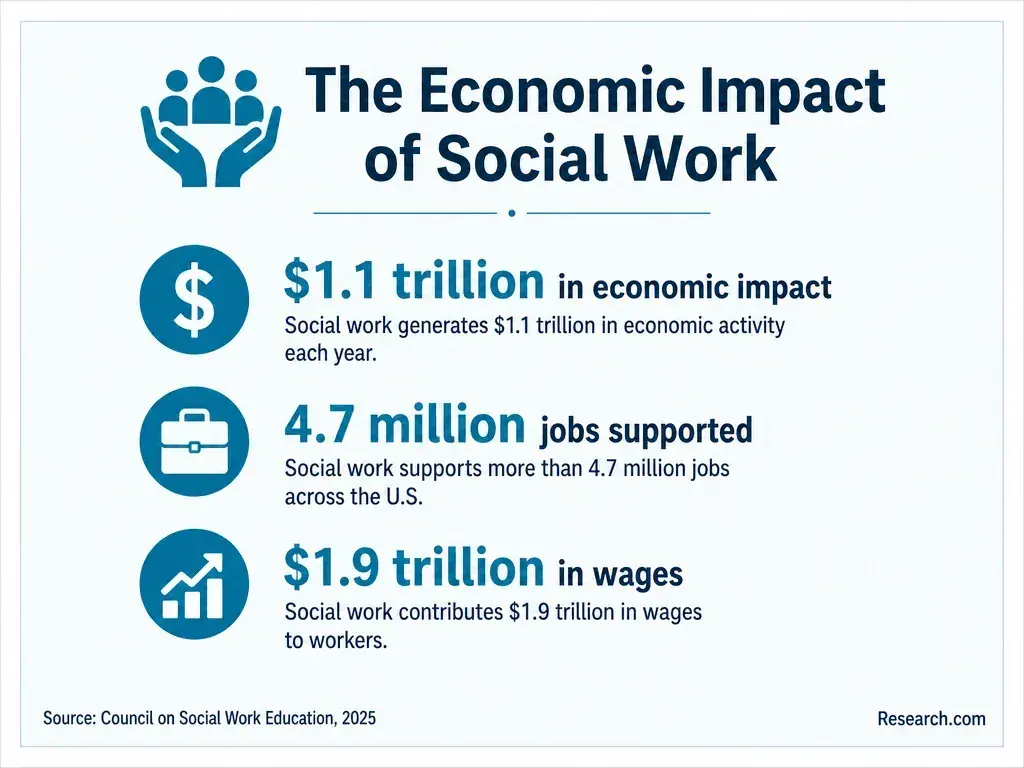
The Bureau of Labor Statistics does not report "wraparound facilitator" as a single occupation, so no national median for that job should be inferred from a social worker category. The figures below are May 2025 U.S. median annual wages and projected 2025-2035 employment growth for related social work occupations; use the category that matches a job's actual duties.
| BLS occupation | Median annual wage, May 2025 | Projected growth, 2025-2035 |
| Child, family, and school social workers | $59,550 | 4% |
| Healthcare social workers | $67,880 | 8% |
| Mental health and substance abuse social workers | $60,280 | 10% |
These occupation-wide figures are not starting salaries, MSW pay premiums, or promises for a particular agency. Compare local postings by required credential, caseload, travel, documentation time, supervision, benefits, and funding stability. When weighing lower-cost MSW choices and professional development, calculate the cost against the jobs for which the degree would actually qualify you. For a coordination role that accepts your existing qualifications, targeted training and strong supervision may be the more direct next step.
Other Things You Should Know About Social Work
No universal eligibility rule applies. Programs set criteria based on their purpose and funding, so ask the local provider which youth and families it serves.
Often, yes. Family-identified natural supports are central to the approach, but participation and information sharing should follow the family's choices and applicable consent rules.
The team should document the gap, explore feasible alternatives with the family, and identify who will follow up. A written plan cannot create an unavailable service.
Team members should follow their roles, agency safety procedures, and applicable reporting requirements. A wraparound meeting is not a substitute for the relevant emergency or protective response.
- Wraparound - California Department of Social Services https://www.cdss.ca.gov/inforesources/cdss-programs/foster-care/wraparound
- Effectiveness of wraparound vs. case management for... - PMC https://pmc.ncbi.nlm.nih.gov/articles/PMC4278946/
- Intensive Care Coordination Using High Fidelity Wraparound | hhs.gov https://preventionservices.acf.hhs.gov/programs/830/show
- Wraparound Best Practice Guidelines | deschutescounty.gov https://www.deschutescounty.gov/DocumentCenter/View/678/System-of-Care-Best-Practice-Guide
- Evaluating Wraparound | ucdavis.edu https://humanservices.ucdavis.edu/wraparound-services/california-wraparound-standards-toolkit/data-outcomes-evaluation
- Assessment and Fidelity in Wraparound | National Wraparound Initiative (NWI) https://nwi.pdx.edu/assessment-fidelity/
- High Fidelity Wraparound (HFW) | alliancehealthplan.org https://www.alliancehealthplan.org/document-library/59391/
- (PDF) Training, Coaching and Supervision for Wraparound Facilitators: Guidelines from the National Wraparound Initiative https://www.researchgate.net/publication/260292279_Training_Coaching_and_Supervision_for_Wraparound_Facilitators_Guidelines_from_the_National_Wraparound_Initiative
- Ten Principles of High-Fidelity Wraparound | Positive Education Program (PEP) https://www.pepcleve.org/resources/articles/2021/12/20/ten-principles-of-high-fidelity-wraparound