2027 Transportation Barriers in Social Work Service Planning: Resources and Coordination
Audited and Verified:
Our Editorial and Data Verification Process
Research.com uses government datasets, official education statistics and primary institutional information to support its career and degree guides. Our review process checks factual accuracy, occupational definitions, source dates and the requirements associated with the credentials discussed.
How This Article Was Fact-Checked
Our editorial team verifies salary estimates, employment projections, education requirements and program information against original data providers and official organizations. Salary figures are checked against the relevant occupational definitions and reporting periods. Information about licensure, accreditation and required in-person training is reviewed separately.
Fact-checked and verified on:

Co-Founder and Chief Data Scientist
A service plan can fail even when the right appointment, benefit, or program is available: the client may have no reliable way to get there. Transportation barriers can affect healthcare, school attendance, employment, and access to basic needs.
This guide is for social work students, case managers, and community-service professionals who need to assess those barriers and coordinate realistic solutions. It explains which resources to check, how to work with providers, where ethical limits apply, and what education or experience supports this work.
Key Things You Should Know
- Assess the entire trip, not just whether a client owns a car, including cost, accessibility, scheduling, childcare, and the return journey.
- Match the ride to the trip's purpose and the client's eligibility; Medicaid nonemergency medical transportation, paratransit, and community rides have different rules and availability.
- Transportation coordination is often part of case management rather than a separately licensed specialty. For career context, U.S. healthcare social workers had a $67,880 median annual wage in May 2025, but that occupation-wide figure does not predict a coordinator's pay.
How do transportation barriers affect social work service planning?
A transportation barrier is any difficulty getting to or from a service reliably, safely, and at an affordable cost. It may involve a missing bus route, an inaccessible vehicle, unpredictable work hours, limited fare money, or a trip that requires several transfers. In a person-in-environment assessment, these are service-access conditions, not evidence that a client lacks motivation.
The consequence depends on the service. A missed benefits interview may delay an application; a missed recurring appointment may interrupt care; an unreliable route to a training program may threaten attendance.
A useful plan therefore pairs each important service with a feasible way to reach it, a backup when appropriate, and a check on whether the arrangement worked. Transportation should be discussed alongside other barriers rather than treated as an afterthought.
These tasks appear across several roles, not only jobs titled "social worker." Readers comparing service-coordination work with other options can review MSW career directions beyond a single job title; the right qualification still depends on the position's duties and employer requirements.
How do social workers assess clients' transportation needs?
Start with the client's destination and preferred way of traveling, then examine whether that choice works for the actual trip. Ask permission before contacting a ride provider or sharing information. An assessment should capture what the client can do independently without assuming that disability, age, income, or location determines their preference.
These questions turn a general statement such as "I need a ride" into information that can guide a referral:
- Trip details: Where and when must the client arrive, how long might the visit take, and is a return ride needed?
- Practical access: Can the client reach the pickup point, pay any fare, travel with a child or support person, and use the vehicle offered?
- Reliability and choice: What has worked before, what has failed, and which options does the client consider safe and acceptable?
- Eligibility: Is the trip medical or nonmedical, and do coverage, residency, disability-related, age-related, or program rules apply?
Document the barrier in functional terms—for example, that the available bus does not reach an appointment before check-in—rather than labeling the client "noncompliant." Reassess when the destination, health, schedule, or provider changes.
Prospective students considering where to develop these assessment skills can use social work degree planning for prospective students as a starting point, then inspect each program's actual practice and field curriculum.
What transportation resources can social workers connect clients with?
Resource selection begins with the trip's purpose, the client's eligibility, and local service coverage. A ride advertised as available may still exclude a destination, require advance notice, or lack an accessible vehicle.
The comparison below identifies common U.S. options and their main limits; it is not a promise that any particular service operates locally.
| Resource | Potential fit | Limit to verify |
| Public transit or reduced-fare programs | Regular trips on a usable route | Hours, transfers, fare eligibility, and access to stops |
| ADA complementary paratransit | Eligible riders whose disability prevents use of the fixed-route system for covered trips | Individual eligibility, service area, booking rules, and fares |
| Medicaid nonemergency medical transportation | Eligible Medicaid-related trips to covered care when transportation is needed | State and plan rules, approved destinations, scheduling, and available ride types |
| Area Agency on Aging, disability, or community programs | Trips supported by a local aging or community-service network | Population served, trip priorities, capacity, and funding |
| Agency assistance, volunteer drivers, or accessible taxis | A gap not covered by a standing transit option | Agency approval, cost, insurance, accessibility, and driver procedures |
For a medical trip, check the client's applicable coverage and transportation administrator before spending scarce agency funds. For a recurring nonmedical trip, compare reliability and total cost over time, not just the price of one ride. A referral directory is useful only if staff confirm current hours, service boundaries, and contact procedures.
Students interested in generalist resource navigation can examine field opportunities while choosing an accredited BSW program. Accreditation supports the educational pathway; it does not guarantee that a placement will teach a particular local transportation system.
Client choice remains central even when staff believe one route is easiest. Explain the available options and meaningful limits, including cost, shared rides, advance booking, and information a provider needs.
Share only information necessary to arrange the trip, using the consent and record-handling rules that apply to the agency, service setting, and jurisdiction. Professional ethical guidance, privacy law, contracts, and agency policy may impose different requirements.
Safety questions include whether a vehicle can accommodate the rider, whether a child or support person may travel, who assists at pickup and drop-off, and what the provider does when a ride fails. Do not assume a volunteer driver, staff member's personal car, or rideshare account is an approved substitute.
Confirm insurance, screening, accessibility, expense, and boundary rules before proposing such an option. A transportation plan is not an emergency-response plan; urgent safety concerns require the agency's applicable procedures.
Students and new graduates should distinguish coordination performed within an approved role from clinical decisions that require separate authority. Planning supervised experience in a social work career is a separate question: arranging rides during BSW or MSW field education does not automatically count as post-degree clinical supervision.
What careers, salaries, and job prospects involve social work service coordination?
Transportation coordination appears in healthcare social work, child and family services, aging and disability programs, housing services, and other case-management roles.
The amount of coordination varies: one job may focus on benefits navigation, while another combines discharge planning or broader social work assessment with referrals. Review the actual duties, caseload, travel expectations, supervision, and degree or license requirements before treating a title as a career match.
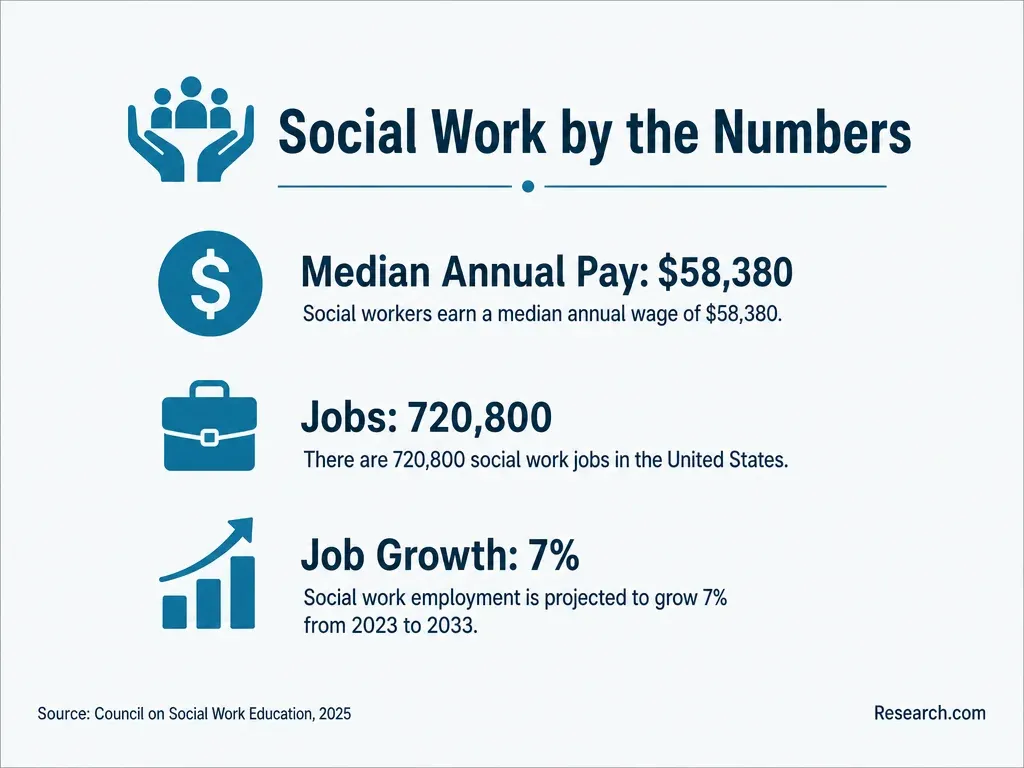
For U.S. salary context, the Bureau of Labor Statistics reports a May 2025 median annual wage of $67,880 for healthcare social workers, with employment projected to grow 8% from 2025 to 2035. Child, family, and school social workers had a $59,550 median and 4% projected growth.
These are occupational figures, not wages or growth forecasts specifically for transportation coordinators, MSW graduates, or a particular agency. Location and employer also matter; a state-level social work pay comparison guide can provide additional context when weighing local opportunities.
Other Things You Should Know About Social Work Programs
First confirm the client's immediate situation and the provider's missed-ride procedure. Then help the client decide whether to reschedule, seek an approved alternative, or notify the destination. Document what happened without assuming the client caused the failure.
Check the service's own transportation options, local aging or disability networks, and approved community providers. If none can serve the trip, document the access gap and consider whether the service can be delivered at another location or remotely when appropriate.
Do not make an informal payment without checking agency policy and professional boundaries. Ask a supervisor about approved emergency assistance, reimbursement, or referral funds and how the expense must be recorded.
Track measures the agency can collect lawfully, such as referrals made, rides confirmed, missed pickups, and whether clients reached the intended service. Review results with clients and partners; a confirmed booking alone does not establish successful access.
- Case Management - StatPearls - NCBI Bookshelf https://www.ncbi.nlm.nih.gov/books/NBK562214/
- Lack of Reliable Transportation for Daily Living Among Adults | cdc.gov https://www.cdc.gov/nchs/products/databriefs/db490.htm
- A systematic review of interventions to minimize transportation barriers among people with chronic diseases - PMC https://pmc.ncbi.nlm.nih.gov/articles/PMC6450539/
- NASW Standards for Social Work Case Management | nycourts.gov https://www.nycourts.gov/reporter/webdocs/nasw_standards_socialwork_casemgt.htm
- Transit Coordination in the U.S.: A Survey of Current Practice | usf.edu https://digitalcommons.usf.edu/cgi/viewcontent.cgi
- What Is Case Management in Social Work? | University of Nevada, Reno https://onlinedegrees.unr.edu/blog/what-is-case-management-in-social-work
- Transportation access | Urban Institute https://upward-mobility.urban.org/framework/neighborhoods/transportation
- Population Considerations for Rural Transportation Programs | Rural Health Information Hub https://www.ruralhealthinfo.org/toolkits/transportation/1/population-considerations