
2027 Transition-Age Youth Services: Connecting Child and Adult Support Systems
Audited and Verified:
Our Editorial and Data Verification Process
Research.com uses government datasets, official education statistics and primary institutional information to support its career and degree guides. Our review process checks factual accuracy, occupational definitions, source dates and the requirements associated with the credentials discussed.
How This Article Was Fact-Checked
Our editorial team verifies salary estimates, employment projections, education requirements and program information against original data providers and official organizations. Salary figures are checked against the relevant occupational definitions and reporting periods. Information about licensure, accreditation and required in-person training is reviewed separately.
Fact-checked and verified on:

Co-Founder and Chief Data Scientist
A young person can leave foster care, school-based services, or pediatric care before adult housing, benefits, or treatment is in place. Transition-age youth services aim to prevent that gap. For students, new social workers, and human services professionals, the work raises a career decision: do you want to coordinate services, provide clinical care, or improve the systems youth must navigate?
This guide explains the handoff, the qualifications different roles require, and how to evaluate education and field opportunities against the work you actually want to do.
Key Things You Should Know
- Transition-age youth services connect young people with adult supports before child-focused eligibility ends; the age range and available services vary by program and state.
- Service coordination may be open to BSW graduates or other qualified human services workers, while independent clinical treatment requires a state-specific license and additional supervised practice.
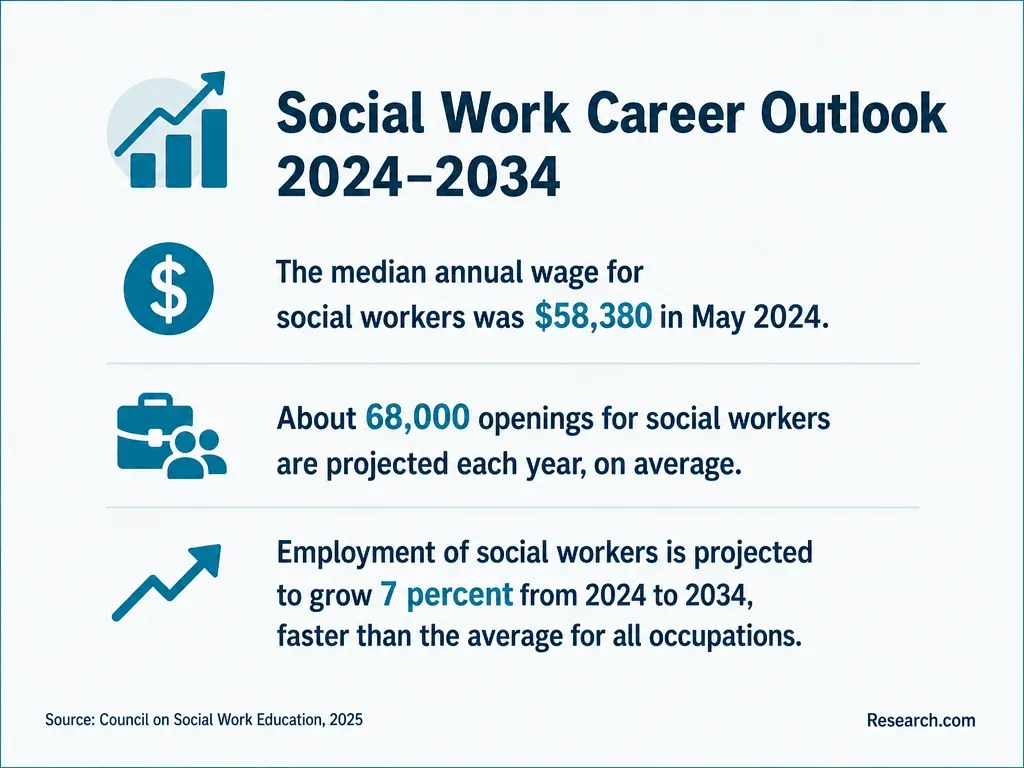
- For salary context, the U.S. Bureau of Labor Statistics reports a May 2025 median of $59,550 for child, family, and school social workers - not a promised wage for transition-services jobs.
What are transition-age youth services in social work?
Transition-age youth services help adolescents and young adults move from child-focused programs toward stable adult supports. Agencies use different age ranges and eligibility rules. The work may involve youth leaving foster care, students exiting school-based disability services, or young people transferring from pediatric to adult behavioral healthcare.
The central problem is that these systems do not share one timetable. A school support may end at graduation while an adult service has a waiting list; a housing application may require documents a young person does not have. Social workers assess needs in context, help youth set their own priorities, and coordinate across agencies rather than treating a referral as a completed handoff.
Not every transition-support position requires a social work degree. If you are deciding between general service coordination and a regulated social work role, comparing social work degrees before enrollment is more useful than choosing a degree based on the population name alone.
How do social workers connect youth with adult support systems?
Effective transition work begins while youth-focused support is still available. The social worker and young person identify upcoming eligibility changes, strengths, immediate risks, and practical barriers such as transportation, identification documents, insurance, or a place to stay. With appropriate consent, the worker brings relevant providers together and clarifies who will do what.
A workable handoff has a sequence that the youth can understand and the team can verify:
- Set youth-directed goals and identify which child-focused services may end or change.
- Check adult-program eligibility, application deadlines, documentation needs, and waiting lists.
- Arrange introductions or appointments rather than relying only on a list of referrals.
- Confirm whether services actually started, document unresolved barriers, and revise the plan with the youth.
Privacy and authority matter throughout. Reaching adulthood may change who can consent to sharing information, even when family members remain important supports. Workers should follow applicable law and agency policy rather than assuming a prior release still applies. Coordinating a mental health referral is also different from providing psychotherapy; someone drawn to treatment should evaluate clinical social work master's preparation and the later licensing requirements separately.
What degree do you need to work with transition-age youth?
The target duties determine the education route. Some outreach, navigation, and case-management employers consider applicants with a BSW or another relevant bachelor's degree plus experience. Positions specifically classified as social worker, advanced clinical positions, and some school or healthcare roles may impose different degree and credential requirements. Read the duties and minimum qualifications, not just the job title.
A BSW offers generalist social work preparation and supervised field education. A traditional MSW admits eligible graduates from other disciplines and adds foundation and specialized study. Advanced-standing MSW entry generally requires a qualifying BSW and meeting the program's additional criteria; a psychology or human services degree alone does not establish eligibility. For a prospective applicant, planning the transition into an appropriate MSW track can prevent an unrealistic timeline or budget.
If your goal is to coordinate applications and build community partnerships, supervised agency experience or targeted benefits training may be more direct than another degree. Consider an MSW when the positions you want require it or when advanced social work practice is the goal - not because every transition-services job does.
There is no single transition-age youth license. Requirements depend on the state, employer, setting, and activities performed. A navigation position may not require social work licensure, while a position using a protected social worker title may require a state license. Independent clinical assessment or psychotherapy generally involves a separate clinical licensing pathway.
For a regulated role, distinguish graduation from board approval, any required examination, license issuance, and authority to practice independently. An MSW or clinical concentration does not by itself confer that authority. Academic field education is also different from post-degree, board-accepted supervised clinical experience. Before accepting a clinical position or supervision arrangement, review your state board's rules and social work clinical hour requirements.
These jobs differ more by function and setting than by the phrase "transition-age youth" in a posting. The comparison below helps you match your interests to likely duties; employer qualifications and protected titles still need to be checked locally.
| Role or setting | Main contribution to the transition | Qualification to verify |
| Youth navigator or case manager | Coordinates housing, benefits, education, employment, and referrals | Employer's degree, experience, and title requirements |
| Child welfare or independent-living worker | Plans for support as youth leave foster-care services | Agency classification, training, and state requirements |
| School-to-adult-services social worker | Collaborates with students, families, schools, and adult providers | School-specific social work qualifications and state rules |
| Behavioral health social worker | Connects care across youth and adult services; may provide treatment within authorized scope | MSW and applicable license for clinical duties |
| Program coordinator or manager | Improves referral partnerships, staffing, and service follow-through | Relevant service and management experience |
When comparing offers, ask about caseloads, supervision, documentation demands, safety procedures, travel, and whether partner agencies have capacity to accept referrals. Experienced workers seeking program leadership may benefit from targeted management or evaluation training; a doctorate is not a default requirement. Consider affordable advanced social work degree options only if a specific advanced practice, teaching, or leadership objective justifies the additional study.
What are the salaries and job outlook for these social work careers?
No national wage category isolates transition-age youth work. The following U.S. Bureau of Labor Statistics figures offer context for related social worker occupations: median annual wages are for May 2025, and projected employment changes cover 2025-2035.
| BLS occupation | Median annual wage | Projected employment change |
| Child, family, and school social workers | $59,550 | +4% |
| Healthcare social workers | $67,880 | +8% |
| Mental health and substance abuse social workers | $60,280 | +10% |
| Social workers, all specialties | $61,780 | +6% |
These are occupation-wide medians and projections, not starting salaries, youth-program wages, or outcomes guaranteed by a degree. A navigator classified outside a social worker occupation may have a different pay range. Compare local postings by duties, employer, and required license; understanding location differences in MSW earnings can add context, but it cannot replace a specific job offer or pay scale.
Other Things You Should Know About Social Work
Often, if the young adult wants that involvement and applicable consent and privacy rules permit it. Workers should ask the young person how they want supporters included rather than assume parental access continues unchanged.
No. Programs also serve youth moving from school, disability, healthcare, behavioral health, or other child-focused systems. Eligibility depends on the particular service and jurisdiction.
Find out why, check whether information is missing or another eligibility route exists, and help the young person consider available alternatives. Document the barrier and follow the agency's escalation procedures when appropriate.
Track more than referrals sent: confirm whether the young person connected with the adult provider, received the intended service, and knows whom to contact next. Review those measures with youth while protecting their privacy.
- Adult Medicaid & HCBS Transition | Health & Human Services https://hhs.iowa.gov/medicaid/about-medicaid/medicaid-projects/home-project/adult-medicaid-hcbs-transition
- Considerations for privacy and confidentiality in adolescent health care service delivery - PMC https://pmc.ncbi.nlm.nih.gov/articles/PMC10186092/
- Transition from School to Post School for Students with Disabilities | New York State Education Department https://www.nysed.gov/special-education/transition-school-post-school-students-disabilities
- Youth Transition Services | dol.gov https://www.dol.gov/agencies/odep/program-areas/individuals/youth/transition/federal-partners
- Transition-aged Youth - Ohio Department of Behavioral Health https://dbh.ohio.gov/wps/portal/gov/mha/get-help/treatment-services/transition-aged-youth
- Data Systems and Organizational Improvement | Child Welfare Information Gateway https://www.childwelfare.gov/topics/data-systems-and-organizational-improvement
- Healthcare Needs and Transition Planning for Youth with Autism | Autism Spectrum Disorder (ASD) | CDC https://www.cdc.gov/autism/publications/addm-network-adolescents-transition-planning.html
- Children, Youth, and the Law: Transition Age Youth | LibGuides at Boston College Law Library https://lawguides.bc.edu/children-youth-law/transition
- Transition to adult care for youth with medical complexity | sciencedirect.com https://www.sciencedirect.com/science/article/abs/pii/S0882596321002396
- Federal and State Special Education Transition Planning Provisions | aap.org https://www.aap.org/en/patient-care/national-center-for-a-system-of-services-for-children-and-youth-with-special-health-care-needs/incorporating-pediatric-to-adult-health-care-transition-in-sp-ed-transition-planning/federal-and-state-special-education-transition-planning-provisions/


