2027 Symbolic Interactionism in Social Work: Meaning, Identity, and Everyday Interaction
Audited and Verified:
Our Editorial and Data Verification Process
Research.com uses government datasets, official education statistics and primary institutional information to support its career and degree guides. Our review process checks factual accuracy, occupational definitions, source dates and the requirements associated with the credentials discussed.
How This Article Was Fact-Checked
Our editorial team verifies salary estimates, employment projections, education requirements and program information against original data providers and official organizations. Salary figures are checked against the relevant occupational definitions and reporting periods. Information about licensure, accreditation and required in-person training is reviewed separately.
Fact-checked and verified on:

Co-Founder and Chief Data Scientist
A client's description of "independence" may differ from an agency's definition, and a label in a record can shape how others respond. Symbolic interactionism helps social work students and practitioners examine those everyday exchanges rather than assume everyone gives words, roles, and services the same meaning. This guide explains the theory, shows how to use it without overlooking structural barriers, and helps prospective students decide whether studying it calls for a degree, field experience, or more targeted training.
Key Things You Should Know
- Symbolic interactionism examines how people develop and revise meanings through interaction; in social work, it helps practitioners explore what a client's words and social roles mean to that client.
- It is a framework for understanding engagement and identity, not a treatment protocol or a substitute for assessing material needs, safety, and institutional barriers.
- Students can practice the framework through interviews, case simulations, and supervised field learning; studying the theory alone does not confer a social work credential or license.
What is symbolic interactionism in social work?
Symbolic interactionism is a sociological perspective that examines how people act on the meanings things have for them, develop those meanings in interaction, and interpret or revise them over time. A "symbol" can be a word, gesture, professional title, form, or social role. Its significance depends partly on how people use and respond to it.
For social workers, the practical question is not only what happened, but what the people involved understood it to mean. "Support," for example, could mean financial help, privacy, advice, or someone accompanying a person to an appointment.
Asking rather than assuming can improve engagement and collaborative goal setting. The perspective complements person-in-environment assessment: it illuminates interaction without replacing attention to income, housing, discrimination, or policy.
Students exploring this idea during undergraduate study can use planning undergraduate study in social work to compare degree routes. A full BSW makes sense when the goal is qualifying social work preparation, not merely learning one theory.
How does symbolic interactionism explain meaning and identity?
Identity is shaped partly through interaction: people interpret how others see them, take on or resist roles, and adjust their understanding of themselves. A person may identify as a caregiver while an intake form identifies them only as a "service recipient." Neither description captures the whole person. Repeated responses from family members, institutions, and professionals can make particular identities easier or harder to sustain.
Social workers can use this insight to notice how language affects participation. Calling someone "noncompliant" may obscure whether a service plan conflicted with their priorities, was inaccessible, or was never clearly explained. This does not mean every disagreement is a misunderstanding; it means the worker should investigate meaning alongside circumstances and documented facts.
BSW and MSW students may revisit these concepts at different levels of practice. For someone choosing graduate study, MSW pathway differences by prior degree matter more than seeking a program that promises a single theory: qualifying BSW graduates may be considered for advanced standing, while graduates of other disciplines generally enter a traditional or foundation route.
What are examples of symbolic interactionism in social work practice?
These hypothetical examples show how the framework can improve a question or interpretation. They do not establish what intervention a particular client needs.
- Housing services: An agency's goal of "stable housing" may mean a lease in the client's name, while the client prioritizes staying near relatives who provide care. Exploring both meanings can clarify goals without ignoring eligibility rules or housing supply.
- School practice: A student described as "disruptive" may experience repeated public correction as a sign that staff expect failure. A school social worker could examine the interaction and the student's account while also reviewing attendance, accessibility needs, school policy, and safety concerns.
- Healthcare: A patient and care team may use "independent" differently when discussing discharge. Clarifying what tasks, supports, and risks each person has in mind can improve coordination; discharge decisions still depend on clinical judgment and applicable procedures.
These examples span different duties and qualifications. Readers interested in where such work may occur can compare career paths with an MSW, then check the actual position's license and supervision requirements.
Programs may introduce the perspective in human behavior and the social environment, practice, or research courses rather than a class devoted to symbolic interactionism. BSW students might compare competing interpretations of a case simulation; MSW students might examine how professional labels affect an assessment, an organizational process, or a research interview. Course titles and emphases vary.
Field education offers a more demanding test: under approved supervision, students can practice asking what a client means, recording the response accurately, and reflecting on how their own language affected the exchange. A classroom interpretation is not proof of field competence, and field education is not the same as post-degree supervision toward clinical licensure.
Students who want to study how meaning is explored in research or agency work can also ask whether social work graduate assistantships and career skills opportunities fit their goals. An assistantship's tasks, funding, and availability must be confirmed with the program; it does not replace required field education unless the school explicitly approves an arrangement.

What are social workers' salary expectations and job prospects?
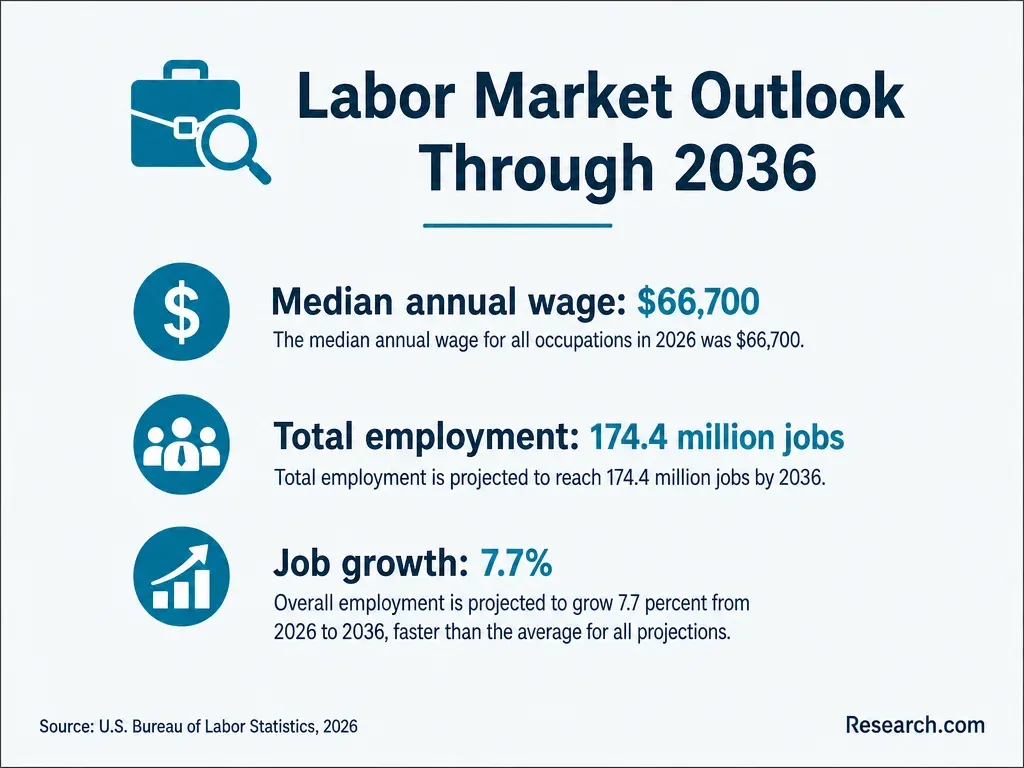
Salary depends on occupation, setting, geography, experience, and employer - not on whether a worker uses symbolic interactionism. The U.S. Bureau of Labor Statistics reports the following national occupational medians for May 2025 and employment projections for 2025-2035.
| BLS occupation | Median annual pay, May 2025 | Projected employment growth, 2025-2035 |
| Child, family, and school social workers | $59,550 | 4% |
| Healthcare social workers | $67,880 | 8% |
| Mental health and substance abuse social workers | $60,280 | 10% |
| Social workers, all specialties | $61,780 | 6% |
These figures describe broad occupations, not starting pay, an MSW graduate's earnings, or the return from studying a particular theory. Use the category that matches the intended work, then compare local postings and the full cost of any required education. Online MSW costs and career outcomes are useful to examine only if the target role actually calls for that degree.
Other Things You Should Know About Social Work
No. They overlap in their interest in socially produced meanings. Symbolic interactionism focuses especially on how meanings are formed and revised through interaction; social constructionism is a broader family of approaches to how shared understandings become established.
No. A worker can take a person's account seriously, ask clarifying questions, and document it accurately while still checking relevant evidence and fulfilling professional and legal duties.
Distinguish what the person said from the worker's interpretation. Use specific, relevant descriptions instead of an unexplained label, and follow agency documentation and confidentiality rules.
Use the agency's qualified language-access process rather than assuming a translated word carries the same meaning for everyone. Check understanding with the client, including what important terms mean in their circumstances.
- Aspects of power sensitivity among social workers and... - PMC https://pmc.ncbi.nlm.nih.gov/articles/PMC12415015/
- NASW Standards for Social Work Case Management | nycourts.gov https://www.nycourts.gov/reporter/webdocs/nasw_standards_socialwork_casemgt.htm
- Social Interactionism as Defined by Herbert Blumer | umn.edu https://www.d.umn.edu/cla/faculty/jhamlin/4111/Blumer/House%20Atreides%20-%20Social%20Interactionism%20as%20Defined%20by%20Herber.htm
- Symbolic Interactionism and Social Assessment | wmich.edu https://scholarworks.wmich.edu/cgi/viewcontent.cgi
- Symbolic Interactionism | iastate.edu https://dr.lib.iastate.edu/bitstreams/3beb3c90-6f2c-41e6-b2aa-6458a1e79ce0/download
- Theory Informed Direct Practice: SSWG 5101 and SSWG 5102 | Research Guides at Temple University https://guides.temple.edu/directpractice/planning-intervention
- Symbolic Interactionist Theory | OpenEd CUNY https://opened.cuny.edu/courseware/lesson/116/student-old/
- How to Perform a Social Work Needs Assessment | Virginia Commonwealth University https://onlinesocialwork.vcu.edu/blog/social-work-needs-assessment/
- Symbolic Interactionism and Social Work: A Forgotten Legacy, Part 1 - James A. Forte, 2004 https://journals.sagepub.com/doi/10.1177/104438940408500317
- George Herbert Mead - Stanford Encyclopedia of Philosophy https://plato.stanford.edu/entries/mead/