2027 Social Workers and Peer Specialists: Professional Expertise and Lived Experience
Audited and Verified:
Our Editorial and Data Verification Process
Research.com uses government datasets, official education statistics and primary institutional information to support its career and degree guides. Our review process checks factual accuracy, occupational definitions, source dates and the requirements associated with the credentials discussed.
How This Article Was Fact-Checked
Our editorial team verifies salary estimates, employment projections, education requirements and program information against original data providers and official organizations. Salary figures are checked against the relevant occupational definitions and reporting periods. Information about licensure, accreditation and required in-person training is reviewed separately.
Fact-checked and verified on:

Co-Founder and Chief Data Scientist
Social workers and peer specialists often serve the same people, but they contribute different kinds of expertise. That distinction matters when an agency builds a team—or when someone with community-service or personal recovery experience chooses a career path.
This guide compares their responsibilities, preparation, credentials, costs, and employment prospects. It also shows how the roles can work together without treating lived experience as clinical training or a social work degree as a substitute for peer support.
Key Things You Should Know
- Social workers use professional education and, where required, licensure; peer specialists use relevant lived experience plus role-specific training to offer nonclinical, mutual support.
- A peer credential does not authorize psychotherapy, and a social work degree does not automatically qualify someone for a peer role or independent clinical practice.
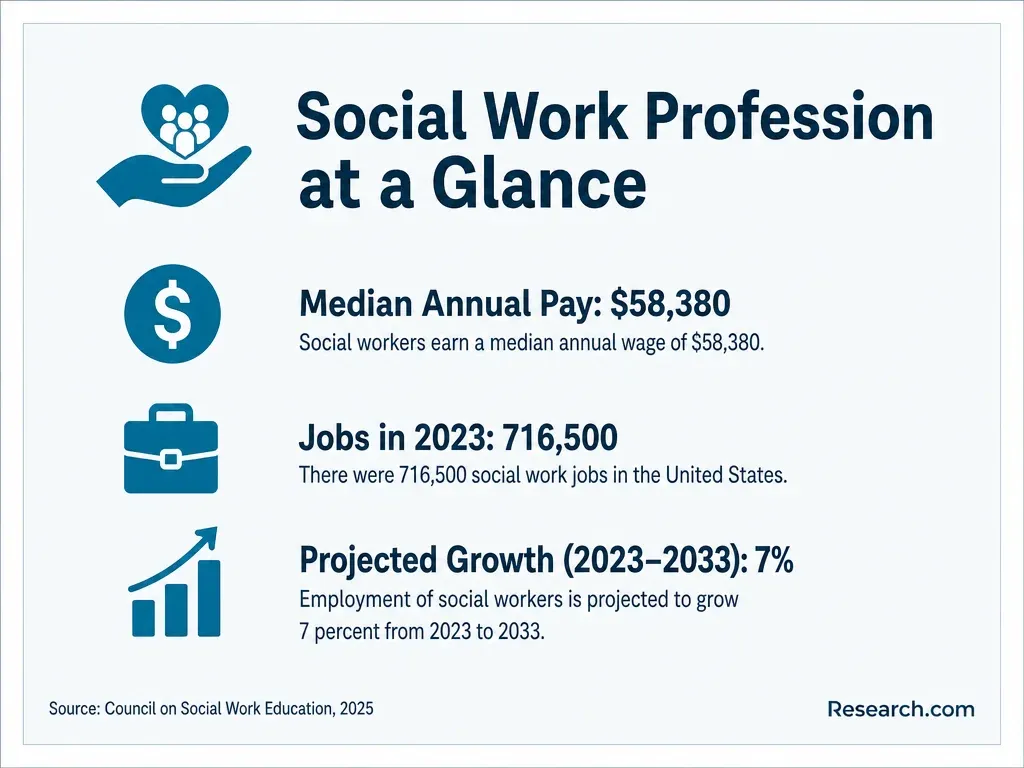
- The U.S. median annual wage for social workers was $61,780 in May 2025, with 6% employment growth projected for 2025-2035; those figures do not describe peer-specialist pay or openings.
What is the difference between a social worker and a peer specialist?
A social worker applies social work education to assess needs in context, coordinate services, advocate, and, when appropriately licensed, provide clinical services. A peer specialist draws on relevant personal experience—often of mental health recovery, substance use recovery, or navigating services—to build trust, share practical strategies, and support a person's self-defined goals. Peer support is an intentional professional role, not simply telling one's story.
The comparison below describes common functions, not permissions that apply in every state or workplace:
| Dimension | Social worker | Peer specialist |
| Primary contribution | Professional assessment, service coordination, advocacy, and other work within education and authorized scope | Mutual support, recovery-oriented encouragement, and insight from relevant lived experience |
| Typical relationship | Professional helping relationship governed by role, ethics, and applicable license | Intentional use of shared experience while maintaining professional boundaries |
| Clinical authority | Depends on state license, supervision, and setting; an MSW alone is insufficient for independent clinical practice | Peer certification does not authorize diagnosis or psychotherapy |
Job titles can be misleading: some case-management positions do not require a social work degree, while "social worker" may be a protected title under state law. People considering broader MSW careers across different practice settings should compare actual duties and hiring requirements rather than titles alone.
What education and training do social workers and peer specialists need?
A BSW prepares graduates for generalist social work practice. An MSW builds on foundational learning and supports more specialized roles; applicants with a bachelor's degree in another subject can generally consider a traditional or foundation MSW sequence. Advanced-standing MSW admission typically requires a qualifying social work bachelor's degree and satisfaction of the individual program's rules. Neither degree replaces employer onboarding or any post-degree supervision required for a license.
Peer-specialist entry generally centers on qualifying lived experience and completion of a state, employer, or credentialing program's training and assessment requirements. Rules vary by peer role: mental health, substance use, family, and youth peer positions may have different eligibility criteria. A social work degree is not generally the prerequisite, and lived experience alone may not meet a funded position's credential requirements.
Someone who already qualifies for advanced standing can explore shorter online MSW degree options but should check placement schedules and whether the route meets their intended state's educational rules. If the target job is peer support, a qualifying peer-training route may be more direct and less costly than an MSW.
What licenses or certifications do these careers require?
Social work licenses are issued by states, which set their own degree, examination, supervised experience, and practice scope rules. Some jobs require a particular license; independent clinical work generally requires a separate clinical licensure pathway after the MSW. Graduation, examination eligibility, passing an exam, and license issuance are distinct steps. Before choosing a school or job, check the relevant state board and the employer's written requirements; a social work master's licensure requirement guide can help frame the questions to ask.
Peer specialists may need a state-recognized certification or an employer-approved credential, particularly where services are billed through Medicaid. Certification titles, eligibility, training, examinations, supervision, and renewal vary. Check the state's peer credentialing authority and the employer or payer before paying for training. Peer certification is distinct from a social work license and does not expand clinical scope.
BSW and MSW study commonly covers human behavior in its social environment, policy, research literacy, ethics, engagement, assessment, intervention, and evaluation. Supervised field education gives students opportunities to demonstrate those competencies in approved settings. Programs differ in their clinical, community, policy, and other specialized offerings; coursework or field experience does not itself confer a license.
Peer training typically emphasizes purposeful use of lived experience, recovery-oriented practice, self-determination, communication, boundaries, confidentiality, cultural responsiveness, and navigating resources. Training should also make clear when a concern must be referred to a clinician, supervisor, or other designated staff member. Ask whether a course includes observed skills practice and satisfies the specific credential sought, rather than assuming any peer-support certificate will qualify.
For a social work applicant, the most useful curriculum is the one that supports the intended role and includes workable field placements—not necessarily the most expensive one. Compare course and placement support when reviewing lower-tuition Master of Social Work pathways. A DSW or PhD serves different advanced practice, leadership, or research aims and is not a routine requirement for either entry-level role.
For a BSW or MSW, verify the institution's accreditation and the exact social work program's Council on Social Work Education (CSWE) accreditation status, including any status or cohort conditions. Then ask the prospective state licensing board whether the degree and delivery arrangement satisfy its education rules. Institutional accreditation alone does not establish CSWE program accreditation or licensure eligibility.
Online classes do not eliminate field education, live skills work, or possible campus visits. Compare who finds placements, where they may occur, what qualified field instruction is available, and whether required hours fit work and caregiving commitments. When comparing online social work education pathways, request these details in writing for the intended enrollment term and location.
Peer training follows a different verification route: ask the applicable state or credentialing body which providers and formats it accepts. A campus-based social work program is not automatically a route to peer certification, and an online peer course is not automatically accepted across states.
A full-time BSW commonly follows a four-year bachelor's sequence. A traditional full-time MSW often takes about two academic years, while an eligible student's advanced-standing sequence can be shorter; part-time schedules and placement availability can extend either route. Peer training is usually much shorter than a degree, but total time to certification may include an assessment, supervised work, or other jurisdiction-specific steps. Request the actual sequence and next available start dates rather than relying on an advertised minimum.
Compare the total cost to the intended role, not tuition alone. Social work students may face fees, books, screening, travel, and reduced paid hours during field placement; prospective licensees may also face examination, application, and supervision costs. Peer trainees should check training and assessment charges and whether an employer or public workforce program covers them. Neither pathway guarantees a paid placement or a particular salary.
Doctoral study adds substantial time and expense and is rarely the shortest route into these two jobs. If an experienced social worker has a separate leadership or research goal, social work doctoral tuition comparisons are more relevant than they are to an entry-level social worker-versus-peer decision.
How do salaries and job outlook compare for social workers and peer specialists?
U.S. Bureau of Labor Statistics figures put the median annual wage for social workers across specialties at $61,780 in May 2025, with employment projected to grow 6% from 2025 to 2035. The figures vary meaningfully by specialty: the reported medians were $59,550 for child, family, and school social workers, $67,880 for healthcare social workers, and $60,280 for mental health and substance abuse social workers. Their corresponding projected growth rates were 4%, 8%, and 10%.
BLS does not report peer specialists as a directly comparable, standalone occupation in those figures. Broader support-worker categories can include very different jobs, so their medians should not be presented as a peer-specialist salary. Compare local peer postings with social work postings that match the required degree, license, setting, and schedule. For social work roles, comparing pay locations for master's-prepared social workers can add geographic context, but occupation-wide medians are not offers or guaranteed returns on education.
Other Things You Should Know About Social Work
No. Purposeful self-disclosure should serve the person's goals and respect the peer specialist's boundaries. Employers may have policies about what is appropriate to share.
Potentially, if they independently meet both sets of requirements. They should clarify which role they are performing in each encounter and follow its scope and documentation rules.
Not necessarily. Family, youth, mental health, and substance use peer credentials may define qualifying experience differently. Check the exact designation before enrolling.
Confirm the applicable credential and funding rules, define peer-specific duties, provide appropriate supervision, and establish consent, documentation, referral, and boundary procedures with the team.
- An Update of Peer Support/Peer Provided Services... - PMC https://pmc.ncbi.nlm.nih.gov/articles/PMC8855026/
- Levels and Eligibility Requirements | North Carolina Social Work Certification and Licensure Board https://www.ncswboard.gov/levels-and-eligibility-requirements/
- Medi-Cal Peer Support Services Specialist Program - DHCS https://www.dhcs.ca.gov/medi-cal-peer-support-services-specialist-program-frequently-asked-questions/
- Chapter 5 - Supervision of Peer Specialists - NCBI https://www.ncbi.nlm.nih.gov/books/NBK596264/
- Emerging Roles for Peer Providers in Mental Health and Substance Use Disorders - ScienceDirect https://www.sciencedirect.com/science/article/pii/S0749379718316052
- The Emerging Field of Behavioral Health Paraprofessionals | National Governors Association https://www.nga.org/publications/the-emerging-field-of-behavioral-health-paraprofessionals/
- Scope of Practice | capeercertification.org https://www.capeercertification.org/scope-of-practice/
- Licensure FAQs: NASW-PA Chapter | nasw-pa.org https://www.nasw-pa.org/page/licensure-FAQs
- Brief Allied Health Professions Series: Social Workers | ncsl.org https://www.ncsl.org/health/social-workers
- Best Practice Standards in Social Work Supervision | socialworkers.org https://www.socialworkers.org/Practice/NASW-Practice-Standards-Guidelines/Best-Practice-Standards-in-Social-Work-Supervision