2027 Social Work with Survivors of Financial Exploitation: Roles and Referral Partnerships
Audited and Verified:
Our Editorial and Data Verification Process
Research.com uses government datasets, official education statistics and primary institutional information to support its career and degree guides. Our review process checks factual accuracy, occupational definitions, source dates and the requirements associated with the credentials discussed.
How This Article Was Fact-Checked
Our editorial team verifies salary estimates, employment projections, education requirements and program information against original data providers and official organizations. Salary figures are checked against the relevant occupational definitions and reporting periods. Information about licensure, accreditation and required in-person training is reviewed separately.
Fact-checked and verified on:

Co-Founder and Chief Data Scientist
Financial exploitation can leave a person facing lost income, unsafe housing, damaged trust, and pressure from someone they depend on. Social workers help address those interconnected needs, but they do not investigate fraud or recover money on their own.
For students and early-career professionals, the important decisions are where to refer a concern, what work falls within their role, and which education or supervision will prepare them. This guide explains survivor-centered practice, referral partnerships, and the credentials worth checking before pursuing this work.
Key Things You Should Know
- Social workers assess safety and practical needs, support the survivor's choices, document concerns, and coordinate with protective services, financial institutions, legal aid, and other partners within consent and reporting rules.
- There is no universal "financial exploitation social worker" license. The required degree and license depend on the job, state, and whether the role includes regulated clinical practice.
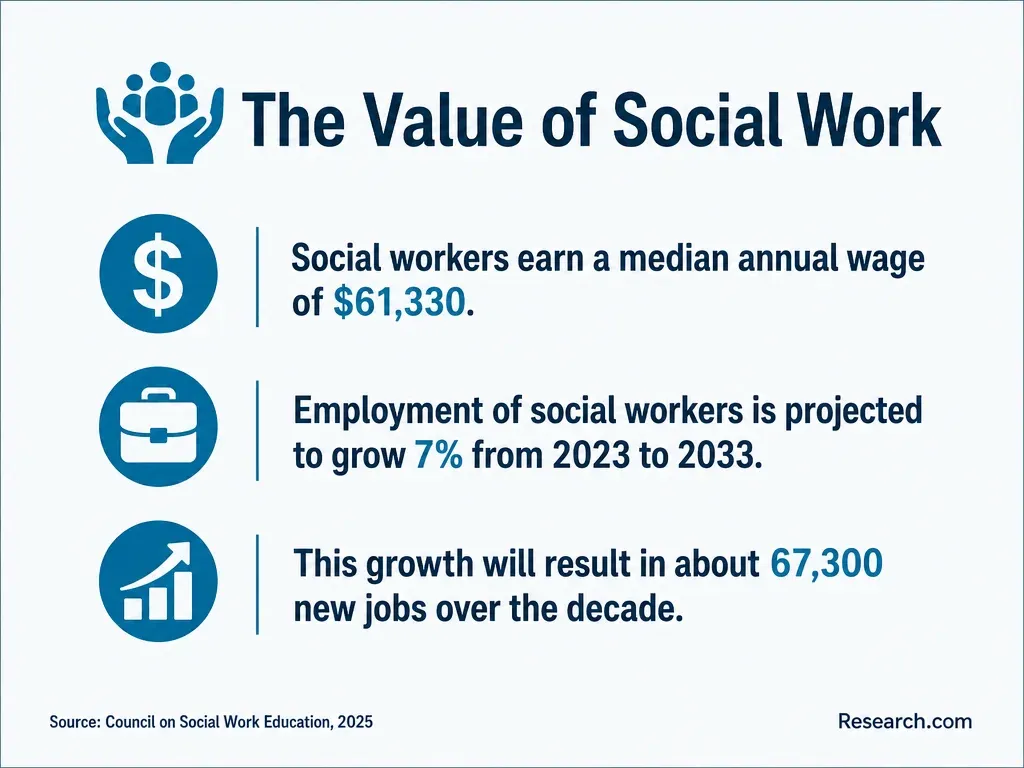
- For career planning, the Bureau of Labor Statistics reports a $61,780 median annual wage for social workers across specialties in May 2025 and projects 6% employment growth from 2025 to 2035; neither figure predicts pay or demand for this niche role.
What do social workers do for survivors of financial exploitation?
Financial exploitation generally means the improper use of someone's money, property, benefits, or financial authority for another person's gain. It may involve a caregiver, relative, acquaintance, or stranger. Social workers encounter it in aging services, adult protective services (APS), healthcare, disability services, housing programs, and community agencies.
The social worker's contribution is a person-in-environment assessment: Is the person safe, able to access food and housing, dependent on the suspected exploiter for care, or struggling to navigate benefits and services? The worker explains options, helps establish priorities, coordinates referrals, and follows up when the agency's role permits. A financial loss may also create a care crisis; addressing only the transaction can miss the survivor's immediate needs.
These responsibilities draw on social work master's skills across career settings, but the worker's authority remains role-specific. Bank employees assess account activity, investigators investigate, attorneys advise on legal remedies, and social workers do not promise recovery of funds.
What degree do you need to work with survivors of financial exploitation?
Start with the position description, not the issue alone. A BSW can prepare someone for generalist social work and some case-management or protective-services positions. Other navigator or victim-services jobs may accept a human services degree or relevant experience. An MSW may be preferred or required for advanced social work roles, clinical services, or supervisory positions. A DSW or PhD is not ordinarily needed for direct survivor support.
Someone entering from another discipline can pursue a traditional or foundation MSW; advanced-standing MSW entry generally requires a qualifying prior BSW and satisfaction of the program's rules. The choice between those routes is explained in MSW track selection based on educational background. Neither an MSW concentration nor experience handling fraud automatically grants clinical authority.
Before enrolling, compare three actual job postings in your target setting. Note whether they require a social work degree, a state license, experience with the population, or training in protective-services procedures. If the work you want is primarily financial investigation or legal representation, specialist training in those fields may be more direct than another social work degree.
Which organizations partner with social workers on financial exploitation referrals?
Effective partnerships connect the survivor's immediate needs with the organization that can address each concern. The table distinguishes common partners by function; eligibility, authority, and information-sharing rules vary by state and agency.
| Partner | Primary contribution | Important boundary |
| Adult protective services | Receives and assesses eligible reports involving adults covered by state law | Eligibility and reporting rules are state-specific |
| Bank or credit union fraud team | Reviews accounts and available fraud-response measures | The institution controls its accounts and procedures |
| Legal aid or elder-law services | Evaluates legal options, benefits problems, or misuse of financial authority | Social workers should not provide legal conclusions |
| Law enforcement | Receives crime reports and investigates where appropriate | A report does not guarantee investigation or restitution |
| Benefits, housing, and care providers | Address interrupted income, shelter, food, medication, and support needs | Each service has its own eligibility and consent rules |
Referrals work best when an agency knows its partners' intake criteria, after-hours coverage, accessible communication options, and follow-up process. Students evaluating placements can ask whether the site teaches these relationships through supervised work. Social work master's field office services are relevant when a student needs help identifying an appropriate agency placement; the school does not replace the agency's referral network.
There is no separate national license for financial exploitation work. State boards determine social work license categories, qualifying education, examinations where required, supervised experience, and permitted activities. Employers may impose additional qualifications. Some victim-services or case-management positions are not licensed social work positions, while a job that includes psychotherapy may require a clinical license and post-degree supervised practice.
Before accepting a role, check the state board's current rules and the employer's written scope: which professional title may you use, what services may you deliver, and what supervision is available? Social work master's licensure disclosure questions can help prospective students raise jurisdiction-specific issues with a program. Graduation, passing an exam, and receiving a license are distinct steps; an MSW alone does not authorize independent clinical practice.
Useful coursework includes social work ethics, human behavior and aging, disability practice, policy and public benefits, trauma-informed engagement, assessment, and interprofessional collaboration. The key is applying that knowledge under supervision: discussing consent, documenting without speculation, recognizing structural barriers, and knowing when a question belongs with an attorney, investigator, or clinician.
Potential placements include APS, aging-services agencies, healthcare social work, disability services, and victim-assistance programs. Ask a field office whether a site permits supervised participation in assessments and referrals, how safety and confidentiality are taught, and who evaluates the learning agreement. A student's paid job or volunteer service counts as field education only if the program approves the arrangement and its learning requirements.
Academic field instruction is also different from post-degree licensure supervision. Students considering clinical roles should separately investigate planning supervised experience in a social work career; field hours do not automatically satisfy a state's later clinical-experience requirements.
What are the career options, salaries, and job outlook for social workers?
Work involving financial exploitation appears within broader jobs, including APS casework, aging-services coordination, hospital social work, victim services, and behavioral health. The population, caseload, travel, documentation, safety procedures, and quality of supervision may matter more to workplace fit than whether "financial exploitation" appears in the job title.
The following US Bureau of Labor Statistics figures describe broad occupations, not salaries for financial-exploitation specialists. May 2025 median wages and projected employment change from 2025 to 2035 offer context for comparing settings.
| BLS occupation | Median annual wage, May 2025 | Projected employment change, 2025-2035 |
| Social workers, all specialties | $61,780 | +6% |
| Child, family, and school social workers | $59,550 | +4% |
| Healthcare social workers | $67,880 | +8% |
| Mental health and substance abuse social workers | $60,280 | +10% |
Use the category that matches the actual position, then compare local postings and pay scales. For geographic context, MSW salary comparisons by state can inform a search, but an occupation-wide median does not guarantee an MSW graduate's wage. For a first job, ask how suspected exploitation is escalated, who provides consultation, and whether the agency has functioning referral partnerships.
Other Things You Should Know About Social Work
Yes. Having legal authority over someone's finances does not necessarily mean every use of that authority is proper. Whether conduct breaches a duty or a law requires review of the document and applicable state law by an appropriate legal or investigative professional.
No. Adults of many ages can experience coercion, scams, or misuse of their assets. Protective-services eligibility and reporting duties may differ by age, disability status, and state.
That would raise serious boundary and conflict-of-interest concerns. A worker should not take control of a client's finances as an informal solution; they should consult agency policy, supervision, and qualified legal resources about appropriate alternatives.
Raise the gap with the field instructor and faculty liaison before handling a concern independently. Ask how the agency currently addresses safety, reporting, consent, documentation, and partner referrals, and follow the approved supervision process.
- Strategies to build more effective interventions for elder abuse | nih.gov https://pmc.ncbi.nlm.nih.gov/articles/PMC9762662/
- Guidance for Financial Institutions - DFPI - CA.gov https://dfpi.ca.gov/consumers/protecting-the-financial-rights-of-domestic-violence-survivors/guidance-for-financial-institutions/
- Abuse, Neglect, and Exploitation of Vulnerable Adults in Georgia https://aging.georgia.gov/report-elder-abuse-neglect-or-exploitation/abuse-neglect-and-exploitation-vulnerable-adults-georgia
- Interagency Statement on Elder Financial Exploitation | NCUA https://ncua.gov/newsroom/press-release/2024/agencies-issue-statement-elder-financial-exploitation/interagency-statement
- Trauma-Informed Care: A Sociocultural Perspective - NCBI https://www.ncbi.nlm.nih.gov/books/NBK207195/
- Elder Justice Resources & Referrals https://www.justice.gov/file/982311/dl
- Reporting elder financial abuse | consumerfinance.gov https://www.consumerfinance.gov/consumer-tools/educator-tools/resources-for-older-adults/reporting-elder-financial-abuse-guide/
- What is Financial Exploitation? | Protect Texas Adults https://www.dfps.texas.gov/Protect_Texas_Adults/financial-exploitation/
- Trauma-Informed Approaches and Programs | samhsa.gov https://www.samhsa.gov/mental-health/trauma-violence/trauma-informed-approaches-programs
- Chapter 14: Victimization of the Elderly | ojp.gov https://ovc.ojp.gov/sites/ovc/files/pubs/OVC_Archives/nvaa2001/chapter14.html