2027 Social Work with Family Caregivers: Responsibilities, Training, and Career Settings
Audited and Verified:
Our Editorial and Data Verification Process
Research.com uses government datasets, official education statistics and primary institutional information to support its career and degree guides. Our review process checks factual accuracy, occupational definitions, source dates and the requirements associated with the credentials discussed.
How This Article Was Fact-Checked
Our editorial team verifies salary estimates, employment projections, education requirements and program information against original data providers and official organizations. Salary figures are checked against the relevant occupational definitions and reporting periods. Information about licensure, accreditation and required in-person training is reviewed separately.
Fact-checked and verified on:

Co-Founder and Chief Data Scientist
Family caregivers often coordinate appointments, manage daily needs, and make difficult decisions while navigating services they may never have used before. Social workers can help them find support, plan for transitions, and address stress without losing sight of the person receiving care. This guide is for students, career changers, and early-career practitioners considering caregiver-focused work. It explains the responsibilities, settings, qualifications, training, and pay data that can help you choose a realistic route into the field.
Key Things You Should Know
- Caregiver support can involve assessment, care coordination, education, advocacy, and counseling within a worker's authorized role; the care recipient's wishes and privacy remain central.
- A BSW may fit generalist service roles, while many hospital and clinical roles seek an MSW and may require licensure; no degree alone grants independent clinical authority.
- Relevant U.S. occupations had May 2025 median annual wages of $59,550 for child, family, and school social workers and $67,880 for healthcare social workers - not caregiver-specialist starting salaries.
What do social workers do for family caregivers?
A family caregiver is an unpaid relative, partner, friend, or other person who helps someone manage illness, disability, aging-related needs, or daily activities. Social workers may support that caregiver, the person receiving care, or both. Their first task is to establish who the client is, what each person wants, and what information can be shared.
Depending on the setting, a social worker may assess practical and emotional needs; explain respite, transportation, benefits, or home-care options; coordinate a hospital discharge; help a family prepare for a care-planning meeting; or refer a caregiver for counseling. They may also identify barriers such as language access, transportation, cost, or an unsafe housing situation. Effective support is not simply handing over a resource list: it includes checking eligibility, helping the family weigh feasible options, and following up when a referral fails.
The worker must not assume that the caregiver's preferences override those of an adult receiving care. Consent, decision-making authority, confidentiality, and reporting duties depend on the circumstances and applicable law and agency policy. Students who want to observe these decisions in practice can ask how a prospective program arranges aging, healthcare, disability, or hospice placements; a guide to school-supported MSW placements provides useful questions about placement support, though no school can guarantee a particular site.
What degree do you need to work with family caregivers?
Start with the job's duties rather than a degree label. Caregiver navigation and outreach may be open to people with human services experience; jobs designated as social work positions may require a BSW or MSW. Employers and state law determine when a social work license is also necessary.
The routes differ in preparation and likely job fit:
| Route | Likely fit for caregiver-focused work | Important limit |
| Relevant experience or adjacent degree | Resource navigation, outreach, and some care-coordination jobs | Does not qualify someone for positions requiring a social work degree or license |
| BSW | Generalist assessment, case management, and community services | Some hospital and clinical positions require an MSW or license |
| Traditional MSW | Advanced practice preparation for applicants with a bachelor's degree in another field | Graduation does not confer independent clinical authority |
| Advanced-standing MSW | A shorter MSW route for applicants with a qualifying BSW who meet program rules | A psychology, sociology, or human services degree does not ordinarily establish eligibility |
If you already work in caregiver services, compare job postings before paying for another degree. An MSW may be worthwhile for a target hospital or clinical role; agency training may be more direct for a navigation role. A DSW or PhD is generally unnecessary for direct caregiver support. For a broader review of entry routes, see comparing social work degrees before enrollment.
What licensing or certification is required for this social work career?
There is no single U.S. "family caregiver social worker" license. Requirements depend on the state, job title, setting, and activities. A state may regulate use of the social worker title or require a license for particular services; an employer may impose additional qualifications. Voluntary specialty training is different from a state license.
Care coordination and resource referral do not necessarily require an independent clinical license. Psychotherapy or other independently performed clinical services may require an MSW, a state-issued clinical license, and qualifying post-degree supervised experience. Academic field education is not a substitute for that supervision. Before accepting a job or training arrangement, check the state board's current rules and the employer's written scope and supervision expectations. The distinction is especially important when reviewing clinical hours and social work professional preparation.
A certificate in aging, dementia care, or caregiver support can build useful skills, but it does not expand legal practice authority. Ask employers whether a particular course or credential is valued before paying for it.
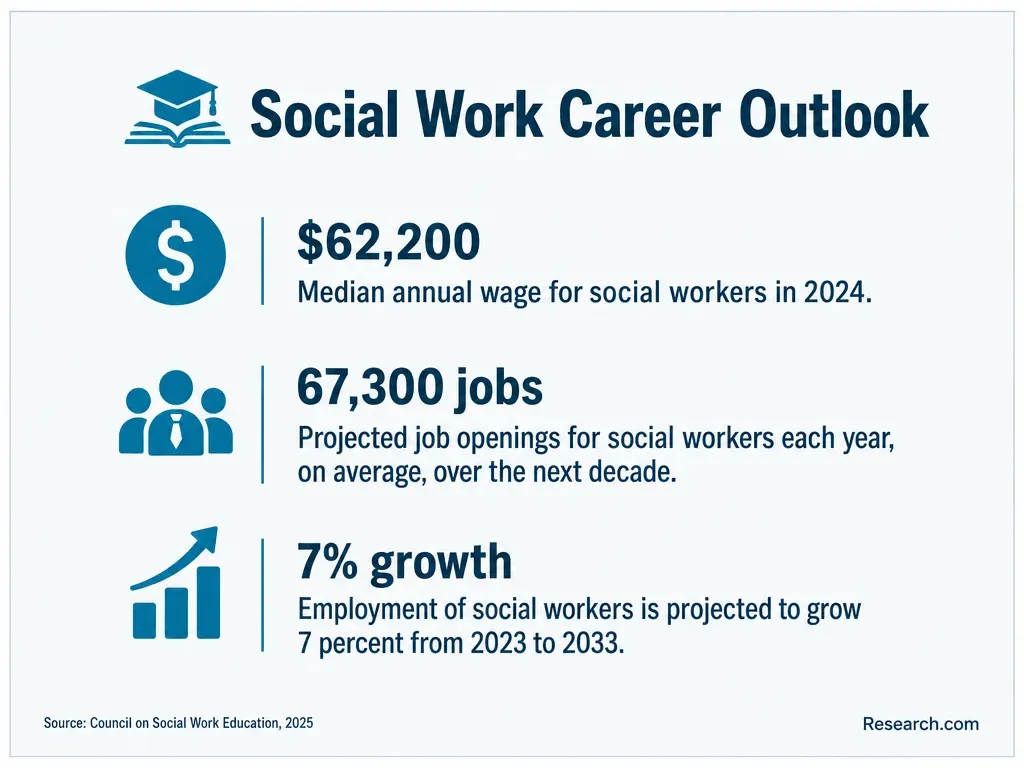
The Bureau of Labor Statistics does not publish a separate wage or growth series for social workers who support family caregivers. These U.S. occupational categories provide context, but each includes jobs with duties beyond caregiver support.
| BLS occupation | May 2025 median annual wage | Projected employment growth, 2025-2035 |
| Child, family, and school social workers | $59,550 | 4% |
| Healthcare social workers | $67,880 | 8% |
| Mental health and substance abuse social workers | $60,280 | 10% |
| Social workers, all specialties | $61,780 | 6% |
A hospital-based caregiver role may align most closely with healthcare social work; a family-services role may fit another category. These medians are not starting-pay estimates or expected earnings from a particular degree. Compare local postings by required license, experience, employer type, and schedule. Geographic context from comparing pay locations for master's-prepared social workers can help, but local job offers are more useful for a personal budget.
BSW applicants commonly begin with university admission and may later apply separately to the social work major or field sequence. MSW applicants generally submit transcripts, a statement of purpose, references, and evidence of relevant readiness; exact GPA, prerequisite, interview, and experience rules vary. A traditional or foundation MSW can admit applicants whose bachelor's degree is outside social work.
Advanced standing is different: programs generally reserve it for applicants with a qualifying BSW and may impose accreditation, grade, and degree-recency conditions. Relevant caregiving or human services work can strengthen an application but does not turn another bachelor's degree into a BSW. When comparing MSW programs with accessible admissions, confirm the entry route and field eligibility as carefully as the admissions criteria; getting admitted does not guarantee a particular placement or eventual license.
How long do social work programs take, and what do they cost?
A full-time BSW typically fits within a four-year bachelor's degree. A traditional MSW commonly takes about two academic years full time, while an advanced-standing MSW may take roughly one year; part-time schedules take longer, and each school sets its own sequence. Those timelines should be checked against field availability and any required course order.
Compare the full cost of reaching your target role, not tuition alone. Include fees, books, transportation or parking for placement, screening requirements, possible reductions in paid work hours, and licensing-related expenses if the job requires a license. For career changers and working caregivers, lost earnings during field education can matter as much as a tuition difference. Use a consistent estimate of credits, fees, and time to completion when comparing graduate social work cost and completion time; ask each program whether paid or employment-based field arrangements are possible rather than budgeting as though they are guaranteed.
Other Things You Should Know About Social Work
Often, a caregiver can seek information and support for their own needs. That does not automatically give a social worker permission to disclose the other person's private information or arrange services on their behalf.
Some agencies offer phone or video support. The available services depend on agency policy, privacy requirements, and any state rules governing the worker's activities and location.
No. A social worker can explain service options and make appropriate referrals, but guardianship is a legal matter governed by state law and the relevant court process.
Yes. A caregiver need not wait for a crisis to ask about respite, practical assistance, peer support, or a referral for their own mental health care.
- Get paid as a caregiver for a family member | USAGov https://www.usa.gov/disability-caregiver
- Respecting privacy and upholding confidentiality: core ethical duties - PMC https://pmc.ncbi.nlm.nih.gov/articles/PMC12747445/
- Supporting Family Caregivers in Providing Care - NCBI - NIH https://www.ncbi.nlm.nih.gov/books/NBK2665/
- Caregiver Assistance | Alabama Department of Senior Services https://alabamaageline.gov/alabama-cares/
- NASW Standards for Social Work Case Management | nycourts.gov https://www.nycourts.gov/reporter/webdocs/nasw_standards_socialwork_casemgt.htm
- National Family Caregiver Support Program | acl.gov http://acl.gov/programs/support-caregivers/national-family-caregiver-support-program
- MSW vs. LMSW vs. LCSW: What They Mean and How To Get Licensed | Virginia Commonwealth University https://onlinesocialwork.vcu.edu/blog/msw-lmsw-lcsw-defined/
- Caregiver Self-Assessment Questionnaire | apa.org https://www.apa.org/pi/about/publications/caregivers/practice-settings/assessment/tools/self-assessment
- NASW Standards for Social Work Case Management | socialworkers.org https://www.socialworkers.org/Practice/NASW-Practice-Standards-Guidelines/NASW-Standards-for-Social-Work-Case-Management