
2027 Social Work with Families Facing Housing Displacement: Services and Career Preparation
Audited and Verified:
Our Editorial and Data Verification Process
Research.com uses government datasets, official education statistics and primary institutional information to support its career and degree guides. Our review process checks factual accuracy, occupational definitions, source dates and the requirements associated with the credentials discussed.
How This Article Was Fact-Checked
Our editorial team verifies salary estimates, employment projections, education requirements and program information against original data providers and official organizations. Salary figures are checked against the relevant occupational definitions and reporting periods. Information about licensure, accreditation and required in-person training is reviewed separately.
Fact-checked and verified on:

Co-Founder and Chief Data Scientist
Families facing eviction, unsafe housing, or a sudden move often need more than a referral to a shelter. They may need help navigating benefits, keeping children connected to school, addressing immediate safety concerns, and finding a stable place to live. For students and career changers, the preparation required depends on the work they want to do: housing case management, licensed clinical care, or community-level advocacy.
This guide explains the services, career paths, qualifications, and education choices that matter most, so you can pursue a role without paying for credentials it does not require.
Key Things You Should Know
- Housing-focused work spans eviction prevention, crisis coordination, rehousing, and longer-term support; eligibility for assistance depends on the local program, not a social worker's referral alone.
- Many housing navigator and case-management jobs accept a BSW or other relevant background, while independent clinical social work generally requires an MSW and state-specific post-degree licensing steps.
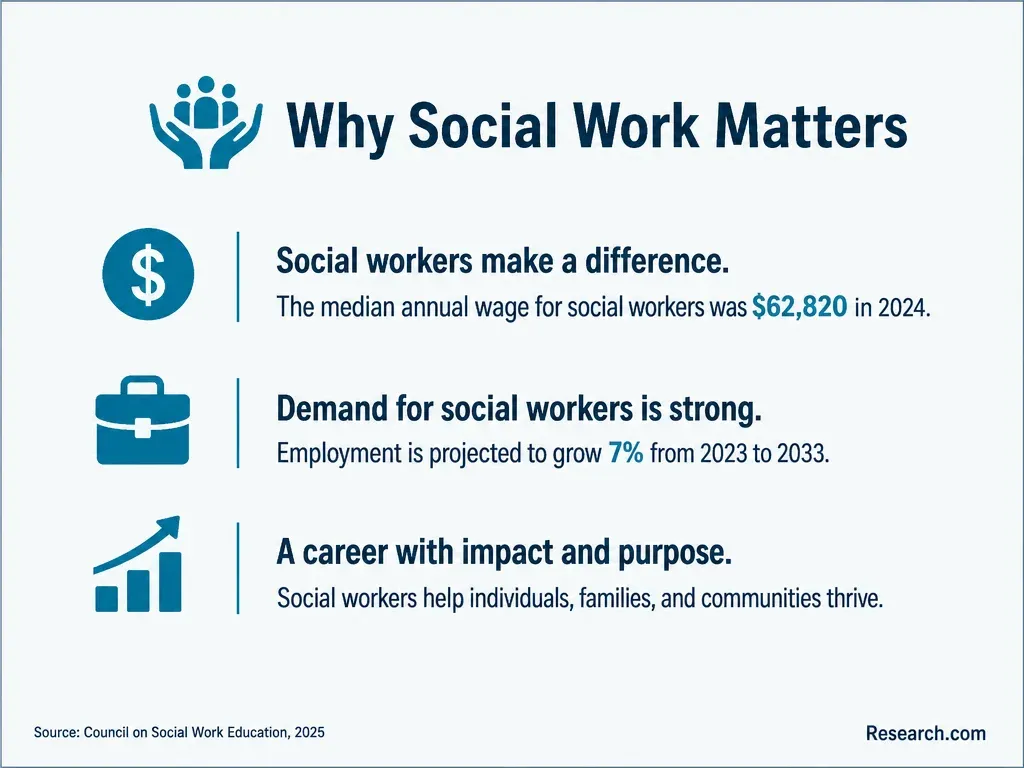
- The U.S. Bureau of Labor Statistics reports a May 2025 median annual wage of $59,550 for child, family, and school social workers, with 4% projected employment growth from 2025 to 2035; neither figure predicts pay or openings in a particular housing agency.
What services do social workers provide to families facing housing displacement?
Housing displacement means a family must leave, or is at serious risk of leaving, its current home. It can follow an eviction, rent increase, disaster, domestic violence, building closure, or loss of a temporary place to stay. The response depends on the family's wishes, immediate safety needs, available resources, and the eligibility rules of each program.
A housing-focused social worker may assess urgent needs, help a family gather documents, connect it with eviction-prevention or legal-aid services, and coordinate applications for shelter, rental assistance, or rehousing. After a move, the work may include benefits coordination, school continuity, landlord communication with the family's consent, and referrals for healthcare, childcare, or employment support. Some roles also examine recurring barriers - such as inaccessible applications or a shortage of family-sized units - and advocate for changes with community partners.
Coordination is not control over housing supply. A worker cannot promise an apartment, stop an eviction by making a referral, or override a funder's eligibility decision. Strong practice means explaining options and uncertainties plainly, documenting only what is needed, respecting family choices, and seeking supervision when safety, confidentiality, or reporting duties arise.
Students who want to learn these tasks through supervised agency work should consider choosing an MSW program with structured field support, rather than assuming classroom coverage of homelessness is enough.
What degree do you need to work with families experiencing housing displacement?
There is no single degree required for every housing-service job. A housing navigator or community outreach employer may accept relevant human services experience or a degree outside social work. A BSW prepares graduates for generalist social work, including assessment, service coordination, and work with community systems. An MSW is more relevant when an employer requires graduate-level social work preparation, specialized practice, or a pathway toward clinical licensure.
The distinction is especially important for career changers. Experience in schools, benefits administration, healthcare, tenant organizing, or nonprofit services may qualify you for an adjacent role now, but it does not substitute for a required social work degree or license. Applicants with a bachelor's degree outside social work can seek a traditional or foundation MSW; advanced standing generally requires a qualifying BSW and satisfaction of the individual program's criteria. Use comparing graduate social work entry-track requirements to clarify that choice before estimating time or cost.
A DSW or PhD is not the normal entry requirement for family housing services. Those routes may fit later goals in practice leadership or research, but targeted experience in housing systems is usually more immediately useful for frontline work. Check actual job postings for the population and agency you want to serve before choosing another degree.
What licensing requirements apply to social workers serving families facing housing displacement?
Licensing depends on the state, job duties, and professional title, not simply on whether clients lack stable housing. Some housing navigation and case-management positions do not require a social work license; an employer may still require a particular degree, background screening, or training. Jobs involving clinical assessment or psychotherapy can have different requirements and supervision rules.
A qualifying BSW or MSW does not itself issue a license. Where licensure applies, the state board determines the accepted education, application and examination requirements, license category, permitted activities, and any post-degree supervised experience. MSW field placement hours should not be assumed to count as post-degree clinical supervision. Readers planning to add therapy to housing services can start by comparing social work clinical experience expectations, then confirm the governing rules with their state board before accepting a position or supervision arrangement.
When reviewing a posting, separate "social worker" as an employer's job label from a state-protected professional title. Ask which tasks require a license, who provides supervision, and whether the agency expects services across state lines.
There is no single federal wage category for "housing social worker." The closest Bureau of Labor Statistics (BLS) category depends on the actual job. These national figures provide context for comparing offers, not a salary forecast for a particular degree, city, shelter, or nonprofit.
The BLS May 2025 median wages and 2025-2035 employment projections below cover broad occupations, including workers whose jobs have little or no housing focus.
| BLS occupation | Median annual wage, May 2025 | Projected employment growth, 2025-2035 |
| Child, family, and school social workers | $59,550 | 4% |
| Healthcare social workers | $67,880 | 8% |
| Mental health and substance abuse social workers | $60,280 | 10% |
| Social workers, all specialties | $61,780 | 6% |
Family shelter and rehousing jobs may align most closely with child and family social work, while hospital-based discharge and housing coordination may align with healthcare social work. A housing navigator without social work duties may fall outside these categories entirely. Compare local postings by employer, location, required license, benefits, and schedule.
When weighing graduate tuition against likely opportunities, exploring the career value of affordable MSW study is more useful than treating a national median as an expected starting salary.
BSW applicants commonly need to meet university admission rules and, where applicable, separate requirements for entry into the social work major. Traditional MSW programs consider applicants with bachelor's degrees in other fields, while advanced-standing tracks generally require a qualifying BSW and may impose additional grade or recency standards. A psychology, sociology, or human services bachelor's degree should not be assumed to qualify for advanced standing.
Programs may review transcripts, GPA, writing, service experience, statements, references, and prerequisite coursework; requirements vary. If housing or family-service experience informs your application, describe what you actually did and learned rather than presenting unsupervised work as clinical practice. Applicants concerned about reference requirements can review planning an MSW application without reference letters, then confirm the current policy for each intended track.
Admission is also separate from placement onboarding. An agency may require screening, training, or a schedule you cannot meet. Ask the program when those conditions become known, especially if you need a local placement.
How long do social work degrees take, and how much do they cost?
A BSW is usually planned as a four-year undergraduate degree, although transfer credit and course sequencing can change the timeline. A traditional MSW commonly takes about two academic years of full-time study; qualifying advanced-standing routes are often shorter. Part-time study, field availability, and required course order can extend any route. Confirm the school's actual plan rather than treating these common patterns as a graduation guarantee.
To compare costs, calculate tuition and mandatory fees across the entire sequence, then add books, technology, placement travel, screening, potential campus visits, and reduced earnings during field hours. Ask whether employment-based placements are permitted and approved, whether paid placements exist, and whether aid or employer assistance has conditions. A lower tuition rate can be offset by a longer program or substantial lost work hours.
Set a budget ceiling based on realistic local job offers, not the national median wage. If you are applying to multiple MSW programs, social work master's application options by selectivity may help you make a manageable shortlist before paying application fees; verify each program's current requirements and housing-related field opportunities independently.
Other Things You Should Know About Social Work
Generally, legal representation is the work of an authorized attorney or legal-aid provider. A social worker can help a family locate legal assistance, organize service-related documents, and coordinate support within agency policy.
The worker can explain the decision, check whether an appeal or correction process exists, and explore other local resources. Eligibility rules differ, so one program's denial does not establish eligibility elsewhere.
They should use the agency's qualified language-access resources and explain options in a way the family can understand. Using a child to interpret sensitive housing or safety information can create serious accuracy and confidentiality problems.
It can. Disaster work may involve temporary shelter systems, disrupted records, and changing assistance programs. Relevant agency training and coordination with authorized emergency-response partners matter more than assuming ordinary housing procedures will cover every situation.
- HOMELESSNESS PREVENTION SERIES: Spotlight on Eviction Prevention | United States Interagency Council on Homelessness https://usich.gov/guidance-reports-data/federal-guidance-resources/homelessness-prevention-series-spotlight-eviction
- NASW Standards for Social Work Case Management | nycourts.gov https://www.nycourts.gov/reporter/webdocs/nasw_standards_socialwork_casemgt.htm
- Renter Support & Stability | Division of Housing - Colorado https://doh.colorado.gov/renter-support-and-stability
- Guide to Disability Rights Laws | ADA.gov https://www.ada.gov/resources/disability-rights-guide/
- Housing Status Assessment Guide for State TANF and Medicaid Programs | ASPE https://aspe.hhs.gov/reports/housing-status-assessment-guide-state-tanf-medicaid-programs-0
- Trauma-Informed Care: A Sociocultural Perspective - NCBI https://www.ncbi.nlm.nih.gov/books/NBK207195/
- Housing Instability - Healthy People 2030 | odphp.health.gov https://odphp.health.gov/healthypeople/priority-areas/social-determinants-health/literature-summaries/housing-instability
- Trauma-Informed Approaches and Programs | samhsa.gov https://www.samhsa.gov/mental-health/trauma-violence/trauma-informed-approaches-programs
- Barriers to housing among unsheltered homeless adults | sciencedirect.com https://www.sciencedirect.com/science/article/abs/pii/S0149718918303823
- Housing Instability among Child Welfare System-Involved Families - Evidence-to-Impact Collaborative https://evidence2impact.psu.edu/resources/housing-instability-among-child-welfare-system-involved-families/


