
2027 Social Work Testimonials and Marketing: Ethical Questions for Career Planning
Audited and Verified:
Our Editorial and Data Verification Process
Research.com uses government datasets, official education statistics and primary institutional information to support its career and degree guides. Our review process checks factual accuracy, occupational definitions, source dates and the requirements associated with the credentials discussed.
How This Article Was Fact-Checked
Our editorial team verifies salary estimates, employment projections, education requirements and program information against original data providers and official organizations. Salary figures are checked against the relevant occupational definitions and reporting periods. Information about licensure, accreditation and required in-person training is reviewed separately.
Fact-checked and verified on:

Co-Founder and Chief Data Scientist
A graduate's success story can make a social work program feel like the right choice. A client's praise can make an agency seem trustworthy. Neither tells the whole story, and client testimonials raise ethical questions that ordinary education marketing does not.
This guide is for prospective BSW and MSW students, early-career social workers, and professionals asked to share a story. It explains when testimonials are useful, when solicitation or publication creates risks, and how to check the program, licensing, cost, and career claims behind an appealing quote.
Key Things You Should Know
- The NASW Code of Ethics says social workers should not solicit testimonial endorsements from current clients or others vulnerable to undue influence; asking to reuse an earlier client statement is also solicitation.
- A student or alumni story is evidence of one person's experience, not proof of accreditation, licensure eligibility, typical earnings, or placement support. Verify each claim with the responsible program or authority.
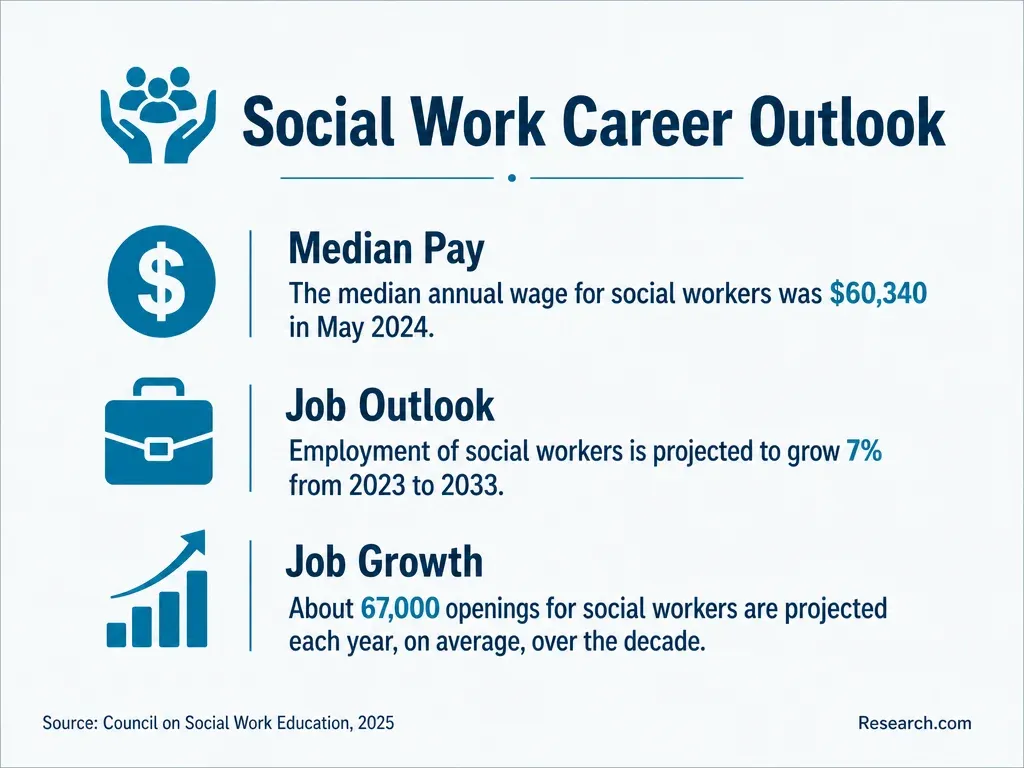
- For career context, U.S. Bureau of Labor Statistics figures list a May 2025 median annual wage of $61,780 for social workers overall and project 6% employment growth from 2025 to 2035; neither figure predicts an individual graduate's outcome.
What are social work testimonials, and how are they used in marketing?
A testimonial is a person's account of an experience presented to influence someone else's decision. Social work schools may feature student or alumni quotes about coursework, field placements, or jobs. Agencies and individual practitioners may publish reviews or success stories to attract clients, donors, or employees. The speaker's relationship to the organization matters: a prospective student hearing from a graduate is in a different position from a service user being asked to praise the person who provides their care.
Testimonials can reveal questions worth asking, but they are rarely representative samples. An alumni story about a hospital position, for example, does not establish how many graduates found similar work or whether the job required a license. Use stories as starting points when investigating social work master's roles and employment settings, not as substitutes for job postings and program outcomes.
What does the NASW Code of Ethics say about soliciting client testimonials?
Section 4.07 of the NASW Code of Ethics says social workers should not solicit testimonial endorsements from current clients or from other people who, because of their circumstances, are vulnerable to undue influence. It expressly includes asking for consent to use a client's earlier statement as an endorsement. A request can feel hard to decline when the requester controls access to services, evaluations, referrals, or other support.
The provision does not mean every unsolicited comment is automatically appropriate to publish, nor does it make every former client an appropriate person to approach. Consider the continuing relationship, vulnerability, privacy, and applicable law and agency policy. It also does not prohibit a school from asking an alumnus about their education; the ethical concern changes if an alumnus is simultaneously a client or feels pressure from someone with authority over them.
For early-career workers, a supervisor's praise about progress toward licensure is not evidence that particular experience qualifies. Check social work experience requirements and professional milestones against the state board's rules and documented supervision, rather than relying on an endorsement.
How can students identify misleading social work program testimonials?
Read a testimonial as a specific, potentially selected account. Its strongest claims are the ones a school should be able to document. A graduate's "I became a therapist after finishing" may leave out a licensing exam, post-degree supervised practice, or an additional credential.
These checks turn an appealing story into useful questions for an admissions office:
- Identify the exact degree, track, campus or online format, graduation cohort, and state behind the story; policies may differ for your entry term.
- Separate what the graduate experienced from what the program guarantees. Ask for written placement procedures, published outcomes, and the definitions and denominators behind any employment or exam-pass figures.
- Investigate unusually broad claims such as "guaranteed placement," "licensed upon graduation," or "six-figure salary." Ask which agency, licensing board, or employer makes the decision.
- Look for a material connection: payment, a tuition benefit, employment by the school, or an incentive to post a favorable review.
A polished student quote cannot establish that a BSW program has the status you need. When choosing an accredited BSW program, check the exact program and applicable cohort rather than treating the school's general reputation as confirmation.
Under the Federal Trade Commission's endorsement guidance, an endorser must clearly disclose a material connection that audiences would not reasonably expect and that could affect how they evaluate the endorsement. Payment is one example; free services, tuition assistance, employment, or another valuable incentive can also matter. A disclosure should be easy to notice and understand in the context where the endorsement appears - not buried elsewhere on a website.
Endorsements must also reflect genuine experiences and must not convey misleading claims. If a program uses an exceptional graduate result to suggest what students generally achieve, it needs appropriate support and context; a disclosure that someone was paid does not cure an unsupported outcome claim. These principles apply whether the promotion concerns a BSW, an MSW, or a purportedly fast doctoral route. Treat an alumni endorsement about speed as one account when accelerated doctoral social work study planning, and request the actual course sequence and completion requirements.
FTC advertising rules, the NASW Code of Ethics, privacy law, and school policy address different questions. Compliance with one does not establish compliance with the others.
Marketing may spotlight the shortest route without stating who qualifies. Compare pathways against your prior education and target role. Requirements vary by school, but the following distinctions help expose omissions in a testimonial.
| Pathway | Typical entry position | What to check beyond the testimonial |
| BSW | Undergraduate entering or applying to a social work major | Admission to the major, generalist coursework, field sequence, and program accreditation |
| Traditional or foundation MSW | Applicant with a qualifying bachelor's degree, including one outside social work | Prerequisites, foundation and specialized coursework, field requirements, and part-time options |
| Advanced-standing MSW | Applicant with a qualifying prior social work degree under the program's rules | Accepted BSW accreditation or equivalency, recency rules, grades, specialized sequence, and field expectations |
A psychology or human services degree may support admission to a traditional MSW but does not, by itself, establish advanced-standing eligibility. Likewise, an alumnus's rapid completion may reflect accepted prior BSW preparation rather than a pace available to every applicant. BSW graduates can use a comparison of BSW graduates comparing MSW entry options to frame questions, then obtain a written decision from each program.
What social work careers offer the best salary potential and job outlook?
Healthcare and mental health or substance use roles can be attractive, but "best" depends on the setting, location, qualifications, supervision available, and the work you want to do. These U.S. Bureau of Labor Statistics occupational figures provide context - not starting salaries, MSW outcomes, or pay guaranteed by a testimonial.
| Social work occupation | Median annual wage, May 2025 | Projected employment growth, 2025-2035 |
| Social workers, all specialties | $61,780 | 6% |
| Child, family, and school social workers | $59,550 | 4% |
| Healthcare social workers | $67,880 | 8% |
| Mental health and substance abuse social workers | $60,280 | 10% |
Healthcare has the highest median among the specialties shown, while mental health and substance abuse social work has the fastest projected growth. Neither comparison captures a particular employer's pay, caseload, schedule, or licensing demands. Use local job postings to identify the required degree and license, then compare compensation with supervision quality and working conditions. For geographic context, review social worker earnings and location considerations without assuming a move or another degree will produce the advertised pay.
Other Things You Should Know About Social Work
Follow your school's and placement agency's rules. Remove identifying details, use an approved hypothetical or composite example when appropriate, and ask your field instructor before using any real case information.
You can ask whether participation is optional, how the review will be used, and whether declining affects your evaluation. Raise concerns with your faculty liaison if you feel pressured.
They should not confirm a professional relationship or disclose confidential information in a reply. Follow agency policy and seek appropriate privacy or legal guidance before responding.
No. Alumni can describe completed study and later experiences; current students can speak to present scheduling and support. Ask both about their track, location, and circumstances before applying their experience to your decision.
- De-identification and the Privacy Act | OAIC https://www.oaic.gov.au/privacy/privacy-guidance-for-organisations-and-government-agencies/handling-personal-information/de-identification-and-the-privacy-act
- eCFR:: 16 CFR Part 255 -- Guides Concerning Use of Endorsements and Testimonials in Advertising https://www.ecfr.gov/current/title-16/chapter-I/subchapter-B/part-255
- Summary of the HIPAA Privacy Rule | hhs.gov https://www.hhs.gov/hipaa/for-professionals/privacy/laws-regulations/index.html
- Ethical considerations associated with Qualitative Research methods - UK Statistics Authority https://uksa.statisticsauthority.gov.uk/publications/ethical-considerations-associated-with-qualitative-research-methods/pages/6/
- Health Products Compliance Guidance | Federal Trade Commission https://www.ftc.gov/business-guidance/resources/health-products-compliance-guidance
- Federal Register:: Guides Concerning the Use of Endorsements and Testimonials in Advertising https://www.federalregister.gov/documents/2023/07/26/2023-14795/guides-concerning-the-use-of-endorsements-and-testimonials-in-advertising
- Ethical considerations in relation to different data structures | UK Data Service https://ukdataservice.ac.uk/learning-hub/data-producer-support/legal-and-ethical-responsibilities/ethical-responsibilities/ethical-considerations-in-relation-to-different-data-structures/
- Social Workers' Ethical Responsibilities as Professionals https://www.socialworkers.org/About/Ethics/Code-of-Ethics/Code-of-Ethics-English/Social-Workers-Ethical-Responsibilities-as-Professionals


