2027 Social Work Syllabi: Building Clear Expectations and Accessible Learning
Audited and Verified:
Our Editorial and Data Verification Process
Research.com uses government datasets, official education statistics and primary institutional information to support its career and degree guides. Our review process checks factual accuracy, occupational definitions, source dates and the requirements associated with the credentials discussed.
How This Article Was Fact-Checked
Our editorial team verifies salary estimates, employment projections, education requirements and program information against original data providers and official organizations. Salary figures are checked against the relevant occupational definitions and reporting periods. Information about licensure, accreditation and required in-person training is reviewed separately.
Fact-checked and verified on:

Co-Founder and Chief Data Scientist
A social work syllabus should tell you more than which books to buy. It should make the workload, assessment standards, accessibility options, and boundaries of field learning clear before problems arise. For prospective and current BSW and MSW students, those details can determine whether a course fits their schedule and prepares them for supervised practice.
This guide explains what to look for, where requirements vary, and which questions to ask when a syllabus leaves an important expectation unclear.
Key Things You Should Know
- A useful social work syllabus connects assignments to learning objectives and explains grading, attendance, participation, and accessibility procedures - not just weekly topics.
- CSWE's 2022 accreditation standards specify at least 400 field education hours for BSW programs and 900 for MSW programs; a course syllabus should explain its part in the approved sequence, not imply that any job or volunteer hours count.
- Compare the syllabus with the program handbook and field manual: the syllabus governs course expectations, while program policies and state licensing boards determine other requirements.
What is a social work syllabus, and what does it include?
A social work syllabus is the instructor's course-level guide to what students will learn, how they will demonstrate learning, and how their work will be evaluated. Typically, it identifies prerequisites, learning objectives, weekly topics, required materials, assignments, grading weights, deadlines, communication rules, and policies on attendance, academic integrity, and accommodations.
Look for objectives that match the actual work. A course on assessment, for example, might require students to demonstrate interviewing and documentation skills through supervised exercises; reading about assessment alone would not show how performance is evaluated. A syllabus may also point to a separate program handbook for policies that apply across courses. When comparing online social work degree programs, request a recent sample syllabus to see how advertised flexibility translates into coursework and scheduled activities.
How do social work syllabi explain assignments, grading, and participation expectations?
The clearest syllabi state what each assignment measures, how much it counts, when it is due, and what satisfactory performance looks like. A policy brief might be graded on evidence and analysis; a simulated interview might be assessed on engagement, ethical boundaries, and reflection. Rubrics help students distinguish these objectives from writing polish or simple completion.
Participation deserves a precise definition. In a skills course, it may mean attending live role-plays and giving constructive feedback; in another course, it may mean contributing to asynchronous discussions. Check whether attendance, preparation, and participation are graded separately, and how absences or missed simulations are handled. Compressed calendars in shorter online Master of Social Work pathways make these deadlines especially important: fewer calendar weeks do not necessarily mean less work.
If grading language is vague, ask the instructor for the rubric and an explanation of how missed work can be made up. Address uncertainty early, before a required demonstration or group project is underway.
How do social work syllabi support accessible learning and accommodations?
An accessible syllabus presents deadlines, assessment methods, and participation requirements in predictable language. It should explain how to contact the institution's disability or accessibility office and how approved accommodations are implemented, without requiring a student to disclose a diagnosis to classmates. Accessible documents, captioned media, readable learning-platform materials, and alternatives for approved participation arrangements can matter as much as an accommodation statement.
Ask how an accommodation applies to the course's actual tasks. Extra time on a written assessment and an alternative arrangement for a live skills demonstration may require different planning. Field placements can involve a separate coordination process among the student, accessibility office, field program, and agency; an academic accommodation does not automatically change agency duties or eliminate required competency assessment.
Accessibility is also a practical comparison criterion alongside tuition. When considering affordable online MSW programs, check whether the tools and support needed to participate in live classes, simulations, and field education are available and usable - not merely whether an accommodation policy exists.
Both degrees teach social work values, ethics, research literacy, policy, and practice with people in their environments. The difference is generally the level and sequence of expected learning. This comparison helps you interpret a course objective without assuming that a course title means the same thing at every school.
| Course feature | BSW syllabus | MSW syllabus |
| Typical emphasis | Generalist knowledge and beginning practice across individuals, families, groups, and communities | Foundation learning followed by more specialized or advanced practice, depending on the program |
| Representative assessment | Apply a practice framework to a case simulation and reflect on ethical choices | Develop and justify a more complex practice, policy, or evaluation approach using relevant evidence |
| Expected independence | Demonstrate developing skills with instruction and feedback | Integrate prior learning while still practicing within educational and supervisory boundaries |
A traditional MSW sequence includes foundation coursework for students without a qualifying BSW. Advanced-standing students enter a program-approved shortened sequence based on qualifying prior social work education; the school decides eligibility. Neither an advanced course nor a clinical concentration grants independent practice authority. If you are reading syllabi with a target job in mind, a guide to professional pathways after an MSW can help you judge whether the learning objectives match that role.
A field-course syllabus should identify the course's learning objectives, seminar expectations, assignments, evaluation methods, and how students document progress. The field manual or learning agreement often supplies further details: approved sites, schedules, hour records, supervision arrangements, safety procedures, and the responsibilities of the student, agency field instructor, and faculty liaison.
Under CSWE's 2022 accreditation standards, BSW programs require at least 400 field education hours and MSW programs at least 900. An individual syllabus may cover only one term of that sequence. Before committing to a schedule, confirm the program's actual required hours, placement dates, travel expectations, and process for addressing a disrupted placement. Paid employment or volunteer service does not count simply because the work is social-work-related; the program must approve an eligible educational arrangement.
Ask who finds sites and what happens if a suitable site is unavailable. Comparing MSW practicum placement assistance is more useful than assuming every school offers the same local agency connections. Academic field instruction is also distinct from any post-degree supervised experience a state may require for clinical licensure.
BSW applicants generally need admission to the institution and may face a separate application or progression requirements for the social work major. Traditional MSW programs typically require a qualifying bachelor's degree and may review transcripts, statements, references, service experience, or program-specific prerequisites. Applicants from psychology, sociology, human services, and other disciplines may be eligible for a traditional MSW; those degrees do not automatically qualify them for advanced standing.
Advanced-standing MSW admission normally requires a qualifying BSW and compliance with the receiving program's rules, which may address accreditation, grades, or degree recency. Compare the exact track requirements - not just a university-wide admission page. Admission-focused online MSW comparisons can help identify questions to ask, but published selectivity claims cannot establish your eligibility or predict admission.
Before applying, ask whether prerequisite work must be finished at application or enrollment and whether admission to the degree guarantees entry to the field sequence. Those answers determine when a sample syllabus becomes a realistic course plan.
What careers, salaries, and job prospects are available to social work graduates?
BSW graduates may pursue generalist social work and related service roles, subject to employer and state requirements. MSW graduates may pursue more specialized work in healthcare, behavioral health, schools, community programs, policy, or administration. Job titles do not reliably indicate licensing requirements: check each posting and the applicable state board. Independent clinical practice generally requires steps beyond the MSW, including qualifying post-degree supervision and licensure under state rules.
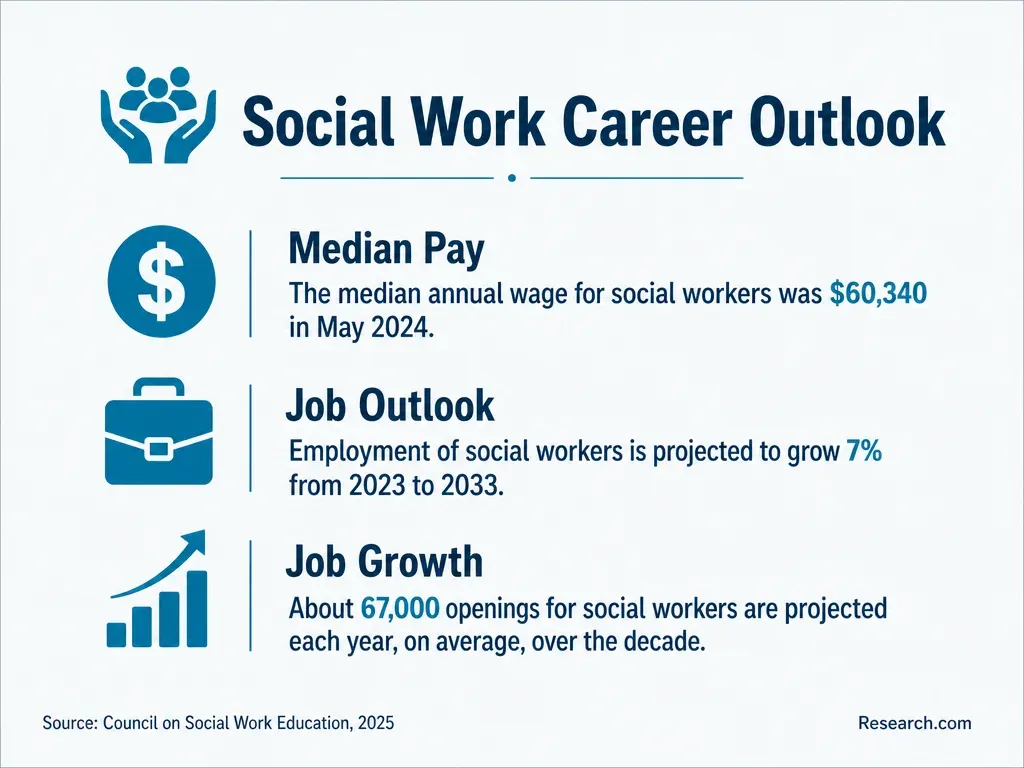
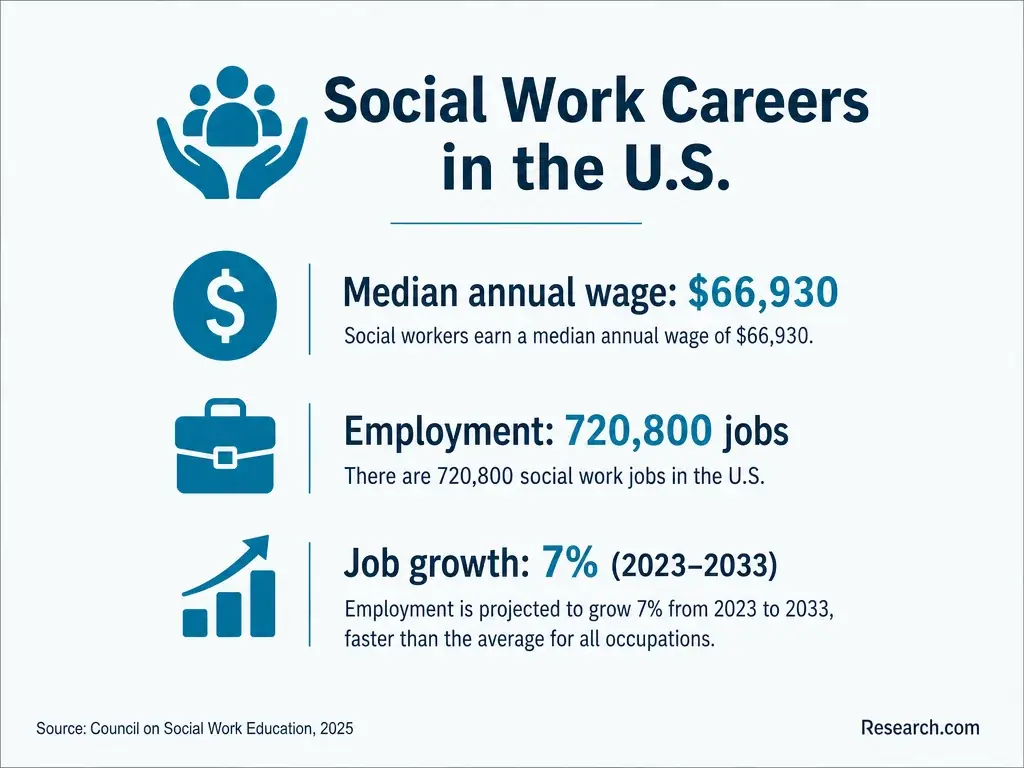
The U.S. Bureau of Labor Statistics reports a May 2025 median annual wage of $61,780 for social workers across specialties and projects 6% employment growth from 2025 to 2035. Its reported median is $59,550 for child, family, and school social workers, $67,880 for healthcare social workers, and $60,280 for mental health and substance abuse social workers. These occupation-wide figures help compare settings; they are not starting salaries or guaranteed outcomes for BSW or MSW graduates.
Use a syllabus to test whether a course builds skills relevant to the setting you want, then compare those skills with actual job qualifications. If your goal is clinical work, planning supervised experience in a social work career requires a separate check of board rules, qualified supervisors, and acceptable documentation.
Other Things You Should Know About Social Work
Often, yes, subject to institutional policy. Check how changes will be announced and ask promptly if a revision affects a major deadline, assessment, or approved accommodation.
Follow the instructor's directions, agency policy, and applicable confidentiality rules first. Do not assume removing a name makes a case unidentifiable; ask about approved simulations or other safe alternatives.
Contact the instructor in writing as soon as you notice the conflict. Keep the response with your course records rather than guessing which date controls.
Yes. Ask the department for a recent sample and confirm which details may change. A sample is useful for planning, but the syllabus issued for your course and term is the one to review with your instructor.
- Disability Discrimination: Technology Accessibility | ed.gov http://www.ed.gov/laws-and-policy/civil-rights-laws/disability-discrimination/disability-discrimination-key-issues/disability-discrimination-technology-accessibility
- Universal Design for Learning: Planning with All Students in Mind | Teaching and Learning Resource Center https://teaching.resources.osu.edu/teaching-topics/universal-design-learning-planning
- Online Syllabus Example Language | msudenver.edu https://sites.msudenver.edu/socialwork/tools/online-syllabus-example-language/
- Universal Design for Learning (UDL) | University of Illinois Chicago https://teaching.uic.edu/cate-teaching-guides/inclusive-equity-minded-teaching-practices/universal-design-for-learning-udl/
- Academic Accommodations - Disability Services https://disabilityservices.studenthealth.virginia.edu/accommodations/academic
- Using Accommodations - Disability Resources for Students | Trends and Issues in Higher Ed https://www.washington.edu/drs/students/using-accommodations/
- Educational Policy and Accreditation Standards | Norfolk State University https://www.nsu.edu/social-work/Educational-Policy-and-Accreditation-Standards.aspx
- Guidelines for Accessible Course Materials and Online Courses - USM https://www.usmd.edu/it-accessibility/guidelines/course-materials
- Attendance Flexibility | Office of Accessible Education https://oae.stanford.edu/students%23academic-accommodations-services-button/attendance-flexibility
- Accessibility: Accessible Course Design | University System of New Hampshire https://td.usnh.edu/TDClient/60/Portal/KB/Article/1316/Accessibility-Accessible-Course-Design