2027 Social Work Service Mapping: Understanding Referral Networks and Bottlenecks
Audited and Verified:
Our Editorial and Data Verification Process
Research.com uses government datasets, official education statistics and primary institutional information to support its career and degree guides. Our review process checks factual accuracy, occupational definitions, source dates and the requirements associated with the credentials discussed.
How This Article Was Fact-Checked
Our editorial team verifies salary estimates, employment projections, education requirements and program information against original data providers and official organizations. Salary figures are checked against the relevant occupational definitions and reporting periods. Information about licensure, accreditation and required in-person training is reviewed separately.
Fact-checked and verified on:

Co-Founder and Chief Data Scientist
A resource directory can tell a social worker where to refer someone, but not whether that person can get through the door. Service mapping examines the connections between agencies, eligibility rules, handoffs, and delays that shape access to care. This guide is for social work students and community-service professionals who need to build or assess a referral network. It explains how to create a useful map, spot bottlenecks without exposing client information, and decide whether coursework, field experience, or another qualification will help you do the work.
Key Things You Should Know
- A useful service map records more than agency names: it shows eligibility, referral steps, capacity, accessibility, and what happens after a handoff.
- To find bottlenecks, compare referral volume with acceptance, time to first contact, and completed connections; a long directory is not evidence of access. Service mapping is used in both licensed and non-licensed roles.
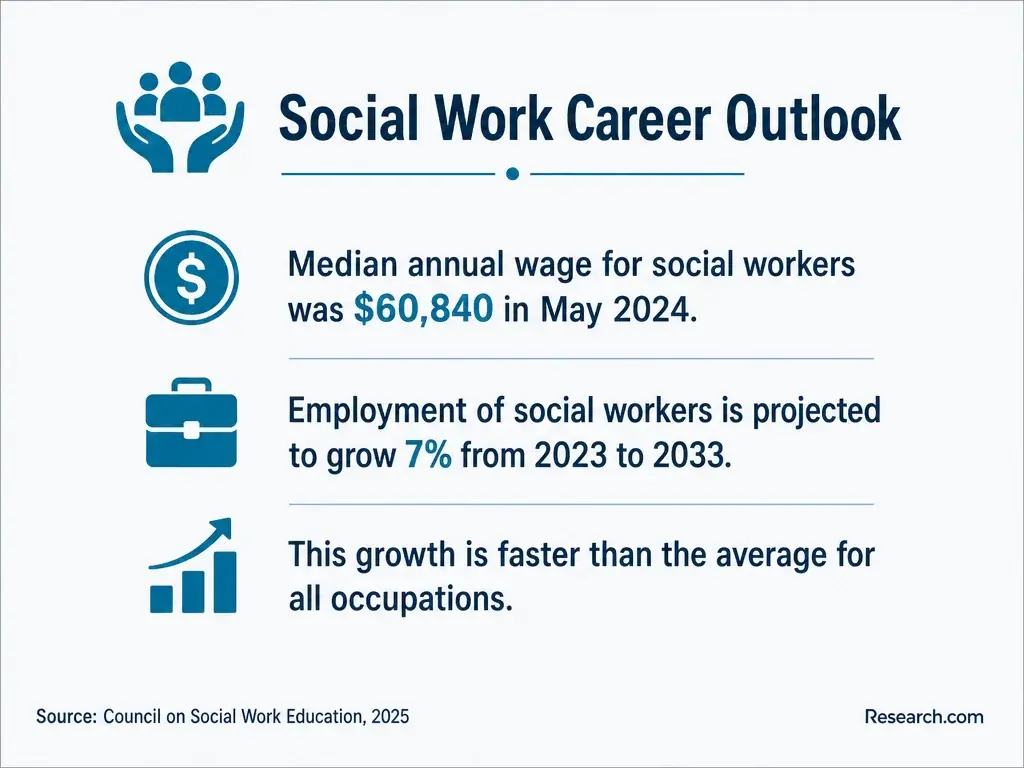
- For context, the U.S. Bureau of Labor Statistics reports a May 2025 median annual wage of $61,780 for social workers across specialties - not a salary for mapping work specifically.
What is service mapping in social work?
Service mapping is the structured identification of available services and the routes people take to reach them. A social worker might map housing assistance, food benefits, transportation, behavioral health care, and legal aid for a particular population and geographic area. The result may be a directory, a visual network diagram, a referral workflow, or a combination of these.
The distinction is between availability and access. A clinic may appear on a map but have a months-long wait, limited language access, or eligibility rules that exclude the people an agency serves. A practical map records those conditions and identifies who confirms them. It should also reflect clients' preferences and the informal supports they choose to use, rather than treating every need as a referral to an institution.
Service mapping is a practice and improvement skill, not a credential. Students considering social work degree program format comparisons should look beyond course delivery and ask whether they can learn about real community partnerships through supervised fieldwork.
How do social workers map referral networks and community resources?
Start with a defined population, service need, and catchment area. A map of youth mental health referrals in one school district requires different partners and eligibility checks from a countywide map of older-adult transportation. Obtain agency approval for the project and agree on what information can be collected and shared.
The following sequence produces a map that staff can use rather than a directory that quickly becomes stale:
- Define the referral question, geographic boundaries, intended users, and who will maintain the map.
- Inventory formal services and relevant community-led supports, then verify contact routes, eligibility, cost, language access, transportation, hours, and current intake capacity with each provider.
- Trace each handoff: who initiates contact, what consent or documents are needed, how the receiving organization responds, and who follows up if contact fails.
- Ask frontline staff, community partners, and people with lived experience where the documented process differs from what happens in practice.
- Record a verification date and owner for each entry, test the workflow with authorized staff, and set a review schedule.
Use aggregated counts or approved, de-identified information for network analysis. Do not copy identifiable case notes into a shared map. Whether referral details can be disclosed depends on applicable law, client consent, agency agreements, and the setting's records rules.
For a student, a bounded resource inventory or supervised handoff analysis may be a feasible field project. When comparing online BSW program structures, ask how the program approves local placements and supervises community-based assignments; online classes alone cannot verify a referral network.
How can service maps reveal referral bottlenecks and gaps in care?
Overlay the stated referral pathway with what can be observed through authorized records and partner feedback. Useful measures include referrals attempted, referrals accepted, time from referral to first contact, and connections completed. Define each measure first: a referral marked "sent" does not establish that an appointment was offered or that a client chose to attend.
The comparison below shows how different patterns point to different questions. It does not diagnose the cause on its own.
| Observed pattern | Possible bottleneck | What to check |
| Many referrals sent; few accepted | Eligibility mismatch or limited capacity | Current criteria, intake status, and referral information requested |
| Referrals accepted; long delay to contact | Intake queue or unreliable handoff | Response expectations, contact methods, and follow-up ownership |
| Service exists; few clients can use it | Practical access gap | Transportation, hours, language access, cost, and client preferences |
A map can also reveal a single point of failure: one provider may receive nearly every referral for a service. That concentration matters even when the provider performs well, because a closure or funding change could interrupt access across the network. Discuss alternatives with partners rather than shifting referrals without their agreement.
Before claiming an improvement, compare measures over an appropriate period and account for changes in demand, eligibility, and documentation. A larger evaluation may fit a practice-focused doctoral project, but a DSW is not required to find or address a local bottleneck. Professionals considering that route can review affordable online Doctor of Social Work pathways against the scope of the project and the experience they already have.
Relevant coursework includes human behavior in the social environment, social policy, community practice, case management, research methods, and program evaluation. The important learning task is to connect an assessment of need with realistic service options while respecting client choice and documenting the handoff appropriately.
Field education adds something a directory exercise cannot: supervised observation of how agencies actually exchange information and respond when a referral stalls. A student might, with school and agency approval, verify resources, diagram an intake process, or analyze aggregated referral outcomes. The learning agreement should identify the deliverable, permitted data, supervision, and how competence will be evaluated. A paid job or volunteer activity does not automatically count as field education.
Students considering planning a shorter MSW pathway should check whether its course and placement sequence leaves adequate time for partner interviews, revision, and supervised feedback. Completing a map quickly is less valuable than establishing that its entries and handoffs are reliable.
What are the salary and job outlook for social workers in these roles?
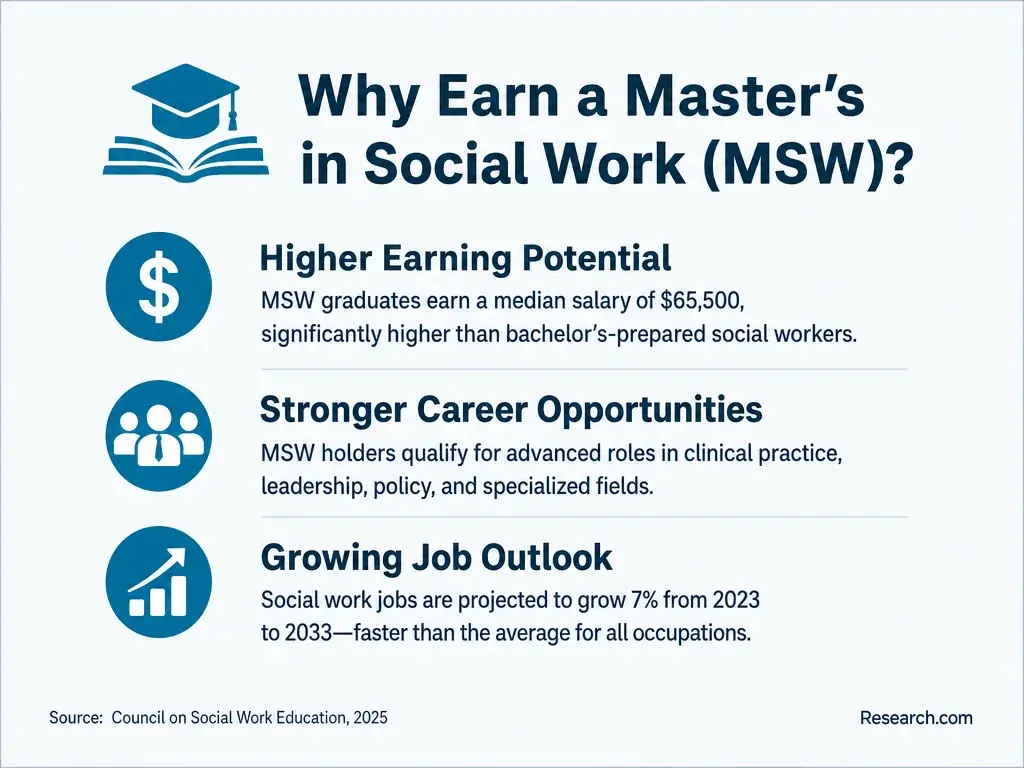
The U.S. Bureau of Labor Statistics reports the following May 2025 median annual wages and projected employment changes for 2025-2035. These are occupation-wide figures, not pay rates for service mapping or promises to graduates.
| BLS occupation | Median annual wage, May 2025 | Projected employment growth, 2025-2035 |
| Child, family, and school social workers | $59,550 | 4% |
| Healthcare social workers | $67,880 | 8% |
| Mental health and substance abuse social workers | $60,280 | 10% |
| Social workers, all specialties | $61,780 | 6% |
Use the category that matches the job's work, not merely its title. A community-resource navigator may fall outside these social worker occupations. Pay also varies by location, employer, experience, and responsibilities; exploring regional pay patterns for MSW careers can help frame a local comparison, but should not substitute for current postings and public-sector pay schedules.
Other Things You Should Know About Social Work
Set a routine review date and recheck high-change details - such as intake capacity and eligibility - before relying on them for a referral. Assign an owner so corrections reach the map.
Record the information as unverified rather than assuming availability. Ask what the provider can share publicly and establish a direct contact route for time-sensitive checks.
Not necessarily. A client-facing version should use clear, accessible language and verified contact information; an internal version may also contain approved workflow details or partner contacts that are not meant for public release.
A maintained spreadsheet and a simple handoff diagram can be enough. Consistent definitions, verification dates, privacy controls, and a responsible owner matter more than a sophisticated visualization.
- Summary of the HIPAA Security Rule | hhs.gov https://www.hhs.gov/hipaa/for-professionals/security/laws-regulations/index.html
- Factors affecting the successful implementation of the referral system: A scoping review - PMC https://pmc.ncbi.nlm.nih.gov/articles/PMC8884299/
- High-value referrals - IRIS https://iris.who.int/server/api/core/bitstreams/3ea58f50-7068-4cb5-8f54-a17dbcdeaace/content
- Indiana Data Partnership: Collaborating to Address the Opioid Crisis: Identifying Referral Networks | in.gov https://www.in.gov/idp/blog/collaborating-to-address-the-opioid-crisis-identifying-referral-networks
- Guide to Data Visualization: Networks - Research Guides https://libguides.utk.edu/data_viz/networks
- Data protection and privacy laws | Identification for Development https://id4d.worldbank.org/guide/data-protection-and-privacy-laws
- Documentation | socialworkers.org https://www.socialworkers.org/Practice/Clinical-Social-Work/Documentation
- Where Referrals Break Down Between Organizations | WellCheck https://www.wellcheck.us/where-referrals-break-down/
- Why Most Behavioral Health Referrals Never Close the Loop | NeuroFlow https://www.neuroflow.com/why-most-behavioral-health-referrals-never-close-the-loop/