2027 Social Work Media Interviews: Role Clarity, Confidentiality, and Public Education
Audited and Verified:
Our Editorial and Data Verification Process
Research.com uses government datasets, official education statistics and primary institutional information to support its career and degree guides. Our review process checks factual accuracy, occupational definitions, source dates and the requirements associated with the credentials discussed.
How This Article Was Fact-Checked
Our editorial team verifies salary estimates, employment projections, education requirements and program information against original data providers and official organizations. Salary figures are checked against the relevant occupational definitions and reporting periods. Information about licensure, accreditation and required in-person training is reviewed separately.
Fact-checked and verified on:

Co-Founder and Chief Data Scientist
A reporter's request can give a social worker a valuable chance to explain a community need - but it can also create pressure to discuss a client, speak beyond their expertise, or appear to represent an agency without permission. This guide is for students, practitioners, and social services professionals deciding whether and how to speak publicly. It covers interview boundaries, privacy safeguards, useful public education, preparation, and the education or credentials that matter if media communication becomes part of a career.
Key Things You Should Know
- Clarify whether you are speaking for yourself, your employer, or another organization before agreeing to an interview; a degree or license does not make you an authorized spokesperson.
- Use public information, aggregate findings, or approved examples - not identifiable client details. Removing a name alone may not prevent identification.
- For most public-education interviews, preparation and subject expertise matter more than another degree; verify the qualifications required for any underlying social work job.
What is a social worker's role in media interviews?
A social worker's role is to provide accurate, appropriately bounded context - not to serve as a source of client stories. Depending on their work, they might explain how a benefits process affects access to services, describe a community program, correct a misconception about mental health care, or discuss the implications of a proposed policy. They should distinguish what they have observed professionally from what research or publicly available data establish.
The invitation determines neither the speaker's authority nor the scope of their expertise. An agency spokesperson may explain an approved organizational position; a practitioner speaking personally may discuss their field of experience without implying employer endorsement. Neither role permits disclosure of protected information or speculation about a person in the news. Readers exploring the wider range of duties behind these interviews can compare social work master's roles and employment settings.
How do social workers protect client confidentiality during media interviews?
Start with a firm boundary: an interview about a public issue does not require discussing an identifiable client. Names are only one identifier. A combination of age, neighborhood, school, unusual circumstances, dates, or a recognizable quotation may allow listeners to identify someone - especially in a small community. "Off the record" is not a substitute for confidentiality safeguards.
Before sharing any client-derived information, check the law, the setting's privacy rules, agency policy, and who is authorized to approve a disclosure. HIPAA may apply to information held by a covered healthcare entity, while other records may be governed by different federal or state rules. Even when disclosure might be legally permitted, professional ethics and client interests still matter. A written release should never be assumed to authorize every detail or every future use.
Prefer published statistics, approved aggregate data, or a clearly labeled hypothetical example that is not a lightly disguised account of a real person. If a reporter asks about a specific client, a usable response is: "I can't discuss anyone's involvement with our services, but I can explain the general process." Students and provisionally licensed practitioners face the same privacy concern: understanding required experience in clinical social work does not make supervised cases available for public discussion. When uncertain, pause and consult a supervisor, privacy officer, or counsel rather than trying to anonymize a case during the interview.
How can social workers use media interviews to educate the public?
Effective public education connects a concrete community concern to a clear explanation of systems, barriers, and available responses. A housing-services worker, for example, can explain that eligibility rules and local service capacity shape access without claiming that one intervention will work for everyone. When citing a statistic, identify its source, population, and time period; distinguish national evidence from local conditions.
Prepare two or three points the audience can use, such as what a service does, who may be eligible, and where people can find locally verified help. Use plain language, avoid portraying people solely through crisis or deficit, and explain uncertainty when evidence is limited. If the goal is occasional public education rather than a regulated social work position, an additional degree may be unnecessary; social work degree planning for prospective students is most useful when the intended work actually calls for social work education.
There is no general "media interview license." Qualifications depend on the job whose expertise the person is asked to explain. A BSW can prepare graduates for generalist social work roles; an MSW may support specialized practice or leadership positions. A traditional MSW can admit graduates of other disciplines, while advanced-standing tracks generally require a qualifying social work bachelor's degree and satisfaction of the program's criteria. DSW and PhD study may suit particular leadership or research goals, but neither is a standard requirement for public commentary.
Licensure is separate from speaking ability. State boards determine protected titles and permitted practice, and an MSW alone does not authorize independent clinical work. Before choosing a program for a licensed role, check MSW licensure alignment before enrollment against the intended state board's current requirements. If the target role is communications or advocacy rather than regulated practice, relevant experience and focused media training may be a more direct investment than another social work degree.
What are the salary and job outlook for social workers?
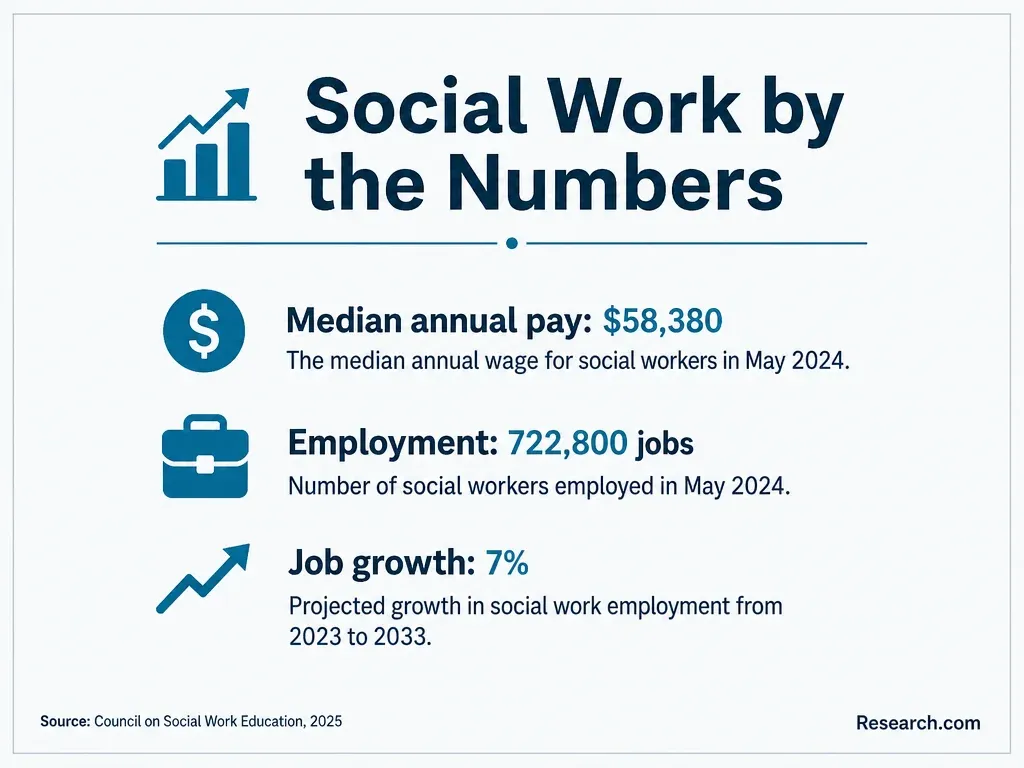
U.S. Bureau of Labor Statistics figures provide context for social work occupations, not a wage forecast for someone who gives interviews. The following May 2025 median annual wages and projected 2025-2035 employment changes describe broad occupational groups.
| BLS occupation | May 2025 median annual wage | Projected employment change, 2025-2035 |
| Social workers, all specialties | $61,780 | +6% |
| Child, family, and school social workers | $59,550 | +4% |
| Healthcare social workers | $67,880 | +8% |
| Mental health and substance abuse social workers | $60,280 | +10% |
These figures do not isolate spokesperson duties, entry-level pay, a particular license, or nonprofit communications jobs. For a job decision, compare the actual posting's pay range, responsibilities, location, and advancement prospects; a state-by-state MSW salary overview can add geographic context without replacing occupation- and employer-specific research.
Other Things You Should Know About Social Work
You can ask, but a journalist may decline. Offer to check technical facts or quotations instead, and do not assume you will have editorial control.
Save the published item, identify the specific error, and promptly contact the journalist or editor with the accurate wording. If you spoke for an employer, coordinate any correction request with its communications team.
Check employer social media rules and the clip's context first. A personal post should not imply organizational endorsement or draw attention to identifiable clients or confidential work.
Disclose the offer to your employer and check conflict-of-interest, ethics, and applicable professional rules before accepting. Payment can affect how audiences interpret your independence.
- NASW Standards for Social Work Case Management | nycourts.gov https://www.nycourts.gov/reporter/webdocs/nasw_standards_socialwork_casemgt.htm
- Informed Consent FAQs | hhs.gov https://www.hhs.gov/ohrp/regulations-and-policy/guidance/faq/informed-consent/index.html
- Anonymizing & Protecting | ucsb.edu https://rcd.ucsb.edu/resources/data-resources/anonymizing-protecting
- Principle V: Confidentiality - OCSWSSW https://www.ocswssw.org/sop/principle-v-confidentiality/
- NSCSW | Guidelines for Social Work Documentation https://nscsw.org/practice/swguidelinesdocumentation/
- Standards for Technology in Social Work Practice | socialworkers.org https://www.socialworkers.org/Practice/NASW-Practice-Standards-Guidelines/Standards-for-Technology-in-Social-Work-Practice