2027 Social Work Macro Practice Portfolios: Showing Policy, Research, and Community Skills
Audited and Verified:
Our Editorial and Data Verification Process
Research.com uses government datasets, official education statistics and primary institutional information to support its career and degree guides. Our review process checks factual accuracy, occupational definitions, source dates and the requirements associated with the credentials discussed.
How This Article Was Fact-Checked
Our editorial team verifies salary estimates, employment projections, education requirements and program information against original data providers and official organizations. Salary figures are checked against the relevant occupational definitions and reporting periods. Information about licensure, accreditation and required in-person training is reviewed separately.
Fact-checked and verified on:

Co-Founder and Chief Data Scientist
A macro social work résumé can say you analyzed policy or worked with community partners; a portfolio can show how you did it. For BSW and MSW students, recent graduates, and social services professionals, the challenge is choosing credible work samples without overstating your contribution or exposing private information. This guide explains what to include, how to present policy, research, and community work, and what to check before sharing field-placement materials. It also helps you decide whether a new degree, a different placement, or simply a better presentation of existing work will advance your goal.
Key Things You Should Know
- Build a focused portfolio around your target role: a small set of relevant samples with your contribution, methods, limitations, and any approved results is more useful than a collection of assignments.
- Policy briefs, evaluation plans, and community-engagement materials can demonstrate different macro skills, but a class exercise or proposed outcome must never be presented as an implemented project or measured result.
- Get permission before sharing agency work and remove identifying information; a redacted file is not automatically safe to publish, especially when small groups or linked details could reveal identities.
What is a macro social work portfolio, and why is it useful?
A macro social work portfolio is a curated set of work products showing how you address problems affecting organizations, communities, or systems. It might document policy analysis, program planning, advocacy, community organizing, or evaluation. Unlike a résumé, it gives an employer evidence of your reasoning and communication - not just a list of responsibilities.
A portfolio is particularly useful when a job title does not convey what you actually did. A student whose placement involved both outreach and data analysis, for example, can show those contributions separately.
Students comparing online social work degree programs can also ask how coursework and field education produce work they will be permitted to discuss or share. The portfolio supports an application; it does not replace required education, experience, or a license.
What should you include in a macro social work portfolio?
Choose samples for the work you want next, not simply for the grade they earned. A policy applicant might lead with a brief, while a program-coordinator applicant might lead with an implementation plan. These are useful categories to draw from; you need not have every one.
- Policy: A legislative or administrative policy brief that defines the issue, compares options, identifies affected groups, and explains implementation trade-offs.
- Research and evaluation: A literature synthesis, logic model, survey proposal, measurement plan, or analysis of data you were authorized to use.
- Community practice: An outreach plan, accessible meeting agenda, stakeholder map, or account of how community feedback changed a proposal.
- Implementation: A training outline, service-access workflow, budget narrative, or project timeline that shows how an idea could operate in an agency.
For each sample, add a short note stating the problem, audience, your exact role, methods, approvals or constraints, and what happened - or that implementation was not assessed. Include a résumé and a brief statement of your practice interests, but omit filler certificates and client-facing documents.
Students assessing social work bachelor's quality and career preparation can look beyond course titles to the opportunities for supervised projects and feedback.
How can a portfolio showcase policy, research, and community engagement skills?
Make your reasoning visible. A polished final product shows communication skill; a short explanation of the choices behind it shows professional judgment. For a policy brief, identify whose perspectives informed the options, the evidence available, likely implementation barriers, and whose access to services might change.
For an evaluation plan, state the question, proposed measures, data limitations, and how findings would be used. Do not call projected effects "results."
Community engagement is not just an attendance count. Explain how you planned accessible participation, handled competing priorities, and incorporated feedback - without identifying participants or claiming their endorsement.
If a project was a group effort, identify which analysis or materials you personally produced and credit collaborators. Macro samples demonstrate systems-level work; they do not establish the assessment or treatment competencies associated with clinical social work coursework and field training.
Permission and de-identification are separate checks. Ask the agency or project owner what you may retain and share, then follow its rules for records, data, branding, and work created during employment or field education. A school assignment using agency material is not automatically yours to publish. Obtain any required review before taking a copy off an approved system.
Remove names, locations, dates, quotations, screenshots, and combinations of details that could identify a person or small community. Aggregated data may still be revealing when groups are small.
Do not upload client records, internal dashboards, unpublished grant information, or identifiable meeting notes to a personal site or an unapproved tool. When a real sample cannot be shared, write a new public-source policy brief or clearly labeled hypothetical evaluation plan instead; never invent findings or imply agency approval.
Returning learners considering online bachelor's social work options for returning learners can ask field offices early how students retain evidence of competencies without keeping restricted documents. Applicable law, agency policy, school rules, and professional ethics may each impose different obligations; confirm the requirements governing your specific material.
Course delivery and placement location are different decisions. An online student may still need scheduled, in-person agency work, live seminars, and meetings with a field instructor. A campus program may have nearby agency relationships, but that does not guarantee a particular policy or community placement. In either format, the school must approve the site, learning agreement, supervision, and competency assessment.
Ask who identifies placements in your area, whether policy or evaluation tasks can meet field objectives, and what happens if a proposed site falls through. If you work for an agency, ask whether an employment-based placement is permitted and how educational tasks will be distinguished from ordinary duties.
For a clearer comparison, examine MSW practicum placement assistance alongside local site availability, required on-site hours, scheduling, travel, and supervision. Neither paid work nor volunteer projects automatically count as field education.
What are the salary and job outlook for macro social work careers?
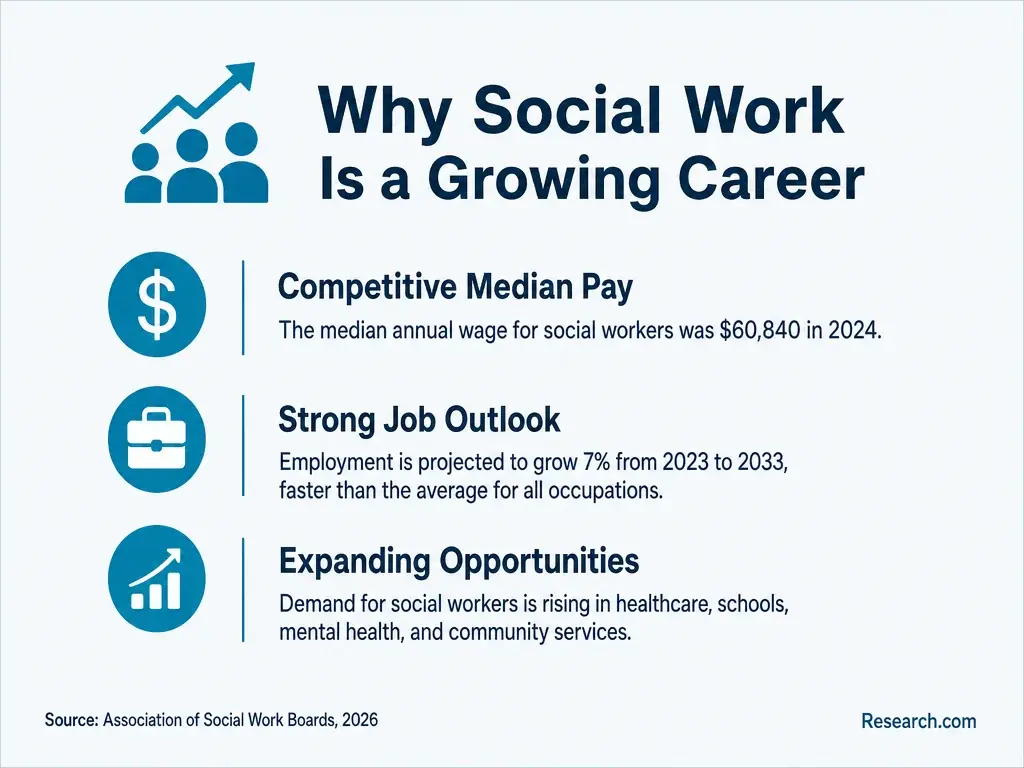
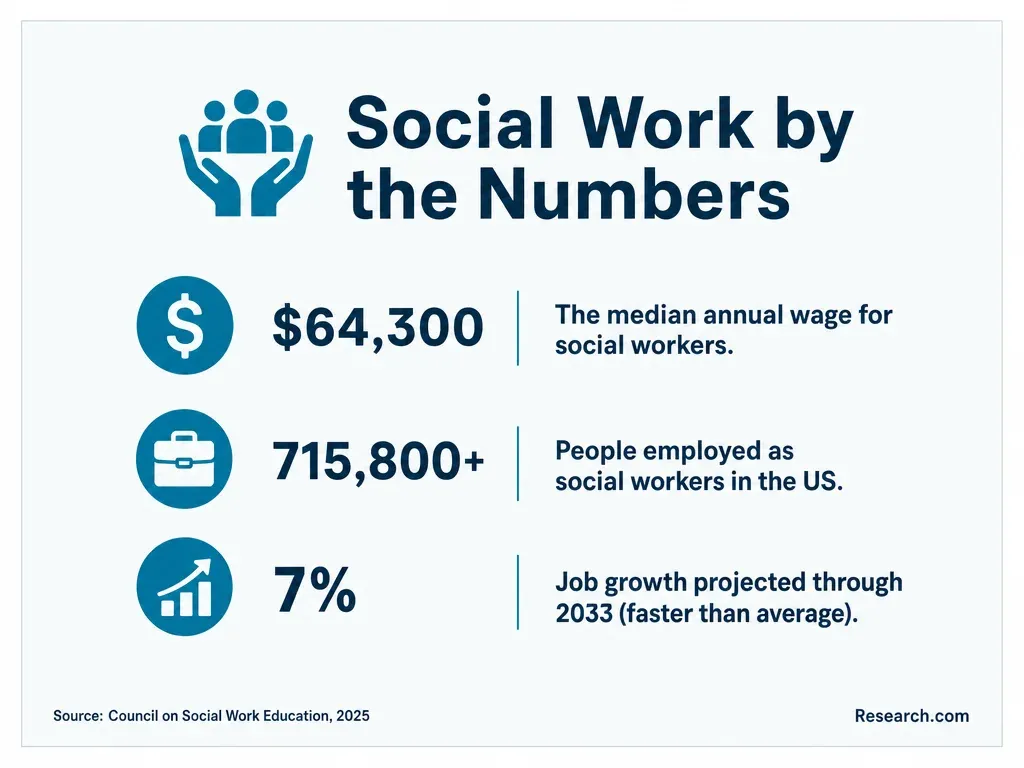
There is no single US Bureau of Labor Statistics (BLS) occupation called "macro social worker." The BLS reports a May 2025 median annual wage of $61,780 for social workers across specialties and projects 6% employment growth from 2025 to 2035. Those figures provide broad social work context, not a salary or growth forecast for policy analysts, nonprofit managers, or everyone with an MSW.
Use the occupation that matches a particular posting's duties before comparing wages. Pay also varies with location, government pay grades, funding, experience, and responsibility; a portfolio does not guarantee a raise. A guide to comparing social worker pay by location can help frame a geographic comparison, but evaluate an actual offer against its job classification, benefits, advancement prospects, and the cost of any further education.
Other Things You Should Know About Social Work
Yes, if it demonstrates sound judgment. Explain what you attempted, what evidence is available, what constrained the work, and what you would change. Do not turn an unmeasured outcome into a success claim.
Yes, when you credit the group and identify your own contribution. Confirm that collaborators and any sponsoring agency permit sharing the material.
No. A tailored PDF or a private set of samples available on request is often sufficient and gives you more control over sensitive or outdated work.
Review it when your responsibilities change and before each application. Replace weaker samples, check sharing permissions again, and remove claims you can no longer substantiate.
- Ethical Considerations and Data Protection Principles | WHO SMART Trust v1.7.4 https://smart.who.int/trust/ethical_principles.html
- Topic: Evidence-Based Practice | Agency for Healthcare Research and Quality https://www.ahrq.gov/topics/evidence-based-practice.html
- A Review of the Quality Indicators of Rigor in Qualitative Research - PMC https://pmc.ncbi.nlm.nih.gov/articles/PMC7055404/
- Using Portfolios in Program Assessment | Assessment and Curriculum Support Center https://manoa.hawaii.edu/assessment/resources/using-portfolios-in-program-assessment/
- Module 17b: Building Relationships with the Community | unc.edu https://ready.web.unc.edu/section-2-transforming-practice/module-17b/
- Social Work Graduate Student Portfolios | ScholarWorks at University of Montana https://scholarworks.umt.edu/socialwork_portfolios/
- 10 skills you need to grow your public policy career | ox.ac.uk https://onlinecourses.bsg.ox.ac.uk/blog/public-policy-skills-you-need-to-grow-your-career
- Data Ethics and Accountability | ncat.edu https://libguides.library.ncat.edu/c.php
- Evaluating impact from research: A methodological framework - ScienceDirect https://www.sciencedirect.com/science/article/pii/S0048733320302225
- Standards and Indicators for Cultural Competence in Social Work Practice | socialworkers.org https://www.socialworkers.org/Practice/NASW-Practice-Standards-Guidelines/Standards-and-Indicators-for-Cultural-Competence-in-Social-Work-Practice