2027 Social Work in School Policy: Attendance, Access, and Student Support Systems
Audited and Verified:
Our Editorial and Data Verification Process
Research.com uses government datasets, official education statistics and primary institutional information to support its career and degree guides. Our review process checks factual accuracy, occupational definitions, source dates and the requirements associated with the credentials discussed.
How This Article Was Fact-Checked
Our editorial team verifies salary estimates, employment projections, education requirements and program information against original data providers and official organizations. Salary figures are checked against the relevant occupational definitions and reporting periods. Information about licensure, accreditation and required in-person training is reviewed separately.
Fact-checked and verified on:

Co-Founder and Chief Data Scientist
Attendance problems often signal barriers a school cannot solve with reminders or penalties alone. Housing instability, disability-related needs, transportation, family responsibilities, and school climate can all affect whether a student gets to class and receives support. This guide is for school and human services professionals, prospective social workers, and early-career practitioners. It explains how school social workers work within attendance and access policies, where their authority ends, and how to assess the education, credentials, and workplace conditions needed for the role.
Key Things You Should Know
- Chronic absenteeism generally means missing at least 10% of school days - about 18 days in a 180-day year - and calls for understanding barriers, not assuming a family is unwilling to cooperate.
- School social workers connect individual support with schoolwide systems, but referral rules, staffing, consent, privacy, and disability-service obligations determine what students can access.
- School qualifications vary by state; an MSW, school credential, social work license, and independent clinical license are distinct qualifications, not interchangeable permissions.
What do school social workers do in student support systems?
School social workers help students participate in education by addressing social, emotional, family, and community factors affecting learning. Their work can include student and family engagement, assessment within their professional role, brief support, crisis collaboration, referrals, case coordination, and consultation with educators. They may also examine whether a school's procedures create avoidable barriers to help.
Many districts organize support through a multi-tiered system of supports (MTSS). In that framework, school social workers might help improve schoolwide belonging and attendance practices, support targeted groups, or coordinate individualized services.
MTSS is an organizing approach, not a substitute for an evaluation or services required under disability law. A social worker's duties also depend on district staffing, supervision, and the qualifications attached to the position.
For someone considering the career, the useful distinction is between working with students and improving the system students must navigate. Ask prospective employers how much time the role allocates to direct service, family outreach, team meetings, documentation, and prevention. Those priorities can shape planning professional progression with an MSW more than the job title alone.
How do school social workers address chronic absenteeism and attendance barriers?
Chronic absenteeism counts missed instructional time regardless of whether absences are excused. It is a useful signal for support, but the count does not explain why a student is absent. A school social worker can help a team review attendance patterns, listen to the student and caregiver, identify practical or school-based barriers, and agree on a plan that can be revisited.
A workable attendance response separates problems the school can change from those requiring outside coordination. The following sequence keeps the response focused on access rather than punishment:
- Check the accuracy of attendance records and look for patterns by day, class, transportation route, or recent school transition.
- Contact the student and family in an accessible language and format, asking about barriers without treating an absence code as a diagnosis.
- Coordinate appropriate school changes, such as a safer arrival plan or a review of disability-related needs, and connect families with community resources when they want them.
- Set a follow-up date and review both attendance and whether the agreed support was actually available.
School staff must follow applicable attendance and reporting rules; a social worker cannot simply waive compulsory-attendance requirements. Nor should attendance intervention delay a needed disability evaluation or substitute for a safety response.
When persistent absence is connected to emotional or behavioral health concerns, social work master's programs emphasizing clinical preparation may be relevant preparation, but clinical coursework alone does not authorize independent treatment or resolve transportation, housing, or school-climate barriers.
How do school policies affect student access to social work services?
Access depends on more than whether a district employs a social worker. A referral-only system may miss students whose caregivers cannot navigate the process; limited staff coverage can produce long waits; and unclear consent rules can discourage appropriate referrals. Schools should distinguish universal outreach, voluntary individual services, crisis procedures, and services required through an individualized education program (IEP) or other applicable process.
Federal protections can affect the pathway to help. Under the Individuals with Disabilities Education Act, an eligible student's IEP may identify social work services needed to benefit from special education. Section 504 may require disability-related supports through its own process.
The McKinney-Vento Act addresses educational access for eligible students experiencing homelessness. These are not interchangeable programs, and an attendance concern by itself does not establish eligibility for any of them.
Privacy and trust are also policy issues. School records are generally governed by the Family Educational Rights and Privacy Act (FERPA), while state law, district procedures, and professional obligations can add requirements.
Staff should explain the limits of confidentiality, document only what is needed, and verify the rules before sharing information with a team or outside provider. Families' language access and disability-related communication needs should be considered when explaining services and obtaining any required consent.
For professionals seeking a policy-facing role, compare how districts handle referral criteria, family communication, evaluation requests, caseloads, and follow-up - not just the services named in a job posting. Those same questions can guide social work degree planning for prospective students who want preparation in both direct practice and school-system change.
The right route depends on the state's school qualification rules and the actual position. A BSW provides generalist social work preparation and may fit some school-linked or community service roles.
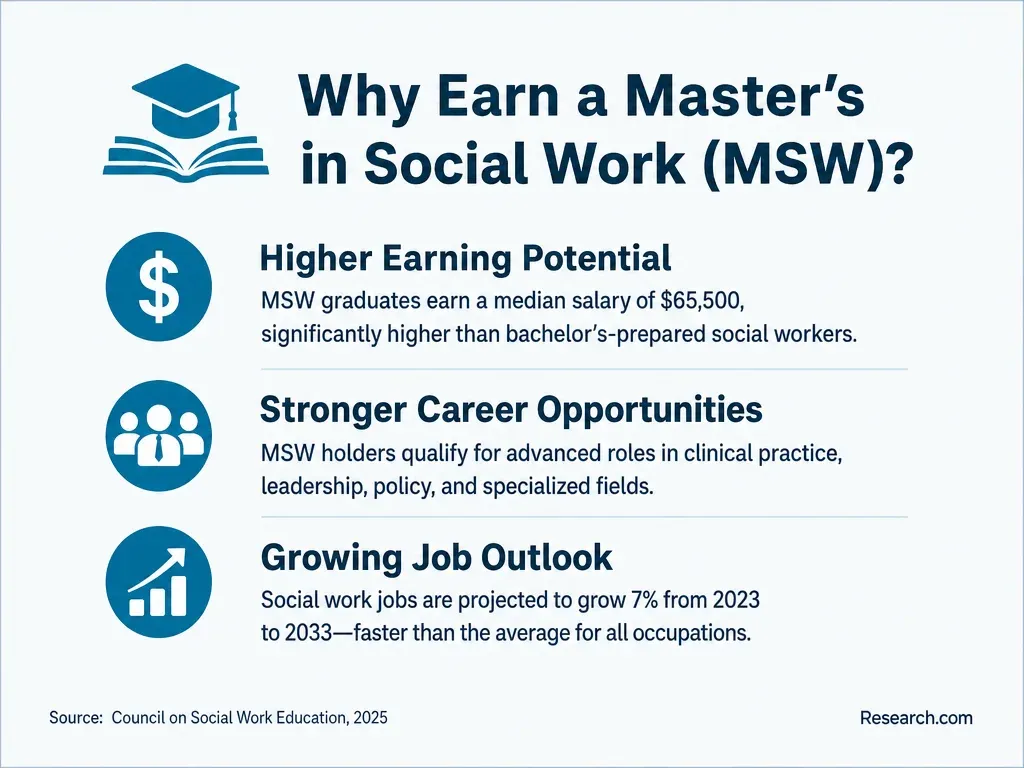
Many school social worker positions require an MSW, sometimes alongside a school-specific credential. A traditional MSW can admit qualified graduates from other disciplines; advanced-standing entry generally requires a qualifying BSW and must be approved by the program.
For a prospective undergraduate, online BSW accreditation and learning format deserve attention before assuming the degree will support a later advanced-standing application. For someone who already holds another bachelor's degree, a traditional MSW may be more direct than earning a second bachelor's degree.
If the target job is attendance outreach or family liaison work rather than a designated social worker position, relevant experience or a different qualification may suffice; verify employer requirements first. A DSW or PhD is not ordinarily the entry qualification for school social work.
What are school social worker salaries and job prospects?
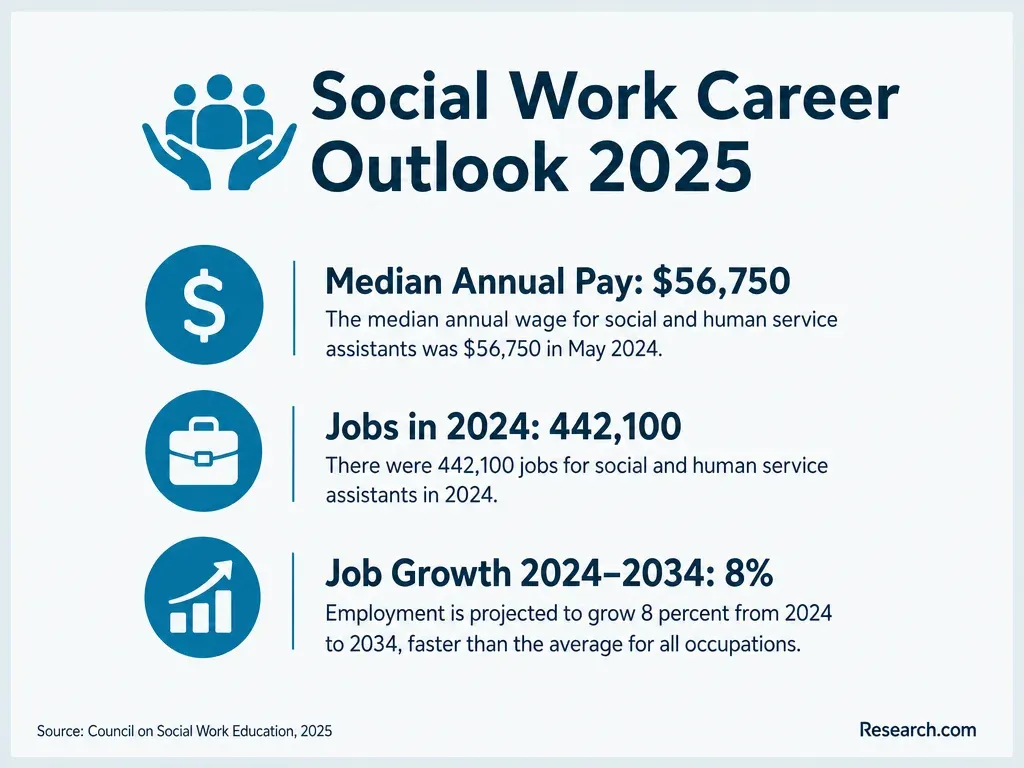
The U.S. Bureau of Labor Statistics groups school social workers with child and family social workers rather than reporting a separate national school-only median. For child, family, and school social workers, the reported May 2025 median annual wage is $59,550, with employment projected to grow 4% from 2025 to 2035. These occupation-wide figures are context, not a salary offer or a forecast of openings in a particular district.
For a practical comparison, review the district's salary schedule, contract length, benefits, travel expectations, supervision, and caseload. A position paid on a school-year schedule may not be directly comparable with a year-round agency job. Geographic comparisons of MSW career compensation by state can add context, but actual school pay depends on the employer's classification and negotiated terms - not the degree alone.
Other Things You Should Know About Social Work
Often, yes. They can help a family identify community options and coordinate within applicable consent and privacy rules. A referral does not guarantee availability, coverage, or that the outside provider will share records with the school.
Not solely because of their job title. District and state attendance rules determine who can change an attendance record and what documentation is required. A social worker can help correct errors and explain relevant circumstances to the authorized team.
Caregivers can ask the school how to inspect records under applicable education-record rules. Access and disclosure may depend on the type of record, the student's rights, and governing law; the district's records office should handle specific requests.
Document which support is missing and ask the designated school contact for a review. If the support is part of an IEP or Section 504 plan, use that plan's team and the district's established procedures rather than relying only on an informal referral.
- The Civil Rights of Students With Hidden Disabilities and Section 504 | U.S. Department of Education http://www.ed.gov/laws-and-policy/individuals-disabilities/section-504/civil-rights-of-students-hidden-disabilities-and-section-504
- The Rights of Students with Disabilities Under the IDEA, Section 504, and the ADA | Congress.gov | Library of Congress https://www.congress.gov/crs-product/R48068
- Role of School Social Worker | NC DPI https://www.dpi.nc.gov/educators/specialized-instructional-support/school-social-work/role-school-social-worker
- FERPA | Protecting Student Privacy - Department of Education https://studentprivacy.ed.gov/FERPA
- Attendance Flexibility | Office of Accessible Education https://oae.stanford.edu/students%23academic-accommodations-services-button/attendance-flexibility
- What is Social Work and What Do Social Workers Do? | buffalo.edu https://socialwork.buffalo.edu/admissions/is-social-work-right-career-for-me/what-is-social-work.html
- NASW Practice Standards for School Social Workers https://www.socialworkers.org/Practice/NASW-Practice-Standards-Guidelines/NASW-Standards-for-School-Social-Work-Services
- SSW Standards / Roles & Responsibilities | wsswa.org https://wsswa.org/SSW_Standards___Roles___Responsibilities
- Reducing Chronic Absenteeism: Lessons From Community Schools | Learning Policy Institute https://learningpolicyinstitute.org/product/chronic-absenteeism-community-schools-report
- Brief Allied Health Professions Series: Social Workers | ncsl.org https://www.ncsl.org/health/social-workers