2027 Social Work Documentation in Schools vs Healthcare: Different Systems and Audiences
Audited and Verified:
Our Editorial and Data Verification Process
Research.com uses government datasets, official education statistics and primary institutional information to support its career and degree guides. Our review process checks factual accuracy, occupational definitions, source dates and the requirements associated with the credentials discussed.
How This Article Was Fact-Checked
Our editorial team verifies salary estimates, employment projections, education requirements and program information against original data providers and official organizations. Salary figures are checked against the relevant occupational definitions and reporting periods. Information about licensure, accreditation and required in-person training is reviewed separately.
Fact-checked and verified on:

Co-Founder and Chief Data Scientist
A school social worker's note may help a team plan a student's educational support; a hospital social worker's note may guide discharge planning across a clinical team. Writing the same account for both settings can leave out essential information - or disclose too much.
This guide is for social work students, new practitioners, and professionals considering a move between schools and healthcare. It compares the records, readers, privacy rules, systems, and payment requirements in each setting so you can assess your preparation and ask better questions before a placement or job change.
Key Things You Should Know
- School records usually connect services to educational access and student support; healthcare records connect interventions to care, coordination, and sometimes medical necessity.
- FERPA generally governs records maintained by a school about its students; HIPAA generally governs records held by a covered healthcare provider. The setting and record holder matter more than the social worker's job title.
- Billing adds requirements beyond a useful practice note: a payer may require a qualifying provider, covered service, documented time or units, and evidence supporting the claim.
How does social work documentation differ between schools and healthcare settings?
The central difference is what the record must help others decide. In schools, social workers document concerns and services in relation to attendance, participation, behavior, safety, and access to learning. In healthcare, they document psychosocial needs, interventions, referrals, care transitions, and information relevant to the treatment team. Both settings require accurate, timely, respectful records, but neither calls for every detail a client shares.
This comparison shows why a useful note in one setting may need a different emphasis in the other.
| Documentation question | School setting | Healthcare setting |
| What is the immediate purpose? | Support educational planning, services, and coordination. | Support care, continuity, discharge, and, where applicable, payment. |
| What context matters? | Student functioning at school and barriers to educational access. | Health-related psychosocial needs and effects on the care plan. |
| What establishes the record's boundaries? | District policy, education law, service plans, and student needs. | Organization policy, clinical workflow, privacy law, and payer rules. |
For a career move, compare actual duties rather than assuming one setting is simply "more clinical." School roles can include crisis response and family coordination; healthcare roles can include nonclinical resource navigation. Reviewing social work master's career options can help place those duties alongside other paths, but a job description and local requirements should control your decision.
What types of notes and reports do school and healthcare social workers write?
School social workers may write contact or service notes, attendance and intervention summaries, psychosocial assessments, crisis documentation, referral records, and contributions to individualized education program (IEP) or Section 504 processes. Which documents they prepare - and who may enter them - depends on their role and district procedures. A school service note might identify the educational concern, service provided, student response relevant to the plan, and agreed follow-up without reproducing an entire conversation.
Healthcare social workers may document psychosocial assessments, progress notes, care plans, resource referrals, family meetings, safety-related consultations, and discharge planning. A healthcare note should make the social worker's contribution and next step clear to the care team; it should not present an unverified referral as a completed service. Documentation for psychotherapy, when within the practitioner's authorized role, can have additional clinical and payer requirements.
Keep different logs separate. A client service note is not automatically proof of field-placement hours or post-degree clinical supervision. If you are tracking the latter, check the board's rules and supervisor-approved records; a guide to comparing social work clinical experience expectations can help frame the questions.
How do FERPA and HIPAA affect social work records in each setting?
FERPA generally protects education records maintained by a school or a party acting for it. That can include school social work records, even when they contain health information. HIPAA generally protects health information held by a covered healthcare entity or its business associate. A hospital does not become subject to FERPA merely because it treats a student, and a school record does not become a HIPAA record merely because it describes counseling or Medicaid-billed services.
Boundaries can be more complicated when a healthcare provider operates on school property or records are shared between organizations. Determine who maintains each record, which entity provides the service, and which law and agreement govern disclosure. FERPA and HIPAA have different access and disclosure provisions; state law may add protections. Neither rule is a blanket instruction to share all details with every colleague or parent.
Before entering or releasing sensitive information, follow the organization's privacy procedures and consult its designated privacy or records staff when uncertain. Licensing rules are a separate question: a guide to social work master's licensure requirements can inform education planning, but it does not replace a school district's or healthcare organization's records policy.
Schools may use student information systems, special education platforms, service-delivery logs, and secure district-approved tools. Healthcare employers commonly use electronic health records (EHRs) with structured assessments, progress-note templates, referrals, and discharge workflows. A social worker may need to work across more than one system in either setting.
Templates make required fields easier to find, but they can also encourage copying old language or placing sensitive information in a field visible to a broader audience. Before saving, check the record, encounter date, author, recipients or visibility, and whether the entry accurately describes what happened. Use only approved devices, accounts, and communication channels; do not move identifying client information into a personal app to make note-writing easier.
Software brands change across employers, so transferable skills matter more than familiarity with one product. When comparing online social work education options for career planning, ask whether students practice secure documentation and receive feedback on notes, not whether a program advertises a particular EHR.
How do school and healthcare social work jobs compare in salary and outlook?
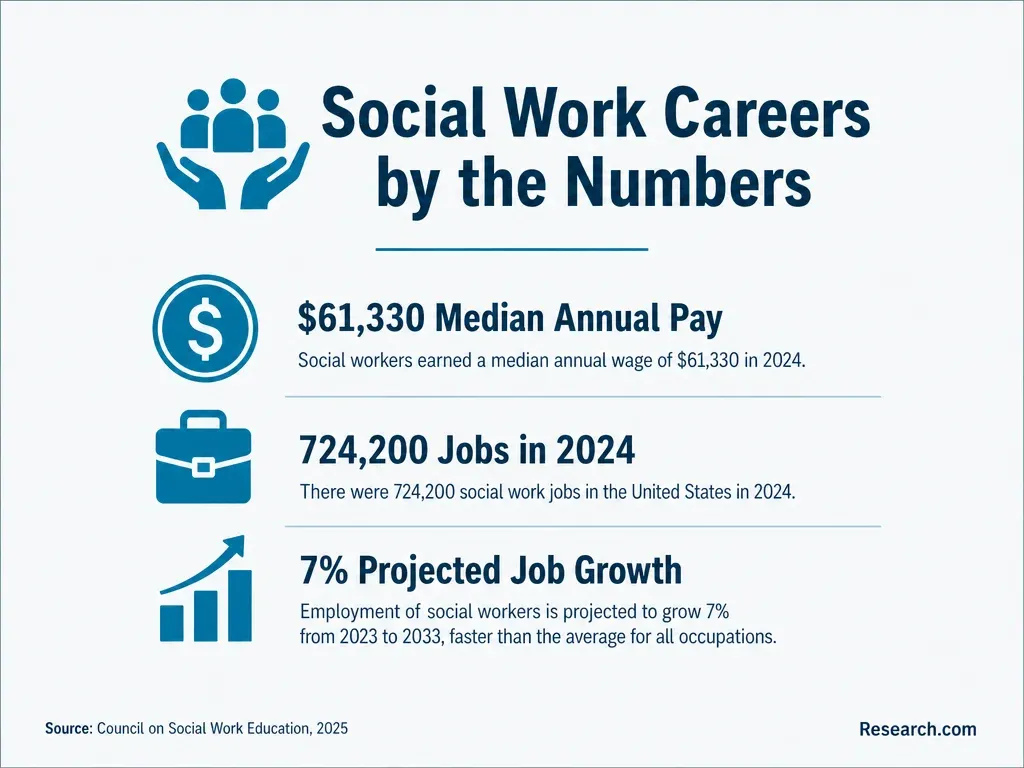
U.S. Bureau of Labor Statistics occupation categories offer a broad comparison, though they do not capture every district, hospital, license level, or job title. The figures below pair May 2025 median annual pay with projected employment growth for 2025-2035.
| BLS occupation | Median annual pay, May 2025 | Projected growth, 2025-2035 |
| Child, family, and school social workers | $59,550 | 4% |
| Healthcare social workers | $67,880 | 8% |
The healthcare category has the higher national median and projected growth, but those figures do not predict an individual offer. Compare local pay schedules, benefits, hours, caseload, supervision, documentation time, and required credentials. School calendars and healthcare shift or on-call arrangements can also change the practical value of an offer. For geographic context, see comparing state salary figures for social work roles; then verify the actual employer's range.
Other Things You Should Know About Social Work
Retention depends on the record holder, applicable federal and state rules, contracts, and agency policy. Follow the employer's schedule; do not delete a record simply because a case closes or you leave the job.
Use the organization's correction or addendum procedure promptly. Preserve the original record and audit trail rather than silently overwriting an entry or backdating a change.
Not without appropriate authorization and safeguards. A fictional, clearly labeled sample written for the interview is usually a safer way to demonstrate your documentation skills.
When relevant to the service, document the language support used and follow agency policy on identifying the interpreter and communication method. Avoid implying that you communicated directly in a language you do not use professionally.
- 45 CFR 164.512 -- Uses and disclosures for which an authorization or opportunity to agree or object is not required. https://www.ecfr.gov/current/title-45/subtitle-A/subchapter-C/part-164/subpart-E/section-164.512
- Summary of the HIPAA Privacy Rule | hhs.gov https://www.hhs.gov/hipaa/for-professionals/privacy/laws-regulations/index.html
- Electronic Health Records - Health IT Playbook https://playbook.healthit.gov/playbook/electronic-health-records/
- Case Management - StatPearls - NCBI Bookshelf https://www.ncbi.nlm.nih.gov/books/NBK562214/
- FERPA | Protecting Student Privacy - Department of Education https://studentprivacy.ed.gov/ferpa
- Code of Ethics: English | socialworkers.org https://www.socialworkers.org/about/ethics/code-of-ethics/code-of-ethics-english
- FERPA: What it means and how it works | splc.org https://splc.org/ferpa-what-it-means-and-how-it-works/
- HIPAA and FERPA Basics | aap.org https://www.aap.org/en/patient-care/school-health/hipaa-and-ferpa-basics/