2027 Social Work Billing Services vs In-House Administration: Comparing Responsibilities
Audited and Verified:
Our Editorial and Data Verification Process
Research.com uses government datasets, official education statistics and primary institutional information to support its career and degree guides. Our review process checks factual accuracy, occupational definitions, source dates and the requirements associated with the credentials discussed.
How This Article Was Fact-Checked
Our editorial team verifies salary estimates, employment projections, education requirements and program information against original data providers and official organizations. Salary figures are checked against the relevant occupational definitions and reporting periods. Information about licensure, accreditation and required in-person training is reviewed separately.
Fact-checked and verified on:

Co-Founder and Chief Data Scientist
Outsourcing billing can free a social work practice from routine claim follow-up, but it cannot transfer responsibility for accurate clinical records or lawful practice. For practice owners, agency managers, and professionals considering billing work, the decision is about more than who submits claims: staffing capacity, payer rules, privacy, and client experience all matter.
This guide maps the work each party performs, shows how to compare costs and vendors, and explains when billing training—not another social work degree—is the more direct career investment.
Key Things You Should Know
- Outsourced billers can manage claims and follow-up; clinicians and practices still control documentation, authorized services, payer contracts, and oversight.
- Compare total costs, not fee percentages alone: at an illustrative 5% of $40,000 in monthly collections, a vendor fee would be $2,000 before setup or other charges.
- Billing roles generally do not require a BSW or MSW; a social work degree or license matters when the person also performs regulated social work services.
How do social work billing services differ from in-house administration?
A social work billing service is an outside company contracted to perform some or all of a practice's revenue-cycle tasks, such as preparing claims, posting payments, and pursuing denials. With in-house administration, practice employees perform those tasks under direct organizational management. Neither model determines which clinical services a social worker may provide or which services an insurer will cover.
The practical difference is control over daily workflow. In-house staff are usually closer to scheduling, client questions, and clinicians; outsourcing may provide more specialized claim expertise and coverage when an employee is absent. Both models need a clear handoff between clinical documentation and claim submission. Practices with varied services should first identify what they actually bill for: psychotherapy claims, hospital-based services, case management, grant-funded work, and public-agency services can follow different payment rules. A guide to professional pathways after an MSW can help distinguish those roles, but the applicable payer contract determines the claim workflow.
A hybrid arrangement is often sensible: an employee manages scheduling, eligibility checks, and client communication while a vendor handles claim submission and denials. The best division depends on claim volume, payer mix, staff capacity, and whether the organization can supervise a vendor effectively.
What responsibilities do outsourced social work billing services typically handle?
A vendor's duties depend on its contract, not its marketing description. A full-service arrangement may cover eligibility inquiries, claim preparation and electronic submission, rejection correction, payment posting, denial follow-up, aging reports, and patient statements. Credentialing applications or prior-authorization support may be separate services.
The handoff needs particular care in social work settings. Before submitting a claim, a biller may check that the clinician, service, date, place of service, and payer information match the practice's records. The vendor should flag missing or inconsistent information rather than invent a diagnosis, change a clinical note, or assume a clinician is approved by a payer. Documented post-degree supervision is a separate matter from claim processing; online resources on social work clinical hours and approval questions address that distinction.
Ask whether the vendor works rejected claims before payer acceptance, pursues denied claims afterward, handles secondary insurance, and reconciles deposits to remittance records. These are different tasks, and leaving one out can create an avoidable backlog.

What billing responsibilities remain with in-house staff and social workers?
Social workers remain responsible for performing services within their authorized scope and creating timely, truthful clinical documentation. A billing company cannot establish medical necessity, supply a missing encounter, or make an unlicensed practitioner eligible for reimbursement. The practice must confirm each clinician's license status, payer enrollment, applicable supervision arrangements, and contract terms.
In-house staff commonly retain scheduling, accurate demographics and insurance intake, consent and financial-policy discussions, referrals of coverage questions, and responses to client concerns. Someone inside the practice also needs authority to resolve discrepancies the biller identifies—for example, a service recorded under the wrong clinician or a payer that has not approved a provider.
For an owner hiring clinicians trained through distance education, online MSW program eligibility by intended state is a distinct question from present license status and payer enrollment. Verify the latter directly with the relevant board and payer before treating services as billable.
Outsourcing often replaces some fixed staffing expense with a contracted fee, but neither model is automatically cheaper. Compare the same scope of work over a full year, including transition costs and the time clinicians or managers spend resolving billing issues.
The table separates costs that can otherwise disappear inside a quoted fee or an employee's salary. A vendor proposal should specify which items it includes.
| Cost or capacity factor | Outsourced service | In-house administration |
| Core charge | Contract fee, which may be based on collections, claims, or a fixed amount | Wages, benefits, payroll costs, and supervision |
| Additional expenses | Possible setup, software, credentialing, statement, or termination charges | Software, training, equipment, hiring, and coverage during absences |
| Management time | Vendor meetings, audits, and exception resolution | Daily oversight, quality checks, and staff development |
| Scaling | Check fee changes as claims or collections grow | Check when a higher volume requires another employee |
For illustration only, a fee of 5% on $40,000 in monthly collections equals $2,000 a month, or $24,000 over 12 months, before other charges. That is not a market-rate estimate or proof of savings. Compare it with the fully loaded cost of staff doing the same work, then review denial recovery, collection timing, and error correction—not just the quoted price.
For someone considering billing as a career, the financial comparison is different: an MSW is usually unnecessary solely to submit claims. An online social work master's affordability guide is relevant if the goal also requires an MSW-qualified social work role, not as a prerequisite for billing work.
Responsibility is shared, but it is not interchangeable. Clinicians are accountable for accurate service records and practicing within their legal authority. The practice is accountable for its contracts, policies, workforce oversight, and correction of identified problems. A vendor is responsible for performing its contracted tasks accurately, protecting the information it receives, and escalating discrepancies. Outsourcing does not relieve a practice of its own compliance obligations.
When a vendor handles protected health information on behalf of a HIPAA-covered practice, assess whether a business associate agreement is required and put the appropriate agreement in place. Limit access to necessary records; define how the vendor reports suspected errors or security incidents; and establish who approves corrections, refunds, or disclosures. The practice should periodically review claim samples against records and reconcile payments, rather than relying only on the vendor's dashboard.
Education and authority should not be confused with billing compliance. Neither an advanced degree nor an accelerated route to one changes state licensing or payer requirements. If a staff member is considering advanced standing vs traditional MSW, that is an education decision; the practice must still verify the resulting clinician's actual authorization and enrollment.
What are the salaries and job outlooks for social workers and medical billers?
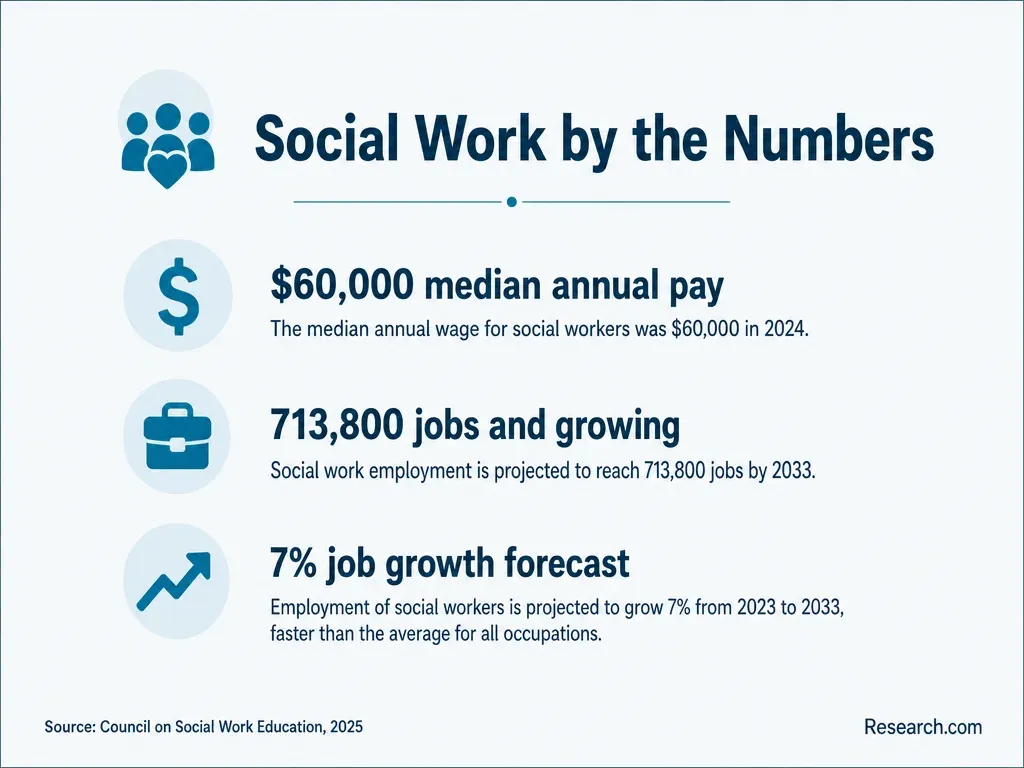
The U.S. Bureau of Labor Statistics reports a May 2025 median annual wage of $61,780 for social workers across specialties and projects 6% employment growth from 2025 to 2035. The combined figure hides meaningful differences: the reported medians are $59,550 for child, family, and school social workers, $67,880 for healthcare social workers, and $60,280 for mental health and substance abuse social workers. Their projected growth rates are 4%, 8%, and 10%, respectively.
Those are occupation-wide figures, not pay promises for MSW graduates, licensed clinicians, or practice owners. Location, employer, experience, specialty, and license status also matter; comparing pay locations for master's-prepared social workers can add geographic context.
Medical billing is a different occupation from social work, and job titles such as biller, coder, and medical records specialist can involve different duties. Without a verified, directly matching wage and projection series for the specific billing job, a single national figure would be misleading. Compare local postings for the duties and software involved, then weigh pay against training cost, benefits, advancement, and whether the role includes supervising staff or managing an entire revenue cycle.
Other Things You Should Know About Social Work
No. A service must meet the applicable payer's coverage, practitioner, documentation, and contract rules. Some valuable social work activities are paid through grants, salaries, or agency budgets rather than individual insurance claims.
Possibly, but coverage and requirements vary by payer and plan. Confirm the permitted service, practitioner, participant records, and claim instructions before billing.
No. Check the payer's current telehealth coverage, clinician eligibility, location, and claim requirements, as well as applicable state practice rules.
The practice should set and explain its financial policy and resolve exceptions. A billing vendor may send statements or record approved adjustments, but it should not independently decide what a client owes outside the practice's instructions and payer agreements.
- I. Physician Relationships With Payers - HHS-OIG https://oig.hhs.gov/compliance/physician-education/i-physician-relationships-with-payers/
- Business Associates Frequently Asked Questions (FAQs) | hhs.gov https://www.hhs.gov/hipaa/for-professionals/privacy/guidance/business-associates/index.html
- A systematic review of outpatient billing practices - PMC - NIH https://pmc.ncbi.nlm.nih.gov/articles/PMC9134459/
- Private Practice Social Work Explained | Virginia Commonwealth University https://onlinesocialwork.vcu.edu/blog/private-practice-social-work/
- Defining Clinical Social Work and its Implications for Practice | sagepub.com https://journals.sagepub.com/doi/10.1177/10497315221118361
- Entering a diagnosis and procedure code | AMA https://www.ama-assn.org/health-care-advocacy/administrative-burdens/are-only-physicians-and-other-billing-health-care
- Navigating Payer Enrollment | mdstaff.com https://www.mdstaff.com/navigating-payer-enrollment/
- The Role of Medical Coders in Compliance | AAPC https://www.aapc.com/blog/93056-the-role-of-medical-coders-in-compliance/
- Insurance Billing Practices - National Association of Social Workers https://www.naswma.org/page/172
- Medical billing options for private practices: In-house vs. outsourced - The Intake | Tebra https://www.tebra.com/theintake/getting-paid/medical-billing-in-house-vs-outsourced