2027 Social Services Director vs Nursing Home Administrator: Education and Responsibilities
Audited and Verified:
Our Editorial and Data Verification Process
Research.com uses government datasets, official education statistics and primary institutional information to support its career and degree guides. Our review process checks factual accuracy, occupational definitions, source dates and the requirements associated with the credentials discussed.
How This Article Was Fact-Checked
Our editorial team verifies salary estimates, employment projections, education requirements and program information against original data providers and official organizations. Salary figures are checked against the relevant occupational definitions and reporting periods. Information about licensure, accreditation and required in-person training is reviewed separately.
Fact-checked and verified on:

Co-Founder and Chief Data Scientist
A social services director may lead a nursing home's resident-support team, while a nursing home administrator is accountable for the facility's overall operation. The jobs work closely together, but their qualifications and legal responsibilities differ.
For social work students, healthcare staff, and career changers, that distinction can determine whether a BSW, MSW, healthcare administration degree, or employer-supported training is the better investment. This comparison explains the work, credentials, labor-market evidence, and practical checks to make before choosing a program or applying for either role.
Key Things You Should Know
- Scope: Social services directors lead resident and family support; nursing home administrators oversee the whole licensed facility, including staffing, finances, and compliance.
- Credentials: States require nursing home administrators to be licensed. Social services director qualifications depend on the job, facility, and state; federal rules require a qualified full-time social worker in facilities with more than 120 beds.
- Pay evidence: The May 2025 median for healthcare social workers was $67,880, with 8% projected employment growth from 2025 to 2035. Neither figure is a director-specific estimate, and it should not be compared as though it were a nursing home administrator salary.
How do social services directors and nursing home administrators differ in responsibilities?
The social services director typically manages a facility's psychosocial services: helping residents adjust, coordinating discharge and community referrals, supporting families, documenting needs and interventions, and supervising social services staff. The nursing home administrator manages the facility as an organization.
That includes operational budgets, staffing systems, vendor relationships, regulatory readiness, and coordination across clinical and nonclinical departments. Neither title alone authorizes psychotherapy or another activity reserved to a licensed professional.
The comparison below shows where accountability usually sits. Actual duties depend on facility size, staffing, and state rules:
| Decision factor | Social services director | Nursing home administrator |
| Primary focus | Resident well-being, family communication, service coordination | Facility-wide operations and regulatory accountability |
| Typical management | Social services staff, referrals, documentation workflows | Department leaders, budgets, staffing, contracts, compliance systems |
| Daily contact | Frequent resident and family interactions | Frequent staff, leadership, regulator, and family interactions |
| Best fit | Someone who wants to lead resident-centered services | Someone who wants responsibility for the entire facility |
A director considering a transition into administration can bring valuable knowledge of resident needs, but must also demonstrate competence in finance, staffing, and facility operations. For a broader view of adjacent opportunities, see exploring roles for master's-prepared social workers.
What degrees do social services directors and nursing home administrators need?
A BSW is a direct educational route into social services practice; some employers prefer an MSW for leadership or more complex service settings. Federal nursing home rules do not, however, make an MSW universally necessary for a social services director.
For the federally required qualified social worker in a facility with more than 120 beds, the rule permits a bachelor's in social work or a human services field and also specifies supervised healthcare experience. State rules and job descriptions may be stricter.
Nursing home administrators commonly prepare through healthcare administration, business, long-term care administration, or related study. A social work degree can provide useful resident-care knowledge, but it does not substitute for a state's administrator licensing requirements. Conversely, an administration degree does not establish eligibility for a social work license.
If you already hold a non-social-work bachelor's degree, compare employers' actual requirements before committing to another degree. A traditional MSW may accept applicants from other disciplines; advanced-standing MSW admission generally requires a qualifying BSW. Comparing social work graduate applicant requirements can help you identify an entry route, but the target job - not degree prestige - should drive the choice.
What licenses or certifications are required for each role?
Nursing home administrators need a state-issued administrator license. The state board determines qualifying education, training, examinations, and any state-specific components. National Association of Long Term Care Administrator Boards examinations may form part of the process, but passing an exam is not the same as receiving a license.
A social services director does not have one uniform national license requirement. Federal facility staffing rules define qualifications for the qualified social worker required at facilities with more than 120 beds; they do not make every person with a director title a licensed clinical social worker.
A state may protect particular social work titles or require licensure for particular duties, and an employer may impose additional qualifications. Voluntary certifications can support professional development but do not replace a required state license.
Before accepting a role, ask which duties require a credential and which board governs them. If an MSW is part of your plan, online MSW program eligibility by intended state is a separate question from eligibility for a nursing home administrator license.
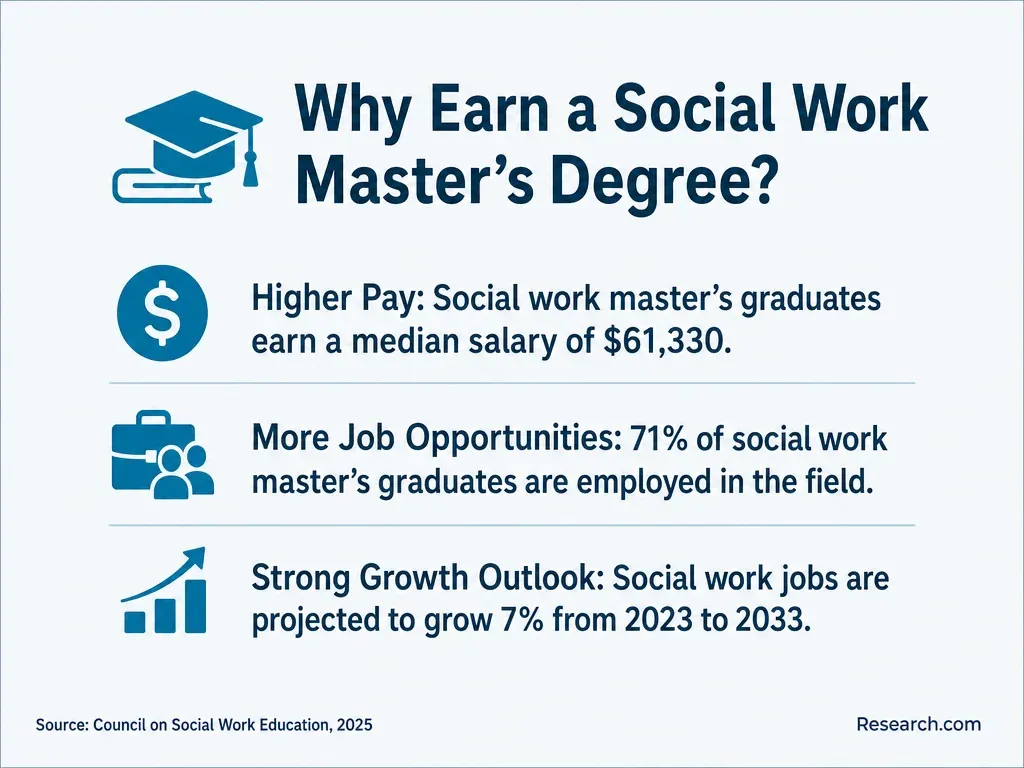
BLS projects employment growth of 8% for healthcare social workers and 6% for social workers overall from 2025 to 2035. These projections cover occupations, not social services director openings.
Administrator opportunities likewise depend on more than a broad management projection: local facilities, turnover, ownership, and state licensing rules affect the jobs available to you.
Use outlook figures to assess the wider field, then examine vacancies in the location where you intend to work. If you want flexibility across direct service and leadership rather than one specific nursing home job, a social work degree pathway overview can help you compare routes against the qualifications in those postings. Do not choose an MSW solely because a broad social work occupation is projected to grow.
For the qualified social worker required in a nursing home with more than 120 beds, federal rules specify one year of supervised social work experience in a healthcare setting working directly with individuals, alongside qualifying bachelor's-level education.
Director vacancies may require additional long-term care, supervisory, or discharge-planning experience. A smaller facility's staffing arrangement does not eliminate its obligation to provide appropriate social services.
Administrator applicants should check their state board's requirements for an administrator-in-training experience or other supervised preparation. A state may specify the training site, preceptor, documentation, and exams. Managing a social services department is relevant experience, but it does not automatically satisfy administrator training rules.
BSW and MSW placements build educational competencies; paid work and post-degree clinical-license supervision are different categories of experience. Confirm what the employer or board will accept before counting hours toward a new goal. If clinical social work is also under consideration, clinical social work experience documentation questions concern a separate licensing pathway, not administrator licensure.
Check the credential you intend to pursue before choosing a school. For a BSW or MSW, verify institutional accreditation, the social work program's Council on Social Work Education accreditation status for your intended cohort, and the relevant state social work board's education rules.
For administration, ask the state administrator licensing board whether the proposed degree and training plan meet its requirements; a CSWE-accredited social work degree alone is not proof of administrator eligibility.
Request written answers from the program and board about the exact degree, delivery format, required placements or administrator training, and eligibility in the state where you plan to work.
Compare approved field arrangements, not just course titles, when reviewing accredited BSW coursework and placement comparisons. School admission, graduation, examination eligibility, and license issuance are separate decisions.
Online coursework can build relevant knowledge for either path, but it cannot make required in-person experience disappear. A social work program may require scheduled skills activities and approved field education at an agency.
An administrator candidate may need state-approved, supervised facility training. Neither an online degree nor an existing healthcare job automatically fulfills those requirements.
Ask who arranges placements, whether your current workplace can qualify, when supervision occurs, and whether travel or campus visits are required. Those details are especially important if you are changing careers while employed.
For an MSW route, compare graduate social work placement coordination options rather than assuming every online program offers the same local support. Confirm administrator-training arrangements separately with the state board.
How long do relevant degree programs take, and what do they cost?
A bachelor's degree commonly takes about four years of full-time study from initial entry. A traditional MSW commonly takes about two years full-time after a bachelor's degree; an eligible BSW graduate may have a shorter advanced-standing option.
Actual schedules depend on accepted credits, course sequencing, placement availability, and enrollment intensity. An administrator applicant's timeline also includes whatever degree, supervised training, examinations, and application steps their state requires.
There is no defensible universal price for either career path. Compare each school's published tuition and fees for your credit load, then add books, placement travel, reduced work hours, and applicable exam and licensing expenses.
Employer education assistance or an approved employment-based placement may change the calculation, but neither should be assumed. Advanced standing and traditional MSW completion planning is particularly relevant if a qualifying BSW could reduce repeated coursework.
If the target administrator job accepts your existing degree, targeted training and the required licensing pathway may cost less than earning an unnecessary MSW.
Other Things You Should Know About Social Work
Possibly, but only if state rules, facility staffing requirements, qualifications, and workload permit it. Holding an administrator license does not waive social services staffing obligations.
Either role may receive one. The appropriate response depends on the issue and facility policy: a social services director may address service needs, while the administrator retains facility-wide oversight. Residents must also have access to applicable grievance processes.
No. Director describes a job function; clinical social worker describes a state-regulated credential or practice authority. Check the person's license and permitted duties rather than inferring them from the title.
Ask about decision-making authority, staff support, after-hours expectations, reporting relationships, and the facility's process for handling resident concerns. Those answers reveal more about daily work than the title alone.
- 42 CFR 483.10 -- Resident rights. | ecfr.gov https://www.ecfr.gov/current/title-42/chapter-IV/subchapter-G/part-483/subpart-B/section-483.10
- Nursing Home Administrator - CDPH - CA.gov https://www.cdph.ca.gov/Programs/CHCQ/LCP/Pages/NHA.aspx
- Florida Board of Nursing Home Administrators https://floridasnursinghomeadmin.gov/nursing-home-administrator/
- Nursing Homes | cms.gov https://www.cms.gov/medicare/health-safety-standards/certification-compliance/nursing-homes
- Social Security Act §1819 https://www.ssa.gov/OP_Home/ssact/title18/1819.htm
- Discover Nursing Home Administrator Job Responsibilities With Texas State https://online.txst.edu/degrees/healthcare/master-long-term-care-administration/nursing-home-administrator-role/
- Career Guide: Nursing Home Administrator | American College of Education https://ace.edu/student-success/career-guides/nursing-home-administrator/
- How to Become a Nursing Home Administrator | George Washington University https://healthcaremba.gwu.edu/blog/how-to-become-a-nursing-home-administrator
- State Licensure Requirements - NAB https://nabweb.org/seeking-licensure/state-licensure-requirements/nevada