
2027 Salaried vs Hourly Social Work Employment: Workload and Compensation Questions
Audited and Verified:
Our Editorial and Data Verification Process
Research.com uses government datasets, official education statistics and primary institutional information to support its career and degree guides. Our review process checks factual accuracy, occupational definitions, source dates and the requirements associated with the credentials discussed.
How This Article Was Fact-Checked
Our editorial team verifies salary estimates, employment projections, education requirements and program information against original data providers and official organizations. Salary figures are checked against the relevant occupational definitions and reporting periods. Information about licensure, accreditation and required in-person training is reviewed separately.
Fact-checked and verified on:

Co-Founder and Chief Data Scientist
A salaried social work offer may look better than an hourly one until you account for evening documentation, unpredictable caseloads, or unpaid time beyond the posted schedule. An hourly role may pay overtime but offer fewer guaranteed hours or benefits. For BSW and MSW students, new graduates, and working social workers comparing jobs, the distinction affects both income and daily practice.
This guide explains how to calculate effective pay, check overtime and benefits, assess workload, and identify the credentials an employer actually requires - so you can compare offers on the work you will do, not just the advertised rate.
Key Things You Should Know
- Pay format does not determine overtime eligibility: Salaried employees can be nonexempt, and eligible employees generally receive at least 1.5 times their regular rate for hours worked over 40 in a workweek under federal law.
- Compare actual hours, not just posted pay: A hypothetical $65,000 salary works out to $31.25 per hour at 40 hours a week but $25 per hour at 50 hours a week, before any overtime owed.
- Occupation medians are context, not offers: The U.S. Bureau of Labor Statistics reports a May 2025 median of $61,780 for social workers across specialties; your setting, credentials, location, hours, and benefits determine the relevant comparison.
What is the difference between salaried and hourly social work employment?
A salaried employee receives a stated amount per pay period; an hourly employee is paid according to recorded hours. Neither label establishes whether the worker is entitled to overtime. That separate question depends on applicable wage law and whether the position meets an exemption's pay and duties requirements.
In practice, salary often accompanies a continuing position with a defined caseload or program responsibility. Hourly arrangements may suit shifts, variable coverage, or part-time work, but full-time hourly positions also exist. Ask whether the employer guarantees hours and how it records time spent on notes, meetings, travel, and required training.
If you are entering the field, do not treat the pay format as a career pathway. Compare the qualifications for the specific role first; online social work education options for career planning can help frame an education search, but a degree is useful only if it meets the target job's requirements.
How does pay compare for salaried and hourly social workers?
Convert both offers to annual income and an effective hourly rate using realistic hours. An hourly rate multiplied by 2,080 assumes 40 paid hours every week for 52 weeks; it can overstate income when shifts are not guaranteed or time off is unpaid. A salary divided by actual hours worked can expose the cost of routinely long weeks, but it does not erase overtime that a nonexempt employee is legally owed.
This hypothetical comparison shows why the schedule matters. It assumes the stated hours occur every week and excludes benefits, taxes, bonuses, and any overtime payment.
| Offer | Hours assumed | Annual base pay | Effective rate before any overtime owed |
| $30 per hour | 40 per week, 52 weeks | $62,400 | $30 per hour |
| $30 per hour | 35 per week, 50 weeks | $52,500 | $30 per paid hour |
| $65,000 salary | 40 per week, 52 weeks | $65,000 | $31.25 per hour |
| $65,000 salary | 50 per week, 52 weeks | $65,000 | $25 per hour |
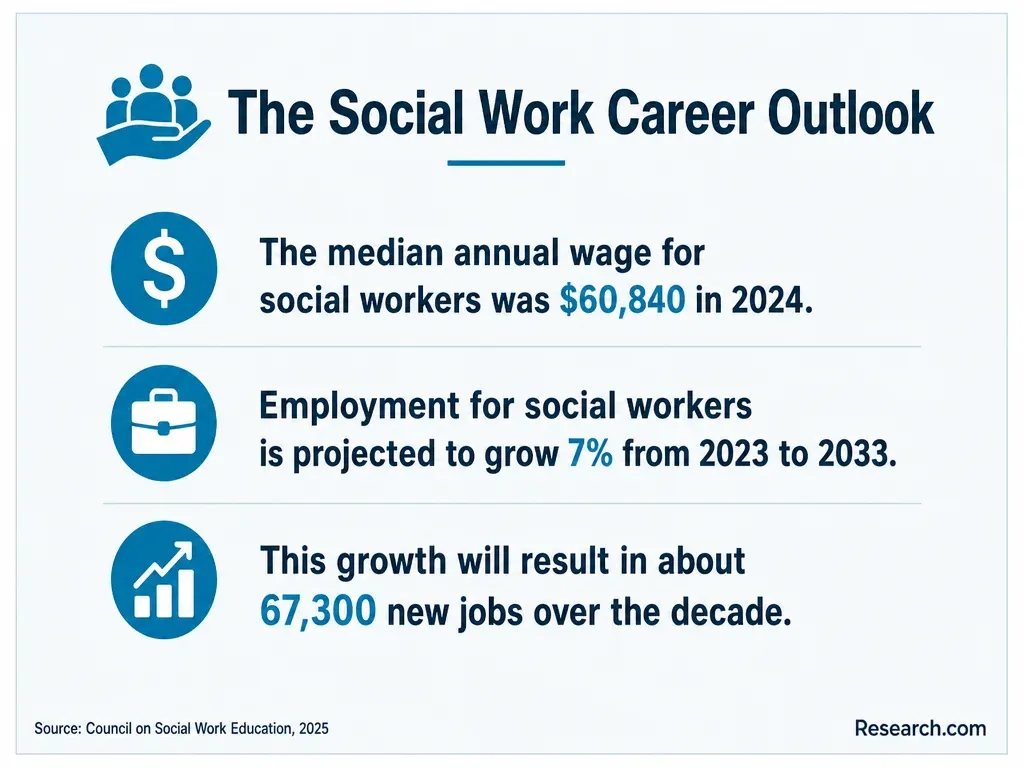
For market context, the Bureau of Labor Statistics reports May 2025 median annual pay of $59,550 for child, family, and school social workers; $67,880 for healthcare social workers; and $60,280 for mental health and substance abuse social workers. These are occupation-wide medians, not separate salaried-versus-hourly figures or promised BSW/MSW earnings. Use state-level salary context for MSW careers alongside local postings and the duties of the actual job.
How do workloads and schedules differ between salaried and hourly social workers?
Pay format alone does not predict workload. A salaried hospital social worker may have a regular shift but face urgent discharge planning; an hourly crisis-service worker may have variable shifts and weekend coverage. In either role, scheduled client contact is only part of the job. Documentation, referrals, interdisciplinary meetings, supervision, travel, and safety planning also consume work time.
Ask for the typical active caseload, expected new cases, documentation deadlines, coverage arrangements, and hours actually worked by people in the role. If the offer ties pay to visits or productivity, clarify what happens when clients cancel and whether non-client tasks are paid. A manageable schedule also depends on administrative support, available community services, and how the agency responds when demand exceeds capacity.
Students planning to work while earning an MSW should compare these expectations with placement and live-class commitments, not just advertised course flexibility. Social work master's programs with flexible learning schedules may offer different coursework arrangements, but online study does not eliminate approved field education or required live activities.
Benefits usually depend more on employer policy, hours, employment status, and eligibility rules than on the word salary or hourly. A full-time hourly employee may receive health insurance, paid leave, and retirement contributions; a part-time salaried employee might not qualify for the same package. Compare when coverage begins, employee premiums and deductibles, leave accrual, retirement matching and vesting, and whether paid holidays depend on scheduled shifts.
Professional support belongs in the comparison too. Ask whether the agency pays for required training, licensing fees, continuing education, and qualified supervision - and whether supervision occurs during paid work time.
Employer education assistance is worth considering only if you have a defined advancement goal and understand its eligibility or repayment terms. For example, shorter practice-focused doctoral social work pathways may interest a worker pursuing a specific leadership role, but a DSW is not a general requirement for a better salaried offer.
What should social workers consider when comparing job offers?
Start with the offer you are qualified to accept now. Request the written pay rate, classification, expected schedule, guaranteed hours if applicable, benefits eligibility date, and supervision terms. Then compare annual compensation using plausible hours and ask people in the role how often they work beyond the posted schedule.
Pay is only one part of a sustainable offer. The most useful interview questions test whether the agency provides enough time and support to serve clients responsibly:
- What are the typical caseload and weekly intake, and how are absences or vacancies covered?
- How much paid time is allotted for notes, travel, team meetings, training, and supervision?
- Who handles urgent cases, after-hours calls, safety concerns, and clinical consultation?
- What license or credential is required now, and what support is provided for any future requirement?
If neither offer supports your intended role, a job with stronger supervision or a manageable caseload may be more valuable than a higher headline rate. Career changers should first identify transferable skills and any actual credential gap; attainable entry requirements for MSW applicants may help explore an education route, but a graduate degree is unnecessary when the target position accepts your existing qualifications.
Other Things You Should Know About Social Work
No. Per-visit pay is tied to completed services rather than a stated rate for each hour. Before accepting it, ask how cancellations and time spent on documentation, travel, and meetings are handled, and whether the position is classified as employee or independent-contractor work.
No. A genuine independent contractor has a different legal and tax relationship from an employee. A contract label alone does not establish contractor status; the actual working arrangement matters. Check classification and licensing obligations before comparing the advertised rate with an employee offer.
Count a bonus as uncertain unless the employer provides written eligibility rules and a realistic explanation of how it is earned. Compare dependable base compensation first, then consider whether productivity targets leave sufficient time for documentation and appropriate service.
Sometimes. Civil-service grades, union agreements, and salary schedules may limit discretion, but an employer may be able to consider qualifying experience, placement within a pay range, or a permitted hiring incentive. Ask what the applicable policy allows before negotiating.
- Overtime Pay | dol.gov https://www.dol.gov/agencies/whd/overtime
- NASW Standards for Social Work Case Management | nycourts.gov https://www.nycourts.gov/reporter/webdocs/nasw_standards_socialwork_casemgt.htm
- Salary Disparities in Public Health Occupations - PMC - NIH https://pmc.ncbi.nlm.nih.gov/articles/PMC10882389/
- Five Ways High Caseloads Hinder Social Work | Walden University https://www.waldenu.edu/online-masters-programs/master-of-social-work/resource/five-ways-high-caseloads-hinder-social-work
- Social Worker Salary: BSW vs. MSW Pay Differences | CU Online https://online.campbellsville.edu/social-work/bsw-vs-msw-salary-guide/
- Flexibility and Overtime Among Hourly and Salaried Workers | epi.org https://www.epi.org/publication/flexibility-overtime-hourly-salaried-workers/
- Salaried Employee | How Does Salary Pay Work? https://www.adp.com/resources/articles-and-insights/articles/s/salaried-employee
- Social Work Salaries | socialworkers.org https://www.socialworkers.org/careers/career-center/kickstart-your-job-hunt/social-work-salaries


