
2027 Research Questions vs Hypotheses in Social Work Research: Different Ways to Frame a Study
Audited and Verified:
Our Editorial and Data Verification Process
Research.com uses government datasets, official education statistics and primary institutional information to support its career and degree guides. Our review process checks factual accuracy, occupational definitions, source dates and the requirements associated with the credentials discussed.
How This Article Was Fact-Checked
Our editorial team verifies salary estimates, employment projections, education requirements and program information against original data providers and official organizations. Salary figures are checked against the relevant occupational definitions and reporting periods. Information about licensure, accreditation and required in-person training is reviewed separately.
Fact-checked and verified on:

Co-Founder and Chief Data Scientist
A social work study can fail before data collection if its aim is framed the wrong way. A question about how families experience a service calls for a different approach than a prediction about whether that service changes an outcome.
For BSW and MSW students, field-project planners, and emerging researchers, that distinction affects methods, data access, ethics, and what findings can support. This guide shows how to choose between research questions and hypotheses, write each one precisely, and match the wording to a feasible social work study.
Key Things You Should Know
- A research question states what a study seeks to learn; a hypothesis predicts a specific, testable relationship or difference. A study can use both.
- Use open-ended questions for experiences and processes; use hypotheses when variables, measures, and a defensible prediction are available.
- Neither format makes a project ethical or feasible by itself: check data access, participant protections, agency approval, and required institutional review before collecting information.
What is the difference between a research question and a hypothesis in social work?
A research question identifies an uncertainty the study will investigate: "How do clients describe barriers to attending appointments?" A research hypothesis states an anticipated answer that evidence can test: "Clients offered evening appointments will have higher attendance rates than clients offered daytime appointments." The first invites investigation; the second specifies a predicted comparison.
A question can guide qualitative, quantitative, or mixed-methods work. A hypothesis is most useful when a study can define the relevant variables, collect suitable data, and justify a prediction from prior evidence or theory. It is not a guess that becomes true when the results are statistically significant. Nor is a research hypothesis the same as a tentative explanation a practitioner considers during an individual client assessment. Training in clinical reasoning, such as that discussed in a clinical MSW education and professional development guide, serves a different purpose from testing a claim across study participants.
Wording also determines the strength of the conclusion. A hypothesis about an association does not establish that one variable caused another to change. To make a causal claim, researchers need a design that addresses plausible alternative explanations, not merely a directional prediction.
What are examples of research questions and hypotheses in social work?
The hypothetical examples below show how the same practice concern can lead to different studies. They describe proposed inquiries, not real agency data or established effects.
| Practice concern | Research question | Possible hypothesis |
| Housing-service access | How do applicants describe obstacles to completing a housing-assistance intake? | Applicants offered application-navigation support will be more likely to complete intake within 30 days than comparable applicants not offered that support. |
| Caregiver support | How do caregivers experience a peer-support group? | Among enrolled caregivers, greater group attendance will be associated with lower scores on a specified caregiver-strain measure at follow-up. |
| School referrals | What factors do school social workers identify as shaping referral decisions? | Schools using a standardized referral process will have a shorter median time from referral to first contact than comparable schools using their prior process. |
The housing example illustrates a crucial distinction: interviewing applicants about barriers cannot, on its own, test whether navigation support increases completion. Likewise, comparing completion rates would not fully explain why applicants find the process difficult. A field student considering either project should first confirm what the agency and university permit; planning local placements through an online MSW program does not automatically grant access to agency records or permission to recruit clients.
When should a social work study use a research question, hypothesis, or both?
Choose the format from the decision the study must inform and the evidence you can realistically obtain. Use a research question alone when exploring an underexamined experience, mapping a process, or evaluating a program without a defensible advance prediction. Add a hypothesis when prior evidence supports a particular relationship and you can measure it. Use both when an overarching question is followed by a specific quantitative prediction, or when a mixed-methods study also asks participants to explain the measured pattern.
For example, an agency might ask, "Does a reminder system relate to appointment attendance?" and predict higher attendance among people receiving reminders. Interviews could separately ask how clients experience those reminders. These components answer related but nonidentical questions.
Limited time favors a narrower claim, not an unsupported one. Students considering faster graduate social work study routes should check capstone timelines and approvals before promising a comparison that needs multiple enrollment periods or follow-up. An achievable descriptive question is more useful than a causal hypothesis the available design cannot test.
A useful hypothesis names the population, variables, expected direction or difference, and measurement window. Build it from credible prior research or a clearly stated framework, then check whether the study design and resources can actually evaluate it.
For example: "Among adults newly enrolled in a housing-support program, those offered a scheduled navigation call will have a higher 60-day intake-completion rate than comparable enrollees who are not offered a call." Here, the offer of a call is the predictor, completion within 60 days is the outcome, and the groups and period are explicit. The study must still define "completion," account for how people enter each group, and consider factors such as language access or changing eligibility rules.
Distinguish a substantive prediction from a statistical null hypothesis, which commonly states that the population relationship or difference is absent under the chosen test. Failing to reject a null hypothesis does not prove that a program has no effect; imprecise measures or a small sample may leave the result uncertain. Avoid writing "the intervention will cause improvement" when participants were not assigned in a way that supports causal inference.
Feasibility is part of methodological quality. Doctoral applicants comparing cost-focused online social work doctorate choices should budget for any required recruitment, accessible participation, secure data handling, and analysis support before committing to a hypothesis that depends on them.
Qualitative studies usually ask open-ended "how" or "what" questions about meaning, experience, or processes. Predetermining the answer as a hypothesis can work against an exploratory design. Quantitative studies may ask about frequencies, differences, or relationships; they use hypotheses when an advance prediction is warranted. Mixed-methods studies can pair a measurable question or hypothesis with a qualitative question that explores how participants understand the pattern.
Method choice also changes what counts as a credible result. Interviews need a defensible sampling and analysis plan; a survey needs clear measures and attention to response bias. A comparison of outcomes needs enough relevant observations and a plan for competing explanations. No method becomes stronger simply because it has a hypothesis.
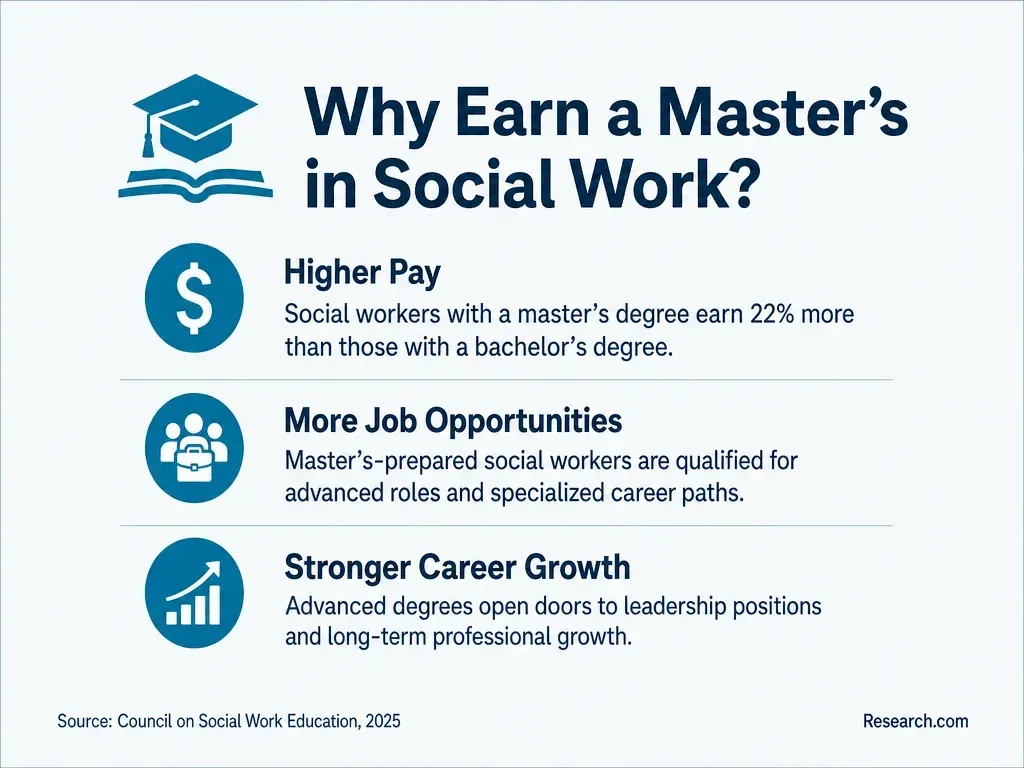
These skills extend beyond a dissertation. Program evaluators, policy analysts, and practice leaders may use different combinations of interviews and administrative data; MSW career directions beyond a single job title include work where framing a useful question matters more than routinely performing statistical tests.
What careers use social work research skills, and what are their salary and licensing requirements?
Social workers use research skills when assessing evidence, tracking service outcomes, and improving programs. Agency evaluators and policy researchers may spend more time designing measures, interviewing stakeholders, or analyzing administrative data; those positions can also be open to people trained in public health, statistics, or public policy. A research-focused job does not automatically require a clinical license, while a role that includes regulated clinical services may require a state-specific license and, for independent practice, additional supervised experience.
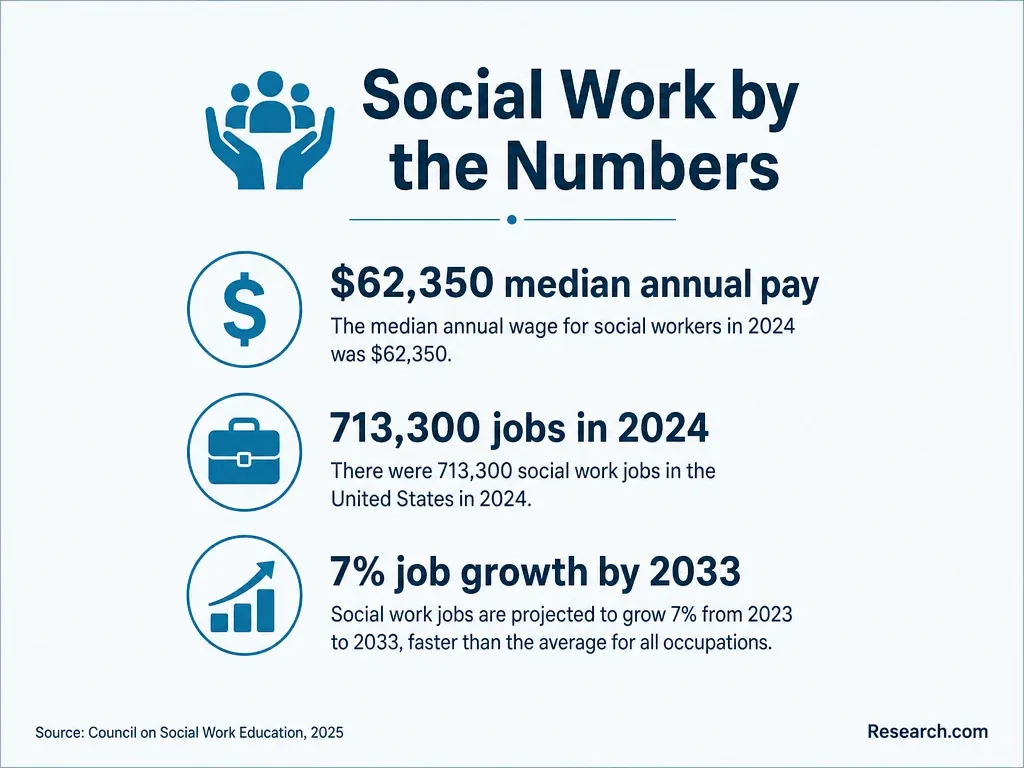
For salary context, the U.S. Bureau of Labor Statistics reports the following occupation-wide figures. These categories cover many duties and employers; they are not salaries for research positions, MSW graduates, or particular license holders.
| U.S. occupation | May 2025 median annual pay | Projected employment growth, 2025-2035 |
| Social workers, all specialties | $61,780 | 6% |
| Healthcare social workers | $67,880 | 8% |
| Mental health and substance abuse social workers | $60,280 | 10% |
Use those figures as labor-market context, then examine actual vacancies for the research tasks, degree, software skills, population experience, and license they specify. Location also affects pay; social work earnings across different state markets can provide context, but an occupation's median is not an offer. To build relevant experience, seek an approved evaluation assignment, practice explaining a study's limitations, and document what you personally did without disclosing client or agency-confidential information.
Other Things You Should Know About Social Work
Preregistration can make planned hypotheses and analyses easier to distinguish from decisions made after seeing results. Ask your advisor whether it fits your design; it does not replace required ethics or agency approvals.
Sometimes, particularly in iterative qualitative work. Document what changed, why, and when. Report new questions or analyses transparently rather than presenting them as planned from the start.
Report the result and its uncertainty honestly. Examine measurement, sample size, missing data, and design limitations; an unsupported prediction can still help an agency decide what to investigate next.
Usually you can describe your question, methods, and your own contribution if course and agency rules allow it. Remove identifying information and obtain permission before sharing agency materials, datasets, or findings that are not public.
- Formulation of Research Question - Stepwise Approach - PMC https://pmc.ncbi.nlm.nih.gov/articles/PMC6322175/
- Type I and Type II Errors and Statistical Power - NCBI - NIH https://www.ncbi.nlm.nih.gov/books/NBK557530/
- 3. Chapter 3: Research Questions | Monash University Library https://openpub.libraries.rutgers.edu/irphabcd/chapter/chapter-3-research-questions/
- Develop a Research Question/Hypothesis - Systematic Reviews - Research Guides at UCLA Library https://guides.library.ucla.edu/systematicreviews/DevelopAQuestion
- Social Work Research Methods | Virginia Commonwealth University https://onlinesocialwork.vcu.edu/blog/social-work-research/
- Full article: Ethical considerations in social work research | tandfonline.com https://www.tandfonline.com/doi/full/10.1080/13691457.2018.1544117
- Research Guides: Organizing Your Social Sciences Research Paper: 6. The Methodology | usc.edu https://libguides.usc.edu/writingguide/methodology
- Research Questions Versus Research Hypotheses | sagepub.com https://methods.sagepub.com/video/download/research-questions-versus-research-hypotheses
- LibGuides: Social Work Library Resources: Research Questions and Research Methods | unc.edu https://guides.lib.unc.edu/social-work-resources/research
- Overview of Research Methods: Qualitative, Quantitative, and Mixed Methods - Crafting the Dissertation https://saintpeters.pressbooks.pub/dissertationguide/chapter/overview-of-research-methods/


