2027 Randomized Trials in Social Work Research: Assignment, Comparison Groups, and Limitations
Audited and Verified:
Our Editorial and Data Verification Process
Research.com uses government datasets, official education statistics and primary institutional information to support its career and degree guides. Our review process checks factual accuracy, occupational definitions, source dates and the requirements associated with the credentials discussed.
How This Article Was Fact-Checked
Our editorial team verifies salary estimates, employment projections, education requirements and program information against original data providers and official organizations. Salary figures are checked against the relevant occupational definitions and reporting periods. Information about licensure, accreditation and required in-person training is reviewed separately.
Fact-checked and verified on:

Co-Founder and Chief Data Scientist
A social services program may appear to help clients, but improvements alone cannot show whether the program caused them. Randomized trials address that question by assigning eligible participants to different service conditions and comparing outcomes.
For social work students, agency evaluators, and prospective researchers, the challenge is knowing when this design is credible, ethical, and feasible. This guide explains assignment, comparison groups, common limitations, and alternatives - then shows how to assess the training and career paths that support this work.
Key Things You Should Know
- Random assignment places eligible people or groups into at least two study conditions by chance; it does not guarantee that a small trial starts with perfectly balanced groups.
- The comparison group determines the question answered: an added service versus usual care, for example, is different from one service model versus another.
- Randomization strengthens causal inference, but attrition, service crossover, small samples, privacy constraints, and unequal implementation can still undermine a social work trial.
What are randomized trials in social work research?
A randomized controlled trial is a study in which a chance-based process assigns eligible participants - or sometimes agencies, schools, or teams - to an intervention or comparison condition. Researchers define outcomes in advance and assess whether the groups differ after assignment. In social work, a trial might test whether adding a structured housing-navigation service to existing support improves housing stability compared with existing support alone.
Randomization helps separate an intervention's effect from differences in participants' motivation, needs, or access to resources. It does not make every study definitive: the outcome measures, implementation, follow-up period, and people recruited still determine what the result means. Students exploring a guide to choosing an online social work degree should look beyond a course labeled "research" and ask whether it teaches them to interpret those design choices.
How does random assignment work in social work trials?
Researchers first specify who is eligible, what each group can receive, and when assignment occurs. They then use a genuinely chance-based procedure, such as a computer-generated allocation sequence, rather than letting staff choose a group. A 1:1 allocation gives each condition the same intended share of assignments; it does not ensure identical group sizes or characteristics in a small sample.
The unit of assignment matters. Assigning individual clients may be practical when services are delivered separately. If staff would inevitably share a new approach across clients, assigning whole teams or agencies may reduce contamination. That cluster design needs enough independent teams or agencies for a credible comparison; a large client count within only a few agencies cannot substitute for it.
Allocation should be concealed until an eligible participant is enrolled so staff cannot steer enrollment toward a preferred condition. Researchers may also group assignments by site or an important baseline characteristic, then report how they did so. When comparing MSW programs with shorter study schedules, prospective researchers should check whether a compressed methods course still offers practice designing and critiquing allocation procedures.
What comparison groups are used in social work trials?
A comparison group is not necessarily a group receiving no help. Its services establish the trial's practical question, so readers should identify exactly what both groups could access, including referrals and support outside the study.
The following distinctions help determine which finding would be useful to an agency choosing services.
| Comparison condition | Question the trial can address | Interpretive caution |
| Usual services | Does the new intervention improve outcomes beyond existing services? | "Usual" services can vary across sites and over time. |
| Another active service | Which of two available approaches performs better? | A small difference does not show that either is better than receiving no service. |
| Added-service comparison | Does a new component add value to a shared service package? | Differences may reflect extra staff attention as well as the component itself. |
| Waitlist or delayed start | Does earlier access change outcomes during the waiting period? | Results may not describe long-term effects after both groups receive services. |
A no-service group may be inappropriate when people are entitled to care or withholding it poses unacceptable risks. Readers making undergraduate social work program quality comparisons can ask whether research courses teach students to describe the actual comparison condition rather than simply call every nonintervention group a "control."
Social work trials frequently involve people seeking essential services or navigating unequal power relationships. A study team should establish which institution will review the project, whether informed consent is required and how it will be obtained, how risks and benefits will be monitored, and which services remain available regardless of assignment. An agency's description of a project as "program evaluation" does not, by itself, settle whether institutional review board oversight is required.
Consent must be understandable and voluntary. Declining research participation should not be presented as a reason to lose services to which someone is otherwise entitled. Researchers also need a plan for accessible participation, secure records, limited data access, and handling safety concerns under applicable law and agency policy. Community partners can help identify outcomes participants value and burdens that a study team might overlook.
Field students should not assume their placement authorizes them to recruit clients or use case files for a project. Before proposing a trial at a placement, clarify the school's and agency's approval processes and online MSW placement responsibilities before enrollment, including who can approve learning activities involving clients or records.
Start with the work you want to perform: interpret published trials, evaluate an agency service, or lead independent research. Then compare programs using evidence of training rather than delivery format alone. For BSW and MSW study, verify the relevant program's Council on Social Work Education accreditation status and applicable cohort, along with institutional accreditation. Doctoral applicants should examine the particular program's faculty, methods sequence, and research support rather than assume BSW/MSW accreditation describes a DSW or PhD.
Ask for recent syllabi and project examples that can be shared appropriately. Look for instruction in causal inference, quantitative methods, ethics, data management, and critical appraisal; access to mentoring and feasible agency or community partnerships; and a realistic account of who helps students secure approved data and oversight. A published faculty interest in trials is not a guarantee that every student can join one.
Online study may still require live classes, group projects, field education, or on-site activities. Verify those commitments, total cost, and enrollment eligibility before committing. Students considering an MSW for both research and potential practice should separately address checking MSW program authorization and professional eligibility in the jurisdiction where they intend to work; research training and licensure eligibility answer different questions.
What are the salary prospects and job outlook for social work researchers?
There is no single U.S. wage category for "social work researcher." Pay depends on whether a position is classified as a research coordinator, analyst, faculty member, social worker, or another occupation, as well as its employer, location, funding, and required skills. A social worker salary figure should not be treated as a research-job offer.
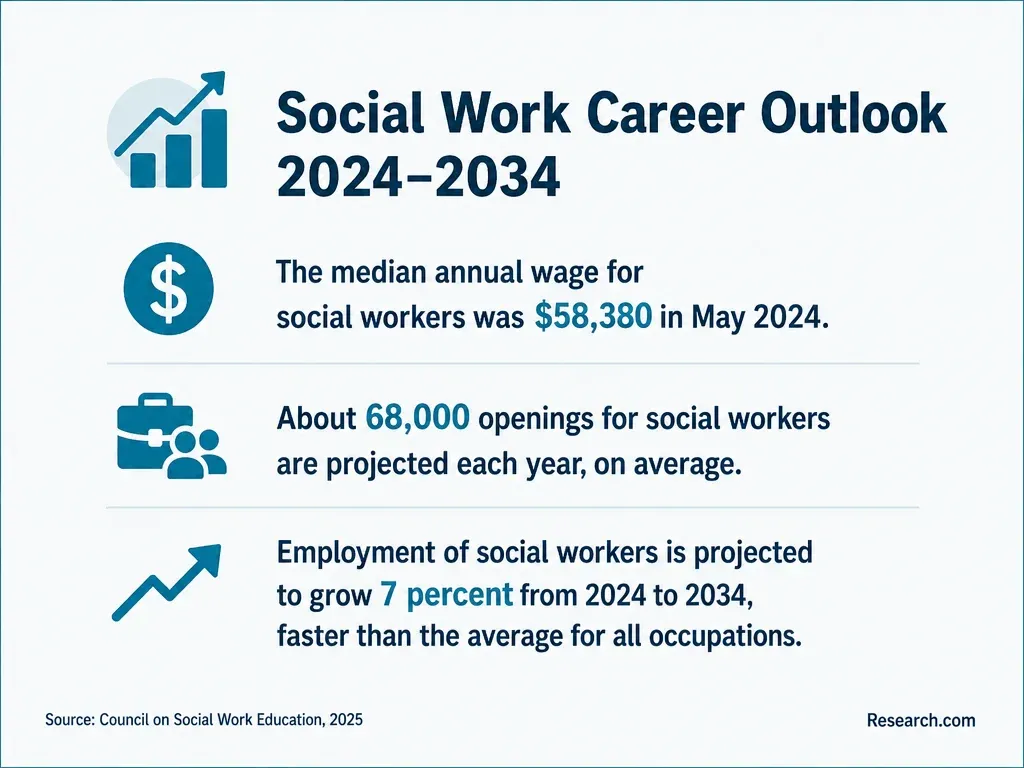
For context, U.S. Bureau of Labor Statistics figures supplied for social workers across specialties report a May 2025 median annual wage of $61,780 and 6% projected employment growth from 2025 to 2035. Those figures describe the broad social worker occupation, not research specialists or the return on an MSW or doctorate. For a realistic research-career comparison, examine local postings with matching duties, employment terms, and qualifications.
Doctoral applicants should also distinguish a salaried research position from a time-limited assistantship or stipend. MSW students considering planning paid university work alongside MSW study should verify pay, weekly hours, eligibility, and whether the assignment develops usable research skills. Funding can improve affordability without guaranteeing a later research job.
Other Things You Should Know About Social Work
No. Random assignment determines which study condition an enrolled participant receives. Random sampling determines how people are selected from a larger population. A trial can use random assignment even if its volunteers are not a random sample of all service users.
Often they cannot: people usually know which service they provide or receive. Researchers may still be able to keep outcome assessors unaware of assignments and use consistent measurement procedures.
Only with the necessary agency permissions, data protections, and applicable institutional review. Access for field learning or employment does not automatically authorize research use or publication.
A pilot can test recruitment, service delivery, data collection, and follow-up procedures. Unless it is designed and powered to estimate an outcome reliably, a promising pilot result should not be presented as proof that the intervention works.
- Selection of Control, Randomization, Blinding, and Allocation Concealment - PMC https://pmc.ncbi.nlm.nih.gov/articles/PMC6743387/
- TCPS 2 (2018) - Chapter 11: Clinical Trials https://ethics.gc.ca/eng/tcps2-eptc2_2018_chapter11-chapitre11.html
- Informed Consent FAQs | hhs.gov https://www.hhs.gov/ohrp/regulations-and-policy/guidance/faq/informed-consent/index.html
- Potential impact of missing outcome data on treatment effects in systematic reviews: imputation study | The BMJ https://www.bmj.com/content/370/bmj.m2898
- The importance of ethical considerations in research and clinical trials | Penn LPS Online https://lpsonline.sas.upenn.edu/features/importance-ethical-considerations-research-and-clinical-trials
- A roadmap to using randomization in clinical trials | springer.com https://link.springer.com/article/10.1186/s12874-021-01303-z
- The use of waitlists as control conditions in anxiety disorders research - ScienceDirect https://www.sciencedirect.com/science/article/abs/pii/S0022395616302448
- Generalizability of RCTs | northwestern.edu https://sites.northwestern.edu/rcts/
- Study Design 101: Randomized Controlled Trial | Research Guides at George Washington University https://guides.himmelfarb.gwu.edu/studydesign101/randomized-controlled-trial