2027 Questions to Ask Before Accepting a Mobile Crisis Social Worker Position
Audited and Verified:
Our Editorial and Data Verification Process
Research.com uses government datasets, official education statistics and primary institutional information to support its career and degree guides. Our review process checks factual accuracy, occupational definitions, source dates and the requirements associated with the credentials discussed.
How This Article Was Fact-Checked
Our editorial team verifies salary estimates, employment projections, education requirements and program information against original data providers and official organizations. Salary figures are checked against the relevant occupational definitions and reporting periods. Information about licensure, accreditation and required in-person training is reviewed separately.
Fact-checked and verified on:

Co-Founder and Chief Data Scientist
A mobile crisis offer can look compelling until you learn who responds with you, what happens after a dangerous call, or whether overnight coverage is paid. For social workers considering field-based crisis work, those details matter as much as the job title. This guide turns the offer into questions you can ask about duties, qualifications, compensation, safety, scheduling, clinical authority, and supervision. It also explains when further education may help - and when better onboarding or a different employer is the more direct solution.
Key Things You Should Know
- Before accepting, ask whether calls are staffed in pairs, how dispatch screens hazards, and who can end an unsafe response.
- Get the full pay arrangement in writing: base rate, overnight and on-call pay, overtime eligibility, travel costs, and benefits.
- Confirm your duties against your license and supervision: the relevant BLS mental health and substance abuse social worker category has a $60,280 median annual wage and 10% projected growth from 2025 to 2035, but neither figure describes this specific offer.
What does a mobile crisis social worker do?
A mobile crisis team responds outside a conventional office - often in homes, shelters, schools, or other community settings - to people experiencing an urgent behavioral health crisis.
Depending on the program, a social worker may engage the person, assess immediate needs and risks, develop a short-term safety plan within their scope, coordinate voluntary care, arrange follow-up, and document the encounter. A telephone crisis line may triage the call before the team travels.
Ask the hiring manager: Who is eligible for a response, who travels on each call, and what happens after the initial encounter? Some positions emphasize brief assessment; others also require repeated outreach, referral tracking, and substantial documentation.
Ask to see the job description and a de-identified sample workflow. If your strengths lie in care coordination rather than rapid field assessment, clarify how much of each the role involves. For a broader view of where an MSW can lead, compare MSW education and career pathway connections.
What degrees and licenses are required for mobile crisis social work?
There is no single nationwide mobile crisis credential. Requirements depend on state law, the employer's service model, funding contracts, and the duties assigned. An agency may employ BSW-prepared staff in support or care-coordination roles, require an MSW for clinician positions, or require an active state clinical license for independent assessment or supervision.
Job titles alone do not establish legal authority to diagnose, provide psychotherapy, or make decisions reserved to licensed professionals.
Ask: Which license must I hold on my start date, which duties require it, and who performs those duties when I am not authorized? If you are an MSW graduate working toward independent clinical licensure, request written confirmation of the supervision arrangement and check it against your state board's rules.
An MSW, field placement, or passed examination does not itself grant independent clinical authority. If you are still choosing a bachelor's route, review social work bachelor's accreditation questions before assuming a program supports your intended next step.
What salary and benefits should mobile crisis social workers expect?
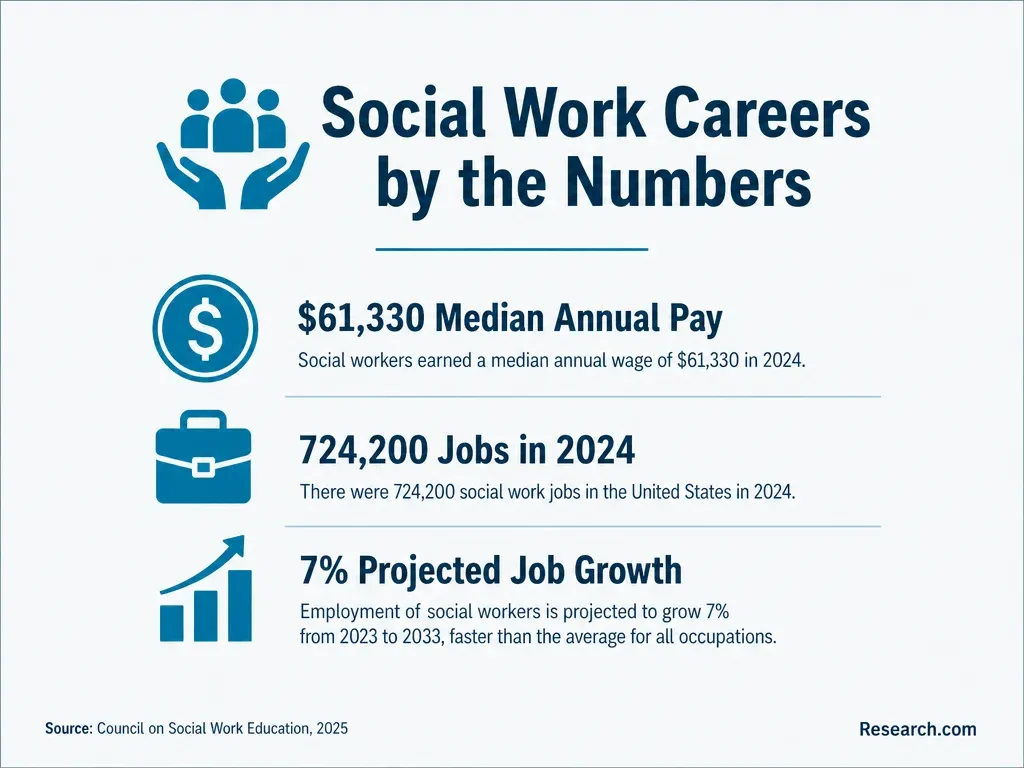
Use the offer's actual classification and pay terms - not a national median - to judge compensation. U.S. Bureau of Labor Statistics figures put the May 2025 median annual wage for mental health and substance abuse social workers at $60,280.
That occupation is a useful comparison for some mobile crisis clinician jobs, but it includes other settings and does not predict pay at a particular agency, in a particular state, or for a particular license. Local comparisons, including social work earnings across different state markets, need the same caution.
Ask for a written breakdown of base pay, shift differentials, standby and call-out pay, overtime eligibility, paid documentation time, mileage or vehicle provision, parking, and phone costs.
Compare health coverage, paid leave, retirement contributions, liability coverage, and any license or continuing-education reimbursement. A higher annual salary may be less attractive if it assumes frequent uncompensated availability or use of your own vehicle. Confirm whether a sign-on payment has a repayment condition.
"Full time" does not reveal whether the job includes nights, rotating weekends, holidays, or standby periods. Ask for a sample schedule covering several weeks, the notice given for changes, the expected response time while on call, and how coverage works when a colleague is absent. Confirm when a shift ends if a response or documentation runs late - and how that time is recorded and paid.
A crisis team's workload is better measured than by an average caseload alone. Ask how many calls a worker typically handles per shift, how long travel and documentation take, whether follow-up cases remain assigned, and whether staff have protected time for breaks and consultation.
These details are especially important if you are balancing work with caregiving or study. Even self-paced MSW options and their scheduling limits should be checked against live coursework and field obligations before you assume they fit a rotating crisis schedule.
Ask who conducts and signs assessments, which decisions require a licensed clinician's review, and how the team documents risk, consent, referrals, and follow-up. Clarify what happens when a person declines help and who determines whether the legal criteria for an involuntary intervention may apply. Those decisions must follow current jurisdiction-specific law and agency policy; a general job description is not enough.
Request the agency's criteria for involving law enforcement: when officers are dispatched alongside clinicians, when staff may request them later, and who communicates with the person in crisis. Ask how the team protects confidentiality while sharing information needed for safety, and whether it reviews encounters for avoidable escalation.
If you are selecting an MSW program to prepare for this work, use licensure-focused MSW program selection questions to check the education-to-license pathway; a program cannot authorize duties reserved by state law.
Ask what training occurs before independent deployment: observed responses, de-escalation practice, assessment and documentation systems, cultural responsiveness, accessibility, and agency-specific emergency procedures.
Find out who reviews early encounters, how quickly a supervisor is available during a live call, and whether staff receive regular case consultation after onboarding. "A supervisor is available" is less informative than a named role, coverage schedule, and escalation process.
If you need hours toward clinical licensure, ask separately whether the proposed supervisor, duties, setting, frequency, and records meet your state board's rules. Employer coaching, BSW/MSW field instruction, and board-qualifying post-degree supervision are not automatically interchangeable. Review a guide to social work clinical experience requirements, then verify the arrangement directly with the applicable board before relying on the job for licensure progress.
What is the job outlook for mobile crisis social workers?
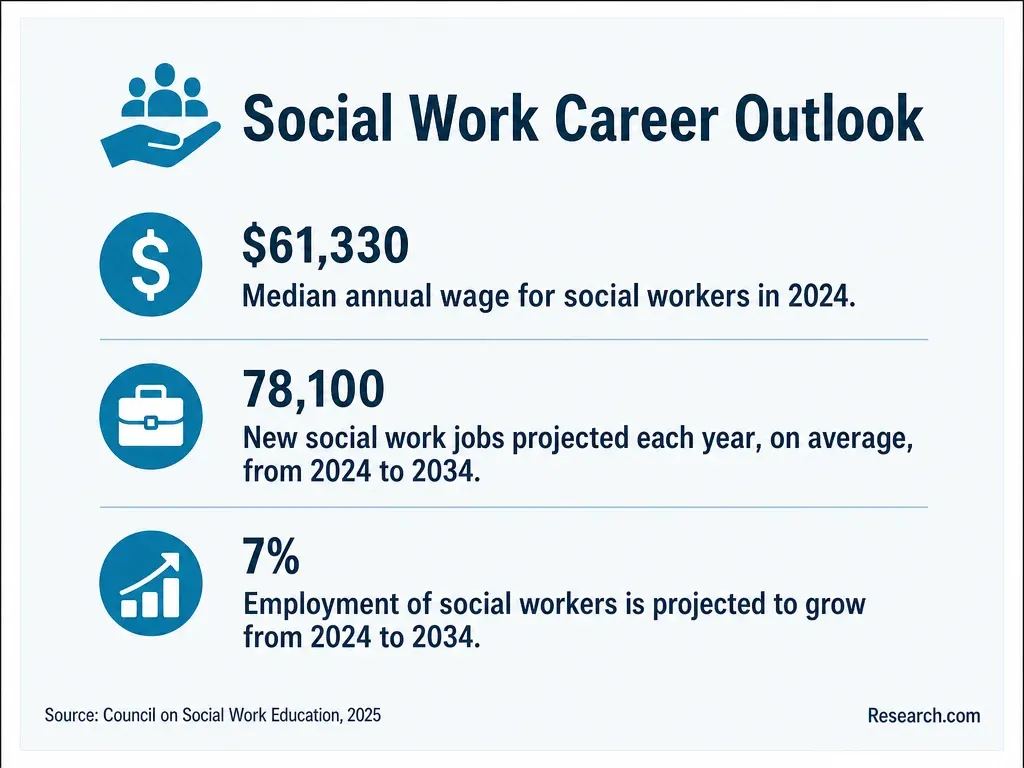
The BLS projects 10% employment growth for mental health and substance abuse social workers from 2025 to 2035. This category can include relevant crisis positions, but BLS does not provide a separate national projection for the job title "mobile crisis social worker." Growth in the broader occupation cannot guarantee openings, stable funding, or advancement at a particular mobile team.
Ask how the program is funded, whether the position is new or a replacement, how long staff tend to stay, and what advancement looks like beyond taking more calls. If you are considering education to enter the field, BSW graduates comparing MSW entry options should first establish which route they qualify for; faster study is valuable only if it leads to the qualifications employers and state boards require. Judge this offer on its supervision, safety, and workload - not the national growth projection alone.
Other Things You Should Know About Social Work
Ask whether a fleet vehicle is available. If personal-car use is required, get the mileage policy, insurance expectations, parking arrangements, and accident-reporting procedure in writing before accepting.
Yes. Some teams include peer specialists whose lived-experience expertise supports engagement and recovery. Ask how their role, training, compensation, and decision-making responsibilities differ from the social worker's.
Yes. Discuss the essential duties and the accommodation process with the employer's designated contact. Do not assume a field-based job rules out accommodations or that every proposed arrangement will work for every duty.
Keep the written offer, job description, benefits summary, proposed schedule, and any written explanation of supervision or vehicle use. Ask the employer to resolve material differences between interview statements and those documents before you accept.
- Contingency Planning Emergency Response and Safety - PMC https://pmc.ncbi.nlm.nih.gov/articles/PMC7149346/
- Travel Time | dol.gov https://www.dol.gov/general/topic/workhours/traveltime
- Social Work Licensure & Practice (LCSW) | nysed.gov https://www.op.nysed.gov/professions/licensed-clinical-social-worker/faq-licensure-practice
- Wage and Hour FAQs - Wage Standards Division https://labor.hawaii.gov/wsd/wage-and-hour-faqs/
- Clinical Social Workers and Independent Clinical Social Workers (216-RICR-40-05-7) - Rhode Island Department of State https://rules.sos.ri.gov/regulations/part/216-40-05-7
- Licensed Clinical Social Worker | floridasmentalhealthprofessions.gov https://floridasmentalhealthprofessions.gov/licensed-clinical-social-worker/
- Requirements for holders of an LMSW seeking an LCSW | Texas Behavioral Health Executive Council https://bhec.texas.gov/texas-state-board-of-social-worker-examiners/applying-for-a-social-work-license/how-to-become-an-lcsw/requirements-for-holders-of-an-lmsw-seeking-an-lcsw/
- Suicide: Assessment and Management - StatPearls - NCBI - NIH https://www.ncbi.nlm.nih.gov/books/NBK617057/
- Typology | Vera Institute of Justice https://www.vera.org/behavioral-health-crisis-alternatives/typology
- Policy 448 Crisis Intervention Team | powerdms.com https://public.powerdms.com/WorcesterPolice/documents/3354860