2027 Questions to Ask Before Accepting a Military Family Social Worker Position
Audited and Verified:
Our Editorial and Data Verification Process
Research.com uses government datasets, official education statistics and primary institutional information to support its career and degree guides. Our review process checks factual accuracy, occupational definitions, source dates and the requirements associated with the credentials discussed.
How This Article Was Fact-Checked
Our editorial team verifies salary estimates, employment projections, education requirements and program information against original data providers and official organizations. Salary figures are checked against the relevant occupational definitions and reporting periods. Information about licensure, accreditation and required in-person training is reviewed separately.
Fact-checked and verified on:

Co-Founder and Chief Data Scientist
A military family social worker offer can sound clear until you ask who employs you, which families you will serve, and what happens when a client's needs conflict with reporting rules or a command's request for information. Those details can change the work - and whether the job fits your license, experience, and life outside work.
This guide is for social workers, new graduates, and career changers evaluating a specific offer. It explains the questions to put to the hiring manager before you accept, so you can compare the role's responsibilities, compensation, safeguards, and room to grow.
Key Things You Should Know
- Ask for the employing organization, job classification, duty location, and benefits in writing; an on-base job is not necessarily a federal job or military service. Verify the required license and permitted duties before accepting.
- An MSW does not itself authorize independent clinical practice, and employer supervision may not qualify toward a state license. Compare the offer with its actual caseload and schedule, not an occupation-wide wage.
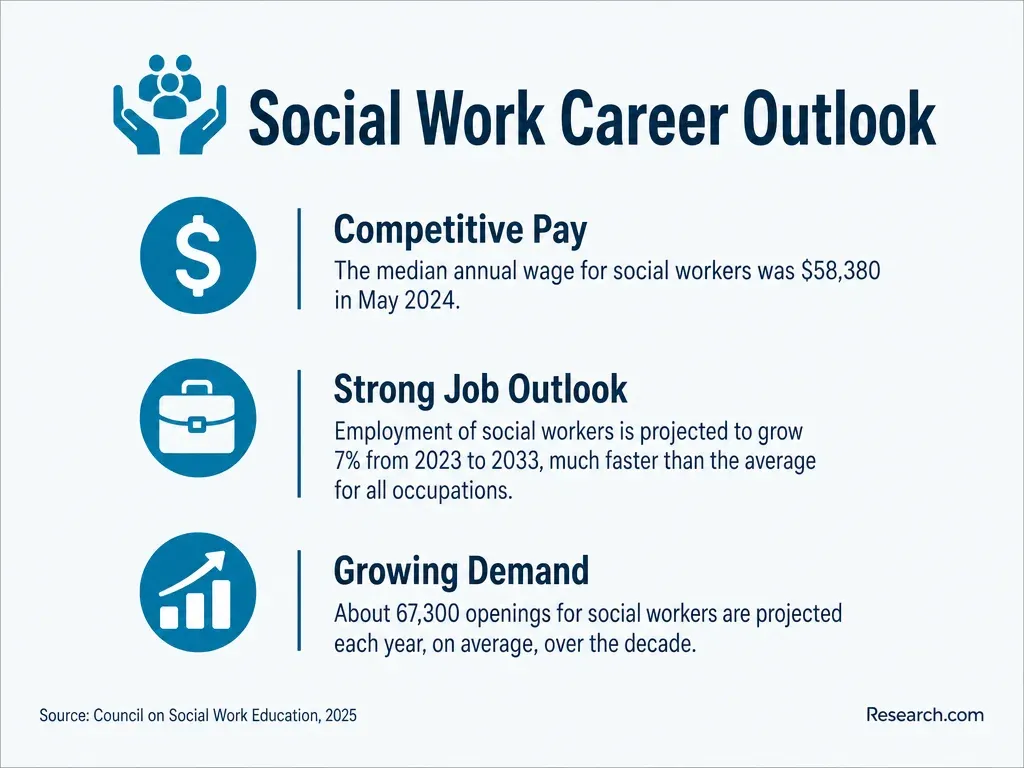
- The U.S. Bureau of Labor Statistics reports a May 2025 median of $59,550 for child, family, and school social workers, not a military-family-specific salary.
What does a military family social worker do?
A military family social worker helps service members and their families navigate needs that may be intensified by relocation, separation, deployment, or a return to civilian life. Depending on the program, the work may include family assessment, counseling within licensed scope, safety planning, parenting support, referrals, and coordination with schools, healthcare teams, or community agencies. The job title alone does not tell you whether the position is clinical, case-management-focused, or primarily preventive.
Ask the hiring manager: "What are the three most common services this position delivers, and which duties require an independent clinical license?" Request the position description and compare it with how staff actually spend their week. An MSW can support social work master's skills across career settings, but it does not make counseling, protective-services decisions, and resource navigation interchangeable tasks.
What salary and benefits do military family social workers receive?
There is no single military family social worker pay scale. A federal civilian position, uniformed position, nonprofit job, and contractor role can have different salary-setting rules, leave, retirement benefits, insurance, and eligibility for overtime or premium pay. Ask for the written pay range or grade, duty location, expected hours, benefits summary, and whether the offer is contingent on funding.
These national BLS figures provide context for two occupations that may overlap with the work. Neither is a pay quote for a military installation or a particular offer.
| U.S. occupation | May 2025 median annual pay | Projected employment growth, 2025-2035 |
| Child, family, and school social workers | $59,550 | 4% |
| Mental health and substance abuse social workers | $60,280 | 10% |
Use the category closest to the actual duties, then weigh the offer against local living costs and the full benefits package. MSW career compensation by state can add geographic context, but a state figure still cannot establish what this employer will pay. Ask whether relocation assistance, continuing education, license fees, and any on-call compensation are included rather than assuming they are.

What education and licenses does the position require?
Ask for the minimum qualification for this exact vacancy, not a general description of military social work. Some coordination and support roles may accept a BSW or another human-services background; clinical positions may require an MSW, an active state license, and independent clinical authority. Confirm whether the employer requires a license at application, at start, or after a stated period - and whether a license from your current state meets its rule.
If you are still working toward an MSW, distinguish a traditional program, which can admit graduates of other disciplines, from advanced standing, which generally requires a qualifying BSW and program approval. Shorter graduate pathways in social work may help an eligible applicant plan a transition, but program speed does not waive field education or licensing requirements. Ask the employer which credentials are mandatory and which are preferred before paying for another degree or certificate.
"Military families" can describe substantially different caseloads. One team may focus on prevention and referrals; another may handle complex behavioral health or family-safety concerns. Ask which populations the program is authorized to serve, how clients enter the service, whether participation is voluntary, and when a case must be transferred to another provider. Those answers reveal both the skills you need and the limits of the role.
Request a typical active caseload, expected new intakes per week, appointment length, documentation time, and coverage arrangements during absences. A manageable case count in a counseling service may be unmanageable if the same worker also conducts outreach, travels, and coordinates urgent referrals. If you are a student or new graduate, ask whether previous military-family placements developed the relevant competencies; comparing social work placement support policies can help you assess preparation, but field experience is not a substitute for employer onboarding or an active license.
Ask for the usual weekly schedule and the exceptions: evenings, weekends, on-call coverage, travel between sites, exercises, temporary assignments, and work during deployment or reintegration periods. Clarify whether you may be required to deploy or travel, rather than inferring that from the families served. Get the frequency, notice period, reimbursement rules, and any conditions on declining an assignment in writing.
For a working parent or someone planning additional education, predictable hours matter as much as the posted full-time status. If you are considering online social work study and professional preparation alongside the job, check live class meetings, skills labs, and field-placement schedules against actual work and travel obligations; online coursework does not eliminate those commitments.
The location of the work does not identify your employer. Ask for the legal employer, employment status, appointment length, funding source, and the organization that sets your duties and performance standards. A civilian job on an installation is not the same as joining the armed forces; a contractor working beside federal staff is not automatically entitled to federal employee benefits.
This distinction also affects whether an employer will help fund further education. If an MSW is only preferred for your target role, compare the value of employer-paid training with the cost of a degree before committing. A guide to affordable online MSW study is useful for estimating an education option, but the hiring organization must confirm its own reimbursement terms, service obligations, and eligibility rules. Before accepting, request the benefits documents issued by the entity that will actually employ you.
This is a defining question for military-family work. Ask which program rules govern records, who can access them, what information may be shared with command, and how clients are told about limits to confidentiality before services begin. Also ask who makes reporting decisions and provides consultation when a concern involves child or adult protection, imminent safety, or another legally reportable issue. Do not accept a vague assurance that information is "confidential" without understanding the exceptions.
For remote services, confirm where clients may be physically located and which jurisdiction's practice and privacy rules apply. Checking MSW program authorization and professional eligibility is a separate task from confirming permission to serve a client across state lines: the employer's counsel, applicable licensing boards, and current program policies should resolve that question. Ask for the written protocols and the name of the person who handles difficult disclosures.
Ask who supervises the position, how often case consultation occurs, and who is available during an urgent situation. New graduates need structured feedback on assessment, documentation, boundaries, and referrals; experienced clinicians still need orientation to the program's rules and local resources. Request specifics about training in military culture, family systems, safety procedures, records, and interdisciplinary communication.
If you plan to seek independent clinical licensure, get a separate answer about whether this job, supervisor, and supervision documentation meet your state board's requirements. Routine management supervision does not automatically count. Use questions about qualifying clinical social work experience to prepare for that discussion, then verify the arrangement with the board. Also ask about access to confidential employee support and coverage after especially distressing work; support should be practical, not merely promised.
What advancement opportunities and job prospects exist in military family social work?
Ask where people in this position have advanced within the organization: clinical specialization, supervision, program management, training, or broader family-services leadership. Find out which steps require an independent license, management experience, another appointment process, or a move to a different employer. The BLS growth figures above describe national occupations, not vacancies in military-family programs; local contracts and staffing decisions matter more to this specific opportunity.
For an experienced social worker pursuing program leadership, a practice-focused doctorate may be worth exploring, but it is not a routine promotion requirement. Comparing affordable social work practice doctorates makes sense only after checking whether the desired role values that qualification more than demonstrated leadership, supervision, or program-evaluation experience. Before accepting, ask what advancement has actually looked like for employees in this position - not just what a career ladder suggests is possible.
Other Things You Should Know About Social Work
No. Civilian federal agencies, nonprofits, and contractors also employ people who serve military families. Confirm the employment relationship in the offer.
No. Screening requirements depend on the position and worksite. Ask which background checks, access credentials, or clearances are required and when they must be completed.
No. Eligibility depends on the hiring authority and the applicant's circumstances. Review the vacancy announcement and submit the documentation it requests.
Often, yes, if the posting does not require it. Explain your transferable family-service skills and ask what military-culture training the employer provides.
- Considerations for privacy and confidentiality in adolescent health care service delivery - PMC https://pmc.ncbi.nlm.nih.gov/articles/PMC10186092/
- Security Clearance Process | intelligencecareers.gov https://www.intelligencecareers.gov/dia/security-clearance-process
- What VA Social Workers Do - Veterans Affairs https://www.socialwork.va.gov/socialworkers.asp
- Mandatory and Permissive Reporters | wa.gov https://www.dshs.wa.gov/mandatory-and-permissive-reporters
- DBA Information | dol.gov https://www.dol.gov/agencies/owcp/dlhwc/ExplainingDBA
- General Licensing Information - Office of the Professions - Nysed https://www.op.nysed.gov/about/general-information-policies
- Case Management - StatPearls - NCBI Bookshelf https://www.ncbi.nlm.nih.gov/books/NBK562214/
- Post-Deployment Reunion & Reintegration | militaryonesource.mil https://www.militaryonesource.mil/resources/millife-guides/post-deployment-reintegration/
- Risk Assessment | ncsu.edu https://emmc.ehps.ncsu.edu/risk-assessment/
- Crisis protocols for counselors: Balancing client care and personal well-being | HPSO https://www.hpso.com/Resources/Treatment-and-Care/Balancing-client-care-and-personal-well-being