2027 Post-MSW Clinical Supervision in Vermont: Supervisor Approval, Records, and Work Settings
Audited and Verified:
Our Editorial and Data Verification Process
Research.com uses government datasets, official education statistics and primary institutional information to support its career and degree guides. Our review process checks factual accuracy, occupational definitions, source dates and the requirements associated with the credentials discussed.
How This Article Was Fact-Checked
Our editorial team verifies salary estimates, employment projections, education requirements and program information against original data providers and official organizations. Salary figures are checked against the relevant occupational definitions and reporting periods. Information about licensure, accreditation and required in-person training is reviewed separately.
Fact-checked and verified on:

Co-Founder and Chief Data Scientist
After earning an MSW, the next job you accept can determine whether your clinical work moves you toward Vermont's licensed independent clinical social worker (LICSW) credential. The degree and its field placement are not substitutes for post-degree supervised experience, and an appealing clinical job may not provide qualifying supervision.
This guide is for new graduates and experienced social workers planning a Vermont LICSW application. It explains how to evaluate a supervisor and workplace, keep usable records, budget for the process, and identify questions to settle with Vermont's Office of Professional Regulation before relying on hours.
Key Things You Should Know
- Vermont's LICSW pathway calls for 3,000 hours of supervised post-MSW clinical experience, including 2,000 hours of direct client service, plus 100 hours of supervision; confirm the applicable rules with the Office of Professional Regulation (OPR) before starting.
- A clinical job title is not enough: the supervisor's qualifications, actual clinical duties, supervision format, and supporting records all matter when OPR evaluates experience.
- Keep separate logs for total work, direct client service, and supervision from the first day; MSW field hours and an out-of-state license do not automatically satisfy Vermont's post-degree requirements.
What are Vermont's post-MSW clinical supervision requirements for LICSW licensure?
Vermont's LICSW is the credential for independent clinical social work practice. Its post-degree experience requirement is distinct from MSW coursework, academic field education, and passing a licensing examination.
Vermont's published pathway specifies 3,000 hours of supervised clinical experience, including 2,000 hours of direct service to clients, and 100 hours of supervision. Confirm the rules and application instructions that apply when your experience begins and when you apply; the numbers alone do not establish that particular hours qualify.
Direct service is the crucial distinction when comparing jobs. A position may fill a full-time schedule with meetings, travel, administrative work, and documentation yet generate direct-client hours more slowly.
Ask a prospective employer what clinical activities you will perform under supervision and how it will distinguish them from other paid duties. For graduates checking online MSW alignment with licensing goals, degree eligibility and post-MSW experience are two separate checks.
Do not assume that the right hour totals compensate for an unqualified supervisor or nonclinical duties. OPR, rather than an employer or university, determines whether submitted experience meets Vermont's licensing requirements.
What education and registration are required before clinical supervision begins in Vermont?
Start by confirming that your completed master's degree in social work satisfies Vermont's education requirement. Keep your official transcript and information about your program's accreditation readily available.
An advanced-standing MSW and a traditional MSW are different routes to the degree; neither makes pregraduation field hours into post-degree clinical experience. BSW graduates comparing MSW entry options should make that distinction when estimating their path to independent practice.
Before providing clinical services, check which Vermont credential, application, or registration applies to your specific position. In particular, Vermont regulates psychotherapy practice by people who are not independently licensed; whether its roster or another requirement applies depends on the activities performed and the credentials held. An MSW, an employer's permission to work, or an application in progress is not itself independent clinical authority.
Send OPR a description of your proposed duties, current license or registration, work location, and anticipated supervision arrangement if any point is unclear. Obtain an answer before beginning work you expect to count, and follow the employer's rules on scope, billing, documentation, and client disclosures.
Who qualifies as a clinical supervisor, and how does Vermont verify their qualifications?
Choose a supervisor for regulatory eligibility first and professional fit second. Vermont's supervision rules and OPR's reporting materials govern which professional licenses qualify and what a supervisor must attest to.
Do not presume that a senior employee, an MSW holder, a clinical director, or a licensed professional from another discipline is automatically eligible. Verify the person's license category, status, jurisdiction, and any applicable experience requirement with OPR before counting the relationship.
The supervisor must be able to review your clinical work and accurately attest to the nature, dates, and amount of supervision and experience. A supervisor who rarely sees your work, joins only administrative meetings, or cannot document the arrangement may leave you with hours that are difficult to substantiate. If your workplace changes supervisors, document the transition and obtain the departing supervisor's report promptly.
A doctorate is not a shortcut around these rules. Before considering an additional degree, including DSW tuition and fee considerations, check whether the intended goal actually requires it; a DSW does not replace a qualifying clinical license or Vermont's supervision standards.
Eligibility depends on the work performed and supervised, not simply the organization's name. Community mental health agencies, hospitals, outpatient behavioral health programs, and similar employers may offer suitable roles when the position includes qualifying clinical service and access to an eligible supervisor.
A hospital discharge-planning job or a nonprofit case-management job, however, should not be treated as clinical experience solely because clients have behavioral health needs.
Use the following comparison when assessing an offer. It highlights what to verify, not an automatic OPR ruling on any setting.
| Position feature | Why it matters for LICSW experience |
| Regular clinical assessment or treatment duties | May provide direct-client experience if performed within the worker's lawful role and accepted under Vermont's rules. |
| Primarily referrals, benefits navigation, or administration | May provide valuable social work experience without producing the required volume of clinical direct-service hours. |
| Eligible supervisor with time for clinical review | Supports both learning and credible verification of supervision. |
| Clear records and employer cooperation | Make duties, dates, and hours easier to substantiate at application time. |
Ask the employer for a written description of duties, supervision access, and its experience supporting LICSW candidates. An MSW placement is a separate academic arrangement. Comparing social work placement support policies can help students before graduation, but placement approval does not preapprove a later job for licensure hours.
Keep a contemporaneous log rather than reconstructing months of work from payroll records. The objective is to show OPR what you did, when you did it, and who supervised it without placing confidential client details in a personal licensing file. These records will also help you spot a shortage of direct-service hours while you can still change your schedule.
A workable recording and reporting routine is:
- Record dates, workplace, total qualifying experience hours, and direct-client hours in separate columns; exclude leave and activities that do not qualify.
- Log each supervision meeting's date, duration, format, participants, and supervisor; distinguish individual from group supervision where the applicable form requires it.
- Reconcile totals with your supervisor regularly and obtain a signed report when a supervisory relationship or job ends.
- Use OPR's current LICSW application and supervisor-report instructions when submitting evidence; retain copies of records and confirmation of submission.
Clinical documentation must remain in approved employer systems. A personal hour log can identify the category of work without client names, diagnoses, or case details.
If you are still completing graduate study, comparing social work degrees before enrollment is a different task from maintaining the post-degree records OPR will evaluate.
Do not treat "100 hours of supervision" as permission to obtain every hour in any format. Vermont's rules distinguish supervision that meets its requirements from informal consultation, and the applicable individual-versus-group and remote-communication conditions should be checked against OPR's current rules.
Before scheduling group or video meetings, ask OPR how those sessions may count, what documentation is required, and whether the proposed supervisor and supervisee locations affect the arrangement.
Remote work adds a second issue: permission to serve a client is not the same as permission to receive remote supervision. Client location, the clinician's authorization to practice there, employer policy, confidentiality safeguards, and the supervisor's ability to oversee the work all matter. Record the supervision format in your log rather than assuming a video meeting will later be accepted as an in-person meeting.
Online education does not settle these practice questions. Even shorter graduate pathways in social work do not shorten Vermont's post-MSW experience requirement.
The timeline depends on three rates: total eligible hours, direct-client hours, and qualifying supervision hours. At 40 eligible hours every week, 3,000 hours would take 75 weeks of work; holidays, leave, administrative duties, part-time schedules, and the separate 2,000-hour direct-service target can extend the calendar considerably.
This is arithmetic for planning, not a statement that Vermont permits completion in 75 weeks or that every paid hour counts. Check any minimum-duration or other timing conditions in OPR's applicable rules.
Budget for costs beyond a licensing application: possible outside-supervisor fees, time away from billable work for supervision, examination charges, registration or licensing fees, and record requests. If supervision is employer-provided, ask whether it occurs on paid time, what happens if the supervisor leaves, and whether you owe repayment after changing jobs.
Someone who prioritized social work master's study on a budget should still compare the total cost of prospective supervised jobs, not just their starting salaries. Verify current OPR and examination fees rather than relying on an old cost estimate.
It may count if OPR determines that the education, clinical work, supervisor, supervision, and documentation satisfy Vermont's applicable requirements. Experience accepted for another state's license is useful evidence, not automatic Vermont credit. Likewise, an active out-of-state license does not by itself authorize independent practice with clients in Vermont.
Before relocating, assemble official license verification, employer descriptions, dated hour logs, and supervisor reports. Ask OPR which application route applies to you and whether it needs additional evidence from an earlier supervisor. If a supervisor or agency has closed, resolving missing records before a move may be far easier than reconstructing them afterward.
Consider compensation alongside portability. MSW affordability and career value considerations are incomplete if a move delays licensure because previously earned hours cannot be verified or accepted.
Apply through Vermont OPR using its current LICSW application process. Expect to document qualifying education and supervised experience, meet the applicable clinical licensing examination requirement, and provide any other information OPR requests.
Follow OPR's instructions on examination authorization and score reporting; completing hours, submitting an application, and passing an exam are separate milestones from license issuance.
Before submitting, compare each supervisor report with your own totals and check that dates, direct-service hours, supervision hours, credentials, and signatures are consistent. Disclose prior licenses and disciplinary history as the application asks. Keep practicing only within your existing authorization while OPR reviews the file; do not advertise or bill as a Vermont LICSW until the license is issued and active.
If independent clinical work is not your immediate goal, exploring roles for master's-prepared social workers may reveal positions that fit your current credentials while you complete supervision.
What are the career opportunities, salaries, and job outlook for Vermont clinical social workers?
Vermont LICSWs may pursue clinical positions in behavioral health, healthcare, community agencies, or other settings that need independently licensed practitioners. Actual duties and compensation depend on the employer, client population, payer requirements, caseload, and experience.
When comparing supervised jobs with independent roles, examine access to consultation, documentation expectations, on-call work, and whether the position provides the clinical experience you still need.
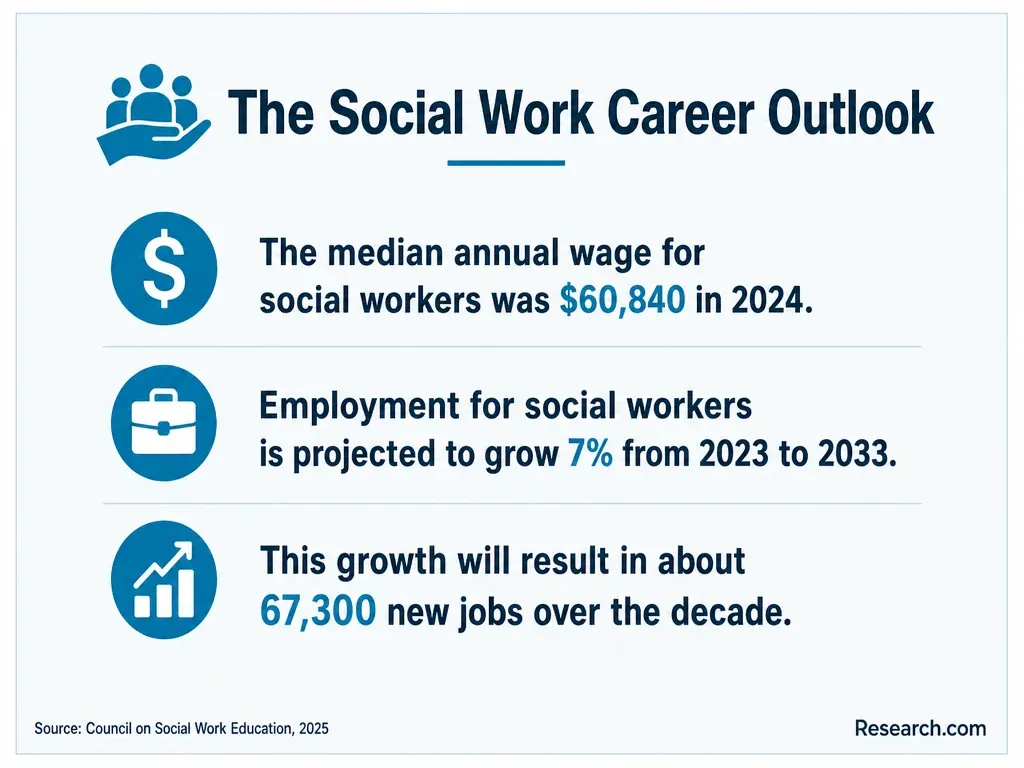
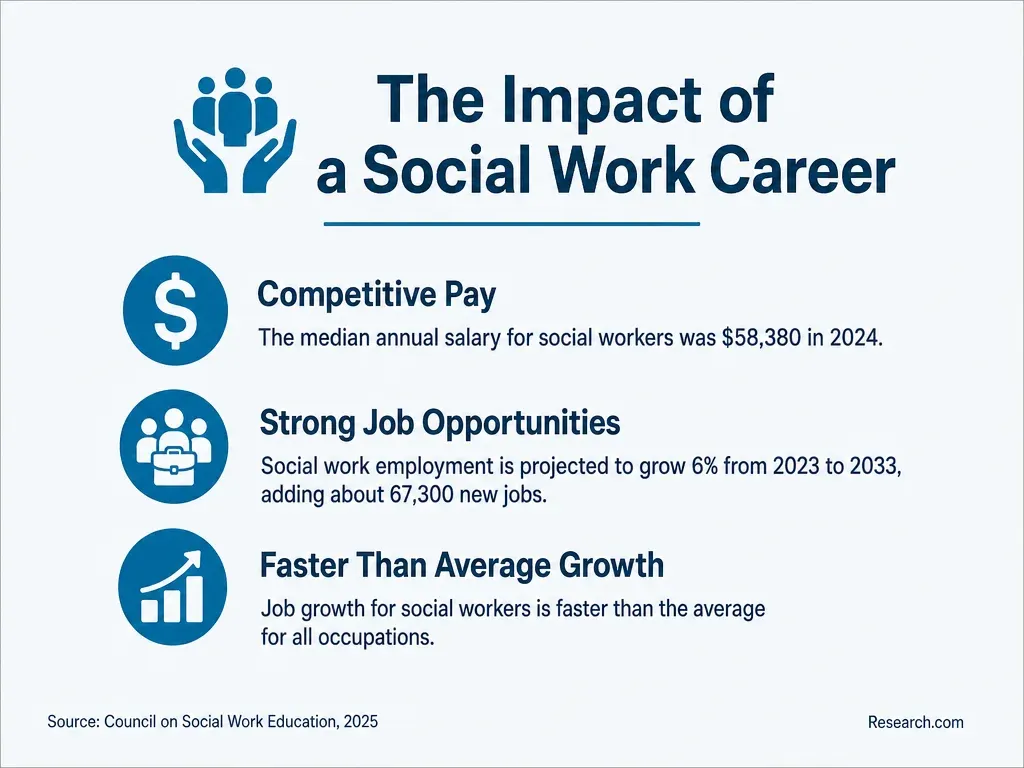
The U.S. Bureau of Labor Statistics reports a May 2025 national median annual wage of $60,280 for mental health and substance abuse social workers and projects 10% employment growth from 2025 to 2035 for that occupation.
Those figures describe a national occupational group, not Vermont LICSW wages, a guaranteed offer, or the outlook for one employer. For geographic context, use a state-level social work pay comparison guide, then check current Vermont job postings for the particular license and setting you want.
Other Things You Should Know About Social Work Programs
No. A concentration may strengthen preparation, but Vermont grants the license only after an applicant satisfies its education, experience, examination, and application requirements.
Do not assume it will. Ask OPR whether the particular duties, supervisor, authorization to practice, and records meet its requirements before relying on unpaid hours.
Request a completed report covering the period they supervised you, preserve your logs, and verify the replacement supervisor's eligibility before continuing to accrue hours.
No. Use only titles your current credential permits. An application or completed supervision does not confer an active Vermont LICSW license.
- Mental Health Supervisor Registry | vermont.gov https://sos.vermont.gov/allied-mental-health/supervisor-registry
- Supervision Series: Supervision Records - Minnesota.gov https://mn.gov/boards/psychology/blog/
- Supervision Questions from the Recent Rule Change | ohio.gov https://cswmft.ohio.gov/about-the-board/news-and-events/news/Supervision_FAQs
- NYS Social Work: LCSW License Requirements | nysed.gov https://www.op.nysed.gov/professions/licensed-clinical-social-worker/license-requirements
- Record keeping guidelines | apa.org https://www.apa.org/practice/guidelines/record-keeping
- Frequently Asked Questions | socialworkers.org https://naswvt.socialworkers.org/About/Frequently-Asked-Questions
- Code of Vermont Rules, Chapter 070, Section 04 030 070 | justia.com https://regulations.justia.com/states/vermont/agency-04/sub-agency-030/chapter-070/section-04-030-070/