2027 Peer Support Specialist vs Social Worker: Lived Experience, Credentials, and Team Roles
Audited and Verified:
Our Editorial and Data Verification Process
Research.com uses government datasets, official education statistics and primary institutional information to support its career and degree guides. Our review process checks factual accuracy, occupational definitions, source dates and the requirements associated with the credentials discussed.
How This Article Was Fact-Checked
Our editorial team verifies salary estimates, employment projections, education requirements and program information against original data providers and official organizations. Salary figures are checked against the relevant occupational definitions and reporting periods. Information about licensure, accreditation and required in-person training is reviewed separately.
Fact-checked and verified on:

Co-Founder and Chief Data Scientist
If your experience navigating recovery or behavioral health services motivates you to help others, you may not need a social work degree to begin. Peer support and social work can serve the same people, but they bring different qualifications, responsibilities, and opportunities for advancement.
This comparison is for prospective peer specialists, career changers, and human services workers deciding whether certification, a BSW, or an MSW fits their goal. It explains what each role can do, where their boundaries meet, and which education and employment details to verify before committing time or money.
Key Things You Should Know
- Peer specialists use relevant lived experience and role-specific training; social workers generally enter through social work education, with state licensure required for some titles and duties.
- The U.S. Bureau of Labor Statistics reports a May 2025 median annual wage of $61,780 for social workers overall, but does not publish a directly comparable national wage specifically for peer support specialists.
- Peer certification may take weeks or months, depending on the state and provider; a BSW commonly takes four academic years, while an MSW adds a separate graduate sequence and field education.
What is the difference between a peer support specialist and a social worker?
A peer support specialist uses relevant personal experience - often with mental health conditions, substance use recovery, or navigating services - to build mutual understanding and support someone's self-defined goals. A social worker uses formal social work preparation to assess needs, coordinate services, advocate, and, when appropriately licensed, provide clinical services. Neither role is simply a junior version of the other.
This comparison focuses on typical behavioral health teams; actual duties depend on the job description and state rules.
| Decision factor | Peer support specialist | Social worker |
| Primary contribution | Lived-experience perspective, mutuality, practical encouragement, and connection to community supports | Social work assessment, service planning, advocacy, and interventions within education and licensed scope |
| Typical entry qualification | Relevant lived experience plus employer- or state-recognized training; certification rules vary | Often a BSW or MSW for social worker positions; license requirements vary by state and function |
| Clinical authority | Peer certification does not authorize diagnosis or psychotherapy | Independent clinical work generally requires an applicable state clinical license and qualifying supervised experience |
| Distinctive strength | Shows that navigating recovery and systems is possible without prescribing another person's path | Connects individual needs with family, agency, policy, and service-system considerations |
If you want your lived experience to be central to your daily work, investigate peer positions first. If your target job involves social work assessment or licensed clinical practice, work backward from that employer's qualifications and your state board's rules. Social work master's roles and employment settings can help distinguish MSW-level jobs from adjacent support roles.
What lived experience and certification are required to become a peer support specialist?
Many behavioral health peer roles require personal experience of recovery from a mental health condition or substance use disorder; some family-peer roles instead require experience supporting a child or family member. Programs may also require that applicants be willing to draw on that experience appropriately. There is no single national peer specialist license or uniform definition of qualifying lived experience.
States, credentialing organizations, Medicaid programs, and employers may set different eligibility rules. Depending on the position, these can include an approved training course, an assessment, supervised practice, continuing education, a background check, or separate certification for mental health, substance use, or family support.
Verify the exact credential named in the job posting with its issuing authority before paying for training; a certificate from one provider may not qualify you for another state's reimbursable role. Do not assume that an online social work degree is necessary for peer work. If you are also considering a longer-term transition into social work, compare online social work education options for career planning against the faster, more targeted peer-training route.
What degrees and state licenses do social workers need?
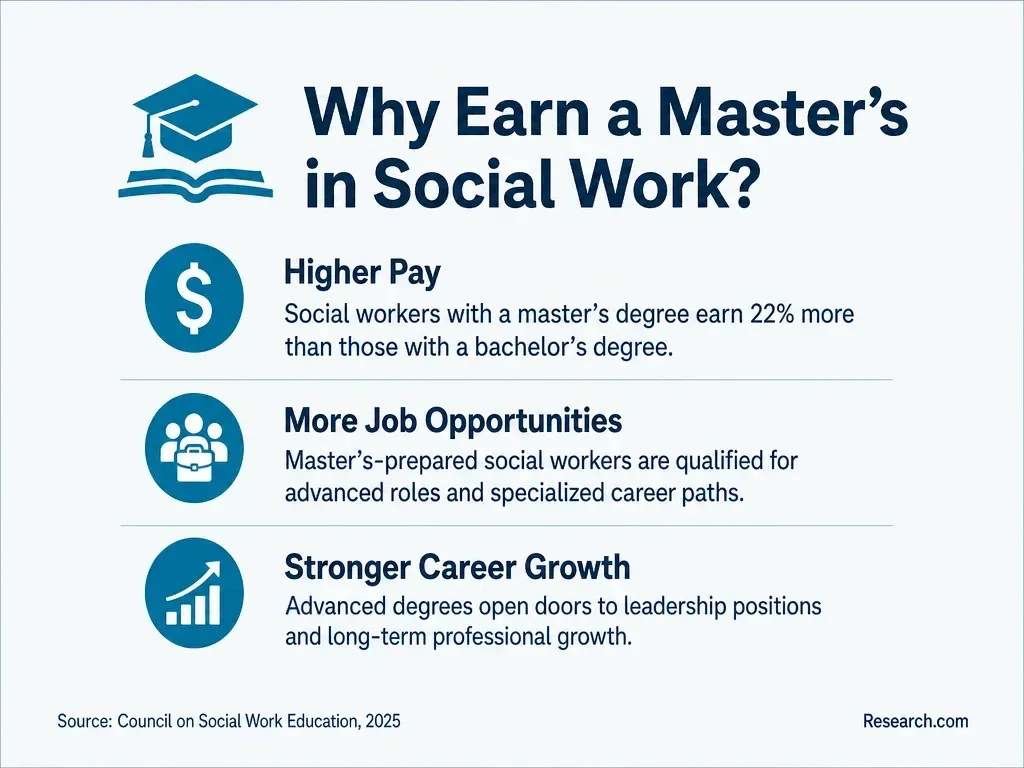
A BSW prepares students for generalist social work practice. An MSW provides graduate-level preparation and is generally the educational route toward clinical social work licensure. A person with a bachelor's degree outside social work can apply to a traditional or foundation MSW program; advanced-standing MSW admission generally requires a qualifying BSW and satisfaction of the program's additional criteria.
Degree, license, and permission to practice independently are separate milestones. States use different license titles and rules. Depending on the role, a graduate may need to apply to a board, meet education requirements, pass an examination where required, and complete approved post-degree supervision. BSW or MSW field education does not automatically count as post-degree clinical supervision. An MSW alone does not authorize independent psychotherapy.
Before enrolling for a regulated role, check the program's CSWE accreditation status and the board rules in the state where you intend to practice. A starting point for comparing MSW programs and state licensure education requirements does not replace confirmation from the program and licensing board.
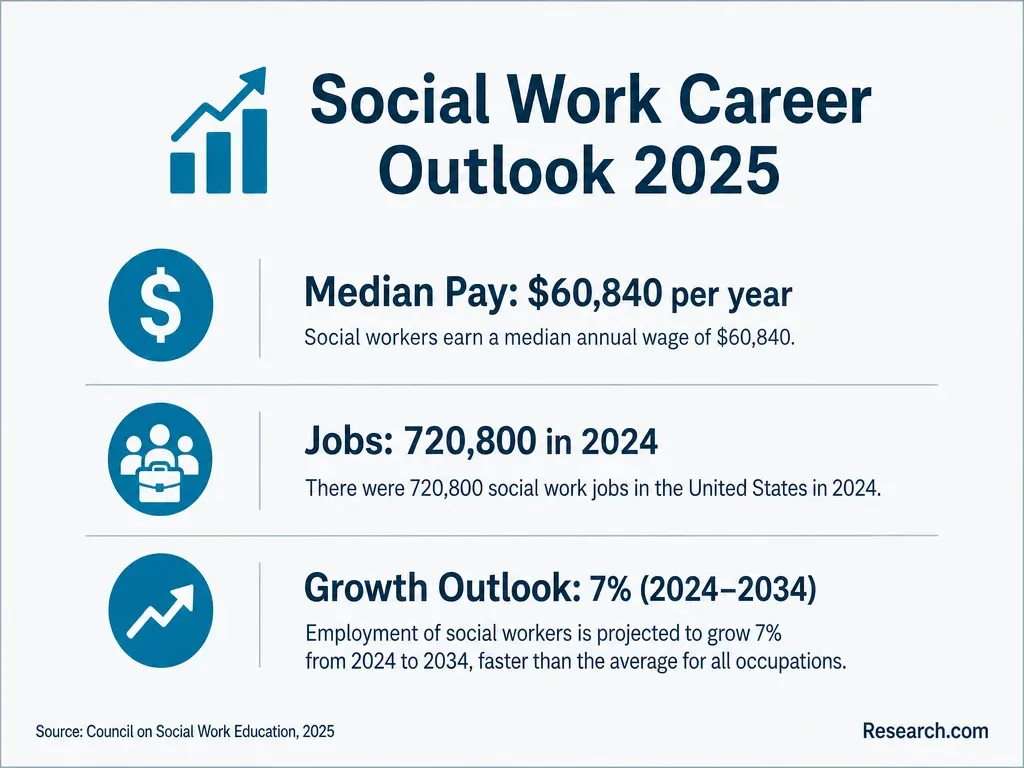
National wage figures are clearer for social workers than for peer specialists. The U.S. Bureau of Labor Statistics (BLS) reports the following May 2025 medians and 2025-2035 employment projections for social work occupations. These occupational categories include workers with different employers, experience levels, degrees, and licenses - not just new graduates.
| BLS occupation | Median annual wage, May 2025 | Projected employment growth, 2025-2035 |
| Social workers, all specialties | $61,780 | 6% |
| Child, family, and school social workers | $59,550 | 4% |
| Healthcare social workers | $67,880 | 8% |
| Mental health and substance abuse social workers | $60,280 | 10% |
BLS does not report a separate, directly comparable national median or growth projection for "peer support specialist." Some peer jobs may fall within broader support occupations, but those figures would include non-peer workers and could mislead as a peer salary estimate. Compare actual local peer and social worker postings by pay, hours, benefits, credential requirements, and funding stability. Geography and specialty also matter; planning an MSW career with regional salary context is more useful than treating a national median as a promised salary.
Consider a behavioral health team helping someone reconnect with care after a service interruption. A peer specialist might share an appropriate personal insight, help the person identify what support they want, and accompany them through unfamiliar service processes. A social worker might assess service needs, address housing or benefits barriers, coordinate referrals, and carry out duties allowed by their license and agency role. Both can flag gaps in access without claiming to speak for the client.
The useful boundary is clear responsibility, not separation. Peers should not be asked to diagnose, provide psychotherapy, or substitute for clinical staffing. Social workers should not treat a peer's story as a clinical assessment or expect disclosure on demand. Both need agreed procedures for consent, documentation, confidentiality, consultation, and escalating safety concerns under applicable law and agency policy.
If clinical treatment is your intended contribution, examine the education and supervised-practice requirements rather than expecting peer certification to expand your scope. Online clinical social work education pathways address the academic portion; state licensure remains a separate decision.
Peer training may be completed in weeks or months, but certification timelines depend on course availability, experience requirements, assessments, and processing. A full-time BSW commonly takes four academic years from initial college entry. A traditional MSW commonly takes about two years of full-time study after a bachelor's degree; qualifying advanced-standing students may have a shorter sequence. Part-time study and placement availability can extend either route. Independent clinical licensure can require additional years of post-degree supervised practice.
There is no reliable single price for either path. Compare peer-course and application fees with the full cost of a degree: tuition, fees, books, placement travel, possible reductions in paid work, and eventual licensing expenses. An employer may pay for peer training, while financial aid or employer assistance may change the net cost of a BSW or MSW. Check conditions before assuming reimbursement or a paid placement.
For a degree, request a total-program estimate, not just a per-credit rate. Cost-focused online MSW program choices can narrow a search, but field schedules and lost earnings may outweigh a modest tuition difference.
Can a peer support specialist become a social worker?
Yes. Peer work can develop engagement, service-navigation, and boundary-setting skills that transfer well to social work education. It does not itself confer a BSW, MSW, field credit, license, or advanced-standing eligibility.
Choose the next step based on the job you want. If you already have a non-BSW bachelor's degree, compare traditional MSW programs with the option of staying in peer or other human services work; a second bachelor's degree may be unnecessary. If you hold a qualifying BSW, ask about advanced standing. If you have not completed a bachelor's degree, compare BSW programs with other routes to your target role. BSW-to-MSW progression and traditional entry routes explains why prior degree type changes the sequence.
Before applying, collect a few target job postings and identify the duties you want that peer certification does not permit or employers do not assign to peers. Confirm the required degree or license, ask programs how field placement would work alongside your job, and calculate the cost of any reduced work hours. If peer practice already offers the work you value, further formal education may not be the best next investment.
Other Things You Should Know About Social Work
Some employers offer remote peer services, but availability depends on the position, service rules, privacy procedures, and the location of the people served. Check whether the job also requires in-person meetings or travel.
Medicaid may cover qualifying peer services under a state's approved benefit and provider rules. Coverage, credential requirements, supervision, and billing arrangements vary; certification alone does not guarantee that a service can be billed.
No. Purposeful, limited self-disclosure can support the client's goals. Personal details need not be shared simply because a worker has lived experience; training and supervision can help establish appropriate boundaries.
Potentially, if they independently meet both sets of requirements. When working, they should clarify which role they are performing and follow its scope, documentation, supervision, and employer rules.
- Peer Support Specialist | Louisiana Department of Health https://ldh.la.gov/page/peer-support-specialist
- Chapter 2 - Roles of the Peer Worker - NCBI https://www.ncbi.nlm.nih.gov/books/NBK596269/
- Crisis Services and the Behavioral Health Workforce Issue Brief | ASPE https://aspe.hhs.gov/reports/crisis-services-behavioral-health-workforce-issue-brief
- Peer Recovery Support Services Across the Continuum - PMC https://pmc.ncbi.nlm.nih.gov/articles/PMC8339174/
- Peer Workers in the Behavioral and Integrated Health Workforce: Opportunities and Future Directions - ScienceDirect https://www.sciencedirect.com/science/article/pii/S0749379718316374
- Massachusetts Peer Support Certification & Medicaid Guide | Smores Health https://smoreshealth.com/state-guides/massachusetts
- The Role of the Peer Support Specialist in a Clinical Treatment Team | ForwardCare https://www.forwardcare.com/blog/the-role-of-the-peer-support-specialist-in-a-clinical-treatment-team
- The Role of Peer Support Specialists in Behavioral Health Care | Steinberg Institute https://steinberginstitute.org/peer-support-specialists/
- How to Become a Peer Support Specialist | Thryve Teams https://thryveteams.com/HowToBecomePSS
- Gaps in Peer Support Reimbursement and Certification in the United States - Policy Center for Maternal Mental Health https://policycentermmh.org/gaps-in-peer-support-reimbursement-and-certification-in-the-united-states/