2027 MSW Placements with Limited Direct Client Contact: Evaluating Learning Fit
Audited and Verified:
Our Editorial and Data Verification Process
Research.com uses government datasets, official education statistics and primary institutional information to support its career and degree guides. Our review process checks factual accuracy, occupational definitions, source dates and the requirements associated with the credentials discussed.
How This Article Was Fact-Checked
Our editorial team verifies salary estimates, employment projections, education requirements and program information against original data providers and official organizations. Salary figures are checked against the relevant occupational definitions and reporting periods. Information about licensure, accreditation and required in-person training is reviewed separately.
Fact-checked and verified on:

Co-Founder and Chief Data Scientist
An MSW placement can offer valuable social work learning without a traditional client caseload - but limited contact can also leave important skill gaps. If you are considering a policy, evaluation, administration, or community-based site, the decision is not simply whether the work counts as "social work."
It is whether your program will approve the placement and whether its supervised tasks prepare you for your intended role. This guide helps MSW students compare placement types, test a proposed learning agreement, and identify the questions to settle before accepting a site.
Key Things You Should Know
- A limited-contact placement may meet MSW field requirements if the program approves its site, supervision, hours, and evidence of required competencies; a macro job title alone is not enough.
- Ask what you will actually do and receive feedback on. Policy research without community input or supervised application may offer less practice learning than a project involving stakeholders and measurable decisions.
- Field education is not post-degree clinical supervision. The reported May 2025 median wage of $61,780 for social workers across specialties is occupational context, not an expected salary for a macro-placement graduate.
What are MSW placements with limited direct client contact?
These are approved field placements in which students spend relatively little time providing services directly to individual clients or families. Instead, they may help an agency assess service gaps, coordinate community partnerships, analyze policy, improve a program, or evaluate how services reach a population.
"Limited" does not necessarily mean no contact: meetings with residents, service users, frontline staff, or community organizations may be central to responsible macro practice.
The distinction is about learning tasks, not whether the work matters to clients. A useful project connects organizational decisions to people affected by them and gives the student opportunities to apply social work ethics, respond to feedback, and reflect with a field instructor.
Students earlier in their education may need more foundational practice exposure before taking on a highly specialized indirect role. For context on that progression, see this guide to accredited undergraduate social work study.
What types of MSW placements involve less direct client contact?
Indirect practice covers distinct kinds of work. The comparison below shows what students might produce and the main learning risk to investigate before accepting an assignment:
| Placement focus | Possible supervised work | Learning risk to check |
| Policy and advocacy | Analyze a proposed rule and gather stakeholder perspectives | Research never informs an actual advocacy or implementation decision |
| Program evaluation | Develop measures, review appropriately accessible data, and present findings | Data access or oversight is unclear |
| Community organizing | Support listening sessions, partnerships, and collective planning | Student observes rather than practices engagement |
| Agency administration | Map referral processes or improve staff training materials | Tasks become routine clerical support |
Placement expectations also depend on the MSW sequence. A traditional program may use foundation field education to build generalist skills before specialized work; advanced-standing eligibility and sequencing depend on a qualifying social work background and the school's rules. Students comparing those routes can review traditional MSW routes for non-BSW graduates.
Can limited-contact placements meet CSWE-accredited MSW field education requirements?
Yes, potentially, but the MSW program must decide whether the particular placement meets its approved field curriculum. CSWE accreditation evaluates social work programs against educational standards; it does not independently approve an individual student's proposed site.
A program must be able to assess the competencies its students are required to develop, including engagement, ethical practice, assessment, intervention, and evaluation as applicable to the learning sequence.
Ask the field office how the site will provide qualified field instruction, suitable tasks, documented hours, supervision, and evaluations. A community or organizational assignment can demonstrate practice competencies, but a project consisting only of unsupervised desk research may not.
Program rules may also require specific generalist experiences or impose concentration-specific conditions. Get approval before assuming that employment, volunteering, or a self-arranged placement will count.
Scheduling matters as much as the academic fit. A student considering shorter graduate pathways in social work should confirm when field courses occur and whether a limited-contact site can provide enough approved work during that sequence.
Start with the work you want to be ready to perform after graduation. A student targeting policy analysis may benefit from supervised legislative or implementation work; a student targeting psychotherapy should not assume an indirect placement will provide enough observed clinical skill practice.
The strongest test is whether the proposed tasks, feedback, and work products match your learning agreement - not whether the agency has a prestigious name.
Before accepting, put these questions to the site and your field office:
- Which required competencies will I demonstrate through specific tasks, and how will my field instructor observe and assess them?
- Whose perspectives will inform the work, and what direct or indirect engagement will I practice?
- What deliverable can be completed within the placement period, and what happens if data access or project priorities change?
- Which skills would I still need to develop through coursework, a later placement, or supervised employment?
A placement that produces an ethically approved, usable agency deliverable may offer better value than one built around an impressive but inaccessible project. When comparing programs as well as sites, weigh field support and likely lost earnings alongside tuition; exploring the career value of affordable MSW study can help frame that broader decision.
A well-designed placement can build skills in community engagement, policy analysis, program design, evaluation, ethical data handling, grant-related work, and communicating findings to decision-makers.
It can also sharpen person-in-environment reasoning: tracing how eligibility rules, transportation, funding, or referral systems shape the options available to individuals and families.
The quality of practice matters more than the project label. For example, mapping a referral bottleneck becomes meaningful field learning when a student gathers permitted input, identifies who may be excluded by a proposed change, recommends an adjustment, and discusses limitations in supervision.
Access to records, interviews, or results must follow agency permissions and applicable oversight; a student should not assume access to identifiable client information.
These skills can support several social work career routes, but an online degree or macro concentration does not itself establish competence in every role. Students exploring online degree routes into social work careers should compare the supervised practice opportunities behind each program's stated emphasis.
Begin with the field office's approved partners and ask specifically for policy, community practice, evaluation, quality improvement, and administration opportunities.
Local government departments, housing organizations, public health partnerships, advocacy groups, foundations, and multiservice nonprofits may offer relevant work, but their suitability depends on supervision and approved learning tasks.
If the program permits students to propose sites, use this sequence before committing:
- Request the school's site, field-instructor, task-supervisor, and affiliation requirements.
- Discuss a feasible project and ask who will provide regular instruction and feedback.
- Confirm anticipated schedule, location, access permissions, onboarding, and any required community contact.
- Submit the proposal for field-office approval and obtain a learning agreement before counting hours.
Do not confuse placement applications with MSW admissions. If you are still selecting a program and application requirements are a barrier, MSW entry options without traditional reference letters address a separate decision; they do not establish whether a school can approve your preferred field site.
Delivery format does not determine whether a limited-contact placement is available. Campus-based programs may have established regional agency partnerships, while online programs may allow approved placements closer to a student's home.
Either may require in-person field work, live supervision, skills activities, or travel. The crucial difference is the particular program's placement network and approval process in your location.
Ask who identifies sites, whether the program has relevant macro partners near you, how it verifies field instructors, and what happens if a proposed site falls through.
An online student should also check jurisdictional enrollment and placement policies before assuming that a nearby agency is eligible. When reviewing comparing social work placement support policies, look for concrete responsibilities and timelines rather than a general promise of assistance.
Your program, not the agency's informal estimate, determines the field hours and documentation required for your sequence. Confirm whether orientation, remote meetings, travel, and project preparation count; how often instruction occurs; who evaluates you; and whether a task supervisor works alongside a qualified field instructor.
A flexible-sounding policy project may still depend on daytime government meetings or community events.
Build a weekly budget that includes class and seminar time, placement hours, commuting, parking, screening or onboarding charges, and any reduction in paid work. Ask whether paid or employment-based field education is permitted and, if so, how the school will distinguish new learning from ordinary job duties. Compensation cannot be assumed.
For a fuller education-cost comparison, exploring less expensive online MSW degrees is a starting point; the most manageable tuition figure may not produce the lowest total cost if field scheduling substantially reduces earnings.
What careers, salaries, and job prospects are associated with macro social work?
Relevant roles may include community organizer, program coordinator, policy analyst, evaluation specialist, advocacy manager, or social services administrator.
Duties and hiring requirements vary: some employers seek an MSW and social work experience, while others accept public health, public administration, research, or nonprofit-management preparation. A license may matter for a particular position or protected title, but it is not a universal requirement for macro work.
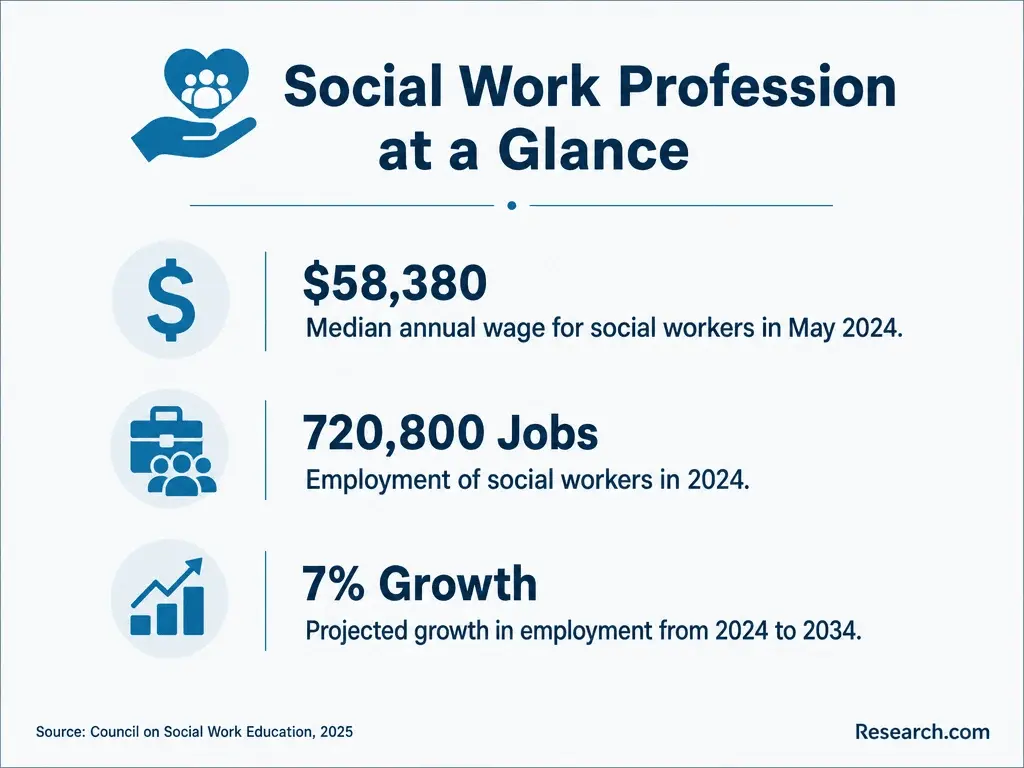
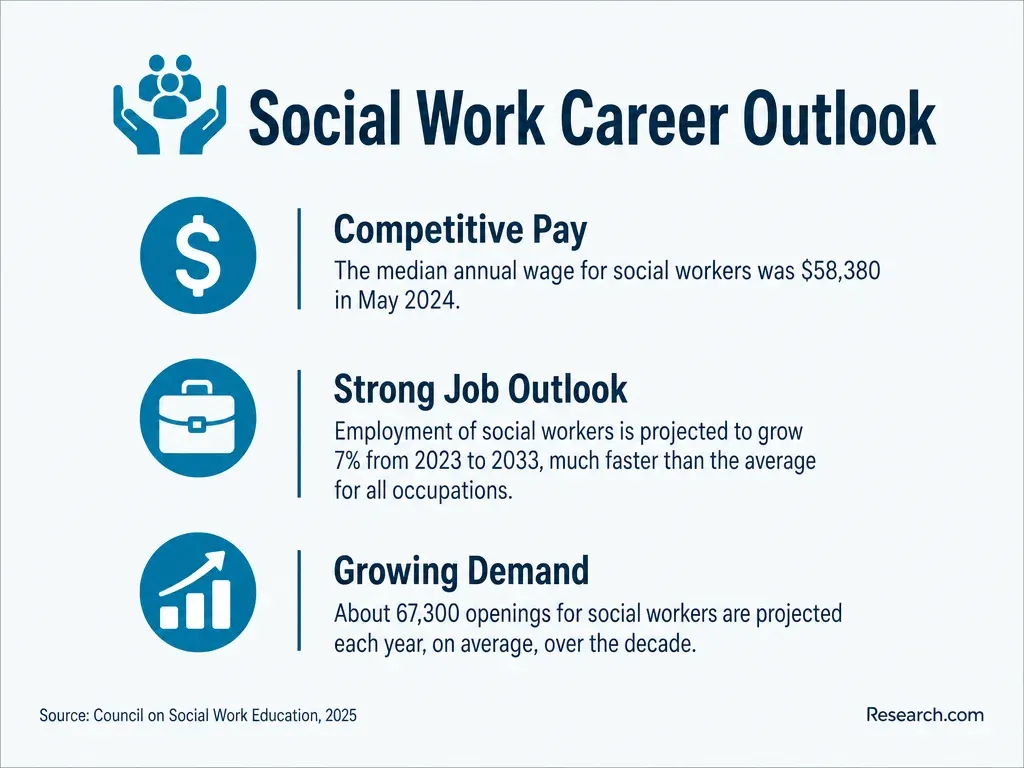
BLS reports a May 2025 median annual wage of $61,780 for social workers across specialties and projects 6% employment growth for that occupation from 2025 to 2035.
Those figures include many direct-service roles; they are not a macro-social-work salary or a forecast for policy analyst jobs. Compare actual postings by duties, employer, location, required credentials, and experience. For geographic context, see social work master's pay and geographic differences, while keeping occupational averages separate from a specific offer.
For a student committed to systems-level work, a placement with substantive stakeholder engagement, supervised decision-making, and a completed project can provide stronger evidence of readiness than a title alone. If your target jobs do not require an MSW, compare their qualifications with a more direct route before choosing additional education.
Other Things You Should Know About Social Work
Yes. Contact the program's accessibility office and field office early to discuss the essential learning requirements and possible accommodations. The approved arrangement should also be clear to the site before work begins.
No. Advocacy placements involve different activities, and some agencies restrict lobbying. Clarify proposed tasks, agency policy, funding restrictions, and your educational objectives before accepting the site.
Only with appropriate agency permission. Use a nonconfidential version that removes identifying information and respects restrictions on internal data, partner contributions, and unfinished work.
Tell your field instructor and faculty liaison promptly. They can assess replacement tasks, revise the learning agreement if appropriate, and determine whether approved hours and competency assessments remain feasible.
- Board of Social Work Board Meeting | virginia.gov https://townhall.virginia.gov/L/GetFile.cfm
- Supervision training in healthcare: a realist synthesis - PMC https://pmc.ncbi.nlm.nih.gov/articles/PMC7359165/
- Qualified Supervisors for Registered Interns | floridasmentalhealthprofessions.gov https://floridasmentalhealthprofessions.gov/qualified-supervisor/
- Master of Social Work Field Education Manual | Academics at Walden University https://academicguides.waldenu.edu/msw-field-education-manual/field-education
- Assessing Student Performance in Field Education | Applied Learning in Social Work Education Journal https://alswe.simmons.edu/article/assessing-student-performance-in-field-education/
- Clinical vs. Macro Social Work: Exploring Career Options with an M.S.W. | Virginia Commonwealth University https://onlinesocialwork.vcu.edu/blog/clinical-vs-macro-social-work-career-options/
- MSW Practicum Manual 2026 - 2027 - IU School of Social Work https://socialwork.iu.edu/msw-practicum-manual.html
- The Nine CSWE Social Work Competencies | texascollege.edu https://www.texascollege.edu/the-nine-cswe-social-work-competencies
- MSW Licensing, Practicum Hours & Accreditation FAQs Explained | Winthrop University https://online.winthrop.edu/resources/msw-licensing-practicum-accreditation-faqs/
- Practicum Education Manual - VI. Practicum Education Placement Policies, Procedures, and Processes https://socialwork.wayne.edu/practicum/manual/policies