2027 MSW Placements in Justice Settings: Access, Professional Boundaries, and Learning
Audited and Verified:
Our Editorial and Data Verification Process
Research.com uses government datasets, official education statistics and primary institutional information to support its career and degree guides. Our review process checks factual accuracy, occupational definitions, source dates and the requirements associated with the credentials discussed.
How This Article Was Fact-Checked
Our editorial team verifies salary estimates, employment projections, education requirements and program information against original data providers and official organizations. Salary figures are checked against the relevant occupational definitions and reporting periods. Information about licensure, accreditation and required in-person training is reviewed separately.
Fact-checked and verified on:

Co-Founder and Chief Data Scientist
A justice-setting MSW placement can offer unusually valuable practice experience - but admission to an MSW program does not guarantee access to a court, jail, prison, or reentry agency. Security screening, restricted records, competing responsibilities to clients and institutions, and qualified field supervision all shape what students can actually do.
This guide is for MSW students comparing placements and programs. It explains how to assess access, maintain professional boundaries, document meaningful learning, and decide whether a proposed site supports the work you hope to pursue after graduation.
Key Things You Should Know
- Placement access is conditional: The agency must accept the student, complete any required screening, and approve the work; MSW admission alone does not secure a justice placement.
- Learning must be supervised: Ask whether the site offers approved tasks, qualified field instruction, and enough access to demonstrate competencies - not simply a place to record hours.
- Field experience is not a license: Justice-placement hours do not automatically count toward post-degree clinical supervision, and occupation-wide social worker salaries do not predict a graduate's pay.
What are MSW placements in justice settings?
A justice-setting placement is an MSW program-approved field assignment connected to a criminal or juvenile legal system. Possible sites include courts, public defender or diversion programs, probation-related services, detention facilities, correctional health teams, victim-service organizations, and community reentry agencies. The student's work depends on the site's mission and permissions: a reentry nonprofit may allow substantial service coordination, while a secure facility may limit direct contact or access to records.
"Justice setting" describes a context, not a single social work role. Some placements emphasize clinical engagement under supervision; others focus on housing referrals, family support, policy, or program evaluation. A student interested in a particular job should compare its duties with a social work graduate career pathway overview, then ask whether the proposed placement teaches the relevant skills. A site's name alone is a poor substitute for an approved learning plan.
How do MSW students access justice placements and meet security requirements?
Start with the MSW field office rather than assuming an agency can approve a self-arranged placement. The school and site may need an agreement, an approved learning plan, a qualified field instructor, and authorization for the student's intended tasks. A facility may separately require a background check, fingerprinting, identification, training, health documentation, or an interview. Requirements differ by agency and may restrict entry even after a placement is proposed.
Ask the field office and agency which approvals must be complete before hours can begin, who pays screening costs, how long onboarding normally takes, and what happens if access is delayed or denied. Disclose a potential screening issue through the school's designated process rather than assuming it automatically disqualifies you or that admission resolves it. Because delayed clearance can compress a term's available field time, compare placement start dates carefully if you are comparing online MSW program lengths.
Secure sites also control everyday access. Confirm where students may work, whether they can meet clients privately, what devices or materials they may bring, and how an interrupted shift is handled. If restrictions prevent the agreed learning tasks, involve the field instructor and faculty liaison early; do not quietly substitute unapproved activities just to accumulate hours.
What professional boundaries apply in justice-setting social work placements?
Justice-involved clients may reasonably wonder whether a student is part of their treatment team, the court, or a supervising authority. Introduce your student role accurately, explain the purpose and limits of contact, and follow site procedures for consent, confidentiality, and documentation. Do not promise secrecy when disclosure may be required by law or agency policy; the applicable rules depend on the setting, jurisdiction, and information involved.
Boundaries matter especially where help and surveillance intersect. A student should not imply they can influence a sentence, release decision, disciplinary outcome, or benefits determination. They should avoid personal favors, off-platform contact, sharing personal contact information, and accessing a record out of curiosity. When a client's wishes conflict with an institutional request, the appropriate response is consultation - not an improvised legal or ethical ruling.
Clinical tasks require another distinction: supervised MSW learning is not independent psychotherapy or a substitute for later licensing requirements. Review clinical hours and social work professional preparation separately from the site's academic field-hour rules. Bring uncertainty about risk, reporting, records, or scope to the field instructor promptly and follow the governing policy.
With appropriate access and supervision, students may practice engagement, person-in-environment assessment, collaborative planning, referral, case documentation, and evaluation of whether services are reachable. They may learn how housing, treatment availability, family relationships, disability accommodations, and legal-system requirements affect a person's options. The emphasis should be on understanding those constraints without reducing a client to a charge, risk label, or case number.
Tasks can differ substantially by site. A student might observe a multidisciplinary meeting, help coordinate a reentry referral, contribute to an approved group, or analyze a service gap using information the agency permits them to access. Observation alone can be useful initially, but a placement should progress toward assessable competencies. Ask what work students have been permitted to perform, how their decisions receive feedback, and how restrictions shape the learning agreement.
Keep the educational outcome distinct from the employment outcome. Practice in a justice setting can strengthen an application, but it does not establish that a graduate will obtain a particular role or salary. When weighing the investment, use social work master's program costs and employment outcomes as a separate comparison rather than treating placement experience as a guaranteed return.
The MSW program determines its approved field sequence, required hours, learning agreement, evaluations, and rules for recording time. The agency controls access and day-to-day tasks. A field instructor provides educational supervision; when another employee directs daily work, that person may serve as a task supervisor under the school's arrangement. The faculty liaison helps connect placement performance to program expectations and address problems the student and site cannot resolve alone.
Before accepting a site, confirm who will provide field instruction, how regularly it occurs, which tasks count, and whether closures or security interruptions could prevent completion. A paid job, volunteer shift, or previously completed service work does not automatically become MSW field education. An employment-based placement needs the program's approval and a clear way to distinguish educational learning from ordinary job duties.
Traditional and advanced-standing MSW sequences can assign field learning differently, so compare your own program's requirements rather than assuming one schedule fits both. The advanced standing and traditional field education differences are particularly relevant when a justice site offers access only during certain terms. Academic field hours also remain distinct from any post-degree, board-approved clinical supervision.

Both online and campus programs may use local agency placements. Neither format, by itself, guarantees a court or correctional site. The practical difference is often the field office's reach: ask whether it already has approved partners near you, whether it will seek a new agreement, and who is responsible for locating a qualified instructor. A school's national enrollment footprint does not necessarily mean every justice agency will accept its students.
Online classes can reduce campus travel without changing an agency's daytime shifts, in-person onboarding, supervision meetings, or restrictions on remote access. Campus programs may have established local relationships but still face limited openings. Use social work degree program format comparisons to narrow formats, then request justice-site placement details for your location and entry term.
For each option, get a realistic weekly schedule that combines coursework, field hours, travel, and any live skills sessions. If a placement falls through, ask who finds an alternative and whether a change could delay the field sequence.
Verify the exact MSW program's Council on Social Work Education (CSWE) accreditation status and whether it covers your planned enrollment route. Institutional accreditation and an advertised forensic or justice focus do not answer that question. Also ask the school about authorization to enroll and place students where you live, and check the licensing board's education rules in the state where you intend to practice.
Then compare placement evidence rather than placement promises: recent justice-setting partners in your area, the number and types of available sites, who secures them, instructor qualifications, typical onboarding barriers, and alternatives when a secure site cannot admit a student. Request examples of learning tasks, not confidential client information. A community reentry placement with reliable supervision may be a better fit than a correctional placement offering little meaningful access.
Finally, compare the full cost and support offered for the opportunities you can realistically use. A lower-tuition program can become less affordable if its placement requires extensive travel or lost wages; social work master's study on a budget should still account for field-related expenses and scheduling.
MSW admission and justice-site eligibility are separate decisions. A traditional or foundation MSW can admit applicants with a non-social-work bachelor's degree under its own criteria; advanced standing generally requires a qualifying BSW and is subject to program rules. Neither route overrides an agency's screening or placement approval. Applicants comparing the guide to MSW admission accessibility should ask the field office about site access before treating an admission offer as a workable justice pathway.
Build a budget around more than tuition: program fees, books, screening, required travel or parking, and earnings forgone during placement can materially change the choice. Ask whether paid or employment-based field is permitted, whether a proposed job qualifies, and whether aid depends on enrollment intensity. Do not count on a stipend without a confirmed offer.
Scheduling deserves the same scrutiny. Courts, facilities, and community partners set their own operating and supervision hours. A student balancing paid work or caregiving should obtain the proposed shift pattern, onboarding dates, commute, and course meeting times in writing before committing to an accelerated or otherwise tightly sequenced plan.
What careers, salaries, and job prospects follow justice-setting MSW placements?
Relevant roles may include reentry social worker, diversion-program clinician, correctional health social worker, victim-services practitioner, or community case manager. Duties and qualifications vary: some positions require an MSW or a state license, while other service-coordination jobs accept different degrees. A placement is most useful when its tasks resemble the target job and the student receives feedback on work the employer values.
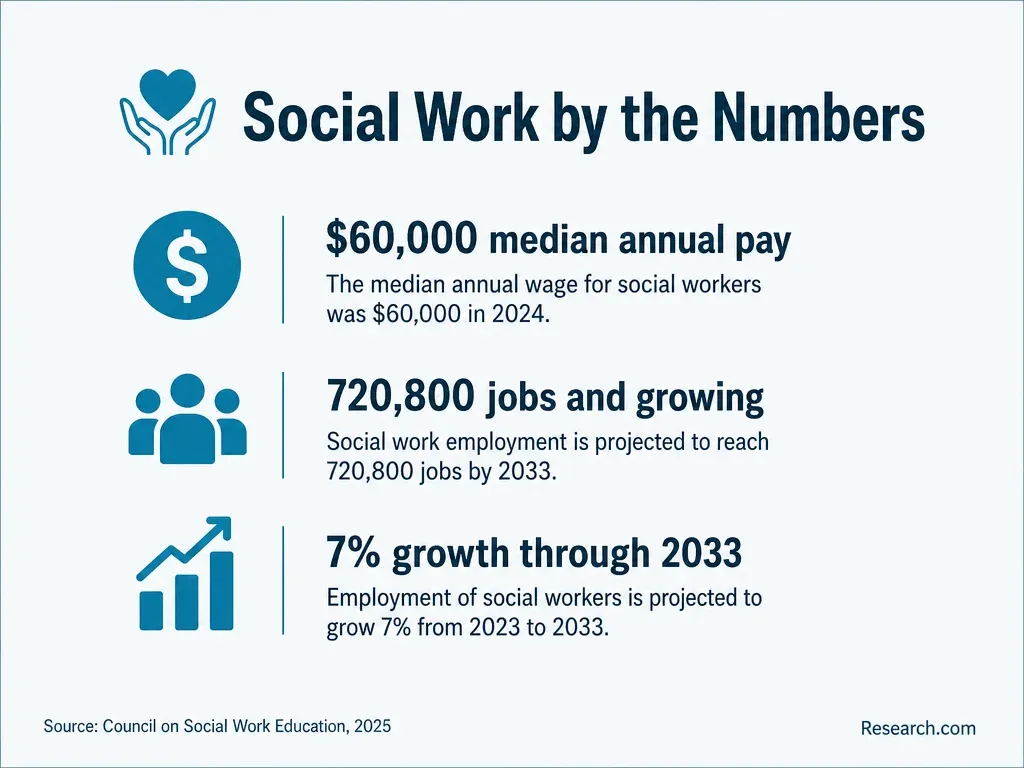
The U.S. Bureau of Labor Statistics (BLS) reports the following May 2025 median annual wages and projected 2025-2035 employment growth for broad social work occupations. These categories are not justice-placement graduate outcomes or salary offers.
| Occupation | Median annual wage | Projected employment growth |
| Social workers, all specialties | $61,780 | 6% |
| Child, family, and school social workers | $59,550 | 4% |
| Healthcare social workers | $67,880 | 8% |
| Mental health and substance abuse social workers | $60,280 | 10% |
The appropriate category depends on the job's actual duties, not whether it occurs in a jail, court, or reentry program. Pay also varies by employer, location, license, and experience; social work earnings across different state markets can provide geographic context. Before choosing a placement for career reasons, compare job postings in your target area with the site's permitted tasks, supervision, and hiring relationships.
Other Things You Should Know About Social Work
Possibly. Public access to a hearing does not automatically make it an approved field activity. Ask the field instructor whether observation serves your learning agreement and follow court rules on attendance, note-taking, and case information.
Only within school and agency rules. Remove identifying details, avoid restricted records, and obtain any required approval before sharing agency-specific information. Changing a client's name alone may not protect their identity.
Follow the facility's directions and notify your field instructor as permitted. Record only time your program accepts, then work with the site and faculty liaison on a revised learning schedule if interruptions threaten completion.
Yes. Contact the school's accessibility office and field office early so they can work with the agency on an appropriate arrangement. Site security rules still need to be addressed; do not wait until onboarding to raise an access concern.
- 6: Confidentiality | United States Department of Justice https://www.justice.gov/elderjustice/mdt-guide-toolkit/6-confidentiality
- Boundary Crossings and Violations in Clinical Settings - PMC https://pmc.ncbi.nlm.nih.gov/articles/PMC3361837/
- Student safety | Practicum Education https://socialwork.wayne.edu/manual/studentsafety
- Master of Social Work Field Education Manual | Academics at Walden University https://academicguides.waldenu.edu/msw-field-education-manual/field-education
- Field Education FAQ | UT College of Social Work https://csw.utk.edu/academics/field-education/field-education-faq/
- Educational Outcomes | syr.edu https://answers.atlassian.syr.edu/wiki/spaces/SOE/pages/166036364/Educational+Outcomes
- CE corner: Protecting patient privacy when the court calls | apa.org https://www.apa.org/monitor/2016/07-08/ce-corner
- Safety Policy and Procedures: MSW Students | Campus Option: Simmons Internal https://internal.simmons.edu/students/academics/ssw/msw-students/practicum-education/safety-policy-and-procedures
- Dual Relationships - IU School of Social Work https://socialwork.iu.edu/professional-standards/dual-relationships.html