2027 MSW Hospital Placements: Team Roles, Documentation Access, and Student Learning
Audited and Verified:
Our Editorial and Data Verification Process
Research.com uses government datasets, official education statistics and primary institutional information to support its career and degree guides. Our review process checks factual accuracy, occupational definitions, source dates and the requirements associated with the credentials discussed.
How This Article Was Fact-Checked
Our editorial team verifies salary estimates, employment projections, education requirements and program information against original data providers and official organizations. Salary figures are checked against the relevant occupational definitions and reporting periods. Information about licensure, accreditation and required in-person training is reviewed separately.
Fact-checked and verified on:

Co-Founder and Chief Data Scientist
A hospital placement can teach MSW students to coordinate care under pressure, but its value depends on more than getting a hospital badge. Students need appropriate supervision, meaningful learning tasks, and clear rules for working with care teams and patient records.
This guide explains what interns may do, what hospitals and schools must approve, and how to compare placements before committing to a program. It is designed for prospective and current MSW students deciding whether hospital field education fits their goals and schedules.
Key Things You Should Know
- Hospital MSW interns may help with psychosocial assessments, discharge planning, referrals, and family communication, but their duties depend on training, supervision, and hospital policy.
- Patient-record access is role-based, not automatic: a hospital must authorize access and documentation, train the student, and establish review procedures.
- MSW field hours are educational hours, not post-degree clinical licensure hours; healthcare social workers earned a U.S. median of $67,880 in May 2025, according to BLS.
What do MSW students do during hospital placements?
A hospital placement is supervised field education in a medical setting, not an independent social work job.
Depending on the unit and learning agreement, an MSW student might observe patient interviews, help assess barriers to care, discuss discharge needs with patients and families, identify community resources, or follow up on referrals. Work can span emergency departments, inpatient units, outpatient clinics, rehabilitation, or palliative care; each has different pace and responsibilities.
Students may contribute to a psychosocial assessment by exploring housing, caregiving, transportation, finances, safety, and a patient's preferences. They should know which findings to bring promptly to a supervisor and which decisions belong to licensed staff or the broader clinical team. A placement centered entirely on copying resource lists offers less learning than one with progressive, observed responsibility and feedback.
If hospital practice is one of several possible destinations, connecting a social work master's degree to career goals can help clarify whether medical social work, behavioral health, or another setting best matches the work you want to do.
How do MSW interns work with hospital care teams?
Hospital social workers collaborate with physicians, nurses, case managers, therapists, interpreters, and community providers.
An intern's contribution is often to explain how a patient's circumstances affect a care plan: for example, whether a proposed discharge depends on transportation, an available caregiver, or services that have not yet been confirmed. The intern gathers information and communicates it within an approved role; the team retains responsibility for its respective clinical and operational decisions.
The distinction between a field instructor and a task supervisor matters in a busy hospital. The field instructor oversees social work learning and evaluation, while a task supervisor may direct day-to-day activities when the field instructor is elsewhere.
The university's faculty liaison monitors the educational placement and helps resolve concerns. Ask how often each person is available, who reviews your work, and what happens when a supervisor is absent.
For an online MSW, geographic proximity alone does not establish a workable partnership. Comparing faculty and agency support for MSW fieldwork is especially useful when the hospital and university have not previously placed students together.
Can MSW interns access and document in patient health records?
The hospital decides whether an intern needs electronic health record (EHR) access for assigned duties and what permissions to grant. Access may be read-only, limited to certain records, or include student documentation subject to review. Some sites do not permit student charting at all. The school's learning goals cannot override hospital access controls, privacy law, or organizational policy.
Before accessing records, students typically complete privacy and security training and receive individual credentials. They should use records only for authorized work, follow the hospital's rules on discussing information with the care team, and never use another employee's login.
If charting is permitted, the student needs a defined note type, documentation standards, and a supervisor-review process. Academic assignments should use only information the school and hospital permit; changing a patient's name alone may not adequately protect identity.
Remote coursework does not imply remote chart access. When considering online social work degree programs, ask separately where fieldwork occurs and whether the placement site allows any off-site access to patient information.
Good field supervision turns encounters into assessable learning. A supervisor can observe how a student engages a patient, review the reasoning behind a referral, discuss a difficult team interaction, and give specific feedback on documentation. The learning agreement should connect those activities to MSW competencies rather than treating a completed shift as evidence of competence.
Hospital placements can strengthen person-in-environment assessment, culturally responsive communication, care coordination, ethical judgment, and recognition of when to consult or escalate a concern. They can also expose limits: an intern may learn from a crisis response or clinical assessment without being authorized to lead it independently. Ask prospective sites how students receive feedback on actual work and how responsibilities grow after orientation.
Field instruction serves an educational purpose, even when the instructor is an experienced clinician. It is not interchangeable with post-degree supervision for independent clinical licensure. Nor does a more advanced degree automatically replace the need for setting-specific mentorship; exploring affordable online DSW education addresses a different educational decision from choosing a well-supervised MSW placement.
The university must approve the site, learning activities, supervision arrangement, and method for evaluating field competencies. Hospitals may separately require an interview, background screening, immunization or health documentation, training, identification, and access approvals. Requirements vary by site and may take time to complete; admission to an MSW program does not guarantee clearance for a particular hospital.
Ask the field office which requirements are known before you apply and which are confirmed only after a hospital offers a placement. Also ask who pays for screening, onboarding, parking, and any required travel.
If you have a disability-related access need or a scheduling constraint, discuss it early with the appropriate university office and placement coordinator rather than assuming every unit can offer the same arrangement.
Application convenience is a separate issue: MSW programs that do not require recommendation letters may still have hospital partners with extensive placement interviews and onboarding requirements. Compare those processes before relying on a proposed start date.
Start with the MSW field office, not an informal promise from a hospital contact. Find out whether the university assigns sites, offers a list of partners, or allows student-proposed sites subject to approval. A student-suggested hospital still needs an agreement with the school, suitable learning tasks, qualified field instruction, and a schedule the program accepts.
Begin the search well before the field term. Tell the coordinator your location, transportation range, preferred patient populations, relevant experience, and availability for on-site shifts.
Ask whether the hospital has accepted the program's students before, who handles affiliation agreements, and what alternatives exist if access or onboarding falls through. Online students should confirm that the school can support placements in their location; campus students should not assume a local teaching hospital has space.
Field access and future licensure are separate checks. If you expect to practice in a particular state after graduation, review online MSW program eligibility by intended state alongside the school's ability to place and supervise you there. The relevant state board and program must confirm their respective requirements.
There is no universal hospital-only hour requirement. The approved MSW program sets its field sequence and accepted hours under applicable accreditation standards; a hospital placement may account for one portion or more of that sequence
Traditional and advanced-standing MSW students can have different plans. Request the program's written total, term-by-term schedule, minimum on-site commitments, and policy for missed hours before accepting a site.
Payment also depends on the arrangement. Some hospital placements offer a stipend or paid role, while others are unpaid. Paid employment does not automatically count as field education: the program must approve the educational assignments, supervision, and evaluation. Even a paid placement may leave students with parking, transportation, or reduced earnings if the schedule displaces other work.
An accelerated calendar can make the weekly field commitment particularly difficult to combine with employment or caregiving. When reviewing a guide to accelerated online MSW education, compare the actual field-week schedule, not just the advertised time to graduation, with your available hours and the hospital's shift expectations.
First verify the specific MSW program's CSWE accreditation status and whether the relevant program and entry route apply to your cohort. Then compare the field experience the school can substantiate. A hospital logo on a partner list is less informative than recent placement availability, the field office's responsibilities, and what happens if a match fails.
The comparison below separates assurances a program may advertise from the evidence you need for a hospital-placement decision.
| Comparison factor | Evidence worth requesting | Why it matters |
| Hospital access | Recent hospital placements in your geographic area and the process for securing one | Past partnerships do not guarantee a seat in your field term. |
| Supervision | Field-instructor qualifications, availability, and backup arrangements | Exposure to a hospital is not the same as guided social work learning. |
| Learning scope | Sample learning activities and how performance is evaluated | Some sites offer more direct practice and feedback than others. |
| Schedule and cost | Required shifts, onboarding timeline, fees, travel, and stipend policy | These determine whether the placement is feasible alongside other obligations. |
Compare total educational cost as well as field support. Online social work master's investment considerations are useful only when they include the time and expenses required to complete an acceptable placement; lower tuition will not compensate for an unworkable field schedule.
What are the salary and job outlook for hospital social workers?
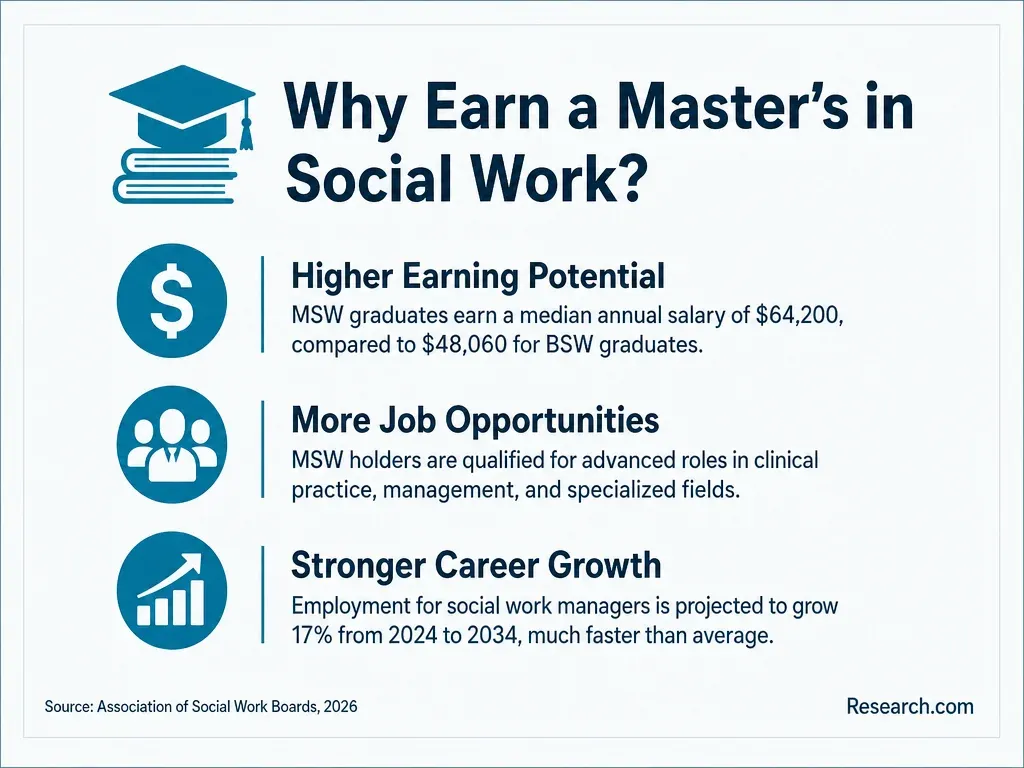
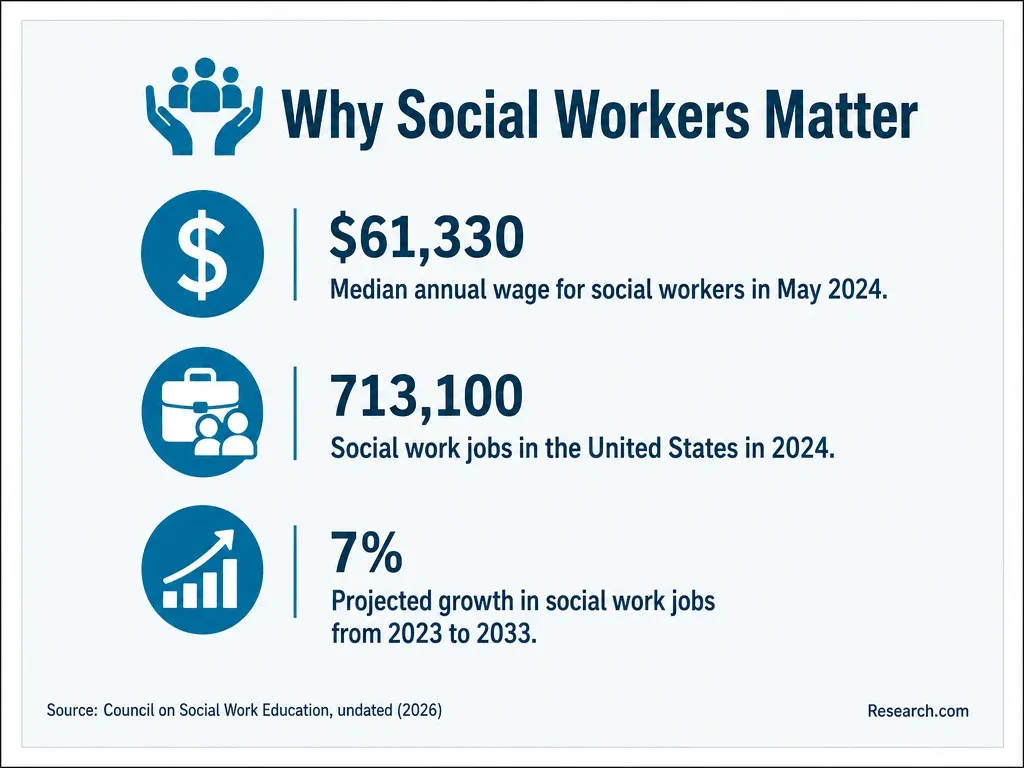
The closest broad U.S. Bureau of Labor Statistics category is healthcare social workers, which includes more than hospital employees. Its May 2025 median annual wage was $67,880, and BLS projects 8% employment growth from 2025 to 2035. The median is the midpoint for workers in the occupation, not an entry-level hospital offer or an expected return from a particular MSW program.
Pay and opportunities depend on location, employer, experience, duties, and any license a position requires. A placement may help you test your fit and develop relevant experience, but it is not a job guarantee.
Compare local hospital postings by required credential, supervision, schedule, and pay; social work salary differences across states provide additional geographic context, not a substitute for a specific offer.
Other Things You Should Know About Social Work Programs
Usually not at a clinician's level. Familiarity with medical terminology helps, but students should expect orientation and ask when an unfamiliar condition or procedure affects their assigned work.
You can express a preference, but unit assignments depend on openings, learning objectives, supervision, and the hospital's approval. Confirm the actual unit before accepting a placement.
Respect the patient's choice and follow the hospital's consent and supervision procedures. A learning opportunity does not override a patient's preferences or rights.
They can discuss skills and responsibilities without identifying patients or disclosing protected or agency-confidential information. Obtain any required school or hospital approval before sharing work products.
- NYS Social Work: Social Work Licensure & Practice FAQs | nysed.gov https://www.op.nysed.gov/professions/licensed-master-social-worker/faq-licensure-practice
- Cultural Competence and Patient Safety | PSNet https://psnet.ahrq.gov/perspective/cultural-competence-and-patient-safety
- Enablers and barriers to effective clinical supervision in the workplace | nih.gov https://pmc.ncbi.nlm.nih.gov/articles/PMC8479981/
- Case Management - StatPearls - NCBI Bookshelf https://www.ncbi.nlm.nih.gov/books/NBK562214/
- Minimum Necessary Requirement | hhs.gov https://www.hhs.gov/hipaa/for-professionals/privacy/guidance/minimum-necessary-requirement/index.html
- MSW Field Placement: What to Expect | University of Saint Mary https://stmary.edu/msw/about-field-placement
- Case Management: Discharge Planning | Hospital for Special Surgery https://www.hss.edu/patient-care/services/case-management-discharge-planning
- School of Education - Answers - Syracuse University https://answers.atlassian.syr.edu/wiki/spaces/SOE/pages/157225487/Field+Instruction+Manual+Social+Work
- Master of Social Work Field Education Manual | Academics at Walden University https://academicguides.waldenu.edu/msw-field-education-manual/field-education
- Cultural Competence in Health Care: Is it important for people with chronic conditions? - Health Policy Institute https://hpi.georgetown.edu/cultural/