2027 MSW Field Placement with Mostly Administrative Tasks: Questions About Learning Quality
Audited and Verified:
Our Editorial and Data Verification Process
Research.com uses government datasets, official education statistics and primary institutional information to support its career and degree guides. Our review process checks factual accuracy, occupational definitions, source dates and the requirements associated with the credentials discussed.
How This Article Was Fact-Checked
Our editorial team verifies salary estimates, employment projections, education requirements and program information against original data providers and official organizations. Salary figures are checked against the relevant occupational definitions and reporting periods. Information about licensure, accreditation and required in-person training is reviewed separately.
Fact-checked and verified on:

Co-Founder and Chief Data Scientist
If your MSW field placement consists largely of scheduling, filing, or updating spreadsheets, it is reasonable to question what you are learning. Administrative work can reveal how services reach clients and communities, but an approved placement should offer more than a way to keep an agency running.
This guide helps MSW students assess their tasks against the learning agreement, determine what to ask about field hours and supervision, and decide when to request changes or explore another placement.
Key Things You Should Know
- Administrative work can support MSW learning when it involves supervised analysis, ethical judgment, service improvement, or other approved competencies; routine clerical work alone is a warning sign.
- Do not assume every hour on site counts. Your MSW program determines which activities meet its field requirements, and the approved learning agreement should guide that decision.
- Document your tasks and supervision, request specific learning opportunities, and involve the faculty liaison promptly if the placement cannot meet its objectives.
Is it normal for an MSW field placement to involve mostly administrative tasks?
Some administrative work is normal. Intake coordination, referral tracking, meeting preparation, program data review, and policy implementation can all be part of social work practice. "Mostly administrative" becomes a learning-quality concern when the student primarily performs repetitive office support without a clear connection to approved competencies, meaningful feedback, or increasing responsibility.
The relevant comparison is not simply "desk work versus client contact." A macro-focused placement may appropriately emphasize community outreach, program evaluation, or organizational change. A placement intended to develop direct-practice skills needs suitable opportunities to observe, practice, and receive feedback on those skills within the student's role. Expectations also depend on the program's foundation or specialized sequence; traditional MSW routes for non-BSW graduates may begin with different learning objectives than advanced-standing sequences.
Check your learning agreement before deciding the placement has failed. If it names engagement, assessment, or intervention but your assignments never let you demonstrate them, the mismatch matters even if the agency's work is valuable.
Do administrative tasks count toward MSW field placement hours?
They may count when your school approves them as part of the placement and they advance its educational objectives. A supervised review of referral barriers, for example, is different from repeatedly entering the same information with no opportunity to interpret it or improve a process. The agency's need for help does not, by itself, make a task an approved field activity.
Ask the field office how it treats orientation, meetings, remote work, travel, breaks, routine clerical duties, and field seminar; policies vary. Record dates, time, activities, and the competencies addressed using the school's required system. If an activity's status is uncertain, seek a written answer rather than filling a timesheet based on your own interpretation.
MSW field hours are curricular hours, not a substitute for any post-degree supervised experience a state may require for clinical licensure. Keep the records separate; social work clinical experience recordkeeping considerations concern a different approval process.
What should you do if your MSW placement offers limited learning opportunities?
Act while there is time to improve the placement. Bring specific examples to your field instructor: "I have spent most of the past three weeks entering referrals, but my learning agreement calls for assessment and evaluation activities." Describe the missing opportunity without dismissing the importance of administrative work. Students who are also planning the cost of an online MSW may benefit from addressing placement concerns early, since delays or changes in fieldwork arrangements can affect their overall program timeline and educational expenses.
A short, documented improvement plan makes it easier to tell whether the situation is changing:
- Compare recent assignments with each applicable learning objective and note where you have little evidence of progress.
- Ask your field instructor for two or three feasible additions, such as observing an approved assessment, analyzing referral patterns, or helping evaluate an outreach process.
- Agree on who will supervise each new activity, what feedback you will receive, and when you will review progress.
- Contact the faculty liaison or field office if the plan is not implemented, supervision is unavailable, or the site cannot provide required learning.
Do not seek client records, conduct interviews, or independently take on restricted work to create learning opportunities. Obtain agency and program approval first. If the issue involves safety, discrimination, confidentiality, or pressure to report hours inaccurately, use the school's designated reporting process promptly rather than waiting for the next routine evaluation.
Good field supervision turns assignments into learning. Your field instructor should understand the program's objectives, review your work, discuss ethical and practice decisions, and give feedback specific enough to improve your performance. An agency task supervisor may direct day-to-day work, while an approved field instructor holds the educational responsibilities defined by the program; ask who fills each role at your site.
After a supervision meeting, you should be able to identify what you did well, what you would do differently, and which competency the discussion addressed. Warning signs include repeatedly canceled meetings, no review of your learning agreement, feedback limited to productivity, or being asked to perform duties beyond your preparation without appropriate oversight. Raise these patterns with the faculty liaison rather than assuming a busy supervisor will eventually have more time.
A compressed calendar can make missed feedback especially consequential. If you are comparing short-format MSW program comparisons, ask how frequently field progress is reviewed and how quickly the program responds when a site cannot deliver its agreed learning opportunities.
Often, a change is possible, but the school - not the student acting alone - must approve the new site and decide how prior work applies. Programs may first try a revised learning plan, additional supervision, or a different assignment within the agency. A move becomes more compelling when the site cannot meet essential objectives, provide appropriate supervision, or maintain a suitable learning environment.
Ask the field office to explain the proposed transition before leaving. Confirm which completed hours it accepts, what evaluations and signatures are needed, how a new agency will be approved, and whether onboarding or placement availability could delay the next field course or graduation. Preserve your own permitted records, but do not remove client or confidential agency information.
Changing an agency is not the same as changing MSW programs. If you are considering the latter because field problems remain unresolved, compare the written policies and total costs rather than assuming a lower advertised tuition solves the problem. Exploring the career value of affordable MSW study is useful only alongside confirmation that the receiving program will accept applicable coursework and provide a workable field plan.
Both formats require an approved field-learning arrangement; online classes do not eliminate agency hours or automatically make their schedules flexible. Some schools match students with partner agencies, while others ask students to help identify potential sites. In either case, the program should approve the site, learning activities, and field instruction under its policies.
Before enrolling - or before relocating during enrollment - ask who finds prospective sites in your area, how instructors are qualified and assigned, whether remote activities are allowed, and what happens if a placement falls through. Also verify weekly scheduling expectations, agency onboarding requirements, live skills activities, and any travel or caregiving costs. These questions are especially important when choosing among online social work programs: course delivery and field-placement support are separate features.
Start by confirming the exact MSW program's Council on Social Work Education accreditation status and the status applicable to your anticipated cohort. Institutional accreditation and programmatic social work accreditation answer different questions. Then examine whether the program can deliver the kind of field learning you need, not just the number of hours it advertises.
The following comparison separates evidence of field support from claims that need follow-up:
| What to compare | More useful evidence | Question to ask |
| Placement support | Written matching responsibilities and a process for failed placements | Who identifies and approves sites in my area? |
| Supervision | Field instructor qualifications, meeting expectations, and liaison access | Who responds if supervision is unavailable? |
| Learning quality | Learning agreements, competency evaluations, and remediation procedures | How are repetitive administrative assignments addressed? |
| Practical fit | Published scheduling and onboarding requirements | Can I meet these requirements alongside work and caregiving? |
Ask for policies that apply to your entry term and proposed location. Students comparing earlier stages of social work education can use the same field-support questions when exploring online social work bachelor's education pathways, but should verify the accreditation and field requirements of the specific BSW rather than assuming they match an MSW.
How can an administrative field placement shape MSW career opportunities?
A strong administrative placement can provide credible examples for jobs in program coordination, community partnerships, policy implementation, quality improvement, or service access. Employers will want to know what you actually did: the problem you examined, your supervised contribution, the ethical constraints you considered, and how the work was evaluated. Avoid claiming outcomes your agency did not measure.
If you want a client-facing or clinical role, identify the experience you still need. Seek approved opportunities in your remaining field time, discuss gaps with your instructor, and evaluate entry-level jobs for onboarding, caseload support, and supervision. A placement neither confines you to administration nor proves competence in work you have not practiced.
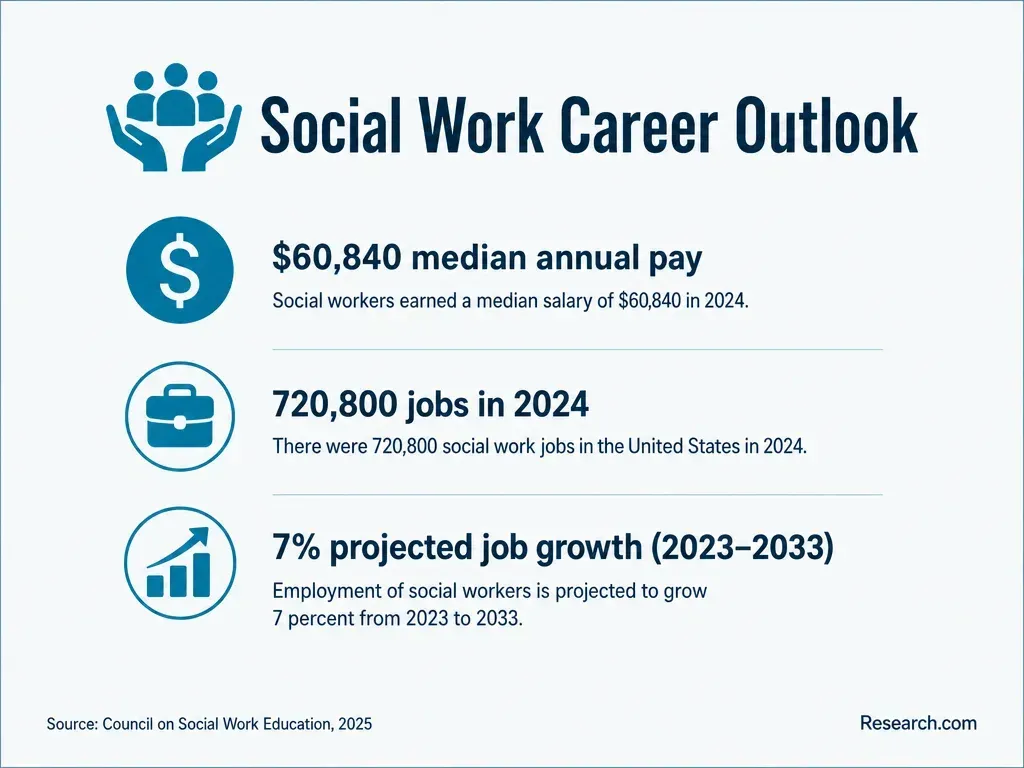
Pay comparisons should be tied to the actual occupation, setting, experience, and location - not the placement title. Understanding location differences in MSW earnings may inform a job search, but no broad social worker salary figure predicts an individual graduate's offer.
Other Things You Should Know About Social Work
Only with agency and program permission. Use work you are authorized to share, remove identifying and confidential information, and describe your own contribution accurately. De-identification alone may not satisfy agency rules.
Usually within the program's confidentiality rules. Follow agency policy, avoid details that could identify clients or staff, and ask your instructor how to present sensitive situations safely.
Some programs permit paid or employment-based placements under specific conditions. Get school approval before assuming your job duties qualify as field learning.
Contact the school's accessibility office and field office to discuss appropriate accommodations and approved learning activities. A placement should be evaluated against essential educational objectives, not an assumption that every student must perform tasks in the same way.
- Feedback and assessment for clinical placements - PMC - NIH https://pmc.ncbi.nlm.nih.gov/articles/PMC4445314/
- The Most Significant Challenges in Social Work Field Education | Applied Learning in Social Work Education Journal https://alswe.simmons.edu/article/the-most-significant-challenges-in-social-work-field-education-perceptions-of-field-educators-and-students-in-canada/
- MSW Field Placement: What to Expect | University of Saint Mary https://stmary.edu/msw/about-field-placement
- Educational Outcomes | syr.edu https://answers.atlassian.syr.edu/wiki/spaces/SOE/pages/166036364/Educational+Outcomes
- What to Expect in the Pitt MSW Field Practicum and Placement Process https://msw.pitt.edu/articles/pitt-msw-field-practicum-and-placement-what-to-expect/
- How Do Social Work Field Placements Work? | Virginia Commonwealth University https://onlinesocialwork.vcu.edu/blog/social-work-field-placement/
- Social Work Competencies: Core Generalist Level of Practice | Crown Family School of Social Work, Policy, and Practice https://crownschool.uchicago.edu/node/1434
- MSW Core Competencies - Department of Social Work | Graduate Program (MSW) https://socialwork.appstate.edu/academic-programs/graduate-program-msw/msw-core-competencies
- The Social Work Field Placement | Springer Publishing https://connect.springerpub.com/content/book/978-0-8261-3753-1/part/part01/chapter/ch01
- Accreditation Standards | Council on Social Work Education https://www.cswe.org/accreditation-standards-epas