
2027 MSW Courses in Assessment vs Courses in Diagnosis: Questions About Training Depth
Audited and Verified:
Our Editorial and Data Verification Process
Research.com uses government datasets, official education statistics and primary institutional information to support its career and degree guides. Our review process checks factual accuracy, occupational definitions, source dates and the requirements associated with the credentials discussed.
How This Article Was Fact-Checked
Our editorial team verifies salary estimates, employment projections, education requirements and program information against original data providers and official organizations. Salary figures are checked against the relevant occupational definitions and reporting periods. Information about licensure, accreditation and required in-person training is reviewed separately.
Fact-checked and verified on:

Co-Founder and Chief Data Scientist
An MSW program may advertise "assessment" without offering much instruction in psychiatric diagnosis. That distinction matters if you hope to work in behavioral health, but it also matters if you do not: many social work roles require excellent assessment without diagnostic authority. For prospective students and early-career social workers, this guide explains what course titles can - and cannot - tell you, how field learning changes the picture, and which questions to ask before choosing a program. The goal is to match training depth to your intended work, not simply to find a clinical-sounding course name.
Key Things You Should Know
- MSW students may learn to evaluate needs, strengths, risks, and environmental factors without learning to assign psychiatric diagnoses.
- CSWE standards address assessment competency, while specialized diagnostic instruction varies by program and field placement.
- An MSW, clinical concentration, or field placement does not itself grant independent diagnostic authority; state licensing rules and post-degree supervision govern that progression.
What is the difference between assessment and diagnosis in MSW training?
Assessment is the process of gathering and interpreting information with a client to understand concerns, strengths, safety needs, relationships, resources, and the effects of their environment. It may lead to a service plan, referral, or further evaluation.
Diagnosis is a more specific clinical judgment that a condition meets applicable diagnostic criteria, made within the practitioner's authorized scope and setting. An assessment course might teach interviewing, biopsychosocial formulation, cultural responsiveness, documentation, and collaborative goal setting.
A diagnosis course may add symptom patterns, differential diagnosis, diagnostic manuals, and the limits of a diagnosis when trauma, disability, substance use, medical conditions, or structural hardship complicate the picture. Neither a classroom exercise nor a screening score alone establishes a diagnosis.
This distinction starts before graduate school: accredited bachelor's pathways into social work develop generalist assessment foundations, while an MSW can build on them through specialized coursework and supervised practice.
For a student targeting clinical work, the useful comparison is not whether both programs say "assessment," but what judgments students practice, who reviews them, and in which settings.
Which MSW courses teach clinical assessment and diagnosis?
Course names are clues, not proof of depth. The table shows what common offerings may contribute - and what a prospective student should look for in the actual syllabus.
| Course or learning experience | Likely contribution | Depth to verify |
| Human behavior and the social environment | Developmental and person-in-environment frameworks | Whether students apply frameworks to clinical presentations |
| Generalist practice or biopsychosocial assessment | Interviewing, strengths, needs, risk awareness, and service planning | Whether work includes mental health assessment or mainly service eligibility |
| Psychopathology, mental health assessment, or diagnosis | Diagnostic criteria, formulation, and possible differential diagnosis | Required versus elective status, case complexity, feedback, and current materials |
| Clinical practice, trauma, or substance use | Integration of assessment with intervention and referral decisions | Whether diagnostic reasoning is taught or presumed |
| Field seminar and supervised placement | Reflection on observed practice and documentation | Whether the placement permits supervised diagnostic learning |
Ask for syllabi and sample learning outcomes, then look for repeated practice with feedback rather than a single lecture on a diagnostic manual. In an accelerated MSW coursework and field expectations comparison, pay particular attention to when clinical courses occur: a faster calendar is not necessarily less training, but it can leave less time between instruction, field application, and feedback.
Does CSWE accreditation require MSW programs to teach diagnostic skills?
No specific diagnosis course is universally required by CSWE accreditation. CSWE's Educational Policy and Accreditation Standards require accredited social work programs to develop and assess practice competencies, including assessment with clients and constituencies. They do not prescribe one course title, require every student to learn psychiatric differential diagnosis to the same depth, or grant clinical practice authority.
That makes accreditation an essential starting check, not the end of a clinical curriculum review. Confirm the exact MSW program's accreditation status and the standards applicable to your cohort.
Then examine its specialized learning outcomes, required courses, field options, and evidence of observed clinical skills. Accreditation belongs in a guide to evaluating MSW degree value, but it cannot answer on its own whether a program provides the diagnostic practice you want.
A generalist or broadly focused track typically prepares students to assess needs and coordinate responses across individuals, families, groups, and systems. A clinical specialization is more likely to require mental health assessment, psychopathology, treatment planning, and supervised direct-practice learning. Neither label guarantees a particular number of diagnostic assignments or access to a diagnostic field placement.
The more revealing comparison is the required sequence: Does every clinical student complete a diagnosis-focused course before relevant field work? Are diagnostic formulations reviewed by qualified practitioners? Can students in a generalist track choose the same courses and placement, or would they need substantial training later?
A generalist emphasis may be the better fit for community organizing, policy, or service coordination; extra diagnostic coursework is not automatically valuable for those goals.
Entry route also affects the sequence. MSW pathway differences by prior degree matter because traditional programs generally include foundation study, while advanced-standing options are for applicants with a qualifying social work bachelor's degree under the school's rules. Neither route should be assumed to provide greater diagnostic depth without comparing its required specialized courses and field learning.
Field education can turn a classroom formulation into a supervised skill: a student observes interviews, conducts approved portions of assessments, documents findings, discusses uncertainty, and revises their reasoning after feedback.
Opportunities depend on the agency, client population, student role, field instructor, and school-approved learning agreement. A behavioral health placement may offer more exposure to diagnostic reasoning than a housing-services placement, but its setting alone is no guarantee.
When comparing MSW practicum placement assistance, ask who locates and approves sites, whether diagnostic-learning placements are realistically available in your area, and who can review clinical work. Also ask what happens if a proposed site offers assessments but does not permit students to participate in diagnostic discussions.
MSW field education is not interchangeable with post-degree clinical supervision. A school approves and evaluates curricular learning; a licensing board decides whether later experience and supervision meet its requirements. Paid employment or volunteering does not automatically count toward either.
They can provide comparable educational opportunities when they use substantive live skills practice, meaningful instructor feedback, and approved local field placements. Delivery mode alone does not establish equivalence: compare required diagnostic courses, opportunities to demonstrate interviewing and formulation, faculty assessment of those skills, and the clinical capacity of available placement sites.
In social work degree program format comparisons, check live-session times, skills labs, possible campus visits, placement days, and who must arrange a site. An asynchronous lecture may fit a work schedule, while supervised practice may require fixed daytime hours. Online enrollment also does not eliminate location-specific rules governing field placements or eventual licensure.
Admission usually begins with a bachelor's degree and program-specific application requirements; relevant experience, references, writing materials, prerequisites, and minimum grades vary. A traditional MSW route admits eligible graduates from other disciplines and includes foundation and specialized study.
Advanced standing generally requires a qualifying social work bachelor's degree and follows a shorter sequence, subject to the school's criteria. Clinical specialization may have additional course or placement conditions.
Program length depends on entry route, full- or part-time enrollment, course sequencing, and field availability. For a realistic cost comparison, request the total required credits and the school's current tuition and mandatory fees, then account for books, screening, travel, placement scheduling, and earnings you may forgo during field work.
There is no responsible single price estimate for all clinical MSW programs. Lower-cost options for future MSW students are worth comparing only after confirming that their required courses and feasible placements meet your clinical-learning goal.
Assessment is central to behavioral health, hospital social work, substance use services, crisis-related services, and many child and family roles. Workers may gather histories, evaluate needs and safety concerns within agency protocols, coordinate care, and document plans.
Diagnostic duties are narrower: whether a particular employee may diagnose depends on state scope-of-practice law, license status, supervision, employer policy, and the position's duties.
If your target is psychotherapy or a position explicitly requiring clinical diagnosis, prioritize a program with required clinical coursework, suitable field learning, and a viable post-degree supervision pathway.
If your goal is case management, benefits navigation, or community services, broad assessment and systems skills may matter more than extensive diagnostic coursework. Use graduate social work career planning to compare actual job requirements rather than assuming that every role called "social worker" uses the same clinical skills.
What are the salary and job outlook for clinical social workers?
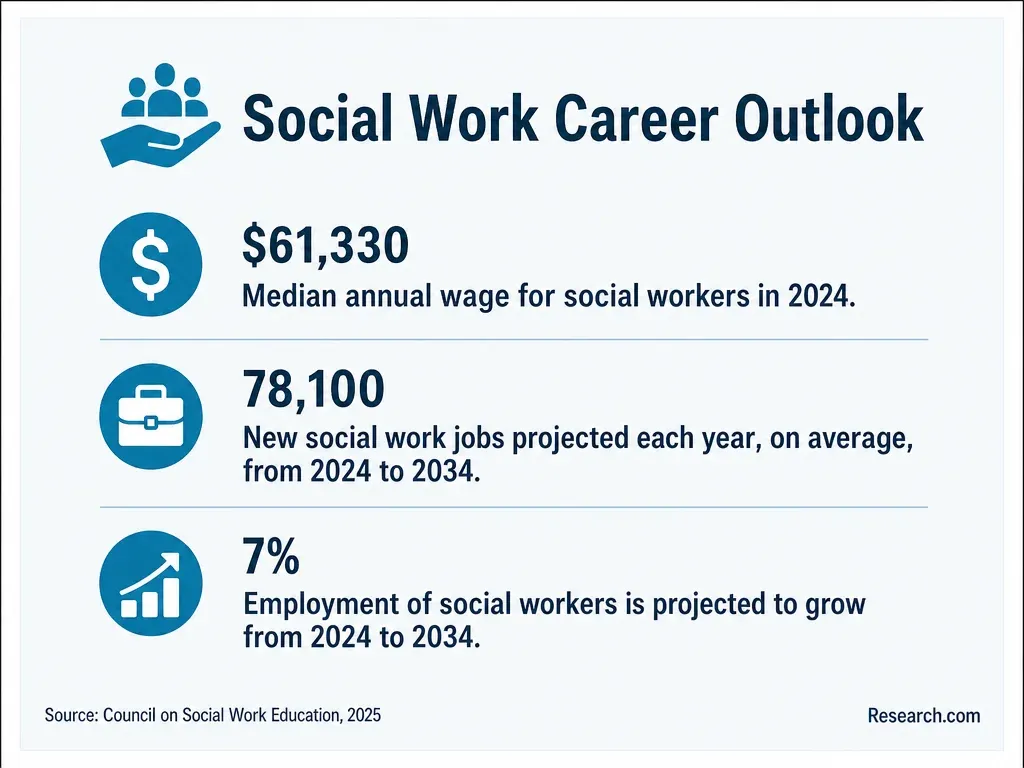
The Bureau of Labor Statistics does not publish one wage series for "clinical social workers" as a license category. Its closest categories include mental health and substance abuse social workers, whose May 2025 median annual pay was $60,280 and whose employment was projected to grow 10% from 2025 to 2035. Healthcare social workers had a $67,880 median and projected 8% growth over the same period.
These are occupation-wide US figures, not salaries for new MSW graduates or guarantees associated with diagnostic coursework. License status, employer, setting, geography, experience, and schedule can change an individual offer. Use social worker earnings and location considerations alongside local job postings and the full cost of your preferred program - not a national median alone - when assessing the financial trade-off.
Other Things You Should Know About Social Work
It can illustrate how you reason through a hypothetical case, but it is not evidence that you have independently diagnosed a client. Explain the assignment's scope and protect any confidential information.
Wait for the required reading list. Programs may specify an edition or provide access through a library or course materials.
It may strengthen knowledge, but check the training's content and feedback opportunities. A certificate does not independently expand legal scope or replace board-required supervised experience.
Use appropriate continuing education, consultation, supervision when required, and current employer procedures. Seek additional training when moving to a population or setting beyond your experience.
- OCCUPATIONS CODE CHAPTER 505. SOCIAL WORKERS | texas.gov https://statutes.capitol.texas.gov/docs/OC/htm/OC.505.htm
- .03 Scope of Practice. | Library of Maryland Regulations https://regs.maryland.gov/us/md/exec/comar/10.42.02.03
- NYS Social Work: Social Work Licensure & Practice FAQs | nysed.gov https://www.op.nysed.gov/professions/licensed-master-social-worker/faq-licensure-practice
- Master of Social Work Field Education Manual | Academics at Walden University https://academicguides.waldenu.edu/msw-field-education-manual/field-education
- Master of Social Work - UNE Online - University of New England https://online.une.edu/program/master-of-social-work/
- Online Advanced Standing MSW Program | Florida State University College of Social Work https://onlinemsw.fsu.edu/program/online-msw-advanced-standing
- CSWE assessment of student learning outcomes | missouri.edu https://healthsciences.missouri.edu/social-work/masters-degree/cswe-assessment-of-student-learning-outcomes/
- WESTERN KENTUCKY UNIVERSITY https://app.wku.edu/syllabus/get/
- Educational Outcomes | syr.edu https://answers.atlassian.syr.edu/wiki/spaces/SOE/pages/166036364/Educational+Outcomes
- MSW Curriculum & Course Descriptions | rutgers.edu https://socialwork.rutgers.edu/academics/master-social-work-msw/msw-curriculum-course-descriptions


