2027 MSW Admissions Interviews: Connecting Experience, Values, and Learning Goals
Audited and Verified:
Our Editorial and Data Verification Process
Research.com uses government datasets, official education statistics and primary institutional information to support its career and degree guides. Our review process checks factual accuracy, occupational definitions, source dates and the requirements associated with the credentials discussed.
How This Article Was Fact-Checked
Our editorial team verifies salary estimates, employment projections, education requirements and program information against original data providers and official organizations. Salary figures are checked against the relevant occupational definitions and reporting periods. Information about licensure, accreditation and required in-person training is reviewed separately.
Fact-checked and verified on:

Co-Founder and Chief Data Scientist
An MSW admissions interview asks you to do more than explain why you want to help people. You need to show how your experience informs your goals, where you still need training, and how you would approach the responsibilities of social work education.
For applicants from social work and other backgrounds alike, preparation can turn a collection of jobs, classes, and volunteer activities into a coherent account of readiness to learn. This guide covers likely questions, adaptable answer strategies, and the program details worth checking before you commit.
Key Things You Should Know
- Prepare two or three specific examples that show what you did, what you learned, and what you would approach differently with MSW training.
- Discuss ethical questions through client rights, role boundaries, consultation, and relevant law or agency policy - not a claim that every dilemma has an easy answer.
- Connect your goals to the program's curriculum and field opportunities, then verify placement logistics, total costs, accreditation, and any state licensing requirements yourself.
What questions are commonly asked in MSW admissions interviews?
Questions vary by school and interview format, but most seek evidence of motivation, reflective judgment, readiness for graduate study, and fit with the program. Review any interview instructions alongside your application; a school may ask about a particular essay, experience, or concentration.
Practice answering questions such as these without memorizing a script:
- Why social work, and why pursue an MSW at this point in your education or career?
- Describe an experience that changed how you understand a person's needs or the systems affecting them.
- Tell us about feedback you received or a difficult interaction. What did you do next?
- How would you respond if a client's preference differed from what you thought was best?
- What do you hope to learn in coursework and field education, and why this program?
Interview availability and selection criteria differ. If an interview is optional, not offered to every applicant, or includes an accessibility concern, confirm the process with admissions rather than inferring what it means for your chances. An online MSW application accessibility guide can help frame questions about application steps, but the school's instructions control.
How should you prepare for an MSW admissions interview?
Start with your submitted materials and the program's actual curriculum. Your aim is to explain your choices consistently, not to recite your personal statement. If you are comparing online degree routes into social work careers, confirm which MSW track you applied to and whether its format includes live classes, campus visits, or locally arranged field education.
A short preparation sequence keeps your answers specific:
- Mark two or three experiences that illustrate service, collaboration, advocacy, research, or learning from feedback; note your own role and limits in each.
- Match each experience to a skill you want to develop, such as assessment, policy analysis, or ethical decision-making.
- Review the school's stated mission, courses, field process, and interview instructions; prepare one genuine reason the program fits your goals.
- Practice aloud with a timer, then revise answers that sound overly polished, vague, or dismissive of others' contributions.
Check the distinction between traditional or foundation MSW admission and advanced standing. A non-social-work bachelor's degree can qualify an applicant for some traditional MSW programs, but does not, by itself, establish advanced-standing eligibility. Confirm the school's requirements rather than trying to resolve an eligibility question in the interview.
How can you connect your experience to social work in an interview?
Use a compact sequence: context, your action, what you observed, and what you need to learn next. This works for paid employment, volunteering, caregiving, coursework, and community involvement. Keep client or organizational details anonymous, and do not claim outcomes you cannot establish.
For example, an applicant who coordinated referrals at a housing nonprofit could explain how they clarified available services, noticed transportation barriers, and learned to ask clients which options were workable. They could then say they want MSW training in person-in-environment assessment and policy advocacy. That connects a real contribution to a learning goal without calling referral work clinical practice.
If you have a BSW, discuss a course or approved field experience and the feedback that shaped your practice. An online BSW accreditation and learning format guide can help you distinguish your prior degree and field preparation from the MSW training you seek. If your bachelor's degree is in another field, identify transferable skills plainly, then acknowledge the foundational social work knowledge you still need.
Cultural humility means remaining willing to examine your assumptions, learn from people's accounts of their own lives, and respond to feedback. It is more credible to describe a time you changed your approach than to claim expertise in every community. Explain how you would ask about a person's priorities, use appropriate language access or accessibility resources, and avoid treating one person as representative of a group.
Connect individual needs to structural conditions without speaking over the people affected. For instance, a service-access example might address eligibility rules, transportation, or agency hours alongside a client's stated goals. If community organizing or policy work interests you, explain what you want to learn about accountable partnership and evaluation. Connecting a social work master's degree to career goals can help you articulate whether your interests point toward direct service, community practice, or both.
Name a direction, not an inflexible job title: the population or problem that interests you, the skills you lack, and the coursework or field setting that could help you test that interest. "I want to build assessment and care-coordination skills in healthcare while learning whether hospital or community-based practice fits me" is more useful than "I want to help everyone."
Distinguish educational preparation from employment and licensing. A clinical concentration may support a clinical goal, but state rules determine license eligibility and any post-degree supervised practice. A macro-focused applicant can likewise explain why policy analysis or program evaluation fits their intended work without implying every such job requires clinical licensure.
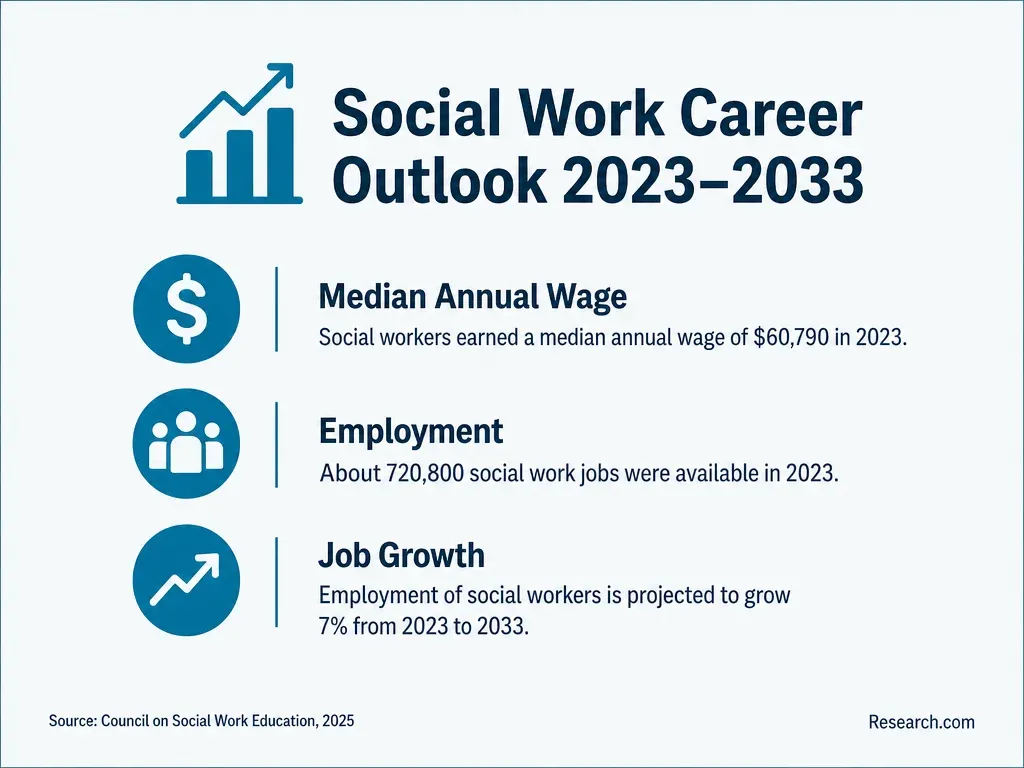
Be realistic about earnings if finances shape your plans. U.S. Bureau of Labor Statistics figures supplied for May 2025 place the median annual wage for mental health and substance abuse social workers at $60,280 and for healthcare social workers at $67,880. Those are occupation-wide medians, not starting salaries or promised returns on an MSW; geography, employer, experience, and role matter. Understanding location differences in MSW earnings can inform a location-specific discussion, but it should not replace a cost plan.
Readiness means having a workable learning plan, not claiming you already practice at a graduate social worker's level. Give an example of managing demanding reading, writing, research, or feedback. If an earlier academic result was weak, briefly explain what changed and identify evidence of improved preparation without making excuses.
For field education, describe how you will make time for agency hours, supervision, seminar, onboarding, and travel. Ask the school which placements and schedules it approves; paid work or volunteering does not automatically count as curricular field education. Field hours also differ from post-degree clinical-license supervision. If independent clinical practice is a long-term goal, planning records for social work clinical hours is a separate, later task governed by the relevant licensing board.
The substance of your answers should remain consistent across formats, but preparation differs. For a virtual interview, test your connection, audio, and a private space; keep brief notes nearby without reading from them. For an in-person interview, confirm the location, arrival instructions, and travel time. Request needed accommodations through the school's stated process rather than assuming a particular format is fixed.
In a group interview, evaluators may observe how you listen, share time, disagree respectfully, and invite other perspectives. Contribute clearly without turning every exchange into a competition. If an interview accompanies an online program, it does not establish that the degree is self-paced: online MSW learning schedules for caregivers are worth examining separately from interview convenience, particularly when work or caregiving limits live-session and placement availability.
Use your questions to test whether the program is feasible, not merely to signal enthusiasm. A program's advertised delivery format or tuition figure may leave out obligations that determine whether you can enroll and remain on schedule.
Bring questions that require concrete answers for your track and location:
- What is the expected total tuition and mandatory fees for my track, and which field-related travel, screening, or campus-visit costs are additional?
- Which classes, skills activities, and field seminars have fixed meeting times? Are placements available during the hours I can attend?
- Who identifies and approves field sites in my area, and what happens if an initial site falls through?
- Can an employment-based or paid placement be approved, and how must its learning activities differ from ordinary job duties?
Ask for written policies where possible. Choosing an MSW program with structured field support requires looking beyond a promise of placement assistance to the school's actual responsibilities, geographic limits, and contingency process.
How can you ask about MSW accreditation and state licensing requirements?
Frame this as a request for the authorities and documents you need to check: "What is this MSW program's CSWE accreditation status for my expected enrollment and graduation period, and where can I confirm whether its curriculum meets the education requirements for the state where I plan to seek licensure?" Also ask whether the school can enroll and arrange field education for a student in your jurisdiction.
Institutional accreditation, CSWE programmatic accreditation, and state licensing-board approval serve different purposes. The program can explain its degree and field curriculum; the state board controls license eligibility, required exams where applicable, supervised experience, and practice authority. A social work master's licensure requirement guide can help organize your questions, but confirm requirements with the current board rules for your intended state. Neither an admissions offer nor an MSW alone guarantees a license.
Other Things You Should Know About Social Work
If the program permits follow-up, a brief note thanking the interviewer and referring to one useful point from the conversation is appropriate. Follow any stated communication instructions.
Use a specific example from work, study, or community involvement to show listening, collaboration, or reflective learning. Be clear about what you have not yet been trained to do.
Only if you choose to. Keep the focus on what the experience taught you, your boundaries, and your educational goals; you do not owe an interviewer private details.
Explain what you would clarify, which role limits or client rights matter, and when you would seek supervision. Thoughtful uncertainty is better than inventing a rule or claiming authority you do not have.
- Interview Tips | dol.gov https://www.dol.gov/general/jobs/interview-tips
- Structured Interviews | U.S. Office of Personnel Management https://www.opm.gov/policy-data-oversight/assessment-and-selection/other-assessment-methods/structured-interviews/
- Written Statement of Purpose Prompt | Ohio State College of Social Work https://csw.osu.edu/academics/masters/admissions/written-statement-of-purpose-prompt/
- Master of Social Work (MSW) Admissions | California State University Long Beach https://www.csulb.edu/college-of-health-human-services/school-of-social-work/master-of-social-work-msw-admissions
- School of Education - Answers - Syracuse University https://answers.atlassian.syr.edu/wiki/spaces/SOE/pages/157225487/Field+Instruction+Manual+Social+Work
- Social Work Core Values and Code of Ethics | buffalo.edu https://socialwork.buffalo.edu/admissions/is-social-work-right-career-for-me/values-ethics.html
- MSW program goals and objectives | missouri.edu https://healthsciences.missouri.edu/social-work/masters-degree/msw-program-goals-and-objectives/
- Prospective Students: MS Social Work | CSUDH | Carson, CA https://www.csudh.edu/social-work/admissions/
- Admissions | SDSU - School of Social Work https://socialwork.sdsu.edu/academics/graduate/msw/admissions
- Tips for a practicum placement interview | Practicum Education https://socialwork.wayne.edu/practicum/interview-tips