2027 Moving from Social Work Employment into Consulting: Services, Experience, and Boundaries
Audited and Verified:
Our Editorial and Data Verification Process
Research.com uses government datasets, official education statistics and primary institutional information to support its career and degree guides. Our review process checks factual accuracy, occupational definitions, source dates and the requirements associated with the credentials discussed.
How This Article Was Fact-Checked
Our editorial team verifies salary estimates, employment projections, education requirements and program information against original data providers and official organizations. Salary figures are checked against the relevant occupational definitions and reporting periods. Information about licensure, accreditation and required in-person training is reviewed separately.
Fact-checked and verified on:

Co-Founder and Chief Data Scientist
Moving from agency employment to consulting changes what you sell: instead of filling a staff role, you must define a problem you can solve, show evidence of your expertise, and work within a clear professional scope. This guide is for experienced social workers considering independent projects with nonprofits, healthcare organizations, schools, or public agencies. It explains which services fit different backgrounds, when additional education helps, how to protect former clients and employers, and how to test whether consulting can support a sustainable business.
Key Things You Should Know
- Organizational consulting—such as program design, training, and evaluation—does not automatically require clinical licensure; providing psychotherapy or other regulated services may.
- There is no universal minimum number of employed years before consulting. Documented results, subject-matter knowledge, and the ability to deliver independently matter more than tenure alone.
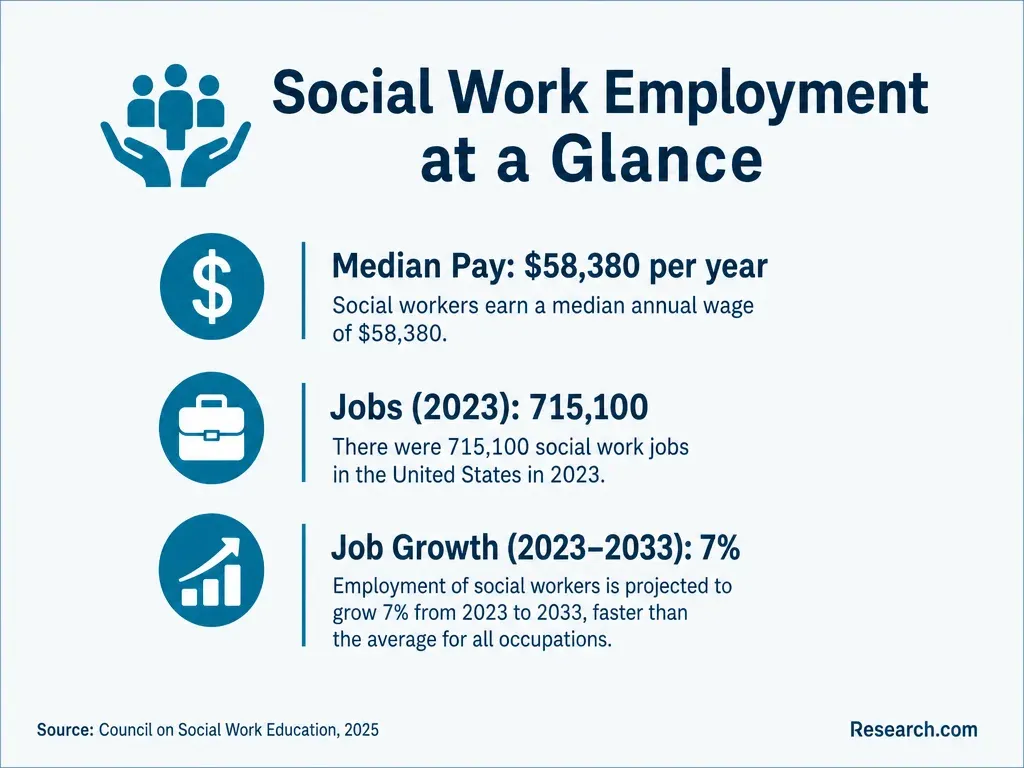
- The U.S. Bureau of Labor Statistics reports a May 2025 median annual wage of $61,780 for social workers overall, but it does not publish a comparable median for independent social work consultants.
What is social work consulting, and how does it differ from clinical practice?
Social work consulting is project-based advice or implementation support grounded in social work knowledge. A consultant might help a housing nonprofit redesign referrals, train staff on documentation, or evaluate a family-services program. The customer is usually an organization, and the deliverable might be a workflow, training series, report, or implementation plan.
Clinical practice is different: it involves services to individuals, families, or groups that may include assessment, diagnosis, or psychotherapy, subject to state law and license scope. Calling a service "consulting" does not make regulated clinical work unregulated. A contract to advise managers on service access is not the same as a contract to treat their clients.
That distinction can prevent an unnecessary education expense. If your goal is organizational improvement and you already have credible experience, another degree may add less value than training in evaluation or contracting. If you intend to provide clinical services, exploring clinical social work master's degrees is relevant—but an MSW alone does not confer independent clinical authority.
What services can social work consultants provide to agencies and organizations?
Start with a service you have performed or helped improve in employment, then define a deliverable a buyer can evaluate. The following examples show how expertise becomes a bounded project rather than an open-ended promise to "help the agency:"
| Service | Potential deliverable | Experience that supports credibility |
| Program design | Service model, referral criteria, and implementation plan | Launching or improving a comparable service |
| Program evaluation | Evaluation questions, feasible measures, and findings report | Data analysis and responsible reporting |
| Workforce development | Training materials and a skills-assessment plan | Staff training and supervision within one's competence |
| Operations and access | Workflow map and recommendations for reducing referral barriers | Knowledge of agency systems and community partnerships |
Agency evaluation requires an agreement about data access, privacy, and who can approve publication of findings. Training staff on a clinical topic also requires competence and accurate statements about what trainees may do under their own licenses and agency policies. A practice-focused doctorate may help someone pursuing sustained leadership or advanced practice-improvement work, but accelerated online social work doctorates are not a prerequisite for selling these services.
What degrees and licenses do social work consultants need?
There is no single U.S. "social work consultant" credential. Requirements depend on the work, the state, the professional title used, and the buyer's contract. An agency may seek an MSW and a clinical license for clinical consultation, yet accept a BSW, an MPH, an MPA, or substantial management experience for a nonclinical operations project.
A BSW can support generalist and community-services expertise; an MSW can add specialized social work preparation. A DSW or PhD may suit advanced practice leadership or research-intensive work, respectively, but neither substitutes for a license required to perform regulated services. Certificates can demonstrate targeted learning without expanding legal scope.
Before advertising services, check the licensing board's rules in every relevant jurisdiction, including rules on protected titles and remote clinical services. If an MSW is part of your plan, review the MSW licensure alignment before enrollment. Program accreditation, graduation, license eligibility, and license issuance are separate determinations.
If you already hold the qualifications your target contracts demand, first ask whether a new social work degree will solve a demonstrable gap. For a consultant specializing in budgets or evaluation, targeted coursework in public administration, statistics, or nonprofit finance may be more direct. If an MSW would open roles you want, compare programs by what you will learn and what completing the degree will require—not by the word "leadership" in a concentration name.
Confirm the specific BSW or MSW program's CSWE accreditation status and the policies applicable to your entry cohort. Then compare coursework in policy, organizational practice, research, and evaluation; field-placement options relevant to your niche; total tuition and fees; and income you may forgo during field education. Ask for written answers about placement scheduling and whether an employment-based placement is possible. An approved placement must meet the school's educational requirements; a current job does not count automatically.
Use MSW program affordability comparisons as a starting point, then calculate your own total cost, including travel, screening, and reduced paid hours. Choose the least costly suitable route only after checking accreditation, curriculum fit, and any licensing requirements that matter to you.
It can, if the program offers the same relevant competencies and meaningful opportunities to apply them. Delivery format alone does not establish consulting readiness. Compare faculty expertise, live skills work, group projects, feedback on writing and analysis, and access to agency partners—not just whether lectures are online.
Online MSW students still need approved field education. Ask who locates and approves sites, whether placements can develop organizational or evaluation skills, how field instruction works, and what happens if a site falls through. MSW practicum site coordination questions can help structure that conversation. Also verify any synchronous classes, campus visits, and jurisdiction-specific enrollment or placement restrictions before assuming online study will fit your work schedule.
A former employer can be a valuable first customer, but familiarity creates risks. Review your employment agreement, agency policies, and prospective contract for restrictions concerning records, intellectual property, conflicts of interest, and solicitation. Obtain permission before using internal materials or describing nonpublic results. A former employee's access to a system or knowledge of a case does not authorize consulting access to those records.
Be especially cautious if an assignment involves people you previously served or supervised. Clarify who the client is, who receives your findings, what information you may see, and how confidentiality and consent will be handled. Avoid using a prior helping relationship to recruit a client into a private arrangement or implying that your new organizational role gives you authority over their care.
The NASW Code of Ethics can inform decisions about confidentiality, conflicts, and professional relationships, but it does not replace applicable law, licensing rules, or agency policy. Seek jurisdiction-specific guidance before accepting work that could involve clinical services, mandatory reporting, or disputed access to client information.
Professionals who are considering graduate study in social work after weighing these professional boundaries may compare social work master's application options by selectivity, which can show how admission requirements, competitiveness, and field placement expectations differ before they decide where to apply.
How much do social work consultants earn, and what affects demand?
Independent consultants usually earn contract revenue, not a predictable salary. The U.S. Bureau of Labor Statistics does not publish a median specifically for social work consultants. For context only, its May 2025 median annual wage for social workers across specialties is $61,780, with employment projected to grow 6% from 2025 to 2035. Those figures describe an employed occupational group; they do not predict a consultant's billings, profit, or client pipeline. MSW salary comparisons by state may help you evaluate the employment income you would give up but should not be used as a consulting rate sheet.
Demand for a particular service depends more directly on agency budgets, procurement rules, the urgency of the problem, and evidence that you can deliver a useful result. A high hourly fee can still yield lower take-home income than employment after accounting for proposal writing, gaps between projects, insurance, software, and taxes. Compare expected paid project hours with all the hours required to win and complete the work before deciding whether to transition full-time.
Other Things You Should Know About Social Work
Decide how you will contract, invoice, pay taxes, and manage liability before accepting work. The appropriate business structure depends on state rules and your circumstances; a qualified attorney or tax professional can help you assess it.
State the problem, deliverables, timeline, client responsibilities, fee, payment terms, confidentiality provisions, and how changes to the scope will be approved. Specify what the project does not include.
Only if you have the necessary permission and can protect client privacy, agency-confidential information, and intellectual property. When in doubt, describe your methods and responsibilities without sharing restricted materials or identifiable results.
Many buyers require coverage, and the appropriate policy depends on your services. Check contract terms and ask an insurance professional whether proposed organizational and any clinical activities are covered.
- Licensing across state lines | hhs.gov https://telehealth.hhs.gov/licensure/licensing-across-state-lines
- NASW Standards for Social Work Case Management | nycourts.gov https://www.nycourts.gov/reporter/webdocs/nasw_standards_socialwork_casemgt.htm
- NYS Social Work: Social Work Licensure & Practice FAQs | nysed.gov https://www.op.nysed.gov/professions/licensed-master-social-worker/faq-licensure-practice
- Examining State Licensing Requirements for Select Master's-Level Behavioral Health Providers for Children - PMC https://pmc.ncbi.nlm.nih.gov/articles/PMC11366493/
- 16.63.16 NMAC - State Records Center & Archives https://www.srca.nm.gov/parts/title16/16.063.0016.html
- Types of Social Work | socialworkers.org https://www.socialworkers.org/News/Facts/Types-of-Social-Work
- Coaching vs. Therapy: Why Mental Health Practices That Offer Both Must Keep the Services Clearly Separated https://www.littlehealthlawblog.com/coaching-vs-therapy-why-mental-health-practices-that-offer-both-must-keep-the-services-clearly-separated/